2023 TOYOTA C-HR first
[x] Cancel search: firstPage 321 of 814

3194-2. Driving procedures
4
Driving
C-HR_HEV_OM_Europe_OM10764E
■Shift ranges and their functions (S mode)
● You can choose from 6 levels of accelerating force and engine braking
force.
● A lower shift range will provide greater accelerating force and engine brak-
ing force than a higher shift range, and the engine revolutions will also
increase.
■ When driving with cruise control or dynamic radar cruise control with
full-speed range acti vated (if equipped)
Even when performing the following with the intent of enabling engine brak-
ing, engine braking will not activate because cruise control or dynamic radar
cruise control with full-speed range will not be canceled.
● While driving in S mode, downshifting to 5 or 4.
● When switching the driving mode to sport mode while driving in D position.
( P. 430)
■ Restraining sudden start (Drive-start Control)
P. 284
■ Shift lock system
The shift lock system is a system to prevent accidental operati on of the shift
lever in starting.
The shift lever can be shifted from P only when the power switc h is in ON
mode and the brake pedal is being depressed.
■ If the shift lever cannot be shifted from P
First, check whether the brake pedal is being depressed.
If the shift lever cannot be shifted with your foot on the brak e pedal while
pressing the button on the shift knob, there may be a problem w ith the shift
lock system. Have the vehicle inspected by any authorized Toyot a retailer or
Toyota authorized repairer, or any reliable repairer immediatel y.
The following steps may be used as an emergency measure to ensu re that
the shift lever can be shifted.
Releasing the shift lock:
Set the parking brake.
Turn the power switch off.
Depress the brake pedal.
1
2
3
Page 430 of 814
4284-5. Using the driving support systems
C-HR_HEV_OM_Europe_OM10764E
■Cruise control can be set when
● The shift lever is in D.
● Vehicle speed is above approximately 30 km/h (20 mph).
■ Accelerating after setting the vehicle speed
● The vehicle can be accelerated by operating accelerator pedal. After accel-
erating, the set speed resumes.
● Even without canceling the cruise control, the set speed can be increased
by first accelerating the vehicle to the desired speed and then pushing the
lever down to set the new speed.
■ Automatic cruise control cancelation
Cruise control is automatically canceled in any of the followin g situations.
● Actual vehicle speed falls more than approximately 16 km/h (10 mph) below
the set speed.
At this time, the memorized set speed is not retained.
● Actual vehicle speed is below approximately 30 km/h (20 mph).
● VSC is activated.
● TRC is activated for a period of time.
● When the VSC or TRC system is turned off by pressing the VSC off switch.
● Speed limiter is activated. (if equipped)
■ If “Check Cruise Control System Visit Your Dealer” is displayed on the
multi-information display
Press the “ON-OFF” button once to deactivate the system, and th en press the
button again to reactivate the system.
If the cruise control speed cannot be set or if the cruise cont rol cancels immedi-
ately after being activated, there may be a malfunction in the cruise control sys-
tem. Have the vehicle inspected by any authorized Toyota retail er or Toyota
authorized repairer, or any reliable repairer.
Page 502 of 814
5004-5. Using the driving support systems
C-HR_HEV_OM_Europe_OM10764E
Assume an ordinary posture for backing up, rest your hands
lightly on the steering wheel without applying any force, direc tly
confirm the safety of the area to the rear and around the vehic le,
confirm that there are no obstacles in the parking space, and
slowly back up while adjusting your speed by depressing the
brake pedal.
● When backing up too quickly, a sharp beeping sound is emit-
ted and assist control is stopped. (P. 493)
● When the vehicle cannot be cleanly entered within the target
parking spot on the first try and multi-turn maneuvering is nec -
essary, proceed to step .
When multi-turn maneuvering is not necessary, proceed to
step .
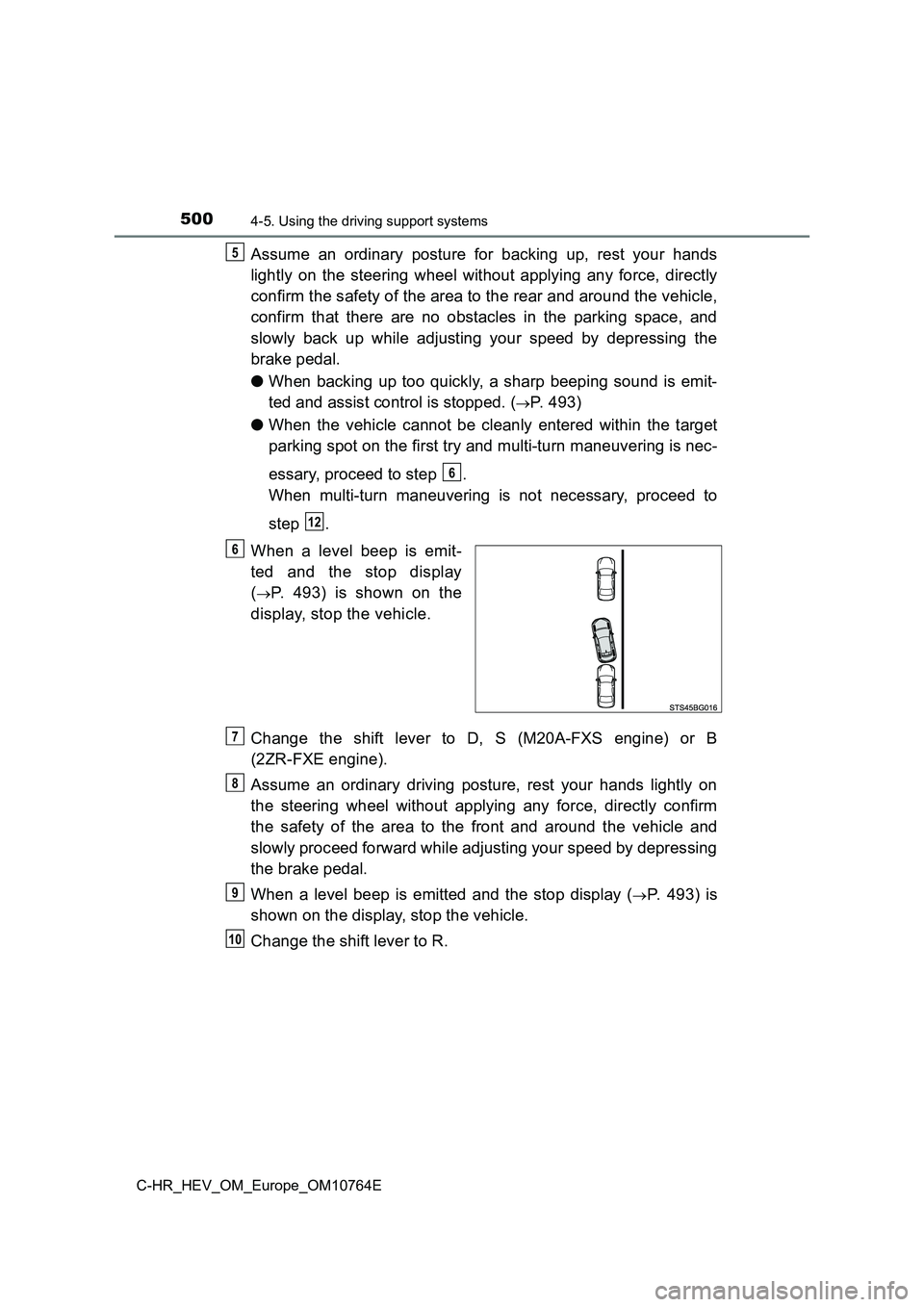
When a level beep is emit-
ted and the stop display
(P. 493) is shown on the
display, stop the vehicle.
Change the shift lever to D, S (M20A-FXS engine) or B
(2ZR-FXE engine).
Assume an ordinary driving posture, rest your hands lightly on
the steering wheel without applying any force, directly confirm
the safety of the area to the front and around the vehicle and
slowly proceed forward while adjusting your speed by depressing
the brake pedal.
When a level beep is emitted and the stop display (P. 4 9 3 ) i s
shown on the display, stop the vehicle.
Change the shift lever to R.
5
6
12
6
7
8
9
10
Page 508 of 814
5064-5. Using the driving support systems
C-HR_HEV_OM_Europe_OM10764E
Assume an ordinary posture for backing up, rest your hands
lightly on the steering wheel without applying any force, direc tly
confirm the safety of the area to the rear and around the vehic le
and slowly back up while adjusting your speed by depressing the
brake pedal.
● When backing up too quickly, a sharp beeping sound is emit-
ted and assist control is stopped. (P. 493)
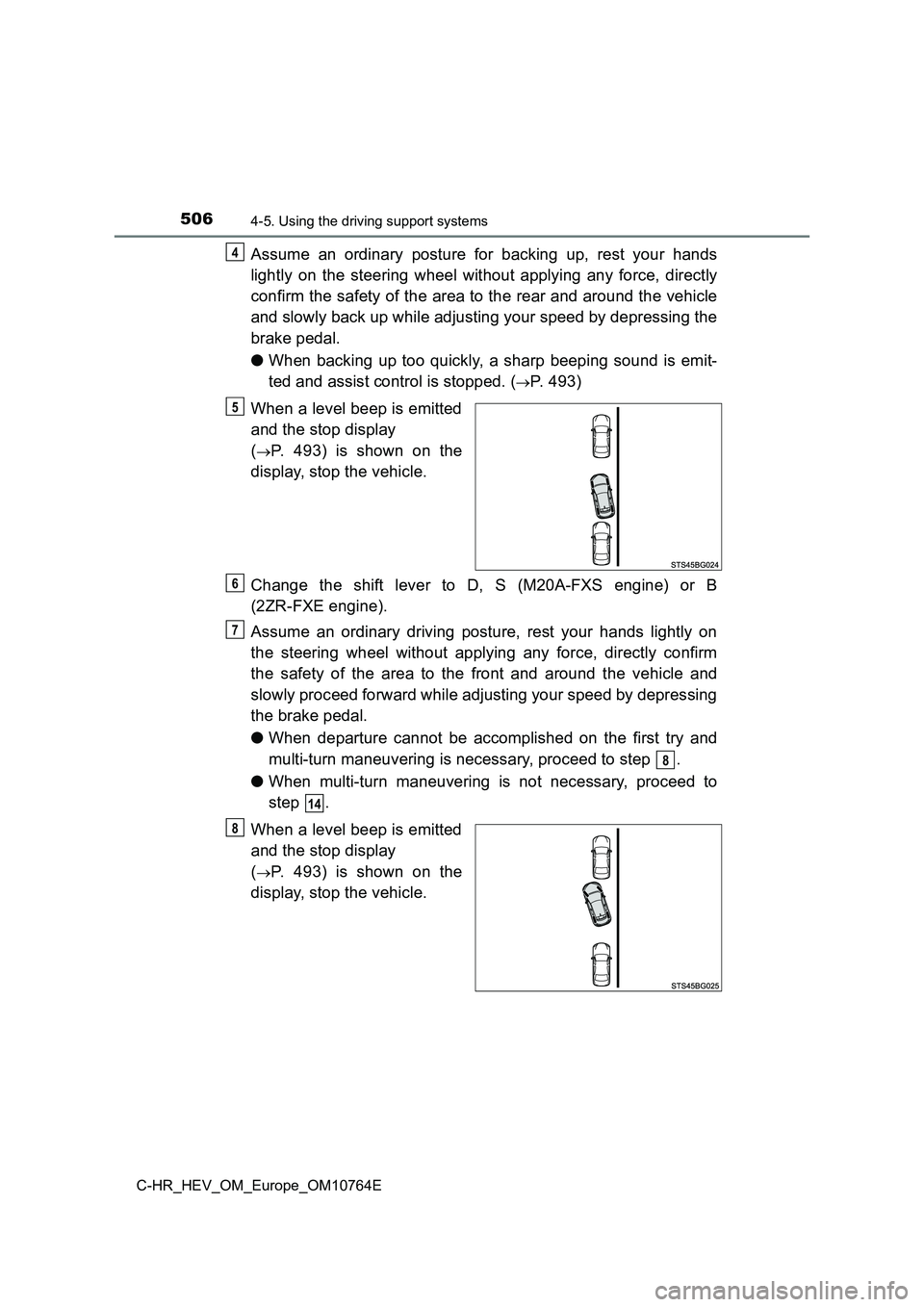
When a level beep is emitted
and the stop display
(P. 493) is shown on the
display, stop the vehicle.
Change the shift lever to D, S (M20A-FXS engine) or B
(2ZR-FXE engine).
Assume an ordinary driving posture, rest your hands lightly on
the steering wheel without applying any force, directly confirm
the safety of the area to the front and around the vehicle and
slowly proceed forward while adjusting your speed by depressing
the brake pedal.
● When departure cannot be accomplished on the first try and
multi-turn maneuvering is necessary, proceed to step .
● When multi-turn maneuvering is not necessary, proceed to
step .
When a level beep is emitted
and the stop display
(P. 493) is shown on the
display, stop the vehicle.
4
5
6
7
8
14
8
Page 515 of 814
5134-5. Using the driving support systems
4
Driving
C-HR_HEV_OM_Europe_OM10764E
Change the shift lever to R.
Assume an ordinary posture for backing up, rest your hands
lightly on the steering wheel without applying any force, direc tly
confirm the safety of the area to the rear and around the vehic le,
confirm that there are no obstacles in the parking space, and
slowly back up while adjusting your speed by depressing the
brake pedal.
● When the vehicle cannot be cleanly entered within the target
parking spot on the first try and multi-turn maneuvering is nec -
essary, proceed to step .
● When multi-turn maneuvering is not necessary, proceed to
step .
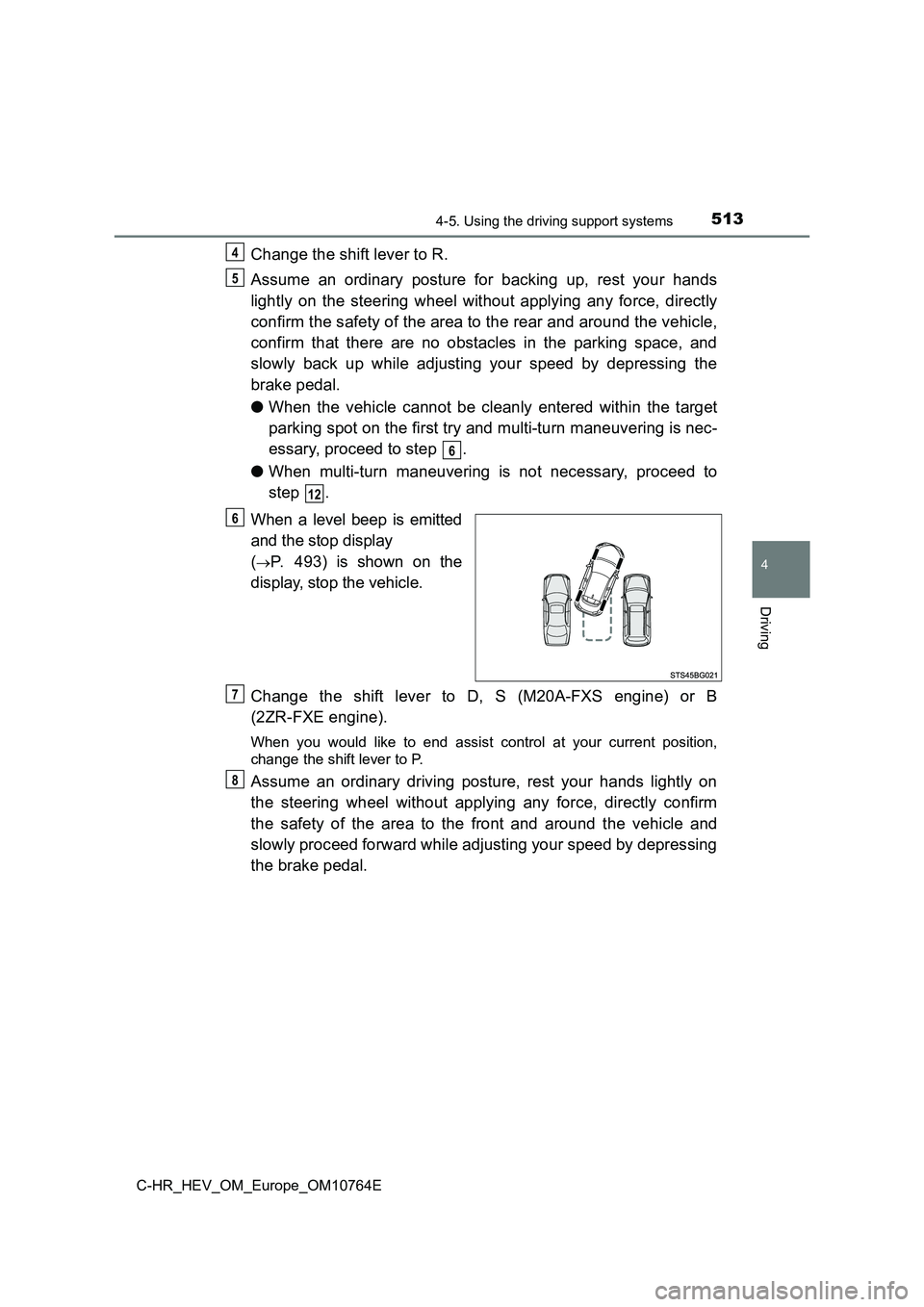
When a level beep is emitted
and the stop display
(P. 493) is shown on the
display, stop the vehicle.
Change the shift lever to D, S (M20A-FXS engine) or B
(2ZR-FXE engine).
When you would like to end assist control at your current posit ion,
change the shift lever to P.
Assume an ordinary driving posture, rest your hands lightly on
the steering wheel without applying any force, directly confirm
the safety of the area to the front and around the vehicle and
slowly proceed forward while adjusting your speed by depressing
the brake pedal.
4
5
6
12
6
7
8
Page 569 of 814
5675-3. Using the storage features
C-HR_HEV_OM_Europe_OM10764E
5
Interior features
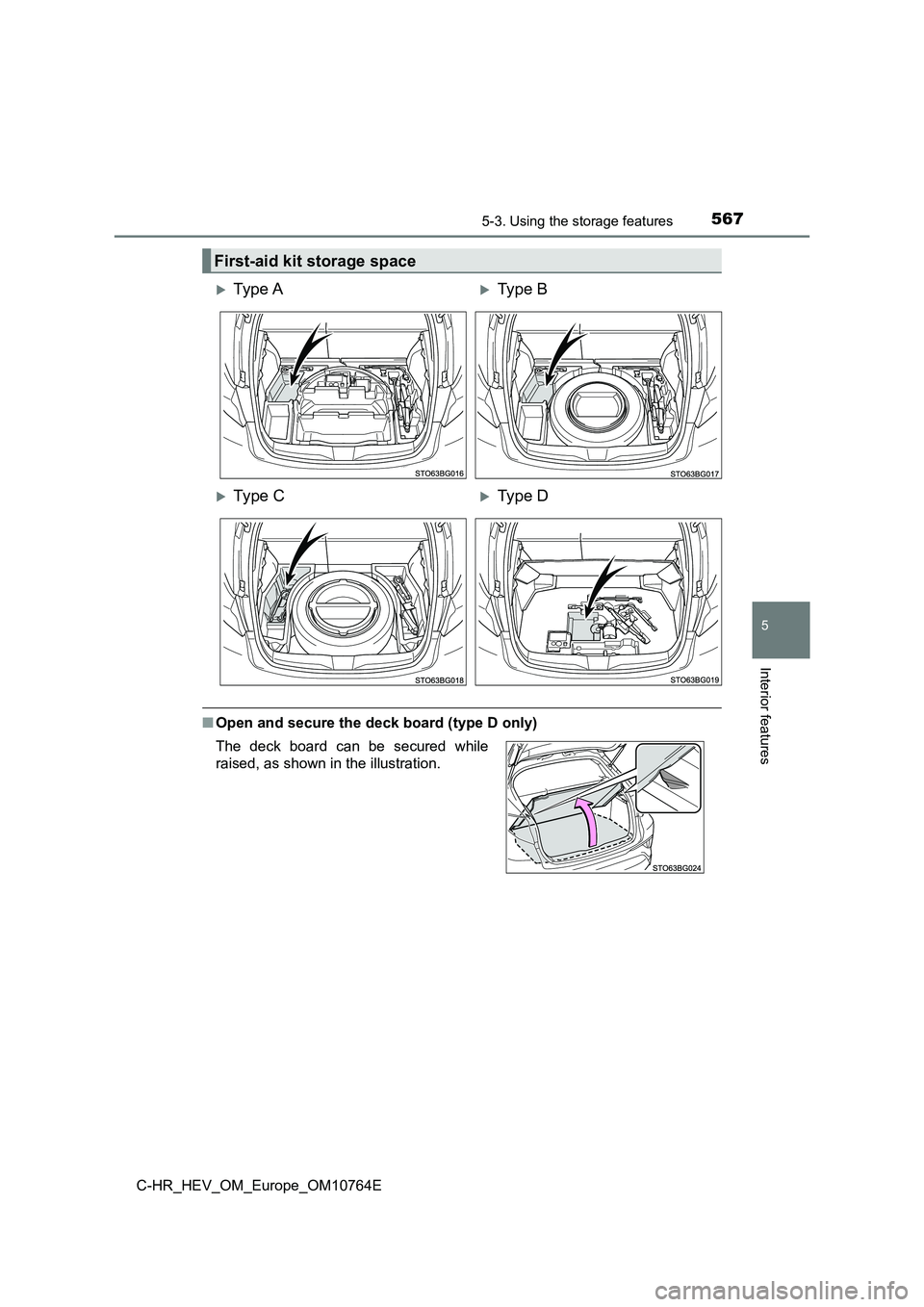
■Open and secure the deck board (type D only)
First-aid kit storage space
Ty pe AType B
Ty pe CType D
The deck board can be secured while
raised, as shown in the illustration.
Page 584 of 814
5826-1. Maintenance and care
C-HR_HEV_OM_Europe_OM10764E
NOTICE
■To prevent paint deterioration and corrosion on the body and compo-
nents (aluminum wheels, etc.)
● Wash the vehicle immediately in the following cases:
• After driving near the sea coast
• After driving on salted roads
• If coal tar or tree sap is present on the paint surface
• If dead insects, insect droppings or bird droppings are presen t on the
paint surface
• After driving in an area contaminated with soot, oily smoke, m ine dust,
iron powder or chemical substances
• If the vehicle becomes heavily soiled with dust or mud
• If liquids such as benzene and gasoline are spilled on the pai nt surface
● If the paint is chipped or scratched, have it repaired immediately.
● To prevent the wheels from corroding, remove any dirt and store in a place
with low humidity when storing the wheels.
■ To prevent damage to the windshield wiper arms
When lifting the wiper arms away from the windshield, pull the driver side
wiper arm upward first, and repeat for the passenger’s side. Wh en returning
the wipers to their original position, do so from the passenger ’s side first.
■ Cleaning the exterior lights
● Wash carefully. Do not use organic substances or scrub with a hard brush.
This may damage the surfaces of the lights.
● Do not apply wax to the surfaces of the lights.
Wax may cause damage to the lenses.
■ When using an automatic car wash
Set the wiper switch to the off position.
If the wiper switch is in “AUTO”, the wipers may operate and th e wiper
blades may be damaged.
Page 688 of 814

6867-2. Steps to take in an emergency
C-HR_HEV_OM_Europe_OM10764E
■Electric power steering system warning light (warning buzzer)
When the 12-volt battery charge becomes insufficient or the vol tage tempo-
rarily drops, the electric power steering system warning light may come on
and the warning buzzer may sound.
■ If the malfunction indicator lamp comes on while driving
For some models, the malfunction indicator lamp will come on if the fuel tank
becomes completely empty. If the fuel tank is empty, refuel the vehicle imme-
diately. The malfunction indicator lamp will go off after sever al trips.
If the malfunction indicator lamp does not go off, contact any authorized
Toyota retailer or Toyota authorized repairer, or any reliable repairer as soon
as possible.
■ Front passenger detection sensor, seat belt reminder and warning
buzzer
● If luggage is placed on the front passenger seat, the front passenger detec-
tion sensor may cause the warning light to flash and the warnin g buzzer to
sound even if a passenger is not sitting in the seat.
● If a cushion is placed on the seat, the sensor may not detect a passenger,
and the warning light may not operate properly.
■ Warning light operations for unfastened rear passenger seat belts
● When opening and closing the rear door, the warning light comes on for
approximately a certain period of time.
● When any of the rear seat belts are unfastened, the warning light comes on.
When the rear doors are opened and closed while the warning light is on, the
warning light will turn off after approximately a certain perio d of time.
■ When the tire pressure warning light comes on
Inspect the appearance of the tire to check that the tire is no t punctured.
If the tire is punctured: P. 697, 727
If the tire is not punctured:
Carry out the following procedure after the tire temperature ha s lowered suffi-
ciently.
● Check the tire inflation pressure and adjust to the appropriate level.
● If the warning light does not go out even after several minutes, check that
the tire inflation pressure is at the specified level and carry out initialization.
( P. 617)
The warning light may come on again if the above operations are conducted
without first allowing the tire temperature to lower sufficient ly.