2023 SUBARU SOLTERRA coolant
[x] Cancel search: coolantPage 468 of 628
4687-3. Do-it-yourself maintenance
Owners Manual_USA_M42C01_en
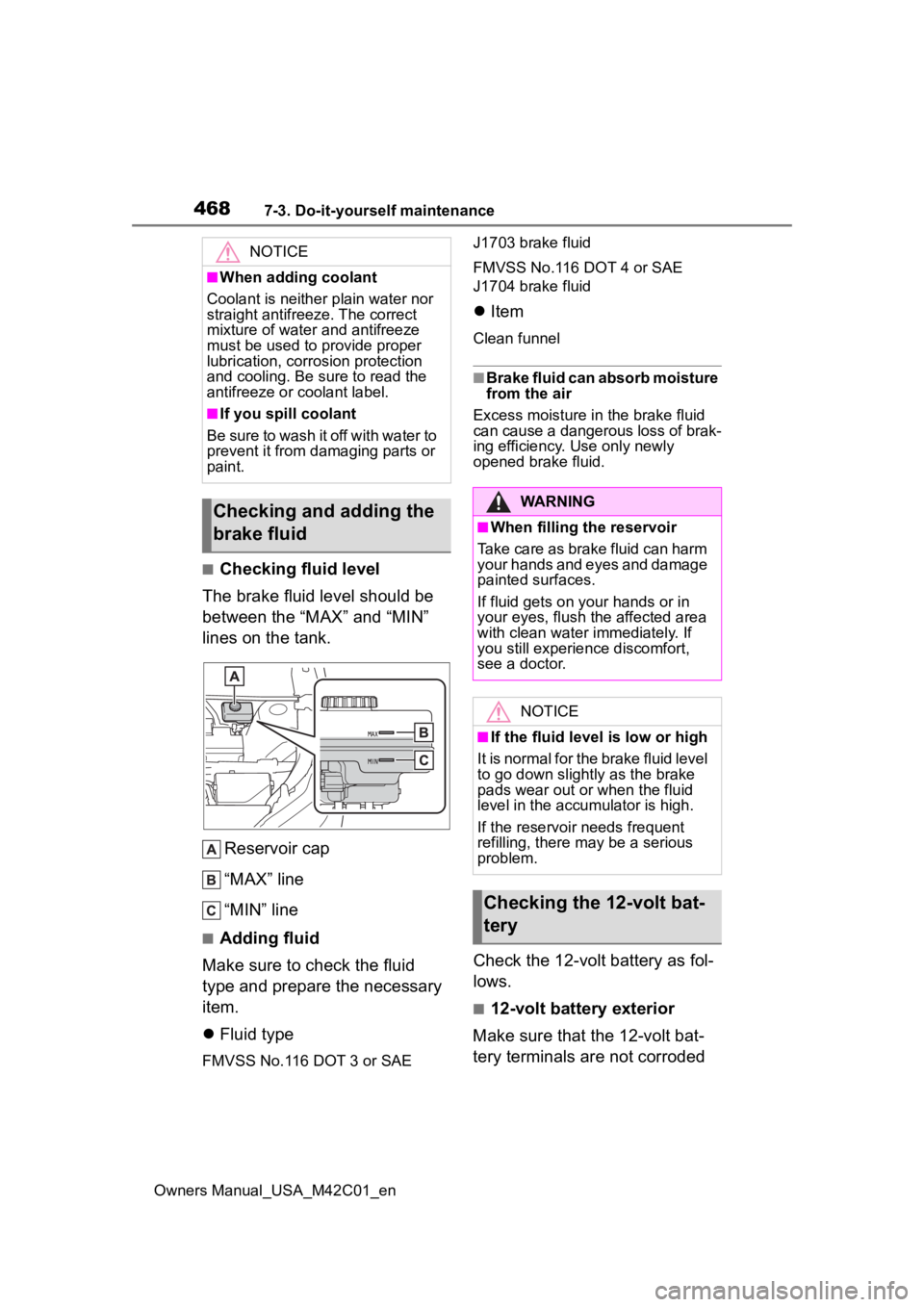
■Checking fluid level
The brake fluid level should be
between the “MAX” and “MIN”
lines on the tank.
Reservoir cap
“MAX” line
“MIN” line
■Adding fluid
Make sure to check the fluid
type and prepare the necessary
item.
Fluid type
FMVSS No.116 DOT 3 or SAE J1703 brake fluid
FMVSS No.116 DOT 4 or SAE
J1704 brake fluid
Item
Clean funnel
■Brake fluid can absorb moisture
from the air
Excess moisture in the brake fluid
can cause a dangerous loss of brak-
ing efficiency. Use only newly
opened brake fluid.
Check the 12-volt battery as fol-
lows.
■12-volt battery exterior
Make sure that the 12-volt bat-
tery terminals are not corroded
NOTICE
■When adding coolant
Coolant is neither plain water nor
straight antifreeze. The correct
mixture of water and antifreeze
must be used to provide proper
lubrication, corrosion protection
and cooling. Be sure to read the
antifreeze or coolant label.
■If you spill coolant
Be sure to wash it off with water to
prevent it from d amaging parts or
paint.
Checking and adding the
brake fluidWARNING
■When filling the reservoir
Take care as brake fluid can harm
your hands and eyes and damage
painted surfaces.
If fluid gets on your hands or in
your eyes, flush the affected area
with clean water immediately. If
you still experience discomfort,
see a doctor.
NOTICE
■If the fluid level is low or high
It is normal for the brake fluid level
to go down slight ly as the brake
pads wear out or when the fluid
level in the accumulator is high.
If the reservoir needs frequent
refilling, there m ay be a serious
problem.
Checking the 12-volt bat-
tery
Page 545 of 628

5458-2. Steps to take in an emergency
Owners Manual_USA_M42C01_en
8
When trouble arises1 Stop the vehicle in a safe
place and turn off the air con-
ditioning system.
2 Leave the EV system operat-
ing and carefully lift the hood.
3 Check if the cooling fan is
operating.
If the fan is operating:
Wait until the “EV System
overheated Output power
reduced” message disap-
WARNING
■When replacing the 12-volt
battery
●When the vent plug is close to
the hold down cl amp, the bat-
tery fluid (acid) may leak.
●For information regarding bat-
tery replacement, contact your
Toyota dealer.
NOTICE
■When handling jumper cables
When connecting the jumper
cables, ensure that they do not
become entangled in the cooling
fan.
If your vehicle over-
heats
When “EV System over-
heated Output power
reduced” is shown on the
multi-information display,
your vehicle may be over-
heating.
NOTICE
■Cooling system coolant
The radiator coolant is exclusive
for radiator usage. Damage may
occur when water or any other
type of coolant is used, so never
use any other fluid. When there is
no “Toyota Genuine Traction Bat-
tery Coolant”, immediately contact
your Toyota dealer.
Correction procedures
Page 546 of 628
5468-2. Steps to take in an emergency
Owners Manual_USA_M42C01_en
pears and then stop the EV
system. If the message does
not disappear, call your Toy-
ota dealer.
If the fan is not operating:
Stop the EV system immedi-
ately and call your Toyota
dealer.
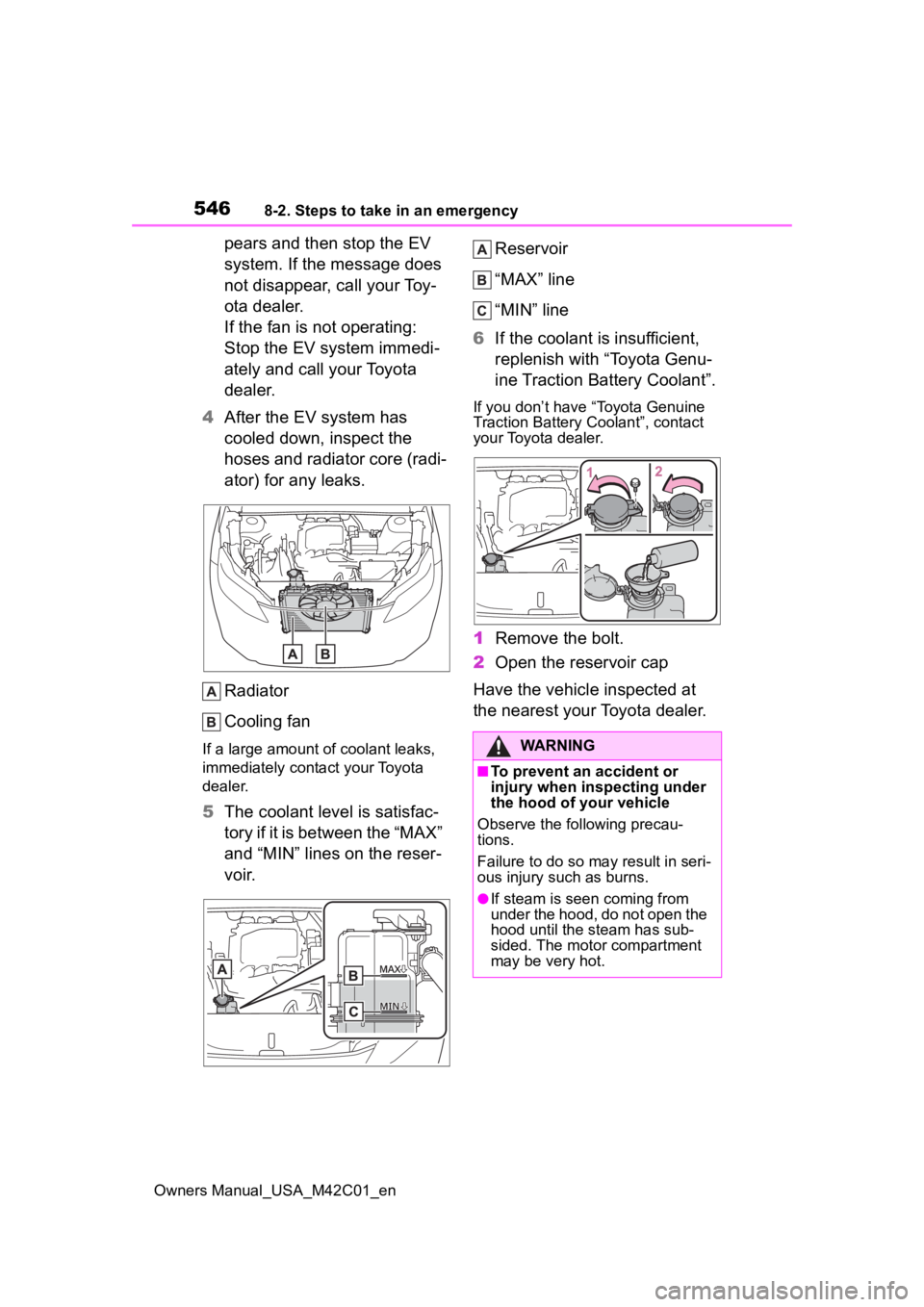
4 After the EV system has
cooled down, inspect the
hoses and radiator core (radi-
ator) for any leaks.
Radiator
Cooling fan
If a large amount of coolant leaks,
immediately cont act your Toyota
dealer.
5 The coolant level is satisfac-
tory if it is between the “MAX”
and “MIN” lines on the reser-
voir. Reservoir
“MAX” line
“MIN” line
6 If the coolant is insufficient,
replenish with “Toyota Genu-
ine Traction Battery Coolant”.
If you don’t have “Toyota Genuine
Traction Battery Coolant”, contact
your Toyota dealer.
1Remove the bolt.
2 Open the reservoir cap
Have the vehicle inspected at
the nearest your Toyota dealer.
WARNING
■To prevent an accident or
injury when inspecting under
the hood of your vehicle
Observe the following precau-
tions.
Failure to do so may result in seri-
ous injury such as burns.
●If steam is seen coming from
under the hood, do not open the
hood until the steam has sub-
sided. The motor compartment
may be very hot.
Page 547 of 628

5478-2. Steps to take in an emergency
Owners Manual_USA_M42C01_en
8
When trouble arises
1 Stop the EV system. Set the
parking brake and shift the
shift position to P.
2 Remove the mud, snow or
sand from around the stuck
tire.
3 Place wood, stones or some
other material under the front
wheels to help provide trac-
tion.
4 Restart the EV system
5 Shift the shift position to D or
R and release the parking
brake. Then, while exercising
caution, depress the acceler-
ator pedal.
■When it is difficult to free the
vehicle
Press to turn off TRAC.
( P.388)
WARNING
●Keep hands and clothing (espe-
cially a tie, a scarf or a muffler)
away from the fan. Failure to do
so may cause the hands or
clothing to be caught, resulting
in serious injury.
●Do not loosen the coolant reser-
voir cap while the EV system
and radiator are hot. High tem-
perature steam or coolant could
spray out.
NOTICE
■When adding coolant
Add coolant slowly after the EV
system has cooled down suffi-
ciently. Adding cool coolant to a
hot EV system too quickly can
cause damage to the EV system.
■To prevent damage to the
cooling system
Observe the following precau-
tions:
●Avoid contaminating the coolant
with foreign matter (such as
sand or dust, etc.).
●Do not use water or any other
coolant when refilling coolant.
Also, do not use any additive
agents for the coolant.
If the vehicle becomes
stuck
Carry out the following pro-
cedures if the tires spin or
the vehicle becomes stuck
in mud, dirt or snow:
Recovering procedure
Page 552 of 628

5529-1. Specifications
Owners Manual_USA_M42C01_en
*1: 2WD models
*2: AWD models
*1: The coolant capacity is the quantity of reference.
If replacement is ne cessary, contact your Toyota dealer.
*2: 2WD models
*3: AWD models
Rear electric motor (traction motor) (AWD models)
Model1YM
Ty p ePermanent magnet synchronous motor
Maximum output80 kW
Maximum torque124.3 ft•lbf (168.5 N•m, 17.2 kgf•m)
Traction battery
Ty p eLithium-ion battery
Voltage3.7 V/cell
Capacity201 Ah*1
205 Ah*2
Quantity96 cells
Nominal voltage355.2 V
Cooling system
Capacity*16.2 qt. (5.9 L, 5.2 Imp. qt.)*2
7.8 qt. (7.4 L, 6.5 Imp. qt.)*3
Coolant type
Use either of the following:
• “Toyota Genuine Tra ction Battery Cool-
ant”
• Similar high-quality ethylene glycol- based, low electric conductivity coolant,
non-amine and non-b orate coolant with
azole additives.
Do not use plain water alone.
Page 553 of 628
5539-1. Specifications
Owners Manual_USA_M42C01_en
9
Vehicle specifications
NOTICE
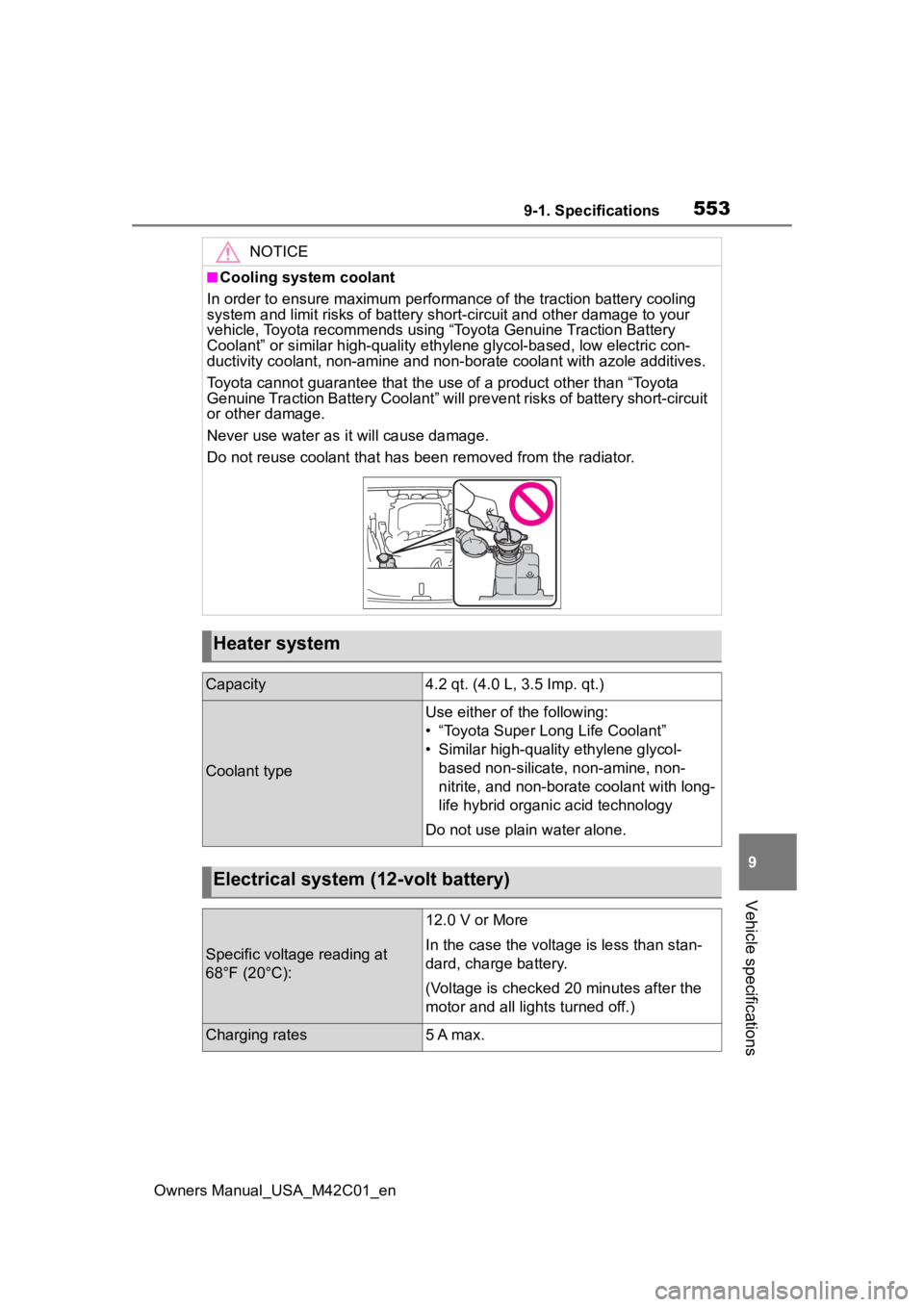
■Cooling system coolant
In order to ensure maximum perfor mance of the traction battery cooling
system and limit risks of battery short-circuit and other damag e to your
vehicle, Toyota recommends using “Toyota Genuine Traction Battery
Coolant” or similar high-quality ethylene glycol-based, low electric con-
ductivity coolant, non-amine and non-borate coolant with azole additives.
Toyota cannot guarantee that th e use of a product other than “Toyota
Genuine Traction Battery Cool ant” will prevent risks of battery short-circuit
or other damage.
Never use water as it will cause damage.
Do not reuse coolant that has been removed from the radiator.
Heater system
Capacity4.2 qt. (4.0 L, 3.5 Imp. qt.)
Coolant type
Use either of the following:
• “Toyota Super Long Life Coolant”
• Similar high-quality ethylene glycol- based non-silicate , non-amine, non-
nitrite, and non-borate coolant with long-
life hybrid organic acid technology
Do not use plain water alone.
Electrical system ( 12-volt battery)
Specific voltage reading at
68°F (20°C):
12.0 V or More
In the case the voltage is less than stan-
dard, charge battery.
(Voltage is checked 20 minutes after the
motor and all lights turned off.)
Charging rates5 A max.
Page 560 of 628

5609-1. Specifications
Owners Manual_USA_M42C01_enheat buildup and possible tire fail- ure.
Glossary of tire terminology
Tire related termMeaning
Cold tire inflation pres-
sureTire pressure when the vehicle has been parked
for three hours or more, or has not been driven
more than 1 mile or 1.5 km under that condition
Maximum inflation pres-
sureThe maximum cold inflated pressure to which a
tire may be inflated, shown on the sidewall of
the tire
Recommended inflation
pressureCold tire inflation pressure recommended by a
manufacturer
Accessory weight
The combined weight (in
excess of those stan-
dard items which may be replaced) of transmis-
sion, power steering, power brakes, power
windows, power seats, radio and heater, to the
extent that these items are available as factory-
installed equipment (whether installed or not)
Curb weight
The weight of a motor vehicle with standard
equipment, including th e maximum capacity of
traction battery and coolant, and if so equipped,
air conditioning and additional weight optional
traction motor
Maximum loaded vehicle
weight
The sum of:
(a) Curb weight
(b) Accessory weight
(c) Vehicle capacity weight
(d) Production options weight
Normal occupant weight
150 lb. (68 kg) times the number of occupants
specified in the second column of Table 1
* that
follows
Occupant distributionDistribution of occupant s in a vehicle as speci-
fied in the third column of Table 1
* below
Page 600 of 628

600Alphabetical Index
Owners Manual_USA_M42C01_en
Coat hooks .............................. 437
Console box ............................ 419
Coolant Capacity ............................... 552
Checking ...................... 465, 467
Preparing and c hecking before
winter.................................. 393
Cooling system EV system overheating ........ 545
Coussins gonflables Modification et é limination en fin
de vie des coussins gonflables ........................................... 589
Précautions avec les coussins gonflables latéraux ............. 585
Précautions avec les coussins gonflables latéraux et rideau........................................... 585
Précautions avec les coussins gonflables pour votre enfant........................................... 585
Précautions avec les coussins gonflables rideau ................ 585
Précautions générales avec les coussins gonflables ............ 585
Cruise control Dynamic radar cruise control................................... 288, 296
Warning lights....................... 517
Cup holders ............................ 419
Current Power consumption . 157
Curtain shield airbags ............. 34
Customizable features ........... 566
D
Daytime running light system248
Daytime running lights Replacing light bulbs ............ 502
DC charging ............................ 113
Deck board .............................. 422
Deck under tray ...................... 423
Defogger Outside rear view mirrors .....404
Rear window.........................404
Windshield ............................403
Digital key................................165
Digital Rear-view Mirror .........201
Dimension ...............................550
Dinghy towing .........................230
Display Charging101, 121, 129, 131, 140
Cruise control .......................297
Dynamic radar cruise control 291
Intuitive parking assist ..........312
Multi-information display.......155
Pedestrians Rear of the Vehicle ...........................................340
RCD (Rear Camera Detection) ...........................................328
Rear Camera Detection (RCD) ...........................................328
Warning message.................522
Do-it-yourself maintenance .455, 460
Door lock Back door .............................172
Side doors ............................167
Smart key system .................187
Wireless remote control........164
Door trim ornament lights .....415
Doors Automatic door locking and unlocking system ................171
Back door .............................172
Door glasses ........................212
Door lock ..............................167
Open door warning buzzer ...170
Outside rear view mirrors .....210
Rear door child-protectors ....171
Side doors ............................167
Drive distance .........................158
Drive information ....................158
Drive-start control ..................224
Driving .....................................219