2023 SUBARU BRZ tow
[x] Cancel search: towPage 278 of 432
BSD/RCTA (If Equipped)
272It is mounted on each side of the outside
mirrors.
The indicator light will illuminate
when a
vehicle approaching from behind is
detected.
The indicator light will flash
to warn the
driver of dangers under the following
conditions.
While the indicator light is illuminating,
if the turn signal lever is operated toward
the side in which this light turned on
When reversing the vehicle while the
system detects a vehicle approaching
from either side
▽ BSD/RCTA approach indicator
light dimming function
When the headlights are turned on, the
brightness of the BSD/RCTA approach
indicator light will be reduced.
NOTE You may have difficulty seeing the
BSD/RCTA approach indicator light
under the following conditions. - When sunlight shines directly on
it
- When the headlight beams from
a vehicle traveling behind shines
directly on it
While the illumination brightness
control dial is in the fully upward posi- tion, even if the headlights are turned
on, the brightness of the BSD/RCTA
approach indicator light will not be
reduced. For details about the illumina-
tion brightness control dial, refer to
"Illumination Brightness Control"
P130.
▼ BSD/RCTA approach warning
buzzer (only when reversing)
A warning buzzer sounds along with
flashing of the BSD/RCTA approach indi-
cator light to warn the driver of dangers.
The setting of the warning buzzer volume
can be changed by operating the center
information display. For details, refer to
"Car settings" P165.
▼ Safety tips regarding the BSD/
RCTA approach indicator light/
warning buzzer
In the following cases, operation of the
BSD/RCTA approach indicator light and
the warning buzzer may be delayed or the
system may fail to issue these warnings.
- When a vehicle moves to the neigh-
boring lane from a lane next to the
neighboring lane
- When driving on a steep incline or
on repeated sharp uphill and downhill
grades
- When going beyond a pass - When both your vehicle and a
vehicle driving on a neighboring lane
are driving on the far side of each lane.
- When several narrowly-spaced
vehicles are approaching in a row
- In low radius bends (tight bends or
when making turns at an intersection)
- When there is a difference in height
between your lane and the neighboring
lane
- Immediately after the BSD/RCTA is
activated by touching “BSD/RCTA”
- Immediately after the shift lever/
select lever is shifted to the “R” position
- When extremely heavy cargo is
loaded in the trunk
During reversing, operation of the BSD/
RCTA approach indicator light and the
warning buzzer may be delayed or the
system may fail to issue these warnings
under the following conditions.
- When backing out of an angled
parking space
- When a large-sized vehicle is
parked next to your vehicle (That
vehicle prevents the propagation of
radar waves.)
- When reversing on sloped roads
- When reversing at a high speedBRZ_U.book 272 ページ 2022年3月29日 火曜日 午後3時59分
Page 283 of 432

Reverse Automatic Braking (RAB) System (If Equipped)
277
Starting and Operating7
– CONTINUED –
7-21. Reverse Automatic
Braking (RAB) System (If Equipped)Reverse Automatic Braking (RAB) is a
system designed to help avoid collisions
or reduce collision damage when
reversing the vehicle. If a wall or an
obstacle is detected in the reversing direc-
tion, the system will notify the driver with a
warning sound and may activate the
vehicle’s brakes automatically.
NOTEThe Reverse Automatic Braking (RAB)
system records and stores the follow-
ing data when automatic braking oper-
ates. It does not record conversations,
personal information or other audio
data.
Distance from the object
Vehicle speed
Accelerator pedal operation status
Brake pedal operation status
Select lever position
Outside temperature
The sensitivity setting of the sonar
sensors
SUBARU and third parties contracted
by SUBARU may acquire and use the
recorded data for the purpose of vehi-
cle research and development.
SUBARU and third parties contracted
by SUBARU will not disclose or pro-
vide the acquired data to any other
third party except under the following
conditions.
The vehicle owner has given his/her
consent.
The disclosure/provision is based
on a court order or other legally
enforceable request.
Data that has been modified so that
the user and vehicle cannot be identi-
fied is provided to a research institu-
WARNING
Reverse Automatic Braking
(RAB) is not a system intended to
replace the driver’s responsibility
to check their surroundings for
vehicles or obstacles to avoid a
collision. The driver is responsible for
driving safely. Before reversing,
be sure to first depress the brake
pedal and visually check the
surroundings.
There are some cases in which
the vehicle cannot avoid colli-
sion, because the system opera-
tion has limitations. The warning
sound or automatic braking may
be delayed or may not operate at
all even when an obstacle is
present. Make sure to set the Automatic
Braking to OFF when the vehicle
is on the free roller or on the
chassis dynamometer. Other-
wise, the vehicle may move and it
may cause an accident. Make sure to set the Automatic
Braking to OFF when towing the
vehicle. Otherwis e, the vehicle
may move and it may cause an
accident. The system is not designed to
detect people (including chil-
dren), animals or other moving
objects. Depending on the vehicle condi-
tion or the surrounding environ-
ment, the sonar sensor’s ability
to detect objects may become
unstable.
BRZ_U.book 277 ページ 2022年3月29日 火曜日 午後3時59分
Page 286 of 432

Reverse Automatic Braking (RAB) System (If Equipped)
280
- The rear bumper is exposed to
strong impact, or the rear bumper is
deformed.
On a steep hill, the system’s auto-
matic braking ability will be reduced.
The system is designed to avoid
collisions by automatic hard braking
when the vehicle’s reversing speed is
less than approximately 3 mph (5 km/
h). However, the system does not guar-
antee that the vehicle will be able to
avoid collisions in any situation.
If the vehicle is reversed at an
extremely slow speed, the driver’s
operation may be prioritized. In this
case, automatic braking will not
operate.
The system may not be able to
detect and apply the brake with the
following objects. - Sharp or thin objects such as
poles, fences and ropes which may
not reflect the s ound wave emitted
from the sonar sensor.
- Objects that are too close to the
rear bumper when the select lever is
set to the “R” position.
- Objects with a surface which
may not reflect the sound wave
emitted from the sonar sensor such
as a chain link fence.
Objects the system is not designed
to detect and apply brake. -Pedestrians.
- Moving objects including
moving vehicles.
- Objects which absorbs sound
waves such as cloth or snow.
- Objects whose surface has a
diagonal angle.
- Objects that are low to the
ground such as parking blocks.
- Objects that are high above the
ground such as objects hanging
from above.
- Objects that are out of range of
the center of the vehicle in the hori-
zontal direction.
- Objects that are not perpendic-
ular to the ground.
- The surface of the object is
uneven or wavy.
When reversing the vehicle, the
functions may not be able to work
properly or may cause a system
malfunction if the following conditions
exist.
High frequency sound from other
sources are nearby:
- Horn sound from another
vehicle.
- Engine sound from other vehi-
cles.
- Sound of an air brake.
- Vehicle detection equipment or a
sonar from another vehicle. - A sound wave with a frequency
similar to the vehicle’s system is
transmitted near by.
- A vehicle equipped with the
same system is reversing toward
your reversing direction.
Weather conditions:
- Extremely high or extremely low
temperatures in which the area near
the sonar sensor becomes too hot
or too cold to operate.
- The sonar sensors or the rear
bumper near the sonar sensors are
exposed to heavy rain or a signifi-
cant amount of water.
- Fog, snow or sandstorm, etc.
- Air is moving rapidly such as
when a strong wind is blowing.
Parts attached to the rear bumper
near the sonar sensor:
- Commercial electr onic parts (fog
light, fender pole, radio antenna) or
commercial attachment parts (trailer
hitch, bicycle carrier, bumper guard)
are attached.
- Parts that emit high frequency
sound, such as a horn or speaker,
are attached.
Vehicle conditions:
- Ice, snow or mud is adhered to
the sonar sensors or the rear
bumper near the sonar sensor.
BRZ_U.book 280 ページ 2022年3月29日 火曜日 午後3時59分
Page 295 of 432
Driving Tips8
Driving Tips
8-1. New Vehicle Break-In Driving – the First
1,000 miles (1,600 km) ......................................290
8-2. Fuel Economy Hints ...................... .....................290
8-3. Engine Exhaust Gas (Carbon Monoxide) .........290
8-4. Catalytic Converter .............................................291
8-5. Periodic Inspections ...........................................292
8-6. Driving in Foreign Coun tries .............................292
8-7. Driving Tips .........................................................292
8-8. Winter Driving .....................................................293
Operation during Cold Weather ..................................293 Driving on Snowy and Icy Roads ............................... 295
Corrosion Protection ................................................... 296
Snow Tires.................................................................... 296
Tire Chains ................................................................... 297
Rocking the Vehicle..................................................... 297
8-9. Loading Your Vehicle .........................................297
Vehicle Capacity Weight ............................................. 298
GVWR and GAWR (Gross Vehicle Weight Rating
and Gross Axle Weight Rating) ................................ 299
8-10. Trailer Towing ...................................................299
BRZ_U.book 289 ページ 2022年3月29日 火曜日 午後3時59分
Page 304 of 432

Loading Your Vehicle
298
NOTEFor better fuel economy, do not carry
unneeded cargo.
■ Vehicle Capacity WeightThe load capacity of your vehicle is deter-
mined by weight, not by available cargo
space. The maximum load you can carry
in your vehicle is shown on the tire infla-
tion pressure label attached to the driver’s
side center pillar. It includes the total
Stow cargo and luggage in the
trunk whenever possible. To prevent cargo and luggage
from sliding forward during
braking, do not stack anything in
the enlarged trunk. Keep cargo
and luggage low, as close to the
floor as possible. When you carry something inside
the vehicle, secure it whenever
you can to prevent it from being
thrown around inside the vehicle
during sudden stops, sharp turns
or in an accident. Secure long items properly to
prevent them from shooting
forward and causing serious
injury during a sudden stop. Never exceed the maximum load
limit. If you do, some parts on
your vehicle can break, or it can
change the way your vehicle
handles. This could result in loss
of control and cause personal
injury. Also, overloading can
shorten the life of your vehicle.
Do not place cargo or luggage in
or on the following locations as
the item may get under the clutch,
brake, or accelerator pedal and
prevent the pedals from being
depressed properly, block the
driver’s vision, or hit the driver or
passengers, causing an accident:
- At the feet of the driver- On the front passenger or rear
seats (when stacking items)- On the rear shelf- On the instrument panel- On the dashboard
CAUTION
Do not carry spray cans, containers
with flammable or corrosive liquids
or any other dangerous items inside
the vehicle.
D00250801321
BRZ_U.book 298 ページ 2022年3月29日 火曜日 午後3時59分
Page 305 of 432
Trailer Towing
299
Driving Tips8
weight of the driver and all passengers,
their belongings, and any optional equip-
ment.■ GVWR and GAWR (Gross
Veh icle Weight Rating an d
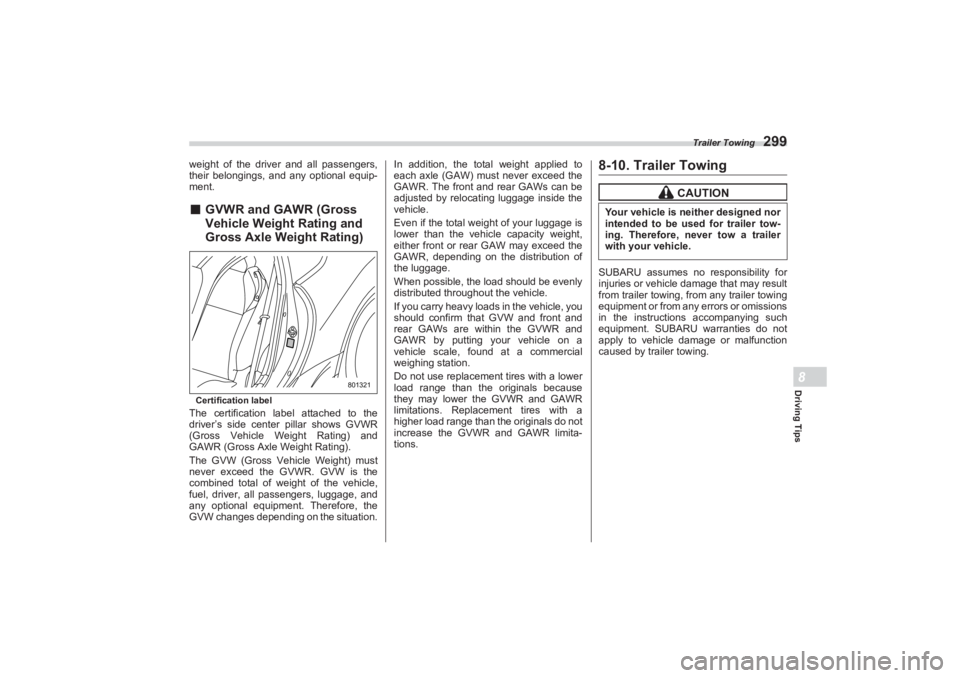
Gross Axle Weight Rating)Certification labelThe certification label attached to the
driver’s side center pillar shows GVWR
(Gross Vehicle Weight Rating) and
GAWR (Gross Axle Weight Rating).
The GVW (Gross Vehicle Weight) must
never exceed the GVWR. GVW is the
combined total of weight of the vehicle,
fuel, driver, all passengers, luggage, and
any optional equipment. Therefore, the
GVW changes depending on the situation. In addition, the tota
l weight applied to
each axle (GAW) must never exceed the
GAWR. The front and rear GAWs can be
adjusted by relocating luggage inside the
vehicle.
Even if the total weight of your luggage is
lower than the vehicl e capacity weight,
either front or rear GAW may exceed the
GAWR, depending on the distribution of
the luggage.
When possible, the load should be evenly
distributed throughout the vehicle.
If you carry heavy loads in the vehicle, you
should confirm that GVW and front and
rear GAWs are within the GVWR and
GAWR by putting your vehicle on a
vehicle scale, found at a commercial
weighing station.
Do not use replacement tires with a lower
load range than the originals because
they may lower the GVWR and GAWR
limitations. Replacement tires with a
higher load range than the originals do not
increase the GVWR and GAWR limita-
tions.
8-10. Trailer TowingSUBARU assumes no responsibility for
injuries or vehicle damage that may result
from trailer towing, from any trailer towing
equipment or from any errors or omissions
in the instructions accompanying such
equipment. SUBARU warranties do not
apply to vehicle damage or malfunction
caused by trailer towing.
801321
CAUTION
Your vehicle is neither designed nor
intended to be used for trailer tow-
ing. Therefore, never tow a trailer
with your vehicle.
BRZ_U.book 299 ページ 2022年3月29日 火曜日 午後3時59分
Page 307 of 432
In Case of Emergency9
In Case of Emergency
9-1. If You Park Your Vehicle in an Emergency.......302
9-2. Maintenance Tools..............................................302
Models with Flat Tire Repair Kit ..................................303
Models with Spare Tire ................................................303
9-3. Flat Tires ..............................................................303
Changing a Flat Tire .....................................................303
Sealing a Flat Tire (Models with the Flat
Tire Repair Kit) ...........................................................306
Tire Pressure Monitoring System (TPMS)
(If Equipped) ...............................................................315
TPMS Screen (If Equipped)..........................................316
9-4. Jump Starting ......................................................316
Battery Precautions......................................................316
How to Jump Start ........................................................317
9-5. Engine Overheating ............................................319
If Steam Is Coming from the Engine
Compartment ..............................................................319 If No Steam Is Coming from the Engine
Compartment ............................................................. 319
9-6. Towing .................................................................320
Towing Hook and Tie-Down Hooks/Holes ................. 320
Using a Flat-Bed Truck................................................ 324
Towing with All Wheels on the Ground ..................... 324
9-7. Access Key Fob – If Access Key Fob Does
Not Operate Properly ...... ..................................325
Locking and Unlocking ............................................... 326
Switching Power Status .............................................. 326
Starting Engine ............................................................ 326
9-8. Malfunctions of the Center Information
Display ...............................................................327
9-9. If Your Vehicle Is Invo lved in an Accident ........328
To Restart the Engine When Involved in an
Accident ..................................................................... 328
BRZ_U.book 301 ページ 2022年3月29日 火曜日 午後3時59分
Page 308 of 432
If You Park Your Vehicle in an Emergency
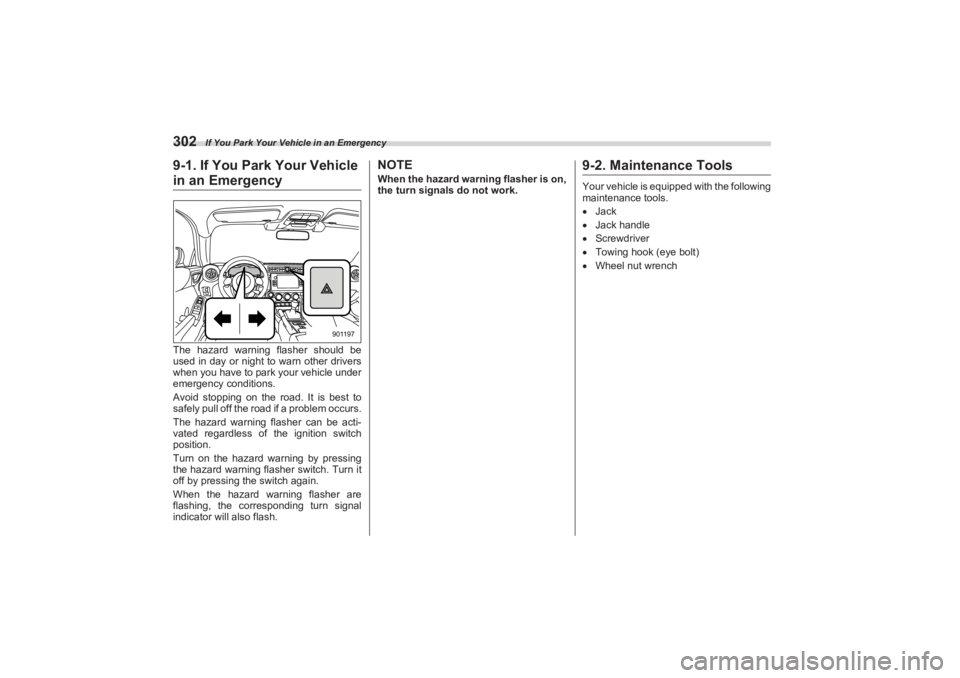
3029-1. If You Park Your Vehicle in an EmergencyThe hazard warning flasher should be
used in day or night to warn other drivers
when you have to park your vehicle under
emergency conditions.
Avoid stopping on the road. It is best to
safely pull off the road if a problem occurs.
The hazard warning flasher can be acti-
vated regardless of the ignition switch
position.
Turn on the hazard warning by pressing
the hazard warning flasher switch. Turn it
off by pressing the switch again.
When the hazard warning flasher are
flashing, the corresponding turn signal
indicator will also flash.
NOTEWhen the hazard warning flasher is on,
the turn signals do not work.
9-2. Maintenance ToolsYour vehicle is equipped with the following
maintenance tools.
Jack
Jack handle
Screwdriver
Towing hook (eye bolt)
Wheel nut wrench
901197
BRZ_U.book 302 ページ 2022年3月29日 火曜日 午後3時59分