2023 RAM PROMASTER lock
[x] Cancel search: lockPage 200 of 296

198IN CASE OF EMERGENCY
To release the jack kit from its storage location,
turn the lock knob a quarter turn counterclockwise
to the unlock position.
Lock Knob
To open the jack kit container, you must push
the container’s release to separate the top and
bottom.
Container Release
Jacking Tools
SPARE TIRE REMOVAL
1. Remove the spare tire before attempting to jack up the vehicle. Attach the lug bolt
adapter to the winch extension and insert it
into the winch mechanism.
Jack Tools
CAUTION!
Do not force lock knob over limit. Damage to
lock knob may occur.
1 — Unlock Position
2 — Lock Position
1 — Tow Eye — If Equipped
2 — Wrench Handle
3 — Lug Bolt Adapter
4 — Jack
5 — Reversible Tool — If Equipped
6 — Tool Handle — If Equipped
7 — Winch Extension
1 — Wrench Handle
2 — Lug Bolt Adapter
3 — Winch Extension
23_VF_OM_EN_USC_t.book Page 198
Page 201 of 296

IN CASE OF EMERGENCY199
Winch Location
The winch mechanism is located under the
rear of the vehicle in between the right rear tire
and spare tire.
Winch Extension
2. Rotate the wheel wrench handle counter
-
clockwise until the spare tire is on the ground
with enough cable slack to allow you to pull it
out from under the vehicle.
Lowering Spare Tire
3. Pull the spare tire out from under the vehicle to gain access to the spare tire retainer.
Spare Tire
4. Lift the spare tire with one hand to give clearance to tilt the retainer at the end of the cable.
Lifting Spare Tire
CAUTION!
The winch mechanism is designed for use with
the jack wrench extension tool only. Use of air
wrench or power tool may damage the winch.
7
23_VF_OM_EN_USC_t.book Page 199
Page 202 of 296

200IN CASE OF EMERGENCY
(Continued)
5. Pull the retainer through the center of the
wheel.
Retainer
JACKING INSTRUCTIONS
Jack Warning Label
Assembled Jack
1. Loosen (but do not remove) the wheel lug bolts by turning them counterclockwise one
turn while the wheel is still on the ground.
WARNING!
Carefully follow these tire changing warnings to
help prevent personal injury or damage to your
vehicle:
Always park on a firm, level surface as far from
the edge of the roadway as possible before
raising the vehicle.
Turn on the Hazard Warning Flashers.
Apply the parking brake firmly and place an
automatic transmission in PARK; a manual
transmission in REVERSE.
Block the wheel diagonally opposite of the
wheel that is to be raised.
Never start or run the engine with the vehicle
on a jack.
Do not let anyone sit in the vehicle when it is
on a jack.
Do not get under the vehicle when it is on a
jack. If you need to get under a raised vehicle,
take it to a service center where it can be
raised on a lift.
Only use the jack in the positions indicated
and for lifting this vehicle during a tire change.
If working on or near a roadway, be extremely
careful of motor traffic.
To assure that spare tires, flat or inflated, are
securely stowed, spares must be stowed with
the valve stem facing the ground.
WARNING!
23_VF_OM_EN_USC_t.book Page 200
Page 204 of 296
202IN CASE OF EMERGENCY
3. Place the wrench handle and lug bolt adapter on the jack screw and turn clockwise until the
jack head is properly engaged in the described
location. Do not raise the vehicle until you are
sure the jack is securely engaged.
4. Raise the vehicle by turning the jack screw clockwise, using the wrench handle and lug
bolt adapter. Raise the vehicle only until the
tire just clears the surface and enough
clearance is obtained to install the spare tire.
Minimum tire lift provides maximum stability. 5. Remove the wheel lug bolts. For vehicles with
wheel covers, remove the cover from the
wheel by hand. Do not pry the wheel cover off.
Then pull the wheel off the hub.
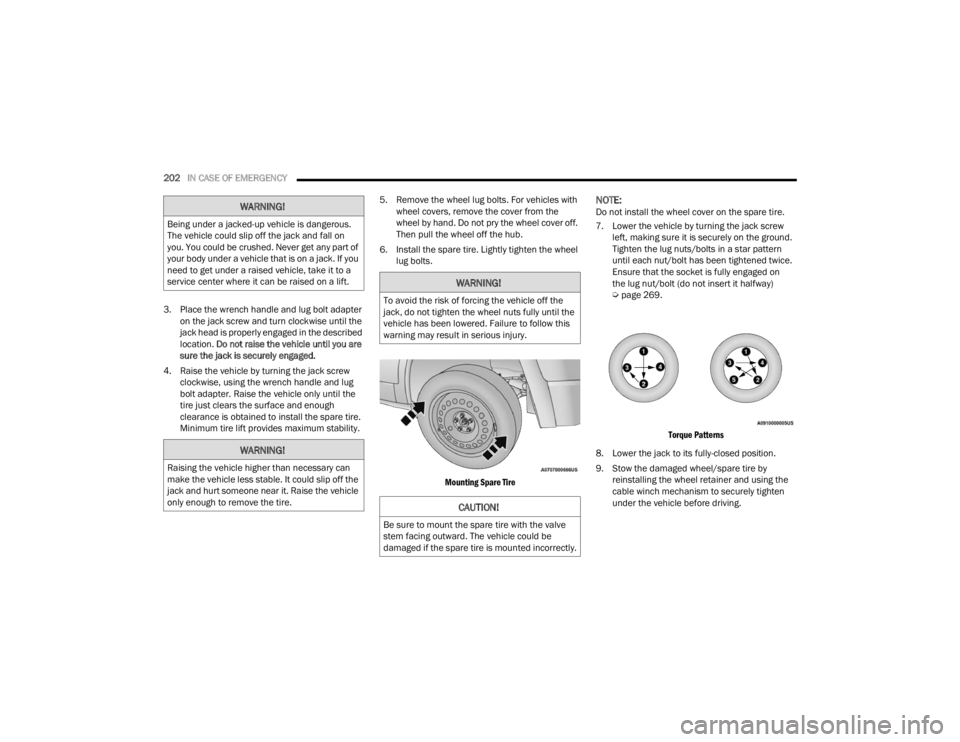
6. Install the spare tire. Lightly tighten the wheel lug bolts.
Mounting Spare Tire
NOTE:Do not install the wheel cover on the spare tire.
7. Lower the vehicle by turning the jack screw left, making sure it is securely on the ground.
Tighten the lug nuts/bolts in a star pattern
until each nut/bolt has been tightened twice.
Ensure that the socket is fully engaged on
the lug nut/bolt (do not insert it halfway)
Úpage 269.
Torque Patterns
8. Lower the jack to its fully-closed position.
9. Stow the damaged wheel/spare tire by reinstalling the wheel retainer and using the
cable winch mechanism to securely tighten
under the vehicle before driving.WARNING!
Being under a jacked-up vehicle is dangerous.
The vehicle could slip off the jack and fall on
you. You could be crushed. Never get any part of
your body under a vehicle that is on a jack. If you
need to get under a raised vehicle, take it to a
service center where it can be raised on a lift.
WARNING!
Raising the vehicle higher than necessary can
make the vehicle less stable. It could slip off the
jack and hurt someone near it. Raise the vehicle
only enough to remove the tire.
WARNING!
To avoid the risk of forcing the vehicle off the
jack, do not tighten the wheel nuts fully until the
vehicle has been lowered. Failure to follow this
warning may result in serious injury.
CAUTION!
Be sure to mount the spare tire with the valve
stem facing outward. The vehicle could be
damaged if the spare tire is mounted incorrectly.
23_VF_OM_EN_USC_t.book Page 202
Page 205 of 296

IN CASE OF EMERGENCY203
Reinstalling The Retainer
Damaged Wheel Stowage
10. Install the winch extension and rotate the
wrench handle clockwise until the winch
mechanism operator hears “three clicks” from
the device to indicate the wheel is properly
stowed under the vehicle.
11. Stow the jack, jack handle and winch handle tools back in the storage compartment. 12. Check the spare tire pressure as soon as
possible. Correct the tire pressure, as
required.
For vehicles with aluminum wheels:
The center cap must be pushed out from the rear
to install the retainer and stow the tire.
WHEEL COVERS
The wheel covers on the vehicle are held in place
by the wheel lug bolts and can be removed after
the wheel lug bolts are taken off.
TIRE SERVICE KIT — IF EQUIPPED
Use this QR code to access your
digital experience.
Depending on vehicle trim level,
tire service kit models may vary.
Small punctures up to 1/4 inch
(6 mm) in the tire tread can be
sealed with the Tire Service Kit.
Foreign objects (e.g., screws or nails) should not
be removed from the tire. The Tire Service Kit
can be used in outside temperatures down to
approximately -4°F (-20°C).
This kit will provide a temporary tire seal, allowing
you to drive your vehicle up to 100 miles (160 km)
with a maximum speed of 50 mph (80 km/h).
WARNING!
A loose tire or jack thrown forward in a collision or
hard stop could endanger the occupants of the
vehicle. Always stow the jack parts and the spare tire
in the places provided. Have the deflated (flat) tire
repaired or replaced immediately.
CAUTION!
Use a back-and-forth motion to remove the
hub cap. Do not use a twisting motion when
removing the hub cap, damage to the hub cap
finish may occur.
7
23_VF_OM_EN_USC_t.book Page 203
Page 215 of 296

IN CASE OF EMERGENCY213
If tire pressure is less than 19 psi (1.3 Bar):
The tire is too badly damaged. Do not attempt to
drive the vehicle further. Call for assistance.
If the tire pressure is 19 psi (1.3 Bar) or higher:
1. Push the Power Button (1) to turn on Tire Service Kit and inflate the tire to the pressure
indicated on the tire and loading information
label on the driver-side door opening.
NOTE:If the tire becomes overinflated, push the Deflation
Button to reduce the tire pressure to the recom -
mended inflation pressure before continuing.
2. Disconnect the Tire Service Kit from the valve stem, reinstall the cap on the valve stem and
unplug from 12 Volt outlet.
3. Place the Tire Service Kit in its proper storage area in the vehicle.
4. Have the tire inspected and repaired or replaced at the earliest opportunity at an
authorized dealer or tire service center.
5. Remove the Speed Limit sticker from the instrument panel after the tire has been
repaired.
6. Replace the Sealant Bottle (4) and Sealant Hose (3) assembly at an authorized dealer as
soon as possible Ú page 213.
NOTE:When having the tire serviced, advise the autho -
rized dealer or service center that the tire has been
sealed using the Tire Service Kit.
(F) Sealant Bottle And Hose Replacement:
1. Replace the Tire Service Kit Sealant Bottle (4) and Sealant Hose (3) prior to the expiration
date (printed at the upper right hand corner
on the bottle label) to assure optimum
operation of the system
Ú
page 213.
Tire Service Kit Sealant Expiration Date Location
2. Uncoil the Sealant Hose (3) (clear in color).
3. Locate the red colored round Sealant Bottle release button at the lower right hand corner
of the kit. 4. Push and hold the Sealant Bottle release
button, then pull out the bottle holding the
button.
5. Clean any remaining sealant from the Tire Service Kit housing.
6. Position the new Sealant Bottle (4) in the housing so that the Sealant Hose (3) aligns
with the hose slot in the front of the housing.
Push and hold the Sealant Bottle release
button, then push the bottle into the housing
by holding the button. An audible click will be
heard indicating the bottle is locked into place.
Release the button.
7. Verify that the cap is installed on the fitting at the end of the Sealant Hose (3) and return the
hose to its storage area (located on top of the
housing).
8. Return the Tire Service Kit to its storage location in the vehicle.
7
23_VF_OM_EN_USC_t.book Page 213
Page 225 of 296

SERVICING AND MAINTENANCE223
Mileage Or Time Passed (Whichever Comes First)
20,000
30,000
40,000
50,000
60,000
70,000
80,000
90,000
100,000
110,000
120,000
130,000
140,000
150,000
Or Years: 2 3 4 5 6 7 8 9 10 11 12 13 14 15
Or Kilometers:
32,000
48,000
64,000
80,000
96,000
112,000
128,000
144,000
160,000
176,000
192,000
208,000
224,000
240,000
Additional Inspections
Inspect the CV/Universal joints. X X X X X X X X X X X X X X
Inspect front suspension, tie rod ends, boot seals, and replace if
necessary. X X X X X X X
Inspect the brake pads, replace as necessary. X X X X X X X
Inspect the rear door net block gap, adjust/replace as necessary. XXXXX
Additional Maintenance
Replace the engine air cleaner filter. XXXXX
Inspect the cabin air filter, replace as necessary. X X X X X X X
Replace the Brake Fluid every two years.
1X X X X X X X
Replace the spark plugs.
1X
8
23_VF_OM_EN_USC_t.book Page 223
Page 233 of 296

SERVICING AND MAINTENANCE231
2. Remove and replace the cabin air filter from the filter retainer.
Removing Air Filter
3. Install the cabin air filter/filter retainer back into the fresh air inlet. When installing the filter retainer
make sure the retainer is fully engaged.
4. Install the two screws back into the assembly to secure the filter retainer to the fresh air inlet.
BODY LUBRICATION
Locks and all body pivot points, including such
items as seat tracks, door hinge pivot points and
rollers, liftgate, tailgate, decklid, sliding doors and
hood hinges, should be lubricated periodically with
a lithium-based grease, such as Mopar® Spray
White Lube to ensure quiet, easy operation and
to protect against rust and wear. Prior to the
application of any lubricant, the parts concerned
should be wiped clean to remove dust and grit;
after lubricating, excess oil and grease should be
removed. Particular attention should also be given
to hood latching components to ensure proper
function. When performing other underhood
services, the hood latch release mechanism, and
safety catch should be cleaned and lubricated.
The external lock cylinders should be lubricated
twice a year, preferably in the Autumn and Spring.
Apply a small amount of a high quality lubricant,
such as Mopar® Lock Cylinder Lubricant directly
into the lock cylinder.
WINDSHIELD WIPER BLADES
Clean the rubber edges of the wiper blades and the
windshield periodically with a sponge or soft cloth
and a mild nonabrasive cleaner. This will remove
accumulations of salt or road film.
Operation of the wipers on dry glass for long
periods may cause deterioration of the wiper
blades. Always use washer fluid when using the
wipers to remove salt or dirt from a dry windshield.
Avoid using the wiper blades to remove frost or ice
from the windshield. Keep the blade rubber out of
contact with petroleum products such as engine
oil, gasoline, etc.
NOTE:Life expectancy of wiper blades varies depending
on geographical area and frequency of use. If chat -
tering, marks, water lines or wet spots are present,
clean the wiper blades or replace as necessary.
1 — Fresh Air Inlet
2 — Cabin Air Filter
3 — Cabin Air Filter Retainer
8
23_VF_OM_EN_USC_t.book Page 231