2023 RAM CHASSIS CAB hood open
[x] Cancel search: hood openPage 337 of 444

IN CASE OF EMERGENCY335
5. Start the engine in the vehicle that has the booster battery, let the engine idle a few
minutes, and then start the engine in the
vehicle with the discharged battery.
6. Once the engine is started, follow the discon -
necting procedure.
Disconnecting The Jumper Cables
1. Disconnect the negative
(-)
end of the jumper
cable from the engine ground of the vehicle
with the discharged battery.
2. Disconnect the opposite end of the negative (-)
jumper cable from the negative (-) post of the
booster battery.
3. Disconnect the positive (+) end of the jumper
cable from the positive (+) post of the booster
battery.
4. Disconnect the opposite end of the positive (+)
jumper cable from the positive (+) post of the
vehicle with the discharged battery, and
reinstall the protective cap over the positive
(+) post. If frequent jump starting is required to start your
vehicle you should have the battery and charging
system inspected at an authorized dealer.
IF YOUR ENGINE OVERHEATS
If the vehicle is overheating, it will need to be
serviced by an authorized dealer.
Potential signs of vehicle overheating:
Temperature gauge is at HOT (H)
Strong smell of coolant
White smoke coming from engine or exhaust
Coolant bottle coolant has bubbles present
In the event it is observed that the temperature
gauge is moving towards or close to the HOT (H)
position, you can reduce the potential for
overheating by taking the appropriate action.
On the highways — slow down.
In city traffic — while stopped, place the trans
-
mission in NEUTRAL (N), but do not increase the
engine idle speed while preventing vehicle
motion with the brakes.
If your Air Conditioner (A/C) is on, turn it off. The
A/C system adds heat to the engine cooling
system and turning the A/C off can help remove
this heat.
You can also turn the temperature control to
maximum heat, the mode control to floor and
the blower control to high. This allows the heater
core to act as a supplement to the radiator and
aids in removing heat from the engine cooling
system.
CAUTION!
Do not connect jumper cable to any of the fuses
on the positive battery terminal. The resulting
electrical current will blow the fuse.
CAUTION!
Accessories plugged into the vehicle power
outlets draw power from the vehicle’s battery,
even when not in use (i.e., cellular devices, etc.).
Eventually, if plugged in long enough without
engine operation, the vehicle’s battery will
discharge sufficiently to degrade battery life
and/or prevent the engine from starting.
WARNING!
You or others can be badly burned by hot engine
coolant (antifreeze) or steam from your radiator.
If you see or hear steam coming from under the
hood, do not open the hood until the radiator
has had time to cool. Never try to open a cooling
system pressure cap when the radiator or
coolant bottle is hot.
7
23_DPF_OM_EN_USC_t.book Page 335
Page 370 of 444

368SERVICING AND MAINTENANCE
(Continued)
To minimize the possibility of catalytic converter
damage:
Do not interrupt the ignition when the transmis
-
sion is in gear and the vehicle is in motion.
Do not try to start the vehicle by pushing or
towing the vehicle.
Do not idle the engine with any ignition compo -
nents disconnected or removed, such as when
diagnostic testing, or for prolonged periods
during very rough idle or malfunctioning oper -
ating conditions.
COOLING SYSTEM
Engine Coolant Checks
Check the engine coolant (antifreeze) protection
every 12 months (before the onset of freezing
weather, where applicable). If the engine coolant is
dirty or rusty in appearance, the system should be
drained, flushed and refilled with fresh coolant.
Check the front of the A/C condenser or radiator
for any accumulation of bugs, leaves, etc. If dirty,
clean by gently spraying water from a garden hose
vertically down the face of the A/C condenser or
the back of the radiator core.
Check the engine cooling system hoses for brittle
rubber, cracking, tears, cuts and tightness of the
connection at the coolant recovery bottle and
radiator. Inspect the entire system for leaks.
DO NOT REMOVE THE COOLANT PRESSURE CAP
WHEN THE COOLING SYSTEM IS HOT.
Cooling System — Drain, Flush And Refill
NOTE:Some vehicles require special tools to add coolant
properly. Failure to fill these systems properly could lead to severe internal engine damage. If any
coolant is needed to be added to the system
please contact an authorized dealer.
If the engine coolant (antifreeze) is dirty or
contains visible sediment, have an authorized
dealer clean and flush with Organic Additive
Technology (OAT) coolant (conforming to
MS.90032).
For the proper maintenance intervals
Úpage 344.
Selection Of Coolant
For further information Ú page 419.
NOTE:
Mixing of engine coolant (antifreeze) other than
specified Organic Additive Technology (OAT)
engine coolant, may result in engine damage
and may decrease corrosion protection. OAT
engine coolant is different and should not be
mixed with Hybrid Organic Additive Technology
(HOAT) engine coolant or any “globally compat -
ible” coolant. If a non-OAT engine coolant is
introduced into the cooling system in an emer -
gency, the cooling system will need to be
drained, flushed, and refilled with fresh OAT
coolant (conforming to MS.90032), by an autho -
rized dealer as soon as possible.
Do not use water alone or alcohol-based engine
coolant products. Do not use additional rust
inhibitors or anti-rust products, as they may not
WARNING!
You or others can be badly burned by hot
engine coolant (antifreeze) or steam from your
radiator. If you see or hear steam coming from
under the hood, do not open the hood until the
radiator has had time to cool. Never open a
cooling system pressure cap when the radi -
ator or coolant bottle is hot.
Keep hands, tools, clothing, and jewelry away
from the radiator cooling fan when the hood is
raised. The fan starts automatically and may
start at any time, whether the engine is
running or not.
When working near the radiator cooling fan,
disconnect the fan motor lead or turn the igni -
tion to the OFF position. The fan is tempera -
ture controlled and can start at any time the
ignition is in the ON position.
WARNING!
23_DPF_OM_EN_USC_t.book Page 368
Page 373 of 444

SERVICING AND MAINTENANCE371
(Continued)
To guarantee optimum performance of the system,
keep the surfaces of the charge air cooler,
condenser and radiator clean and free of debris.
Periodically check the hoses leading to and from
the charge air cooler for cracks or loose clamps
resulting in loss of pressure and reduced engine
performance.
BRAKE SYSTEM
In order to ensure brake system performance, all
brake system components should be inspected
periodically Ú
page 344.
Fluid Level Check — Brake Master Cylinder
The fluid level of the master cylinder should be
checked when performing under the hood service
or immediately if the Brake System Warning Light
indicates system failure.
If necessary, add fluid to bring level within the
designated marks on the side of the reservoir of
the brake master cylinder. Be sure to clean the top
of the master cylinder area before removing cap.
With disc brakes the fluid level can be expected to
fall as the brake linings wear. However, an
unexpected drop in fluid level may be caused by a
leak and a system check should be conducted.
For further information Ú page 421.
WARNING!
Riding the brakes can lead to brake failure and
possibly a collision. Driving with your foot resting
or riding on the brake pedal can result in
abnormally high brake temperatures, excessive
lining wear, and possible brake damage. You
would not have your full braking capacity in an
emergency.
WARNING!
Use only manufacturer's recommended brake
fluid Úpage 421. Using the wrong type of
brake fluid can severely damage your brake
system and/or impair its performance. The
proper type of brake fluid for your vehicle is
also identified on the original factory installed
hydraulic master cylinder reservoir.
To avoid contamination from foreign matter or
moisture, use only new brake fluid or fluid that
has been in a tightly closed container. Keep
the master cylinder reservoir cap secured at
all times. Brake fluid in an open container
absorbs moisture from the air resulting in a
lower boiling point. This may cause it to boil
unexpectedly during hard or prolonged
braking, resulting in sudden brake failure. This
could result in a collision.
Overfilling the brake fluid reservoir can result
in spilling brake fluid on hot engine parts,
causing the brake fluid to catch fire. Brake
fluid can also damage painted and vinyl
surfaces, care should be taken to avoid its
contact with these surfaces.
Do not allow petroleum based fluid to contam -
inate the brake fluid. Brake seal components
could be damaged, causing partial or
complete brake failure. This could result in a
collision.
WARNING!
8
23_DPF_OM_EN_USC_t.book Page 371
Page 388 of 444

386SERVICING AND MAINTENANCE
Replacing Exterior Bulbs
BASE QUAD: LOW BEAM HEADLAMP, HIGH
BEAM HEADLAMP, FRONT PARK AND TURN —
IF EQUIPPED
Low Beam
See the following steps to replace:
1. Open the hood.
2. Disconnect and isolate the negative battery
cable.
3. Reach into the front wheel house ahead of the front wheel, remove the fastener, and lift the
cover over the access hole in the front of the
wheel house splash shield. Access to the rear
of the lamp can be gained through this access
hole.
Splash Shield Access Cover
4. Reach through the access hole of the wheel
house splash shield and disengage the bulb
access cover by rotating counterclockwise.
Bulb Access Cover
5. Disconnect the internal lamp wiring harness connector from the low beam bulb. 6. Rotate the bulb counterclockwise a quarter
turn to unlock the bulb from the lamp.
7. Pull the bulb straight out from the housing.
8. Reverse the procedure for installation of new bulb and covers.
High Beam
See the following steps to replace:
1. Open the hood.
2. Disconnect and isolate the negative battery cable.
Bulb Access Cover
3. Look under the hood and behind the headlamp to find the high beam bulb access
cover.
4. Reach behind the headlamp and disengage the access cover by rotating counterclockwise.
CAUTION!
Do not contaminate the bulb glass by touching
it with your fingers or by allowing it to contact
other oily surfaces. Shortened bulb life will
result.
Always use the correct bulb size and type for
replacement. An incorrect bulb size or type
may overheat and cause damage to the lamp,
the bulb socket, or the lamp wiring.
23_DPF_OM_EN_USC_t.book Page 386
Page 389 of 444
SERVICING AND MAINTENANCE387
5. Disconnect the internal lamp wiring harness connector from the high beam bulb.
6. Rotate the bulb counterclockwise a quarter turn to unlock the bulb from the lamp.
7. Pull the bulb straight out from the housing.
8. Reverse the procedure for installation of new bulb and covers.
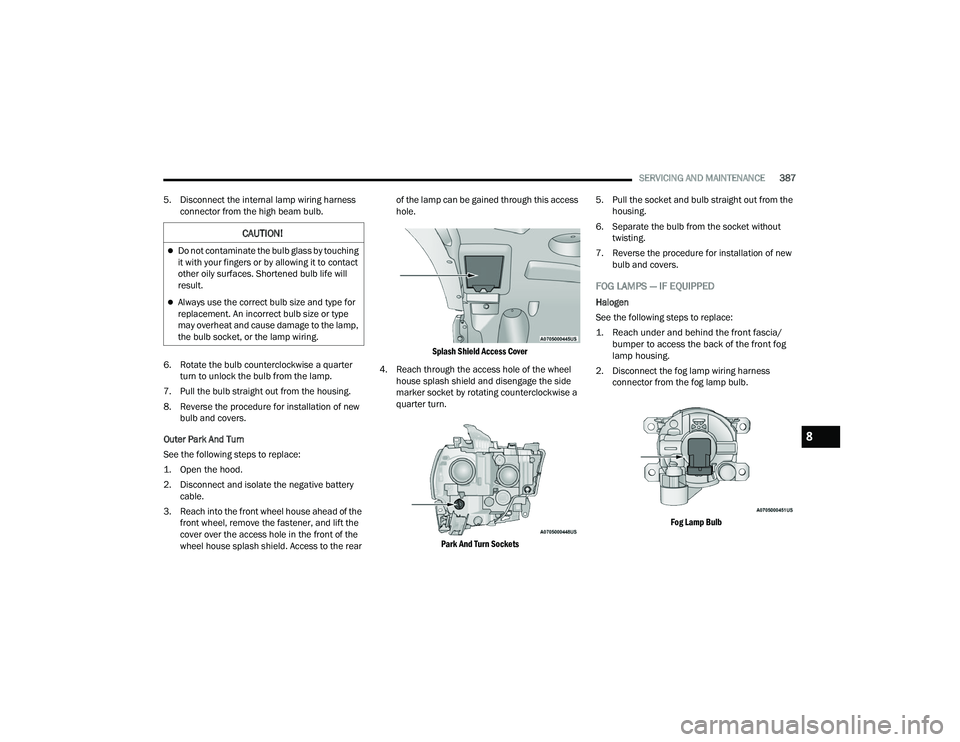
Outer Park And Turn
See the following steps to replace:
1. Open the hood.
2. Disconnect and isolate the negative battery cable.
3. Reach into the front wheel house ahead of the front wheel, remove the fastener, and lift the
cover over the access hole in the front of the
wheel house splash shield. Access to the rear of the lamp can be gained through this access
hole.
Splash Shield Access Cover
4. Reach through the access hole of the wheel house splash shield and disengage the side
marker socket by rotating counterclockwise a
quarter turn.
Park And Turn Sockets
5. Pull the socket and bulb straight out from the
housing.
6. Separate the bulb from the socket without twisting.
7. Reverse the procedure for installation of new bulb and covers.
FOG LAMPS — IF EQUIPPED
Halogen
See the following steps to replace:
1. Reach under and behind the front fascia/bumper to access the back of the front fog
lamp housing.
2. Disconnect the fog lamp wiring harness connector from the fog lamp bulb.
Fog Lamp Bulb
CAUTION!
Do not contaminate the bulb glass by touching
it with your fingers or by allowing it to contact
other oily surfaces. Shortened bulb life will
result.
Always use the correct bulb size and type for
replacement. An incorrect bulb size or type
may overheat and cause damage to the lamp,
the bulb socket, or the lamp wiring.
8
23_DPF_OM_EN_USC_t.book Page 387
Page 434 of 444

432 HomeLink® (Garage Door Opener)
.................. 47Hood Prop........................................................ 77Hood Release.................................................. 77Hub Caps....................................................... 332
I
Idle-Up Feature.............................................. 124Ignition............................................................ 18Switch......................................................... 18Inside Rearview Mirror............................ 39, 326Instrument Cluster........ 83, 84, 85, 86, 87, 89Descriptions.............................................. 110Display........................................................ 89Engine Oil Reset.......................................... 92Instrument Panel Lens Cleaning.................... 410Integrated Trailer Brake Control.................... 188Interior Appearance Care............................... 409Interior Lights.................................................. 55Intermittent Wipers (Delay Wipers).................. 57Intervention Regeneration Strategy........ 98, 364Inverter Outlet (115V)...................................... 72
J
Jack Location................................................ 329Jack Operation.............................................. 329Jacking And Tire Changing............................ 329Jacking And Tire Changing
b
...................... 329Jump Starting............................................... 333
K
Key Fob Panic Alarm
................................................. 16Programming Additional Key Fobs............... 17Key Fob Battery Service
(Remote Keyless Entry).................................... 16
Key Fob Programming (Remote Keyless Entry).. 17
Keyless Enter 'n Go™.................... 25, 115, 117Passive Entry............................................... 25Keys................................................................. 15
L
Lane Change And Turn Signals........................ 54Lane Change Assist......................................... 54LaneSense.................................................... 163Latches......................................................... 324Hood............................................................ 77
Lead Free Gasoline....................................... 413Leaks, Fluid................................................... 324Life Of Tires................................................... 399Light Bulbs........................................... 324, 384LIghtsElectrinic Power Steering Pump................ 105Oil Temperature........................................ 104Lights............................................................ 324Air Bag.................................... 103, 297, 322Automatic High Beam..................................52Brake Assist Warning................................ 274Brake Warning.......................................... 103Bulb Replacement.................................... 384Cab Top Clearance................................... 388Cargo...........................................................54Center Mounted Stop............................... 388Courtesy/Reading........................................55Cruise....................................................... 110Daytime Running.........................................52
Electronic Stability Program (ESP) Indicator.... 104
Exterior.............................................. 51, 324Fog............................................................ 387Four Wheel Drive Indicator....................... 147
23_DPF_OM_EN_USC_t.book Page 432
Page 439 of 444

437
Tires
................................... 323, 397, 401, 406Aging (Life Of Tires)................................... 399Air Pressure............................................... 397Chains....................................................... 404Changing................................................... 329Compact Spare......................................... 401Dual........................................ 332, 406, 411General Information........................ 397, 401High Speed................................................ 398Inflation Pressure...................................... 397Jacking...................................................... 329Life Of Tires............................................... 399Load Capacity............................................ 394
Pressure Monitoring System (TPMS)... 107, 280
Quality Grading.......................................... 406Radial........................................................ 398Replacement............................................. 400Rotation.................................................... 405Safety.............................................. 389, 397Sizes.......................................................... 390Snow Tires................................................. 401Spare Tires...................................... 401, 402Spinning.................................................... 399Trailer Towing............................................ 187Tread Wear Indicators............................... 399Wheel Nut Torque..................................... 411
To Open Hood.................................................. 77Tongue Weight/Trailer Weight...................... 186Torque Converter Clutch............................... 139Towing................................................. 181, 339Disabled Vehicle....................................... 339Guide........................................................ 186Recreational............................................. 194Weight...................................................... 186Towing Behind A Motorhome........................ 194Traction......................................................... 197Traction Control............................................ 277Trailer Sway Control (TSC)............................. 277Trailer Towing............................................... 181Hitches..................................................... 185Minimum Requirements........................... 186Mirrors......................................................... 42Tips........................................................... 192Trailer And Tongue Weight........................ 186Wiring....................................................... 190Trailer Towing Guide..................................... 186Trailer Weight................................................ 186Transfer Case............................................... 374Electronically Shifted....................... 140, 143Fluid......................................................... 421
Transmission................................................. 132Automatic............................... 132, 135, 372Fluid.......................................................... 421Maintenance............................................ 372Shifting..................................................... 130Transporting Pets.......................................... 322Tread Wear Indicators................................... 399Turn Signals.................................. 54, 110, 386
U
Uconnect Phone Call Features
................................. 239Things You Should Know About YourUconnect Phone................................... 242Uconnect Phone............................................ 236Answer Or Ignore An Incoming Call — Call Currently In Progress..................... 241Answer Or Ignore An Incoming Call — No Call Currently In Progress................ 240Bluetooth Communication Link................ 244Call Continuation...................................... 242Call Controls............................................. 240Call Termination....................................... 242Cancel Command..................................... 236
11
23_DPF_OM_EN_USC_t.book Page 437