2023 RAM 1500 warning light
[x] Cancel search: warning lightPage 329 of 416

IN CASE OF EMERGENCY327
(Continued)
Fuel Funnel Location
NOTE:
In certain cold conditions, ice may prevent the fuel door
from opening. If this occurs, lightly push on the fuel door
to break the ice buildup and re-release the fuel door using
the inside release button. Do not pry on the door.
Emergency Gas Can Refueling:
Most gas cans will not open the flapper doors. A funnel is
provided to allow emergency refueling with a gas can.
See the following steps for refueling:
1. Retrieve funnel from under the passenger’s front seat.
2. Insert funnel into same filler pipe opening as the fuel nozzle.
Inserting Funnel
3. Ensure funnel is inserted fully to hold flapper doors open.
4. Pour fuel into funnel opening.
5. Remove funnel from filler pipe, clean off prior to putting back in the spare tire storage area.IF YOUR ENGINE OVERHEATS
If the vehicle is overheating, it will need to be serviced by
an authorized dealer.
Potential signs of vehicle overheating:
Temperature gauge is at HOT (H)
Strong smell of coolant
White smoke coming from engine or exhaust
Coolant bottle coolant has bubbles present
CAUTION!
To avoid fuel spillage and overfilling, do not “top off” the
fuel tank after filling.
WARNING!
Never have any smoking materials lit in or near the
vehicle when the fuel door is open or the tank is
being filled.
Never add fuel when the engine is running. This is in
violation of most state and federal fire regulations
and may cause the Malfunction Indicator Light to
turn on.
A fire may result if fuel is pumped into a portable
container that is inside of a vehicle. You could be
burned. Always place fuel containers on the ground
while filling.
WARNING!
You or others can be badly burned by hot engine
coolant (antifreeze) or steam from your radiator. If you
see or hear steam coming from under the hood, do not
open the hood until the radiator has had time to cool.
Never try to open a cooling system pressure cap when
the radiator or coolant bottle is hot.
WARNING!
7
23_DT_OM_EN_USC_t.book Page 327
Page 343 of 416

SERVICING AND MAINTENANCE341
PRESSURE WASHING
Cleaning the engine compartment with a high pressure
washer is not recommended.
VEHICLE MAINTENANCE
An authorized dealer has the qualified service personnel,
special tools, and equipment to perform all service
operations in an expert manner. Service Manuals are
available which include detailed service information for
your vehicle. Refer to these Service Manuals before
attempting any procedure yourself.
NOTE:Intentional tampering with emissions control systems may
void your warranty and could result in civil penalties being
assessed against you.
ENGINE OIL
Engine Oil Selection
Use only the manufacturer's recommended fluids Úpage 396.
NOTE:Hemi engines (5.7L) at times can tick right after startup
and then quiet down after approximately 30 seconds. This
is normal and will not harm the engine. This characteristic
can be caused by short drive cycles. For example, if the
vehicle is started then shut off after driving a short
distance. Upon restarting, you may experience a ticking
sound. Other causes could be if the vehicle is unused for
an extended period of time, incorrect oil, extended oil
changes or extended idling. If the engine continues to tick
or if the Malfunction Indicator Light (MIL) comes on, see
the nearest authorized dealer.
American Petroleum Institute (API)
Approved Engine Oil
These symbols mean that the oil has been certified by the
API. The manufacturer only recommends API trademark
oils.
The API Starburst trademark certifies 0W-20,
0W-30 and 5W-30 engine oils.
The API Donut trademark certifies 0W-40 and
5W-40 engine oil.
CAUTION!
It is essential when replacing the cables on the
battery that the positive cable is attached to the posi -
tive post and the negative cable is attached to the
negative post. Battery posts are marked positive (+)
and negative (-) and are identified on the battery
case. Cable clamps should be tight on the terminal
posts and free of corrosion.
If a “fast charger” is used while the battery is in the
vehicle, disconnect both vehicle battery cables
before connecting the charger to the battery. Do not
use a “fast charger” to provide starting voltage.
CAUTION!
Precautions have been taken to safeguard all parts and
connections however, the pressures generated by these
machines is such that complete protection against
water ingress cannot be guaranteed.
WARNING!
You can be badly injured working on or around a motor
vehicle. Only do service work for which you have the
knowledge and the proper equipment. If you have any
doubt about your ability to perform a service job, take
your vehicle to a competent mechanic.
CAUTION!
Do not use chemical flushes in your engine oil as the
chemicals can damage your engine. Such damage is
not covered by the New Vehicle Limited Warranty.
8
23_DT_OM_EN_USC_t.book Page 341
Page 354 of 416

352SERVICING AND MAINTENANCE
(Continued)
Cooling System Notes
NOTE:When the vehicle is stopped after a few miles/kilometers
of operation, you may observe vapor coming from the front
of the engine compartment. This is normally a result of
moisture from rain, snow, or high humidity accumulating
on the radiator and being vaporized when the thermostat
opens, allowing hot engine coolant (antifreeze) to enter
the radiator.
If an examination of your engine compartment shows no
evidence of radiator or hose leaks, the vehicle may be
safely driven. The vapor will soon dissipate.
Do not overfill the coolant expansion bottle.
Check the coolant freeze point in the radiator and in
the coolant expansion bottle. If engine coolant needs
to be added, the contents of the coolant expansion
bottle must also be protected against freezing.
If frequent engine coolant additions are required, the
cooling system should be pressure tested for leaks.
Maintain engine coolant concentration at a minimum
of 50% OAT coolant (conforming to MS.90032) and
distilled water for proper corrosion protection of your
engine which contains aluminum components.
Make sure that the coolant expansion bottle overflow
hoses are not kinked or obstructed.
Keep the front of the radiator clean. If your vehicle is
equipped with air conditioning, keep the front of the
condenser clean.
Do not change the thermostat for Summer or Winter
operation. If replacement is ever necessary, install
ONLY the correct type thermostat. Other designs may
result in unsatisfactory engine cooling performance,
poor gas mileage, and increased emissions.
BRAKE SYSTEM
In order to ensure brake system performance, all brake
system components should be inspected periodically
Úpage 334.
Fluid Level Check — Brake Master Cylinder
The fluid level of the brake master cylinder should be
checked whenever the vehicle is serviced, or immediately
if the Brake System Warning Light is on. If necessary, add
fluid to bring level within the designated marks on the side
of the reservoir of the brake master cylinder. Be sure to
clean the top of the master cylinder area before removing
cap. With disc brakes, fluid level can be expected to fall as
the brake pads wear. Brake fluid level should be checked
when pads are replaced. If the brake fluid is abnormally
low, check the system for leaks
Úpage 397.
WARNING!
Riding the brakes can lead to brake failure and possibly
a collision. Driving with your foot resting or riding on the
brake pedal can result in abnormally high brake
temperatures, excessive lining wear, and possible brake
damage. You would not have your full braking capacity
in an emergency.
WARNING!
Use only manufacturer's recommended brake fluid Úpage 397. Using the wrong type of brake fluid can
severely damage your brake system and/or impair its
performance. The proper type of brake fluid for your
vehicle is also identified on the original factory
installed hydraulic master cylinder reservoir.
To avoid contamination from foreign matter or
moisture, use only new brake fluid or fluid that has
been in a tightly closed container. Keep the master
cylinder reservoir cap secured at all times. Brake
fluid in an open container absorbs moisture from the
air resulting in a lower boiling point. This may cause
it to boil unexpectedly during hard or prolonged
braking, resulting in sudden brake failure. This could
result in a collision.
23_DT_OM_EN_USC_t.book Page 352
Page 381 of 416

SERVICING AND MAINTENANCE379
Tire Spinning
When stuck in mud, sand, snow, or ice conditions, do not
spin your vehicle's wheels above 30 mph (48 km/h) or for
longer than 30 seconds continuously without stopping.
For further information
Úpage 329.
Tread Wear Indicators
Tread wear indicators are in the original equipment tires to
help you in determining when your tires should be
replaced.
Tire Tread
These indicators are molded into the bottom of the tread
grooves. They will appear as bands when the tread depth
becomes 1/16 of an inch (1.6 mm). When the tread is
worn to the tread wear indicators, the tire should be
replaced.
For further information
Úpage 380.
Life Of Tire
The service life of a tire is dependent upon varying factors
including, but not limited to:
Driving style
Tire pressure - Improper cold tire inflation pressures
can cause uneven wear patterns to develop across the
tire tread. These abnormal wear patterns will reduce
tread life, resulting in the need for earlier tire
replacement
Distance driven
Performance tires, tires with a speed rating of V or
higher, and Summer tires typically have a reduced
tread life. Rotation of these tires per the vehicle
scheduled maintenance is highly recommended
NOTE:Wheel Valve Stem must be replaced as well when
installing new tires due to wear and tear in existing tires.
Keep dismounted tires in a cool, dry place with as little
exposure to light as possible. Protect tires from contact
with oil, grease, and gasoline.
WARNING!
Fast spinning tires can be dangerous. Forces generated
by excessive wheel speeds may cause tire damage or
failure. A tire could explode and injure someone.
Do not spin your vehicle's wheels faster than 30 mph
(48 km/h) for more than 30 seconds continuously
when you are stuck, and do not let anyone near a
spinning wheel, no matter what the speed.
1 — Tread Wear Indicators
WARNING!
Tires and the spare tire should be replaced after six
years, regardless of the remaining tread. Failure to
follow this warning can result in sudden tire failure.
You could lose control and have a collision resulting in
serious injury or death.
8
23_DT_OM_EN_USC_t.book Page 379
Page 394 of 416

392
TECHNICAL SPECIFICATIONS
VEHICLE IDENTIFICATION NUMBER (VIN)
The VIN is found on the left front corner of the instrument
panel, visible through the windshield.
Vehicle Identification Number
NOTE:
It is illegal to remove or alter the VIN.
BRAKE SYSTEM
If power assist is lost for any reason (for example,
repeated brake applications with the engine off), the
brakes will still function. However, you will experience a
substantial increase in braking effort to stop the vehicle. If either the front or rear hydraulic systems lose normal
braking capability, the remaining system will still function
with some loss of overall braking effectiveness. This will
be evident by increased pedal travel during application,
greater pedal force required to slow or stop, and the Brake
Warning Light and the Anti-Lock Brake System (ABS)
Warning Light will activate during brake use.
WHEEL AND TIRE TORQUE SPECIFICATIONS
Proper lug nut/bolt torque is very important to ensure that
the wheel is properly mounted to the vehicle. Any time a
wheel has been removed and reinstalled on the vehicle,
the lug nuts/bolts should be torqued using a properly
calibrated torque wrench using a six-sided (hex) deep wall
socket.
TORQUE SPECIFICATIONS
**Use only authorized dealer recommended lug
nuts/bolts and clean or remove any dirt or oil before
tightening.
NOTE:Do not oil wheel studs. For chrome wheels, do not
substitute with chrome plated wheel nuts.
Inspect the wheel mounting surface prior to mounting the
tire and remove any corrosion or loose particles.
Wheel Mounting Surface
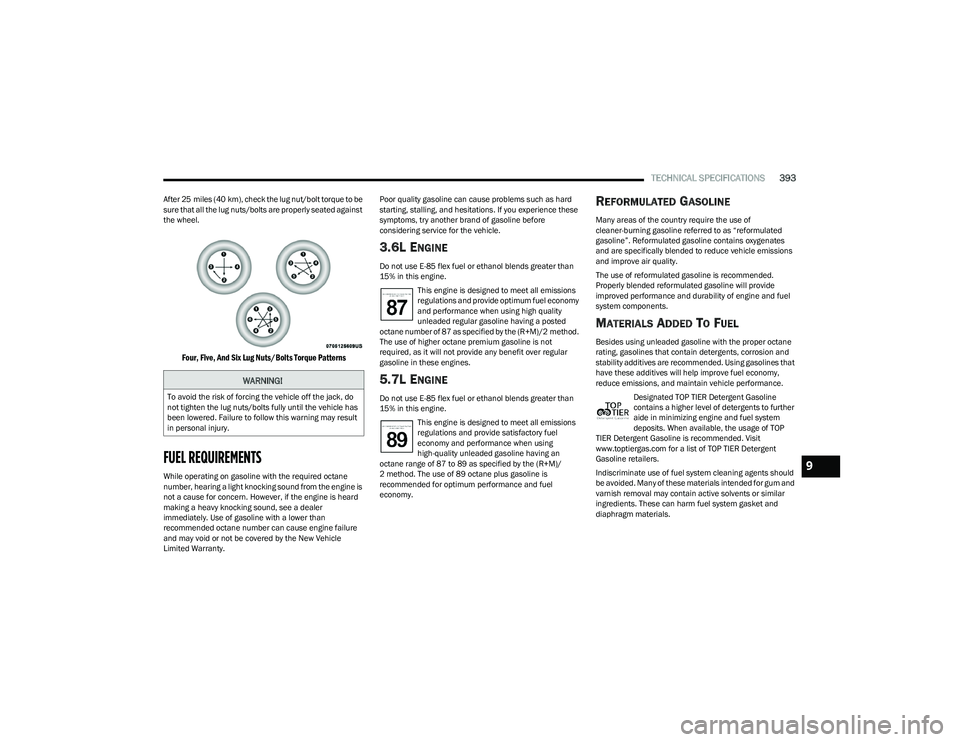
Tighten the lug nuts/bolts in a star pattern until each nut/
bolt has been tightened twice. Ensure that the socket is
fully engaged on the lug nut/bolt (do not insert it halfway).
Lug Nut/
Bolt Torque Lug Nut/
Bolt Type **Lug Nut/
Bolt Size Lug Nut/
Bolt Socket Size
130 ft-lb
(176 N·m) Cone M14 x 1.50 22 mm
23_DT_OM_EN_USC_t.book Page 392
Page 395 of 416
TECHNICAL SPECIFICATIONS393
After 25 miles (40 km), check the lug nut/bolt torque to be
sure that all the lug nuts/bolts are properly seated against
the wheel.
Four, Five, And Six Lug Nuts/Bolts Torque Patterns
FUEL REQUIREMENTS
While operating on gasoline with the required octane
number, hearing a light knocking sound from the engine is
not a cause for concern. However, if the engine is heard
making a heavy knocking sound, see a dealer
immediately. Use of gasoline with a lower than
recommended octane number can cause engine failure
and may void or not be covered by the New Vehicle
Limited Warranty. Poor quality gasoline can cause problems such as hard
starting, stalling, and hesitations. If you experience these
symptoms, try another brand of gasoline before
considering service for the vehicle.
3.6L ENGINE
Do not use E-85 flex fuel or ethanol blends greater than
15% in this engine.
This engine is designed to meet all emissions
regulations and provide optimum fuel economy
and performance when using high quality
unleaded regular gasoline having a posted
octane number of 87 as specified by the (R+M)/2 method.
The use of higher octane premium gasoline is not
required, as it will not provide any benefit over regular
gasoline in these engines.
5.7L ENGINE
Do not use E-85 flex fuel or ethanol blends greater than
15% in this engine.
This engine is designed to meet all emissions
regulations and provide satisfactory fuel
economy and performance when using
high-quality unleaded gasoline having an
octane range of 87 to 89 as specified by the (R+M)/
2 method. The use of 89 octane plus gasoline is
recommended for optimum performance and fuel
economy.
REFORMULATED GASOLINE
Many areas of the country require the use of
cleaner-burning gasoline referred to as “reformulated
gasoline”. Reformulated gasoline contains oxygenates
and are specifically blended to reduce vehicle emissions
and improve air quality.
The use of reformulated gasoline is recommended.
Properly blended reformulated gasoline will provide
improved performance and durability of engine and fuel
system components.
MATERIALS ADDED TO FUEL
Besides using unleaded gasoline with the proper octane
rating, gasolines that contain detergents, corrosion and
stability additives are recommended. Using gasolines that
have these additives will help improve fuel economy,
reduce emissions, and maintain vehicle performance.
Designated TOP TIER Detergent Gasoline
contains a higher level of detergents to further
aide in minimizing engine and fuel system
deposits. When available, the usage of TOP
TIER Detergent Gasoline is recommended. Visit
www.toptiergas.com for a list of TOP TIER Detergent
Gasoline retailers.
Indiscriminate use of fuel system cleaning agents should
be avoided. Many of these materials intended for gum and
varnish removal may contain active solvents or similar
ingredients. These can harm fuel system gasket and
diaphragm materials.
WARNING!
To avoid the risk of forcing the vehicle off the jack, do
not tighten the lug nuts/bolts fully until the vehicle has
been lowered. Failure to follow this warning may result
in personal injury.
9
23_DT_OM_EN_USC_t.book Page 393
Page 402 of 416

400CUSTOMER ASSISTANCE
CUSTOMER ASSISTANCE FOR THE
H
EARING OR SPEECH IMPAIRED
(TDD/TTY)
To assist customers who have hearing difficulties,
FCA US LLC has installed special TDD (Telecommunication
Devices for the Deaf) equipment at its customer center.
Any hearing or speech impaired customer, who has access
to a TDD or a conventional teletypewriter (TTY) in the
United States, can communicate with FCA US LLC by
dialing 1-800-380-2479.
Canadian residents with hearing difficulties that require
assistance can use the special needs relay service offered
by Bell Canada. For TTY teletypewriter users, dial 711 and
for Voice callers, dial 1-800-855-0511 to connect with a
Bell Relay Service operator.
SERVICE CONTRACT
You may have purchased a service contract for a vehicle
to help protect you from the high cost of unexpected
repairs after FCA US LLC's New Vehicle Limited Warranty
expires. The Mopar® Vehicle Protection plans are the
ONLY vehicle extended protection plans authorized,
endorsed and backed by FCA US LLC to provide additional
protection beyond your vehicle’s warranty. If you
purchased a Mopar® Vehicle Protection Plan, you will
receive Plan Provisions and an Owner Identification Card
in the mail within three weeks of the vehicle delivery date. If you have any questions about the service contract, call
FCA US LLC's Service Contract National Customer Hotline
at 1-800-521-9922 (Canadian residents, call (800)
465-2001 English / (800) 387-9983 French).
FCA US LLC is not responsible for any service contract you
may have purchased from another manufacturer. If you
require service after FCA US LLC’s New Vehicle Limited
Warranty expires, please refer to the contract documents,
and contact the person listed in those documents.
We appreciate that you have made a major investment
when you purchased the vehicle. An authorized dealer has
also made a major investment in facilities, tools, and
training to ensure that you are absolutely delighted with
the ownership experience.
WARRANTY INFORMATION
See the Warranty Information for the terms and provisions
of FCA US LLC warranties applicable to this vehicle and
market. Refer to www.mopar.com/om for further
information.
See the Warranty Information for the terms and provisions
of FCA Canada Inc. warranties applicable to this vehicle
and market. Refer to www.owners.mopar.ca/en for further
information.
For French, refer to www.owners.mopar.ca/fr for further
information.
Use this QR code to access your digital
experience.
MOPAR® PARTS
Mopar® original equipment parts & accessories and
factory filled fluids are available from an authorized
dealer. They are recommended for your vehicle to keep it
operating at its best and maintain its original condition.
WARNING!
Engine exhaust (internal combustion engines only),
some of its constituents, and certain vehicle
components contain, or emit, chemicals known to the
State of California to cause cancer and birth defects, or
other reproductive harm. In addition, certain fluids
contained in vehicles and certain products of
component wear contain, or emit, chemicals known to
the State of California to cause cancer and birth
defects, or other reproductive harm.
23_DT_OM_EN_USC_t.book Page 400
Page 405 of 416

403
INDEX
AAccessory Drive Belt Inspection .................................. 346
Adaptive Cruise Control (ACC)
(Cruise Control) ................................................... 143
, 145
Adding Engine Coolant (Antifreeze) ............................ 350
Adding Fuel................................................................... 171
Additives, Fuel .............................................................. 393
Adjust Down...........................................................................32
Forward ...................................................................... 32
Rearward ....................................................................32
Up................................................................................ 32
Adjustable Pedals ...........................................................38
Advance Phone Connectivity ....................................... 235
Air Bag Air Bag Operation.................................................... 290
Air Bag Warning Light .................................... 288
, 291
Enhanced Accident Response ...................... 297, 332
Event Data Recorder (EDR).................................... 332 Front Air Bag ........................................................... 291
If Deployment Occurs ............................................. 297
Knee Impact Bolsters ............................................. 294
Maintaining Your Air Bag System .......................... 298
Maintenance ........................................................... 298
Redundant Air Bag Warning Light ......................... 289
Transporting Pets.................................................... 311
Air Bag Light ...............................................108
, 288, 311
Air Cleaner, Engine (Engine Air Cleaner Filter) ........... 342
Air Conditioner Maintenance ...................................... 344
Air Conditioner Refrigerant .......................................... 344
Air Conditioner System ................................................ 344 Air Conditioning........................................................ 54
, 56
Air Conditioning Filter ............................................59, 344
Air Conditioning System ................................................. 59
Air Conditioning, Operating Tips .................................... 59
Air Filter ............................................................... 342
, 344
Air Pressure Tires.......................................................................... 377
Air Suspension .................................................... 134
, 137
Alarm Panic........................................................................... 17
Security Alarm...................................................23
, 110
Alterations/Modifications Vehicle........................................................................ 11
Antifreeze (Engine Coolant) ............................... 350
, 395
Disposal ...................................................................351
Anti-Lock Brake System (ABS) ..................................... 262
Anti-Lock Warning Light................................................ 110
Assist, Hill Start ............................................................. 266
Audio Settings ............................................................... 224
Audio Systems (Radio) ................................................. 191
Auto Down Power Windows............................................ 70
Automatic Door Locks .................................................... 27 Automatic Headlights ..................................................... 48Automatic High Beams ................................................... 47
Automatic Tailgate Release ........................................... 75
Automatic Temperature Control (ATC) .......................... 59
Automatic Transmission ..................................... 125
, 353
Adding Fluid ............................................................. 353
Fluid And Filter Change ...........................................353
Fluid Change ............................................................353 Fluid Level Check ....................................................353 Fluid Type .......................................................353
, 397
Special Additives ..................................................... 353
Automatic Transmission Limp Home Mode ............... 128
AutoPark ....................................................................... 119
AUX Camera .................................................................. 168
Auxiliary Driving Systems ............................................. 269
Axle Fluid.............................................................. 353
, 397
Axle Locker System ...................................................... 140
Axle Lubrication ............................................................ 353
BBack-Up Camera........................................................... 163
Battery..................................................................108, 340
Charging System Light ............................................ 108
Keyless Key Fob Replacement................................. 17
Battery Saver Feature .................................................... 50
Bed Divider ..................................................................... 84 Bed Extender .................................................................. 84
Bed Step ......................................................................... 78
Bedliner......................................................................... 389
Belts, Seat..................................................................... 311
Blind Spot Monitoring .................................................. 269
Bluetooth Connecting To A Particular Mobile Phone Or Audio Device After Pairing ................................. 231
Body Builders Guide..........................................................9
Body Mechanism Lubrication ...................................... 347
Bodywork ...................................................................... 388
B-Pillar Location ........................................................... 374
Brake Assist System..................................................... 263
Brake Control System .................................................. 263
11
23_DT_OM_EN_USC_t.book Page 403