2023 NISSAN TITAN 4WD
[x] Cancel search: 4WDPage 579 of 644
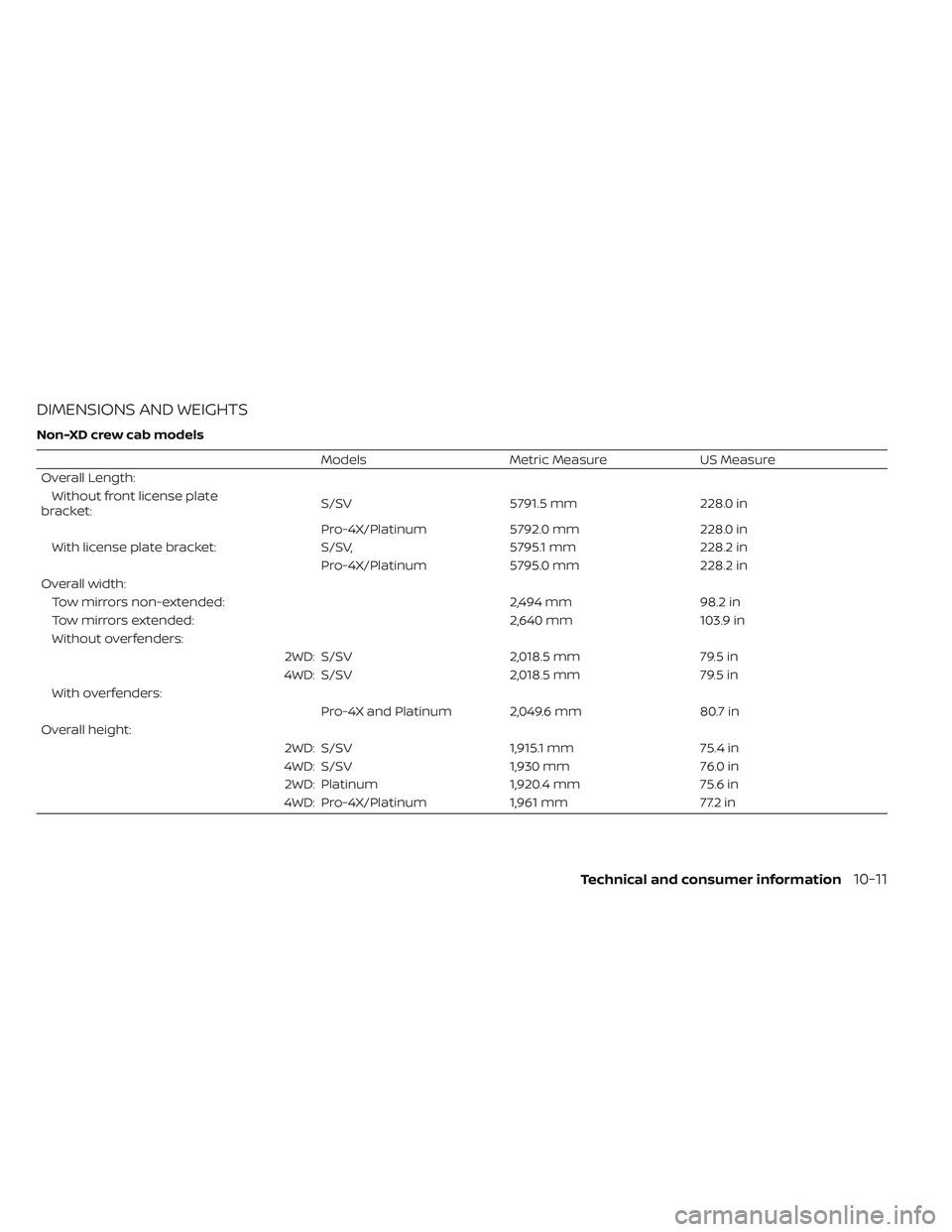
DIMENSIONS AND WEIGHTS
Non-XD crew cab models
ModelsMetric Measure US Measure
Overall Length: Without front license plate
bracket: S/SV
5791.5 mm 228.0 in
Pro-4X/Platinum 5792.0 mm 228.0 in
With license plate bracket: S/SV,5795.1 mm 228.2 in
Pro-4X/Platinum 5795.0 mm 228.2 in
Overall width: Tow mirrors non-extended: 2,494 mm98.2 in
Tow mirrors extended: 2,640 mm103.9 in
Without overfenders: 2WD: S/SV2,018.5 mm79.5 in
4WD: S/SV 2,018.5 mm79.5 in
With overfenders: Pro-4X and Platinum 2,049.6 mm 80.7 in
Overall height: 2WD: S/SV1,915.1 mm75.4 in
4WD: S/SV 1,930 mm76.0 in
2WD: Platinum 1,920.4 mm75.6 in
4WD: Pro-4X/Platinum 1,961 mm77.2 in
Technical and consumer information10-11
Page 582 of 644

Non-XD King Cab® models
ModelsMetric Measure US Measure
Overall Length: Without front license plate
bracket:
S/SV5,791.5 mm 228.0 in
With front license plate
bracket:
S/SV5,795.1 mm 228.2 in
Overall width: Without overfenders: S/SV2,018.5 mm 79.5 in
Overall height: 2WD: S1,908 mm75.1 in
4WD: S 1,923 mm75.7 in
2WD: SV 1,908 mm75.1 in
4WD: SV 1,923 mm75.7 in
Front and Rear Track: 1,725 mm67.9 in
Wheelbase: 3,550 mm139.8 in
Gross vehicle weight rating: Refer to the “F.M.V.S.S. certifi-
cation label” on the center
pillar between the driver's
side front and rear doors.
Gross axle weight rating:
Front:Rear:
10-14Technical and consumer information
Page 604 of 644

TOWING LOAD/SPECIFICATION
WARNING
The towing capacities provided in this
manual are for general reference only.
The safe towing capacity of your ve-
hicle is affected by dealer and factory
installed options and passenger and cargo loads. You must weigh the ve-
hicle and trailer as described in this
manual to determine the actual vehicle
towing capacity. Do not exceed the
published maximum towing capacity
or the GCWR or the GVWR shown on the
FMVSS label. Doing so can result in an
accident causing serious personal in-
jury or property damage.
NOTE:
The SAE J2807 Weight Distributing Class
4 Hitch specifications are based on S and
SV grade models . The Gooseneck Hitch
specifications are based on SV grade
models.
Non-XD models — Crew cab — Towing load specification chart — SAE J2807 Weight Distributing Class 4 Hitch
Axle type 2WD 4WD
Metric measure US MeasureMetric measure US Measure
Maximum Payload 725.7 kg1,600 lbs. 748.4 kg1,650 lbs.
Maximum Towing Capacity *1,
*2, *3 4,222.9 kg
9,310 lbs.4,154.9 kg 9,160 lbs.
Maximum Tongue load *2, *3 422.3 kg931 lbs.415.5 kg 916 lbs.
Maximum Gross Combined
Weight Rating 6,940 kg
15,300 lbs. 6,940 kg15,300 lbs.
Non-XD models — King Cab® — Towing load specification chart — SAE J2807 Weight Distributing Class 4 Hitch
Axle type 2WD 4WD
Metric measure US MeasureMetric measure US Measure
Maximum Payload 730.3 kg1,610 lbs. 766.6 kg1,690 lbs.
Maximum Towing Capacity *1,
*2, *3 4,227.5 kg
9,320 lbs. 4,173 kg9,200 lbs.
Maximum Tongue load *2, *3 422.7 kg932 lbs.417.3 kg920 lbs.
Maximum Gross Combined
Weight Rating 6,940 kg
15,300 lbs. 6,940 kg15,300 lbs.
10-36Technical and consumer information
Page 605 of 644
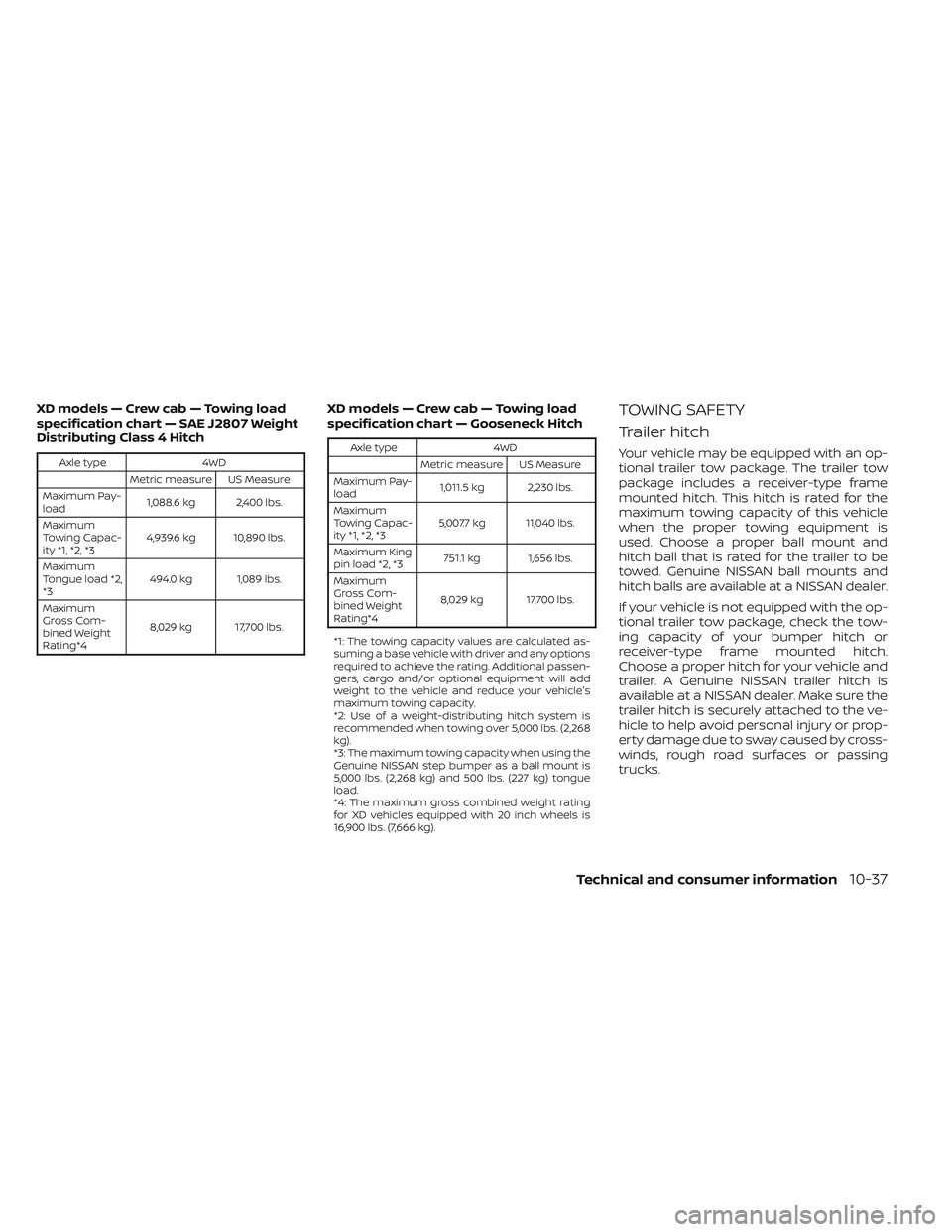
XD models — Crew cab — Towing load
specification chart — SAE J2807 Weight
Distributing Class 4 Hitch
Axle type4WD
Metric measure US Measure
Maximum Pay-
load 1,088.6 kg 2,400 lbs.
Maximum
Towing Capac-
ity *1, *2, *3 4,939.6 kg 10,890 lbs.
Maximum
Tongue load *2,
*3 494.0 kg 1,089 lbs.
Maximum
Gross Com-
bined Weight
Rating*4 8,029 kg 17,700 lbs.
XD models — Crew cab — Towing load
specification chart — Gooseneck Hitch
Axle type
4WD
Metric measure US Measure
Maximum Pay-
load 1,011.5 kg 2,230 lbs.
Maximum
Towing Capac-
ity *1, *2, *3 5,007.7 kg 11,040 lbs.
Maximum King
pin load *2, *3 751.1 kg 1,656 lbs.
Maximum
Gross Com-
bined Weight
Rating*4 8,029 kg 17,700 lbs.
*1: The towing capacity values are calculated as-
suming a base vehicle with driver and any options
required to achieve the rating. Additional passen-
gers, cargo and/or optional equipment will add
weight to the vehicle and reduce your vehicle's
maximum towing capacity.
*2: Use of a weight-distributing hitch system is
recommended when towing over 5,000 lbs. (2,268
kg).
*3: The maximum towing capacity when using the
Genuine NISSAN step bumper as a ball mount is
5,000 lbs. (2,268 kg) and 500 lbs. (227 kg) tongue
load.
*4: The maximum gross combined weight rating
for XD vehicles equipped with 20 inch wheels is
16,900 lbs. (7,666 kg).
TOWING SAFETY
Trailer hitch
Your vehicle may be equipped with an op-
tional trailer tow package. The trailer tow
package includes a receiver-type frame
mounted hitch. This hitch is rated for the
maximum towing capacity of this vehicle
when the proper towing equipment is
used. Choose a proper ball mount and
hitch ball that is rated for the trailer to be
towed. Genuine NISSAN ball mounts and
hitch balls are available at a NISSAN dealer.
If your vehicle is not equipped with the op-
tional trailer tow package, check the tow-
ing capacity of your bumper hitch or
receiver-type frame mounted hitch.
Choose a proper hitch for your vehicle and
trailer. A Genuine NISSAN trailer hitch is
available at a NISSAN dealer. Make sure the
trailer hitch is securely attached to the ve-
hicle to help avoid personal injury or prop-
erty damage due to sway caused by cross-
winds, rough road surfaces or passing
trucks.
Technical and consumer information10-37
Page 618 of 644
• Be certain your rearview mirrors conformto all federal, state or local regulations. If
not, install any mirrors required for towing
before driving the vehicle.
• Determine the overall height of the ve- hicle and trailer so the required clearance
is known.
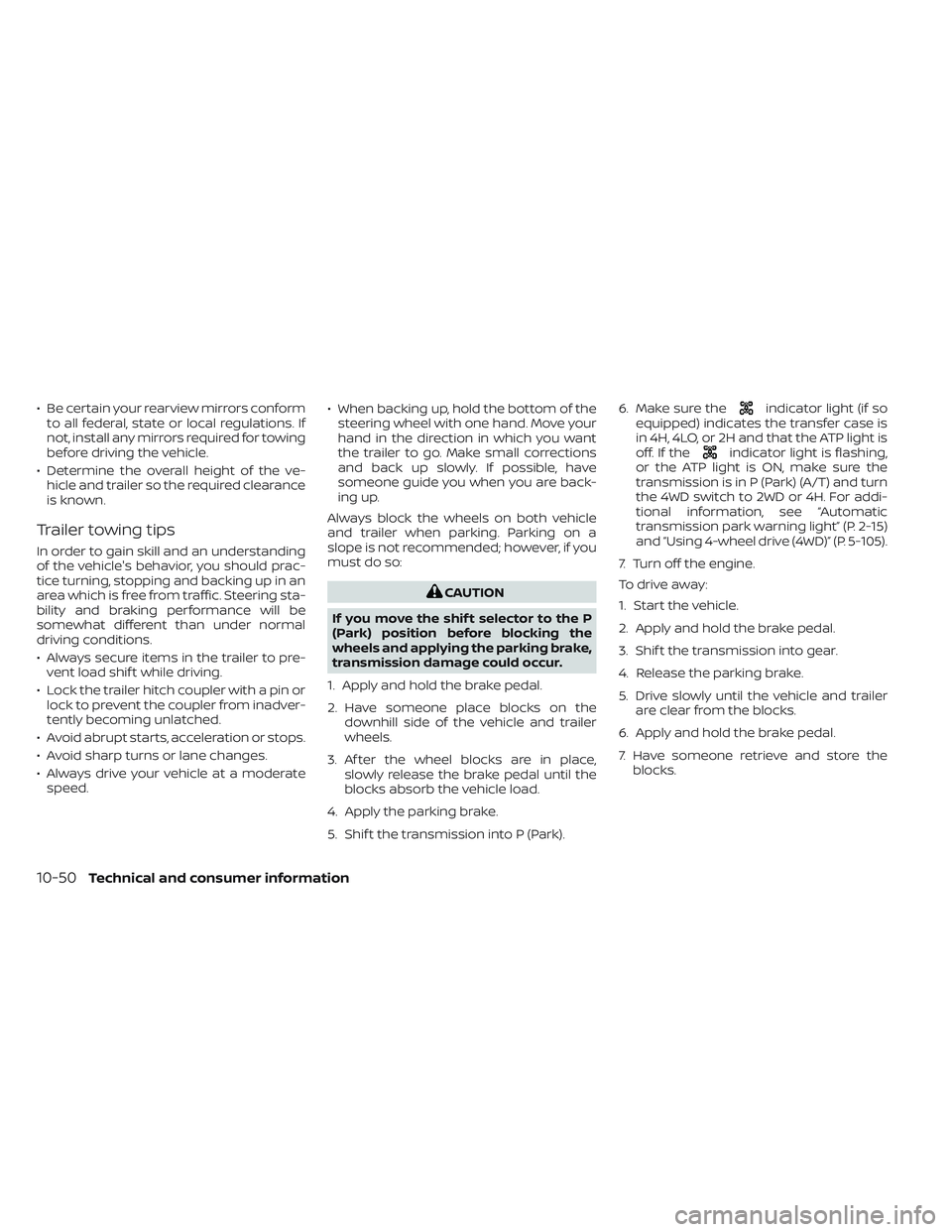
Trailer towing tips
In order to gain skill and an understanding
of the vehicle's behavior, you should prac-
tice turning, stopping and backing up in an
area which is free from traffic. Steering sta-
bility and braking performance will be
somewhat different than under normal
driving conditions.
• Always secure items in the trailer to pre-vent load shif t while driving.
• Lock the trailer hitch coupler with a pin or lock to prevent the coupler from inadver-
tently becoming unlatched.
• Avoid abrupt starts, acceleration or stops.
• Avoid sharp turns or lane changes.
• Always drive your vehicle at a moderate speed. • When backing up, hold the bottom of the
steering wheel with one hand. Move your
hand in the direction in which you want
the trailer to go. Make small corrections
and back up slowly. If possible, have
someone guide you when you are back-
ing up.
Always block the wheels on both vehicle
and trailer when parking. Parking on a
slope is not recommended; however, if you
must do so:
CAUTION
If you move the shif t selector to the P
(Park) position before blocking the
wheels and applying the parking brake,
transmission damage could occur.
1. Apply and hold the brake pedal.
2. Have someone place blocks on the downhill side of the vehicle and trailer
wheels.
3. Af ter the wheel blocks are in place, slowly release the brake pedal until the
blocks absorb the vehicle load.
4. Apply the parking brake.
5. Shif t the transmission into P (Park). 6. Make sure the
indicator light (if so
equipped) indicates the transfer case is
in 4H, 4LO, or 2H and that the ATP light is
off. If the
indicator light is flashing,
or the ATP light is ON, make sure the
transmission is in P (Park) (A/T) and turn
the 4WD switch to 2WD or 4H. For addi-
tional information, see “Automatic
transmission park warning light” (P. 2-15)
and “Using 4-wheel drive (4WD)” (P. 5-105).
7. Turn off the engine.
To drive away:
1. Start the vehicle.
2. Apply and hold the brake pedal.
3. Shif t the transmission into gear.
4. Release the parking brake.
5. Drive slowly until the vehicle and trailer are clear from the blocks.
6. Apply and hold the brake pedal.
7. Have someone retrieve and store the blocks.
10-50Technical and consumer information
Page 621 of 644
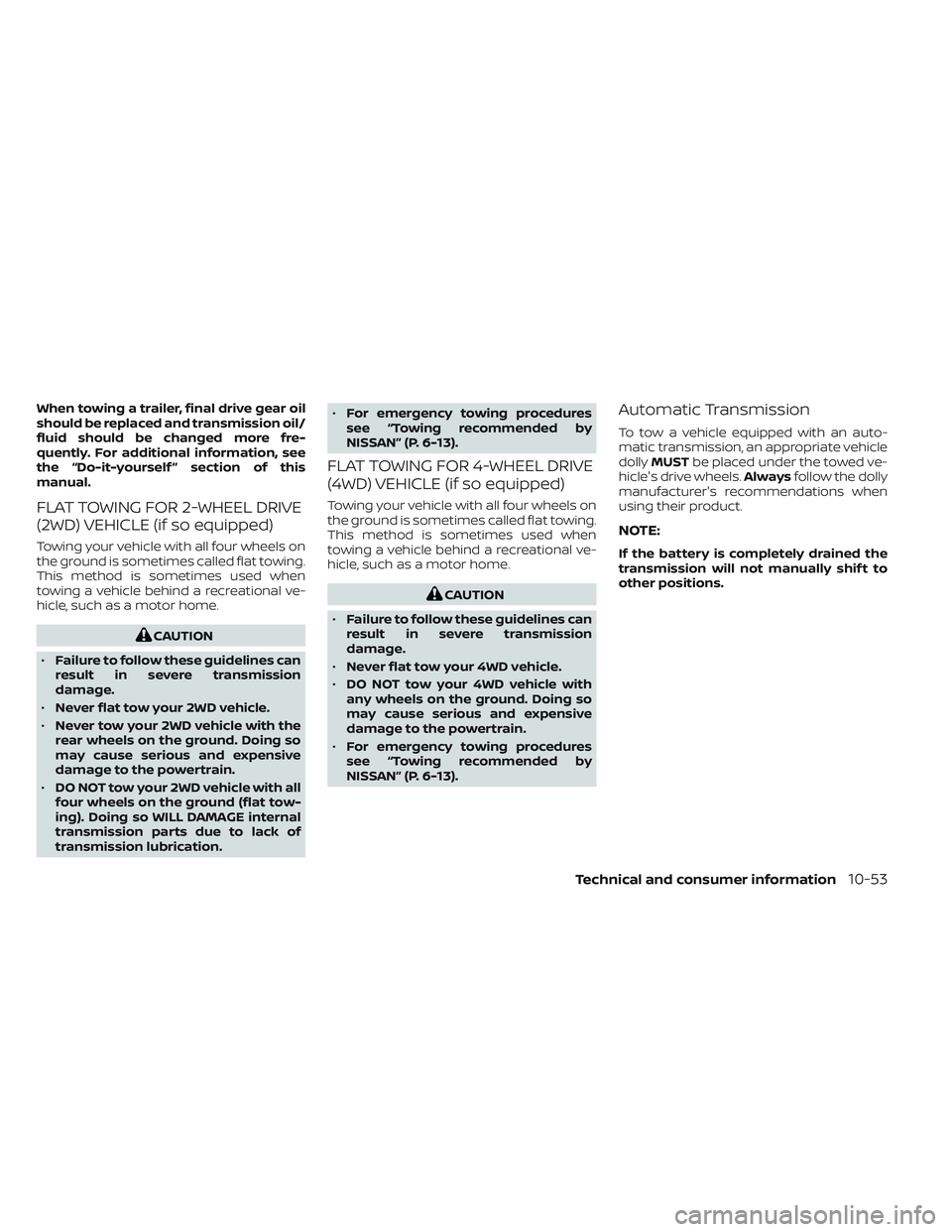
When towing a trailer, final drive gear oil
should be replaced and transmission oil/
fluid should be changed more fre-
quently. For additional information, see
the “Do-it-yourself ” section of this
manual.
FLAT TOWING FOR 2-WHEEL DRIVE
(2WD) VEHICLE (if so equipped)
Towing your vehicle with all four wheels on
the ground is sometimes called flat towing.
This method is sometimes used when
towing a vehicle behind a recreational ve-
hicle, such as a motor home.
CAUTION
• Failure to follow these guidelines can
result in severe transmission
damage.
• Never flat tow your 2WD vehicle.
• Never tow your 2WD vehicle with the
rear wheels on the ground. Doing so
may cause serious and expensive
damage to the powertrain.
• DO NOT tow your 2WD vehicle with all
four wheels on the ground (flat tow-
ing). Doing so WILL DAMAGE internal
transmission parts due to lack of
transmission lubrication. •
For emergency towing procedures
see “Towing recommended by
NISSAN” (P. 6-13).
FLAT TOWING FOR 4-WHEEL DRIVE
(4WD) VEHICLE (if so equipped)
Towing your vehicle with all four wheels on
the ground is sometimes called flat towing.
This method is sometimes used when
towing a vehicle behind a recreational ve-
hicle, such as a motor home.
CAUTION
• Failure to follow these guidelines can
result in severe transmission
damage.
• Never flat tow your 4WD vehicle.
• DO NOT tow your 4WD vehicle with
any wheels on the ground. Doing so
may cause serious and expensive
damage to the powertrain.
• For emergency towing procedures
see “Towing recommended by
NISSAN” (P. 6-13).
Automatic Transmission
To tow a vehicle equipped with an auto-
matic transmission, an appropriate vehicle
dolly MUST be placed under the towed ve-
hicle's drive wheels. Alwaysfollow the dolly
manufacturer's recommendations when
using their product.
NOTE:
If the battery is completely drained the
transmission will not manually shif t to
other positions.
Technical and consumer information10-53
Page 625 of 644

WARNING
A vehicle equipped with 4-Wheel Drive
(4WD) should never be tested using a
two wheel dynamometer (such as the
dynamometers used by some states
for emissions testing), or similar equip-
ment. Make sure you inform the test
facility personnel that your vehicle is
equipped with 4WD before it is placed
on a dynamometer. Using the wrong
test equipment may result in transmis-
sion damage or unexpected vehicle
movement which could result in seri-
ous vehicle damage or personal injury.
Due to legal requirements in some states
and Canadian Provinces, your vehicle may
be required to be in what is called the
“ready condition” for an Inspection/
Maintenance (I/M) test of the emission
control system.
The vehicle is set to the “ready condition”
when it is driven through certain driving
patterns. Usually, the ready condition can
be obtained by ordinary usage of the
vehicle. If a powertrain system component is re-
paired or the battery is disconnected, the
vehicle may be reset to a “not ready” condi-
tion. Before taking the I/M test, check the
vehicle's inspection/maintenance test
readiness condition. Place the ignition
switch in the ON position without starting
the engine. If the Malfunction Indicator
Light (MIL) comes on steady for 20 seconds
and then blinks for 10 seconds, the I/M test
condition is “not ready”. If the MIL does not
blink af ter 20 seconds, the I/M test condi-
tion is “ready”. It is recommended that you
visit a NISSAN dealer to set the “ready con-
dition” or to prepare the vehicle for testing.
This vehicle is equipped with an Event Data
Recorder (EDR). The main purpose of an
EDR is to record, in certain crash or near
crash-like situations, such as an air bag
deployment or hitting a road obstacle, data
that will assist in understanding how a ve-
hicle's systems performed. The EDR is de-
signed to record data related to vehicle dy-
namics and safety systems for a short
period of time, typically 30 seconds or less.
The EDR in this vehicle is designed to re-
cord such data as:
• How various systems in your vehicle were
operating;
• Whether or not the driver and passenger safety belts were buckled/fastened;
• How far (if at all) the driver was depress- ing the accelerator and/or brake pedal;
and,
• How fast the vehicle was traveling.
• Sounds are not recorded.
READINESS FOR INSPECTION/
MAINTENANCE (I/M) TEST EVENT DATA RECORDERS (EDR)
Technical and consumer information10-57