Page 450 of 556
The engine cooling system is filled at the
factory with a pre-diluted mixture of 50%
Genuine NISSAN Long Life Antifreeze/
Coolant (blue) and 50% water to provide
year-round antifreeze and coolant protec-
tion. The antifreeze solution contains rust
and corrosion inhibitors. Additional engine
cooling system additives are not
necessary.
WARNING
• Never remove the coolant reservoir
cap when the engine is hot. Wait until
the engine and radiator cool down.
Serious burns could be caused by
high pressure fluid escaping from the
radiator. For additional information
on precautions, see “If your vehicle
overheats” (P. 6-11).
• The coolant reservoir is equipped
with a pressure type coolant reser-
voir cap. To prevent engine damage,
use only a Genuine NISSAN coolant
reservoir cap.
CAUTION
• Never use any cooling system addi-
tives such as radiator sealer. Addi-
tives may clog the cooling system
and cause damage to the engine,
transmission and/or cooling system.
• When adding or replacing coolant, be
sure to use only Genuine NISSAN
Long Life Antifreeze/Coolant (blue)
or equivalent. Genuine NISSAN Long
Life Antifreeze/Coolant (blue) is pre-
diluted to provide antifreeze protec-
tion to -34° F (-37° C). If additional
freeze protection is needed due to
weather where you operate your ve-
hicle, add Genuine NISSAN Long Life
Antifreeze/Coolant (blue) concen-
trate following the directions on the
container. If an equivalent coolant
other than Genuine NISSAN Long Life
Antifreeze/Coolant (blue) is used, fol-
low the coolant manufacturer’s in-
structions to maintain minimum an-
tifreeze protection to -34° F (-37° C).
The use of other types of coolant so-
lutions other than Genuine NISSAN
Long Life Antifreeze/Coolant (blue)
or equivalent may damage the en-
gine cooling system. •
The life expectancy of the factory-fill
coolant is 105,000 miles (168,000 km)
or 7 years. Mixing any other type of
coolant other than Genuine NISSAN
Long Life Antifreeze/Coolant (blue)
(or equivalent cooling), including
Genuine NISSAN Long Life
Antifreeze/Coolant (green), or the
use of non-distilled water may re-
duce the life expectancy of the
factory-fill coolant. For additional in-
formation, see the “Maintenance and
schedules” section of this manual.
ENGINE COOLING SYSTEM
8-4Do-it-yourself
Page 451 of 556
CHECKING ENGINE COOLANT
LEVEL
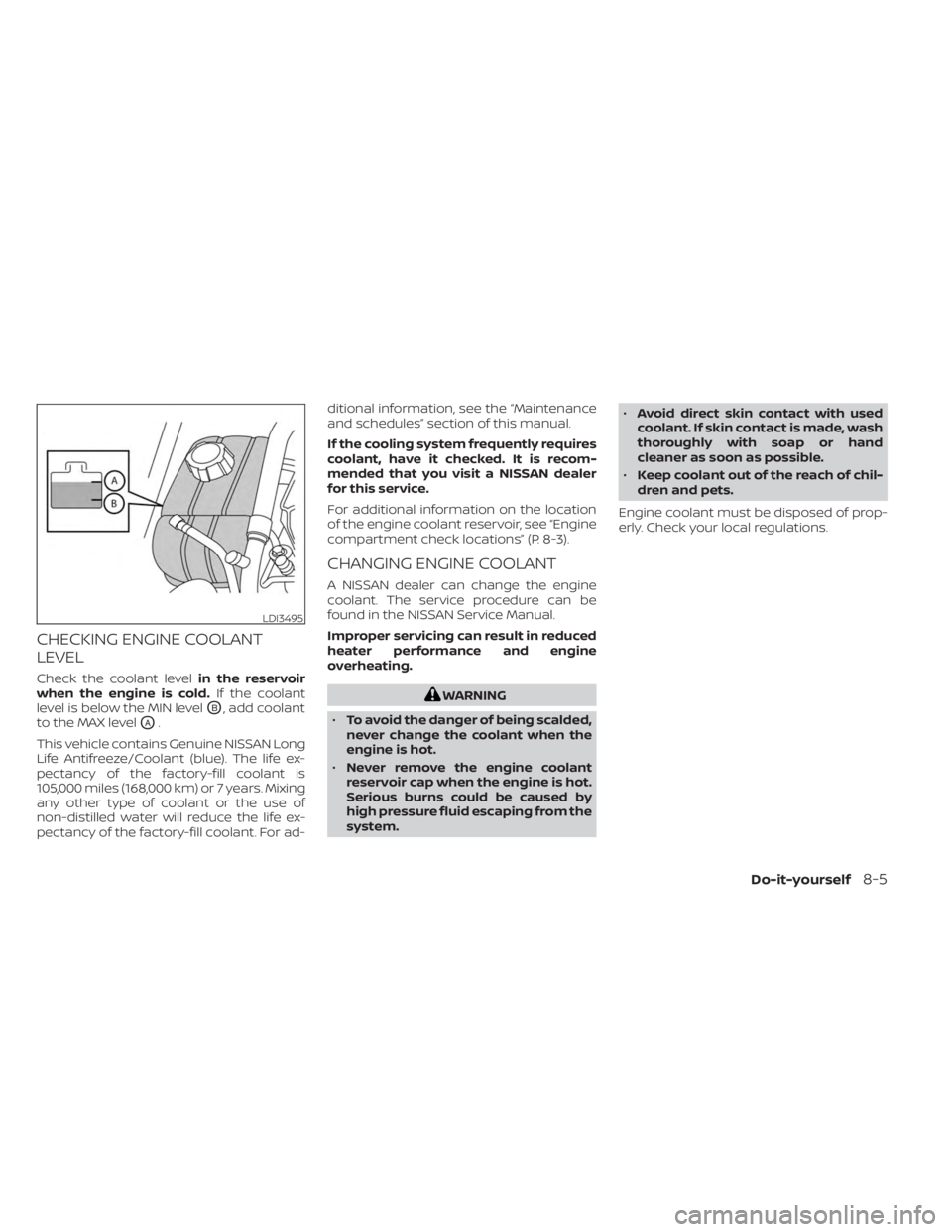
Check the coolant levelin the reservoir
when the engine is cold. If the coolant
level is below the MIN level
OB, add coolant
to the MAX level
OA.
This vehicle contains Genuine NISSAN Long
Life Antifreeze/Coolant (blue). The life ex-
pectancy of the factory-fill coolant is
105,000 miles (168,000 km) or 7 years. Mixing
any other type of coolant or the use of
non-distilled water will reduce the life ex-
pectancy of the factory-fill coolant. For ad- ditional information, see the “Maintenance
and schedules” section of this manual.
If the cooling system frequently requires
coolant, have it checked. It is recom-
mended that you visit a NISSAN dealer
for this service.
For additional information on the location
of the engine coolant reservoir, see “Engine
compartment check locations” (P. 8-3).
CHANGING ENGINE COOLANT
A NISSAN dealer can change the engine
coolant. The service procedure can be
found in the NISSAN Service Manual.
Improper servicing can result in reduced
heater performance and engine
overheating.
WARNING
• To avoid the danger of being scalded,
never change the coolant when the
engine is hot.
• Never remove the engine coolant
reservoir cap when the engine is hot.
Serious burns could be caused by
high pressure fluid escaping from the
system. •
Avoid direct skin contact with used
coolant. If skin contact is made, wash
thoroughly with soap or hand
cleaner as soon as possible.
• Keep coolant out of the reach of chil-
dren and pets.
Engine coolant must be disposed of prop-
erly. Check your local regulations.
LDI3495
Do-it-yourself8-5
Page 518 of 556
Af termarket fuel additives
NISSAN does not recommend the use of
any af termarket fuel additives (for ex-
ample, fuel injector cleaner, octane
booster, intake valve deposit removers,
etc.) which are sold commercially. Many of
these additives intended for gum, varnish
or deposit removal may contain active sol-
vents or similar ingredients that can be
harmful to the fuel system and engine.
Octane rating tips
Using unleaded gasoline with an octane
rating lower than recommended can
cause persistent, heavy “spark knock.”
(“Spark knock” is a metallic rapping
noise.) If severe, this can lead to engine
damage. If you detect a persistent heavy
spark knock even when using gasoline
of the stated octane rating, or if you hear
steady spark knock while holding a
steady speed on level roads, it is recom-
mended that you have a NISSAN dealer
correct the condition. Failure to correct
the condition is misuse of the vehicle, for
which NISSAN is not responsible.Incorrect ignition timing may result in
spark knock, af ter-run and/or overheating,
which may cause excessive fuel consump-
tion or engine damage. If any of the above
symptoms are encountered, have your ve-
hicle checked. It is recommended that you
visit a NISSAN dealer for servicing.
However, now and then you may notice
light spark knock for a short time while
accelerating or driving up hills. This is not
a cause for concern, because you get the
greatest fuel benefit when there is light
spark knock for a short time under heavy
engine load.
10-6Technical and consumer information
Page 543 of 556
Map lights....................2-75Menu button...................4-5Meters and gauges..............2-4Instrument brightness control.....2-58Mirror
Automatic anti-glare inside mirror. . .3-28Outside mirror control..........3-29Outside mirrors..............3-29Rearview...................3-28Vanity mirror................3-27Mirrors......................3-28Moonroof.................2-73,7-5Moving Object Detection (MOD)......4-27
N
NISSAN Intelligent Key®..........3-2,3-7NISSAN Intelligent Key® battery
discharge indicator..............5-13NISSAN Vehicle Immobilizer
System................. .2-49, 5-14NissanConnect® Owner's Manual......4-2
O
Octane rating (See fuel octane rating). .10-6Oil
Capacities and recommended
fuel/lubricants
...............10-2Changing engine oil............8-6Changing engine oil filter.........8-6Checking engine oil level.........8-6Engine oil.................. .8-6
Engine oil and oil filter
recommendation.............10-7Engine oil viscosity.............10-7Outside mirror control............3-29Outside mirrors................3-29Overhead sunglasses holder........2-68Overheat
If your vehicle overheats.........6-11Owner's manual order form........10-25Owner's manual/service manual
order information..............10-25
P
ParkingParking/parking on hills.........5-127Parking brake.................5-22Phone, Bluetooth® hands-free system. .4-66PowerPower door locks...........3-5, 3-6Power outlet................2-64Powerrearwindows............2-71Power steering system.........5-128Power windows..............2-70Rear power windows...........2-71Power outlet................. .2-64Power steering................5-128Precautions
Maintenance precautions.........8-2Precautions on booster
seats...............1-30, 1-36, 1-40Precautions on child
restraints............1-30, 1-36, 1-40
Precautions on seat belt usage.....1-12Precautions on supplemental
restraint system..............1-44Precautions when starting and
driving.................... .5-4Push starting..................6-11
R
Radio
Car phone or CB radio..........4-66FM/AM radio................4-48Readiness for inspection maintenance
(I/M) test................... .10-24Rear Automatic Braking (RAB). . . .2-15, 5-85Rear Cross Traffic Alert (RCTA).......5-48Rear Door Alert.........2-27,2-42, 2-62Rear power windows.............2-71Rear seat.....................1-7Rear Sonar System (RSS)..........5-135Rear window and outside mirror
defroster switch................2-51Rearview mirror................3-28RearView Monitor................4-8Recommended Fluids............10-2Recorders
Event Data................ .10-24Refrigerant recommendation.......10-8Registering a vehicle in another
country.................... .10-12Remote Engine Start..........3-18,5-15Reporting safety defects (US only). . . .10-22
11-5