2023 NISSAN QASHQAI Amp
[x] Cancel search: AmpPage 3 of 508

safety features to all occupants
of the vehicle.
. ALWAYS review this Owner’s Man-
ual for important safety informa-
tion.
On-pavement and off-road
driving
This vehicle will handle and maneuver
differently from an ordinary passenger
car because it has a higher center of
gravity. As with other vehicles with
features of this type, failure to operate
this vehicle correctly may result in loss
of control or an accident. Be sure to
read “Avoiding collision and rollover”
and “Driving safety precautions” in the
“5. Starting and driving” section of this
manual.
MODIFICATION OF YOUR VEHI-
CLE
This vehicle should not be modified.
Modification could affect its perfor-
mance, safety or durability, and may
even violate governmental regula-
tions. In addition, damage or perfor-
mance problems resulting from
modification may not be covered un-
der NISSAN warranties.
WARNING
Installing an aftermarket On-Board
Diagnostic (OBD) plug-in device that
uses the port during normal driving,
for example remote insurance com-
pany monitoring, remote vehicle di-
agnostics, telematics or engine
reprogramming, may cause interfer-
ence or damage to vehicle systems.
We do not recommend or endorse
the use of any aftermarket OBD
plug-in devices, unless specifically
approved by NISSAN. The vehicle
warranty may not cover damage
caused by any aftermarket plug-in
device.
WHEN READING THE MANUAL
This manual includes information for all
features and equipment available on
this model. Features and equipment in
your vehicle may vary depending on
model, trim level, options selected, or-
der, date of production, region or avail-
ability. Therefore, you may find
information about features or equip-
ment that are not included or installed
on your vehicle.
All information, specifications and illustra-
tions in this manual are those in effect at
the time of printing. NISSAN reserves the
right to change specifications, perfor-
mance, design or component suppliers
without notice and without obligation.
From time to time, NISSAN may update
or revise this manual to provide Owners
with the most accurate information cur-
rently available. Please carefully read and
retain with this manual all revision up-
dates sent to you by NISSAN to ensure
you have access to accurate and up-to-
date information regarding your vehicle.
Current versions of vehicle Owner’s Man-
uals and any updates can also be found in
the Owner section of the NISSAN website
at https://owners.nissanusa.com/now-
ners/navigation/manualsGuide. If you
have questions concerning any informa-
tion in your Owner’s Manual, contact
Page 42 of 508

1-24Safety — Seats, seat belts and supplemental restraint system
JVR0555X
LATCH system anchor location
Lower Anchors and Tethers for
CHildren (LATCH) SYSTEM
Your vehicle is equipped with special
anchor points that are used with LATCH
system compatible child restraints. This
system may also be referred to as the
ISOFIX or ISOFIX compatible system. With
this system, you do not have to use a
vehicle seat belt to secure the child
restraint unless the combined weight of
the child and child restraint exceeds 65
lbs (29.5 kg). If the combined weight of the
child and child restraint is greater than 65
lbs (29.5 kg), use the vehicle’s seat belt
(not the lower anchors) to install the child
restraint. Be sure to follow the childrestraint manufacturer’s instructions for
installation.
CAUTION
Store the loose LATCH covers (for
example, in the console box) where
they will not get damaged to avoid
losing them. (See “Console box” (P.2-
71).)
LATCH lower anchor
WARNING
Failure to follow the warnings and
instructions for proper use and in-
stallation of child restraints could
result in serious injury or death of a
child or other passengers in a sud-
den stop or collision:
.
Attach LATCH system compatible
child restraints only at the loca-
tions shown in the illustration.
. Do not secure a child restraint in
the center rear seating position
using the LATCH lower anchors.
The child restraint will not be
secured properly. .
Inspect the lower anchors by in-
serting your fingers into the low-
er anchor area. Feel to make sure
there are no obstructions over
the anchors such as seat belt
webbing or seat cushion material.
The child restraint will not be
secured properly if the lower
anchors are obstructed.
. Child restraint anchorages are
designed to withstand only those
loads imposed by correctly fitted
child restraints. Under no circum-
stances are they to be used to
attach adult seat belts, or other
items or equipment to the vehi-
cle. Doing so could damage the
child restraint anchorages. The
child restraint will not be properly
installed using the damaged an-
chorage, and a child could be
seriously injured or killed in a
collision.
LATCH lower anchor location
The LATCH lower anchor points are
provided to install child restraints in the
rear outboard seating positions only. Do
not attempt to install a child restraint in
the center seating position using the
LATCH lower anchors.
Page 57 of 508
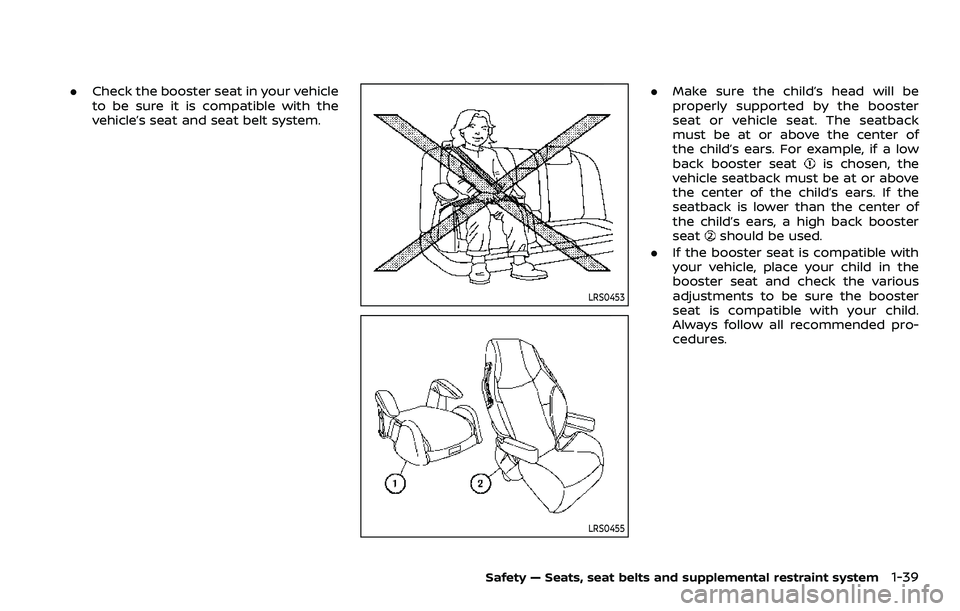
.Check the booster seat in your vehicle
to be sure it is compatible with the
vehicle’s seat and seat belt system.
LRS0453
LRS0455
.Make sure the child’s head will be
properly supported by the booster
seat or vehicle seat. The seatback
must be at or above the center of
the child’s ears. For example, if a low
back booster seat
is chosen, the
vehicle seatback must be at or above
the center of the child’s ears. If the
seatback is lower than the center of
the child’s ears, a high back booster
seat
should be used.
. If the booster seat is compatible with
your vehicle, place your child in the
booster seat and check the various
adjustments to be sure the booster
seat is compatible with your child.
Always follow all recommended pro-
cedures.
Safety — Seats, seat belts and supplemental restraint system1-39
Page 63 of 508
SSS0008
SSS0009
SSS0099
SSS0100
WARNING
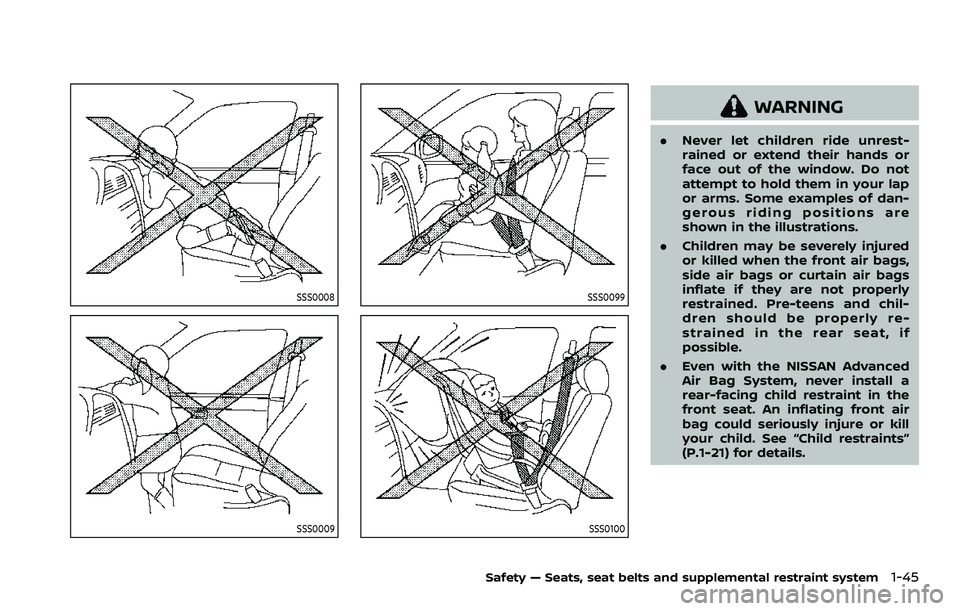
.Never let children ride unrest-
rained or extend their hands or
face out of the window. Do not
attempt to hold them in your lap
or arms. Some examples of dan-
gerous riding positions are
shown in the illustrations.
. Children may be severely injured
or killed when the front air bags,
side air bags or curtain air bags
inflate if they are not properly
restrained. Pre-teens and chil-
dren should be properly re-
strained in the rear seat, if
possible.
. Even with the NISSAN Advanced
Air Bag System, never install a
rear-facing child restraint in the
front seat. An inflating front air
bag could seriously injure or kill
your child. See “Child restraints”
(P.1-21) for details.
Safety — Seats, seat belts and supplemental restraint system1-45
Page 65 of 508
.The curtain air bags ordinarily will
not inflate in the event of a front
impact, rear impact, or lower
severity side collision. Always
wear your seat belts to help
reduce the risk or severity of
injury in various kinds of acci-
dents.
. The seat belts, the side air bags
and curtain air bags are most
effective when you are sitting
well back and upright in the seat.
The side air bags and curtain air
bags inflate with great force. Do
not allow anyone to place their
hand, leg or face near the side air
bags on the side of the seatback
of the front and rear seat or near
the side roof rails. Do not allow
anyone sitting in the front seats
or rear outboard seats to extend
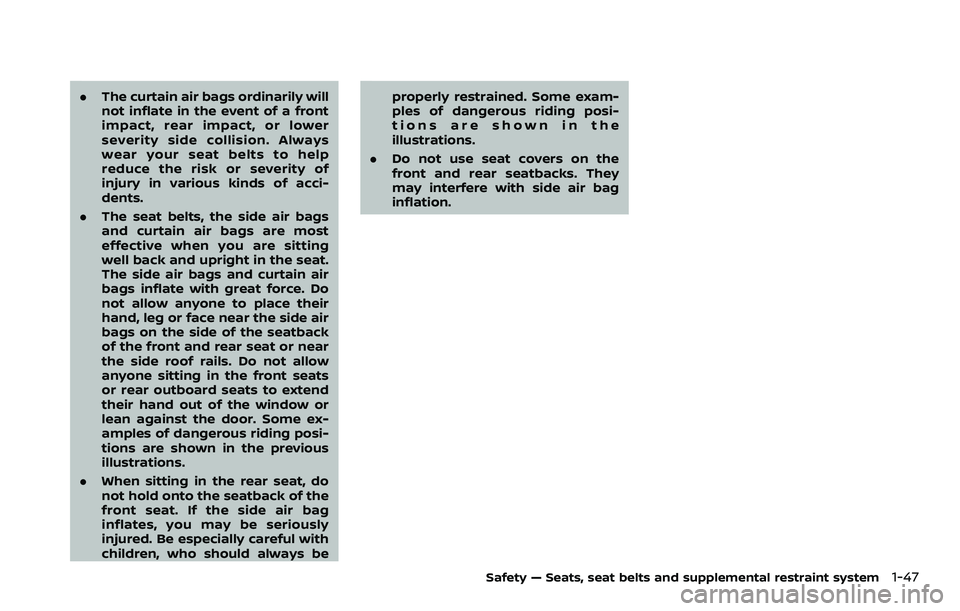
their hand out of the window or
lean against the door. Some ex-
amples of dangerous riding posi-
tions are shown in the previous
illustrations.
. When sitting in the rear seat, do
not hold onto the seatback of the
front seat. If the side air bag
inflates, you may be seriously
injured. Be especially careful with
children, who should always be properly restrained. Some exam-
ples of dangerous riding posi-
tions are shown in the
illustrations.
. Do not use seat covers on the
front and rear seatbacks. They
may interfere with side air bag
inflation.
Safety — Seats, seat belts and supplemental restraint system1-47
Page 71 of 508

Front passenger air bag:
The front passenger air bag is designed
to automatically turn OFF when the
vehicle is operated under some condi-
tions as described below as permitted by
U.S. regulations. If the front passenger air
bag is OFF, it will not inflate in a crash. The
driver air bag and other air bags in your
vehicle are not part of this system.
The purpose of the regulation is to help
reduce the risk of injury or death from an
inflating air bag to certain front passen-
ger seat occupants, such as children, by
requiring the air bag to be automatically
turned OFF.
The occupant classification sensors
(weight sensors) are on the seat cushion
frame under the front passenger seat and
are designed to detect an occupant and
objects on the seat. For example, if a child
is in the front passenger seat, the Ad-
vanced Air Bag System is designed to turn
the passenger air bag OFF in accordance
with the regulations. Also, if a child
restraint of the type specified in the
regulations is on the seat, the occupant
classification sensors can detect it and
cause the air bag to turn OFF.
Front passenger seat adult occupants
who are properly seated and using the
seat belt as outlined in this manual
should not cause the passenger air bagand front passenger knee air bag to be
automatically turned OFF. For small
adults it may be turned OFF, however, if
the occupant does not sit in the seat
properly (for example, by not sitting up-
right, by sitting on an edge of the seat, or
by otherwise being out of position), this
could cause the sensors to turn the air
bag OFF. Always be sure to be seated and
wearing the seat belt properly for the
most effective protection by the seat belt
and supplemental air bag.
NISSAN recommends that pre-teens and
children be properly restrained in a rear
seat. NISSAN also recommends that ap-
propriate child restraints and booster
seats be properly installed in a rear seat.
If this is not possible, the occupant
classification sensors are designed to
operate as described above to turn the
front passenger air bag and front pas-
senger knee air bag OFF for specified
child restraints. Failing to properly secure
child restraints and to use the Automatic
Locking Retractor (ALR) mode (child re-
straint mode) may allow the restraint to
tip or move in an accident or sudden stop.
This can also result in the passenger air
bag and front passenger knee air bag
inflating in a crash instead of being OFF.
(See “Child restraints” (P.1-21) for proper
use and installation.)
If the front passenger seat is not occu-
pied, the passenger air bag and front
passenger knee air bag are designed not
to inflate in a crash. However, heavy
objects placed on the seat could result
in air bag inflation, because of the object
being detected by the occupant classifi-
cation sensors. Other conditions could
also result in air bag inflation, such as if a
child is standing on the seat, or if two
children are on the seat, contrary to the
instructions in this manual. Always be
sure that you and all vehicle occupants
are seated and restrained properly.
Using the front passenger air bag status
light, you can monitor when the front
passenger air bag and front passenger
knee air bag are automatically turned
OFF.
If an adult occupant is in the seat but the
front passenger air bag status light is
illuminated (indicating that the front pas-
senger air bag and front passenger knee
air bag are OFF), it could be that the
person is a small adult, or is not sitting on
the seat properly.
If a child restraint must be used in the
front seat, the front passenger air bag
status light may or may not be illumi-
nated, depending on the size of the child
and the type of child restraint being used.
If the front passenger air bag status light
Safety — Seats, seat belts and supplemental restraint system1-53
Page 74 of 508

1-56Safety — Seats, seat belts and supplemental restraint system
repositioned in the rear seat and it is
recommended that the vehicle should be
checked by a NISSAN dealer as soon as
possible.
3. If the light is OFF with no front passengerand no objects on the front passenger
seat, the vehicle should be checked as
soon as possible. It is recommended you
visit a NISSAN dealer for this service.
Other supplemental front-impact
air bag precautions
WARNING
.Do not place any objects on the
steering wheel pad or on the
instrument panel. Also, do not
place any objects between any
occupant and the steering wheel
or instrument panel. Such objects
may become dangerous projec-
tiles and cause injury if the front
air bags inflate.
. Do not place objects with sharp
edges on the seat. Also, do not
place heavy objects on the seat
that will leave permanent impres-
sions in the seat. Such objects
can damage the seat or occupant
classification sensors (weight
sensors). This can affect the op- eration of the air bag system and
result in serious personal injury.
. Do not use water or acidic clea-
ners (hot steam cleaners) on the
seat. This can damage the seat or
occupant classification sensors.
This can also affect the operation
of the air bag system and result in
serious personal injury.
. Immediately after inflation, sev-
eral front air bag system compo-
nents will be hot. Do not touch
them; you may severely burn
yourself.
. No unauthorized changes should
be made to any components or
wiring of the supplemental air
bag system. This is to prevent
accidental inflation of the supple-
mental air bag or damage to the
supplemental air bag system.
. Do not make unauthorized
changes to your vehicle’s electri-
cal system, suspension system or
front end structure. This could
affect proper operation of the
front air bag system.
. Tampering with the front air bag
system may result in serious per-
sonal injury. Tampering includes
changes to the steering wheel and the instrument panel assem-
bly by placing material over the
steering wheel pad and above the
instrument panel or by installing
additional trim material around
the air bag system.
. Removing or modifying the front
passenger seat may affect the
function of the air bag system
and result in serious personal
injury.
. Modifying or tampering with the
front passenger seat may result
in serious personal injury. For
example, do not change the front
seats by placing material on the
seat cushion or by installing ad-
ditional trim material, such as
seat covers, on the seat that is
not specifically designed to as-
sure proper air bag operation.
Additionally, do not stow any
objects under the front passen-
ger seat or the seat cushion and
seatback. Such objects may inter-
fere with the proper operation of
the occupant classification sen-
sors.
. No unauthorized changes should
be made to any components or
wiring of the seat belt system.
This may affect the front air bag
Page 75 of 508
system. Tampering with the seat
belt system may result in serious
personal injury.
. It is recommended you visit a
NISSAN dealer for work on and
around the front air bag. It is also
recommended you visit a NISSAN
dealer for installation of electrical
equipment. The Supplemental
Restraint System (SRS) wiring
harnesses* should not be modi-
fied or disconnected. Unauthor-
ized electrical test equipment
and probing devices should not
be used on the air bag system.
. A cracked windshield should be
replaced immediately by a quali-
fied repair facility. A cracked
windshield could affect the func-
tion of the supplemental air bag
system.
*The SRS wiring harness connectors are
yellow and orange for easy identifica-
tion.
When selling your vehicle, we request that
you inform the buyer about the front air
bag system and guide the buyer to the
appropriate sections in this Owner’s Man-
ual.
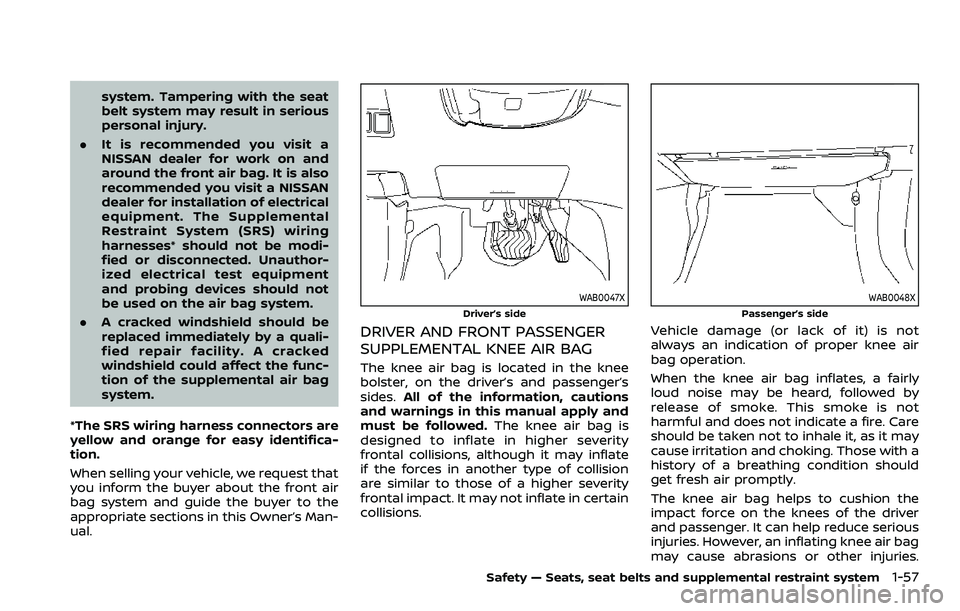
WAB0047X
Driver’s side
DRIVER AND FRONT PASSENGER
SUPPLEMENTAL KNEE AIR BAG
The knee air bag is located in the knee
bolster, on the driver’s and passenger’s
sides. All of the information, cautions
and warnings in this manual apply and
must be followed. The knee air bag is
designed to inflate in higher severity
frontal collisions, although it may inflate
if the forces in another type of collision
are similar to those of a higher severity
frontal impact. It may not inflate in certain
collisions.
WAB0048X
Passenger’s side
Vehicle damage (or lack of it) is not
always an indication of proper knee air
bag operation.
When the knee air bag inflates, a fairly
loud noise may be heard, followed by
release of smoke. This smoke is not
harmful and does not indicate a fire. Care
should be taken not to inhale it, as it may
cause irritation and choking. Those with a
history of a breathing condition should
get fresh air promptly.
The knee air bag helps to cushion the
impact force on the knees of the driver
and passenger. It can help reduce serious
injuries. However, an inflating knee air bag
may cause abrasions or other injuries.
Safety — Seats, seat belts and supplemental restraint system1-57