2023 NISSAN PATHFINDER weight
[x] Cancel search: weightPage 100 of 665

•Modif ying or tampering with the
front passenger seat may result in
serious personal injury. For example,
do not change the front seats by
placing material on the seat cushion
or by installing additional trim mate-
rial, such as seat covers, on the seat
that are not specifically designed to
assure proper air bag operation. Ad-
ditionally, do not stow any objects
under the front passenger seat or the
seat cushion and seatback. Such ob-
jects may interfere with the proper
operation of the occupant classifica-
tion sensor (weight sensor).
• No unauthorized changes should be
made to any components or wiring
of the seat belt system. This may af-
fect the front air bag system. Tam-
pering with the seat belt system may
result in serious personal injury. •
It is recommended that you visit a
NISSAN dealer for work on and
around the front air bag. It is also rec-
ommended that you visit a NISSAN
dealer for installation of electrical
equipment. The Supplemental Re-
straint System (SRS) wiring har-
nesses* should not be modified or
disconnected. Unauthorized electri-
cal test equipment and probing de-
vices should not be used on the air
bag system.
• A cracked windshield should be re-
placed immediately by a qualified re-
pair facility. A cracked windshield
could affect the function of the
supplemental air bag system.
*The SRS wiring harness connectors are
yellow and orange for easy
identification.
When selling your vehicle, we request that
you inform the buyer about the front air
bag system and guide the buyer to the
appropriate sections in this Owner's
Manual.
FRONT, 2ND ROW OUTBOARD, AND
FRONT CENTRAL (if so equipped)
SEAT-MOUNTED SIDE-IMPACT
SUPPLEMENTAL AIR BAG AND
ROOF-MOUNTED CURTAIN
SIDE-IMPACT AND ROLLOVER
SUPPLEMENTAL AIR BAG SYSTEMS
The side air bags are located in the outside
of the seatback of the front and rear seats.
The front central air bag (if so equipped) is
located in the inside of the seatback of the
driver’s seat. The curtain air bags are lo-
cated in the side roof rails in all three rows.
All of the information, cautions and
LRS3400
Safety-Seats, seat belts and supplemental restraint system1-75
Page 118 of 665

The gauge indicates theapproximatefuel
level in the tank.
The gauge may move slightly during brak-
ing, turning, acceleration, or going up or
down hills.
The gauge needle returns to 0 (Empty) af-
ter the ignition switch is placed in the OFF
position.
The low fuel warning message shows in
the vehicle information display when the
amount of fuel in the tank is getting low. Refill the fuel tank before the gauge reg-
isters 0 (Empty).
The
indicates that the fuel-filler door
is located on the driver's side of the vehicle.
CAUTION
• If the vehicle runs out of fuel, the
Malfunction Indicator Light (MIL) may
come on. Refuel as soon as possible.
Af ter a few driving trips, the
light
should turn off. If the light remains on
af ter a few driving trips, have the ve-
hicle inspected. It is recommended
that you visit a NISSAN dealer for this
service.
• For additional information, see “Mal-
function Indicator Light (MIL)”
(P. 2-20) or “Malfunction Indicator
(MIL)” (P. 2-68).
DISTANCE TO EMPTY (DTE)
Displays the estimated distance the ve-
hicle can be driven before refueling. The
value is calculated based on recent fuel
economy, the amount of fuel remaining in
the fuel tank, and the actual fuel
consumption. Changes in driving patterns or conditions
can cause the DTE value to vary. As a result,
the value displayed may differ from the ac-
tual distance that can be driven.
DTE display will change to “---” when the
fuel level in the tank is getting low, prior to
the fuel gauge reaching 0 (Empty).
NOTE:
• The DTE value af ter refill is estimated
based on recent fuel economy and
amount of fuel added.
• If a small amount of fuel is added, or the ignition is on during refueling, the
display may not be updated.
• Conditions that affect the fuel economy will also affect the estimated
DTE value (city/highway driving, idle
time, remote start time, terrain, sea-
sonal weather, added vehicle weight,
added deflectors, roof racks, etc.).
LIC4670
12.3 inch (31 cm) Type B (if so equipped)
Instruments and controls2-11
Page 223 of 665
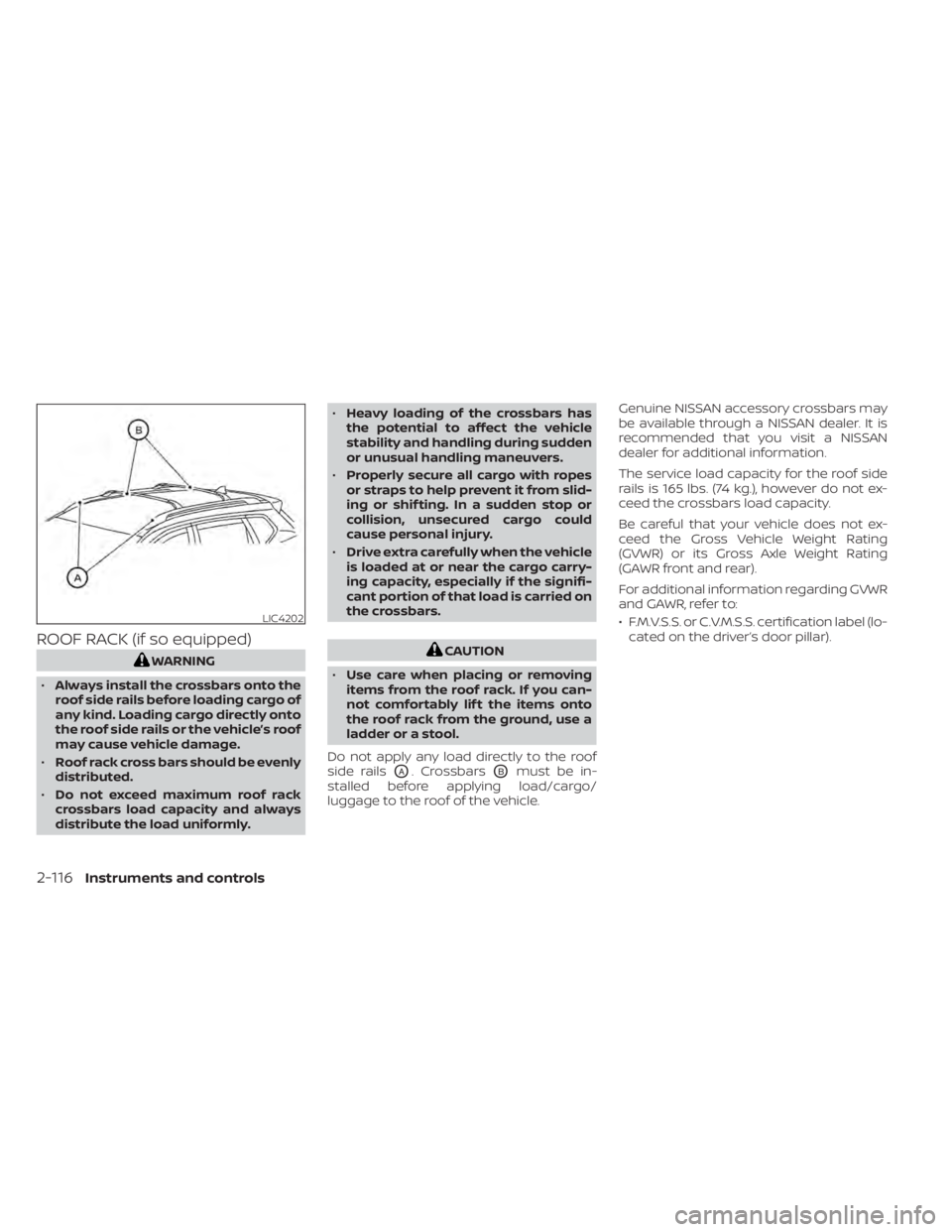
ROOF RACK (if so equipped)
WARNING
• Always install the crossbars onto the
roof side rails before loading cargo of
any kind. Loading cargo directly onto
the roof side rails or the vehicle’s roof
may cause vehicle damage.
• Roof rack cross bars should be evenly
distributed.
• Do not exceed maximum roof rack
crossbars load capacity and always
distribute the load uniformly. •
Heavy loading of the crossbars has
the potential to affect the vehicle
stability and handling during sudden
or unusual handling maneuvers.
• Properly secure all cargo with ropes
or straps to help prevent it from slid-
ing or shif ting. In a sudden stop or
collision, unsecured cargo could
cause personal injury.
• Drive extra carefully when the vehicle
is loaded at or near the cargo carry-
ing capacity, especially if the signifi-
cant portion of that load is carried on
the crossbars.CAUTION
• Use care when placing or removing
items from the roof rack. If you can-
not comfortably lif t the items onto
the roof rack from the ground, use a
ladder or a stool.
Do not apply any load directly to the roof
side rails
OA. CrossbarsOBmust be in-
stalled before applying load/cargo/
luggage to the roof of the vehicle. Genuine NISSAN accessory crossbars may
be available through a NISSAN dealer. It is
recommended that you visit a NISSAN
dealer for additional information.
The service load capacity for the roof side
rails is 165 lbs. (74 kg.), however do not ex-
ceed the crossbars load capacity.
Be careful that your vehicle does not ex-
ceed the Gross Vehicle Weight Rating
(GVWR) or its Gross Axle Weight Rating
(GAWR front and rear).
For additional information regarding GVWR
and GAWR, refer to:
• F.M.V.S.S. or C.V.M.S.S. certification label (lo-
cated on the driver’s door pillar).
LIC4202
2-116Instruments and controls
Page 576 of 665
Incorrect tire pressure, including
under inflation, may adversely af-
fect tire life and vehicle handling.
WARNING
• Improperly inflated tires can
fail suddenly and cause an
accident.
• The Gross Vehicle Weight Rat-
ing (GVWR) is located on the
F.M.V.S.S./C.M.V.S.S. certifica-
tion label. The vehicle weight
capacity is indicated on the Tire
and Loading Information label.
Do not load your vehicle be-
yond this capacity. Overload-
ing your vehicle may result in
reduced tire life, unsafe operat-
ing conditions due to prema-
ture tire failure, or unfavorable
handling characteristics and
could also lead to a serious ac-
cident. Loading beyond the
specified capacity may also re- sult in failure of other vehicle
components.
• Before taking a long trip, or
whenever you heavily load
your vehicle, use a tire pressure
gauge to ensure that the tire
pressures are at the specified
level.
• For additional information re-
garding tires, refer to “Impor-
tant Tire Safety Information”
(US) or “Tire Safety Informa-
tion” (Canada) in the Warranty
Information Booklet.
Do-it-yourself8-29
Page 581 of 665
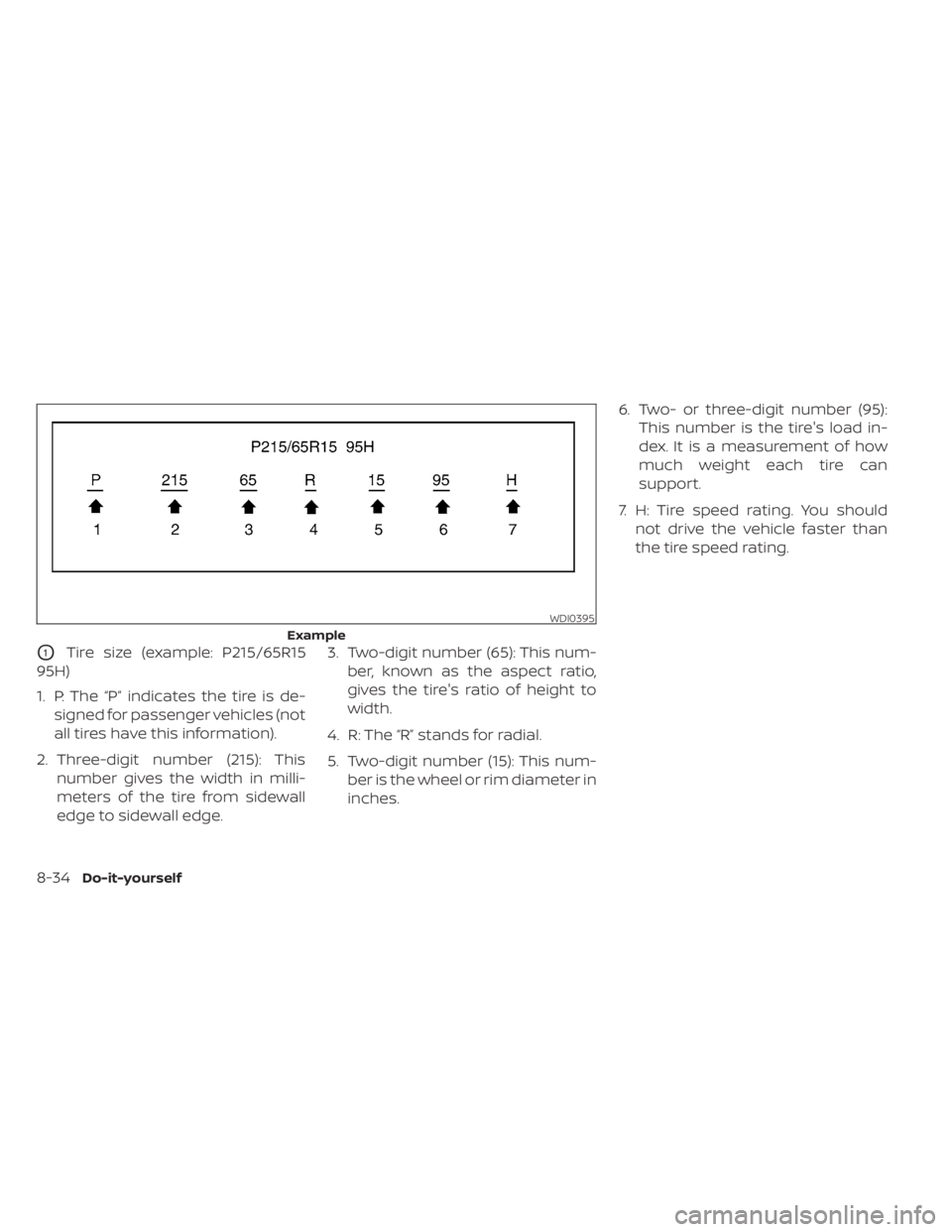
O1Tire size (example: P215/65R15
95H)
1. P: The “P” indicates the tire is de- signed for passenger vehicles (not
all tires have this information).
2. Three-digit number (215): This number gives the width in milli-
meters of the tire from sidewall
edge to sidewall edge. 3. Two-digit number (65): This num-
ber, known as the aspect ratio,
gives the tire's ratio of height to
width.
4. R: The “R” stands for radial.
5. Two-digit number (15): This num- ber is the wheel or rim diameter in
inches. 6. Two- or three-digit number (95):
This number is the tire's load in-
dex. It is a measurement of how
much weight each tire can
support.
7. H: Tire speed rating. You should not drive the vehicle faster than
the tire speed rating.
WDI0395
Example
8-34Do-it-yourself
Page 612 of 665

10 Technical and consumer information
Recommended fluids/lubricants and
capacities...................................... 10-2
Fuel recommendation ......................10-4
Engine oil and oil filter
recommendations .......................... 10-7
Air conditioner system refrigerant and
oil recommendations .......................10-8
Specifications .................................. 10-9
Engine ...................................... 10-9
Wheels and tires ........................... 10-10
Dimensions and weights ...................10-10
When traveling or registering in another
country ........................................ 10-11
Vehicle identification ........................... 10-11
Vehicle Identification Number (VIN)
plate ........................................ 10-11
Vehicle identification number
(chassis number) ............................ 10-11
Engine serial number ......................10-12
F.M.V.S.S./C.M.V.S.S. certification label ........10-12
Emission control information label .........10-13
Tire and Loading Information label .........10-13
Air conditioner specification label ..........10-13
Installing front license plate ...................10-14
Vehicle loading information ...................10-15Terms
...................................... 10-16
Vehicle load capacity ....................... 10-16
Securing the load .......................... 10-18
Loading tips ................................ 10-19
Measurement of weights ...................10-20
Towing a trailer ................................ 10-20
Maximum load limits ....................... 10-20
Towing load/specification ..................10-23
Towing safety .............................. 10-25
Flat towing for 4–Wheel drive vehicle
(if so equipped) ............................. 10-32
Flat towing for front wheel drive vehicle
(if so equipped) ............................. 10-32
Uniform tire quality grading ...................10-33
Emission control system warranty ............10-34
Reporting safety defects ......................10-34
Readiness for Inspection/Maintenance (I/M)
test ........................................... 10-36
E
vent Data Recorders (EDR) ...................10-36
Additional data recording (on vehicles
equipped with optional ProPILOT
Assist) ...................................... 10-37
Owner's Manual/Service Manual order
information ................................... 10-38
Page 621 of 665
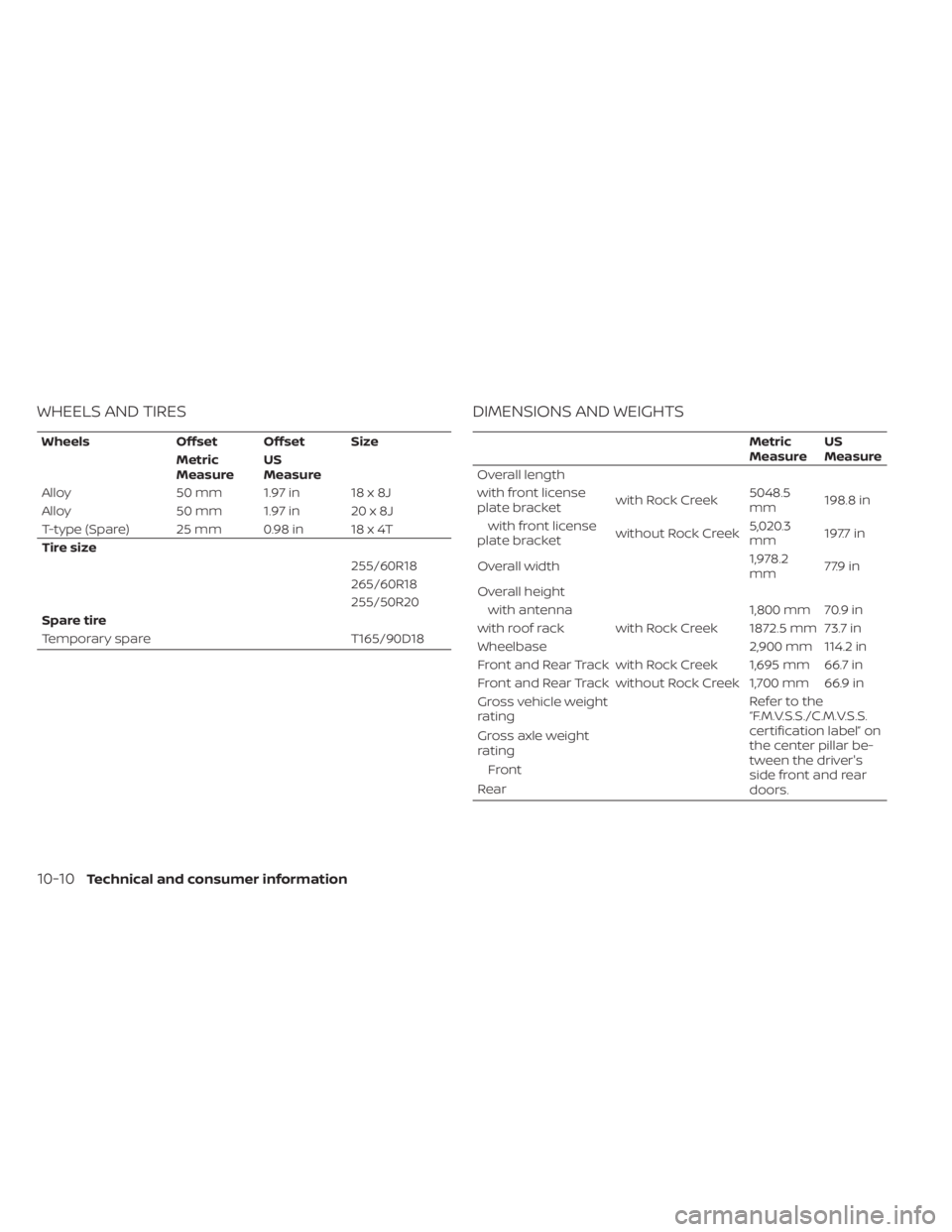
WHEELS AND TIRES
WheelsOffset Offset Size
Metric
Measure US
Measure
Alloy 50mm 1.97in 18x8J
Alloy 50mm 1.97in 20x8J
T-type (Spare) 25 mm 0.98 in 18 x 4T
Tire size 255/60R18
265/60R18
255/50R20
Spare tire
Temporary spare T165/90D18
DIMENSIONS AND WEIGHTS
Metric
MeasureUS
Measure
Overall length
with front license
plate bracket with Rock Creek5048.5
mm198.8 in
with front license
plate bracket without Rock Creek5,020.3
mm197.7 in
Overall width 1,978.2
mm77.9 in
Overall height with antenna 1,800 mm 70.9 in
with roof rack with Rock Creek 1872.5 mm 73.7 in
Wheelbase 2,900 mm 114.2 in
Front and Rear Track with Rock Creek 1,695 mm 66.7 in
Front and Rear Track without Rock Creek 1,700 mm 66.9 in
Gross vehicle weight
rating Refertothe
“F.M.V.S.S./C.M.V.S.S.
certification label” on
the center pillar be-
tween the driver's
side front and rear
doors.
Gross axle weight
rating
Front
Rear
10-10Technical and consumer information
Page 627 of 665
TERMS
It is important to familiarize yourself
with the following terms before
loading your vehicle:
• Curb Weight (actual weight of yourvehicle) - vehicle weight including:
standard and optional equipment,
fluids, emergency tools, and spare
tire assembly. This weight does
not include passengers and cargo.
• GVW (Gross Vehicle Weight) - curb weight plus the combined weight
of passengers and cargo.
• GVWR (Gross Vehicle Weight Rat- ing) - maximum total combined
weight of the unloaded vehicle,
passengers, cargo, hitch, trailer
tongue load and any other op-
tional equipment. This information
is located on the F.M.V.S.S./
C.M.V.S.S. certification label. • GAWR (Gross Axle Weight Rating) -
maximum weight (load) limit
specified for the front or rear axle.
This information is located on the
F.M.V.S.S./C.M.V.S.S. certification
label.
• GCWR (Gross Combined Weight Rating) - The maximum total
weight rating of the vehicle, pas-
sengers, cargo, and trailer.
• Vehicle Capacity Weight, Load limit, Total load capacity - maximum to-
tal weight limit specified of the load
(passengers and cargo) for the ve-
hicle. This is the maximum com-
bined weight of occupants and
cargo that can be loaded into the
vehicle. If the vehicle is used to tow
a trailer, the trailer tongue weight
must be included as part of the
cargo load. This information is lo-
cated on the Tire and Loading In-
formation label. • Cargo capacity - permissible
weight of cargo, the subtracted
weight of occupants from the load
limit.
VEHICLE LOAD CAPACITY
Before driving a loaded vehicle, con-
firm that you do not exceed the
Gross Vehicle Weight Rating (GVWR)
or the Gross Axle Weight Rating
(GAWR) for your vehicle. Both the
GVWR and GAWR are located on the
F.M.V.S.S./C.M.V.S.S. certification label.
For additional information, see “Mea-
surement of weights” (P. 10-20).
Do not exceed the load limit of your
vehicle shown as “The combined
weight of occupants and cargo” on
the Tire and Loading Information la-
bel. Do not exceed the number of
occupants shown as “Seating Ca-
pacity” on the Tire and Loading Infor-
mation label.
10-16
Technical and consumer information