Page 22 of 665
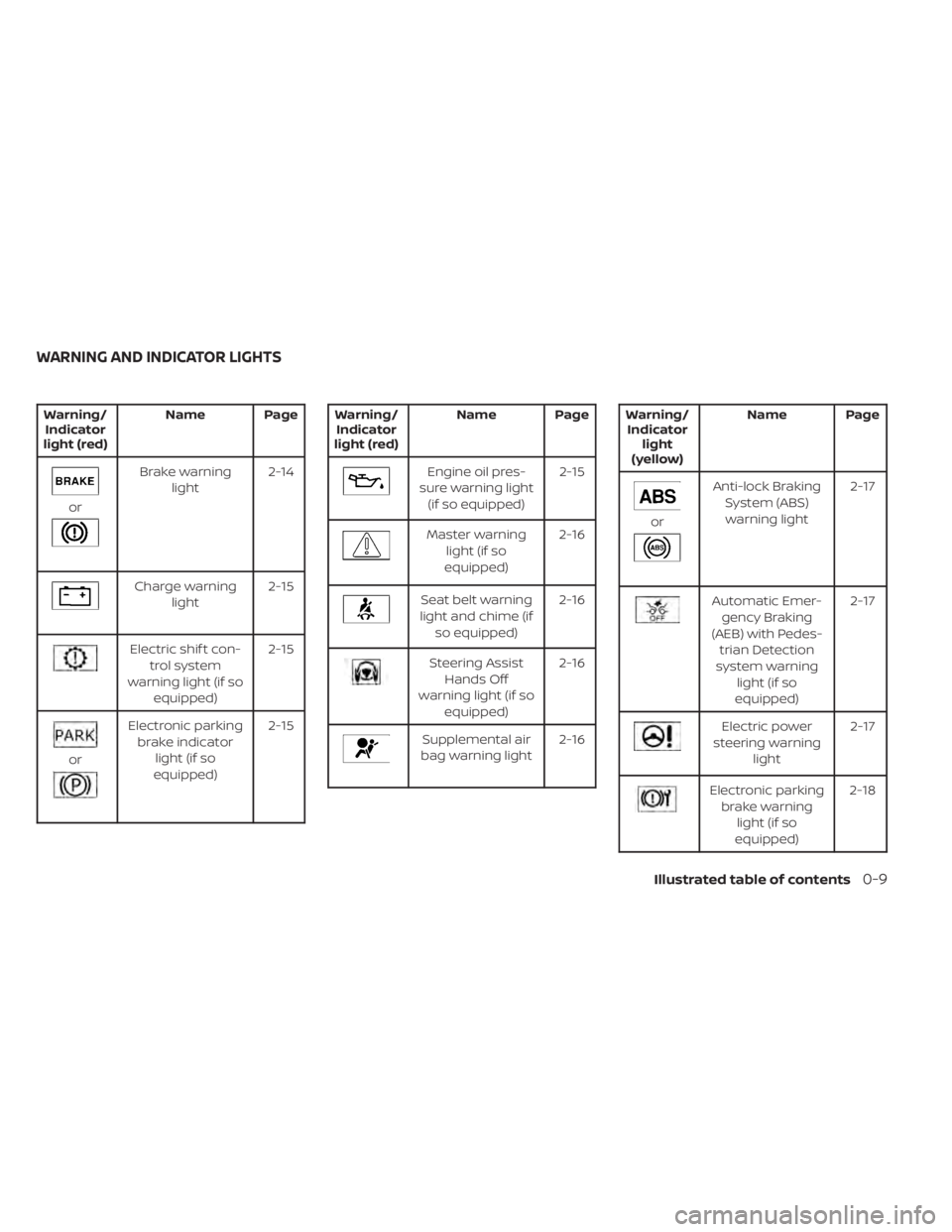
Warning/Indicator
light (red) Name Page
or
Brake warning
light 2-14
Charge warning
light 2-15
Electric shif t con-
trol system
warning light (if so equipped) 2-15
or
Electronic parking
brake indicator light (if so
equipped) 2-15
Warning/
Indicator
light (red) Name Page
Engine oil pres-
sure warning light (if so equipped) 2-15
Master warning
light (if so
equipped) 2-16
Seat belt warning
light and chime (if so equipped) 2-16
Steering Assist
Hands Off
warning light (if so equipped) 2-16
Supplemental air
bag warning light 2-16
Warning/
Indicator light
(yellow) Name Page
or
Anti-lock Braking
System (ABS)warning light 2-17
Automatic Emer-
gency Braking
(AEB) with Pedes- trian Detection
system warning light (if so
equipped) 2-17
Electric power
steering warning light 2-17
Electronic parking
brake warning light (if so
equipped) 2-18
WARNING AND INDICATOR LIGHTS
Illustrated table of contents0-9
Page 23 of 665
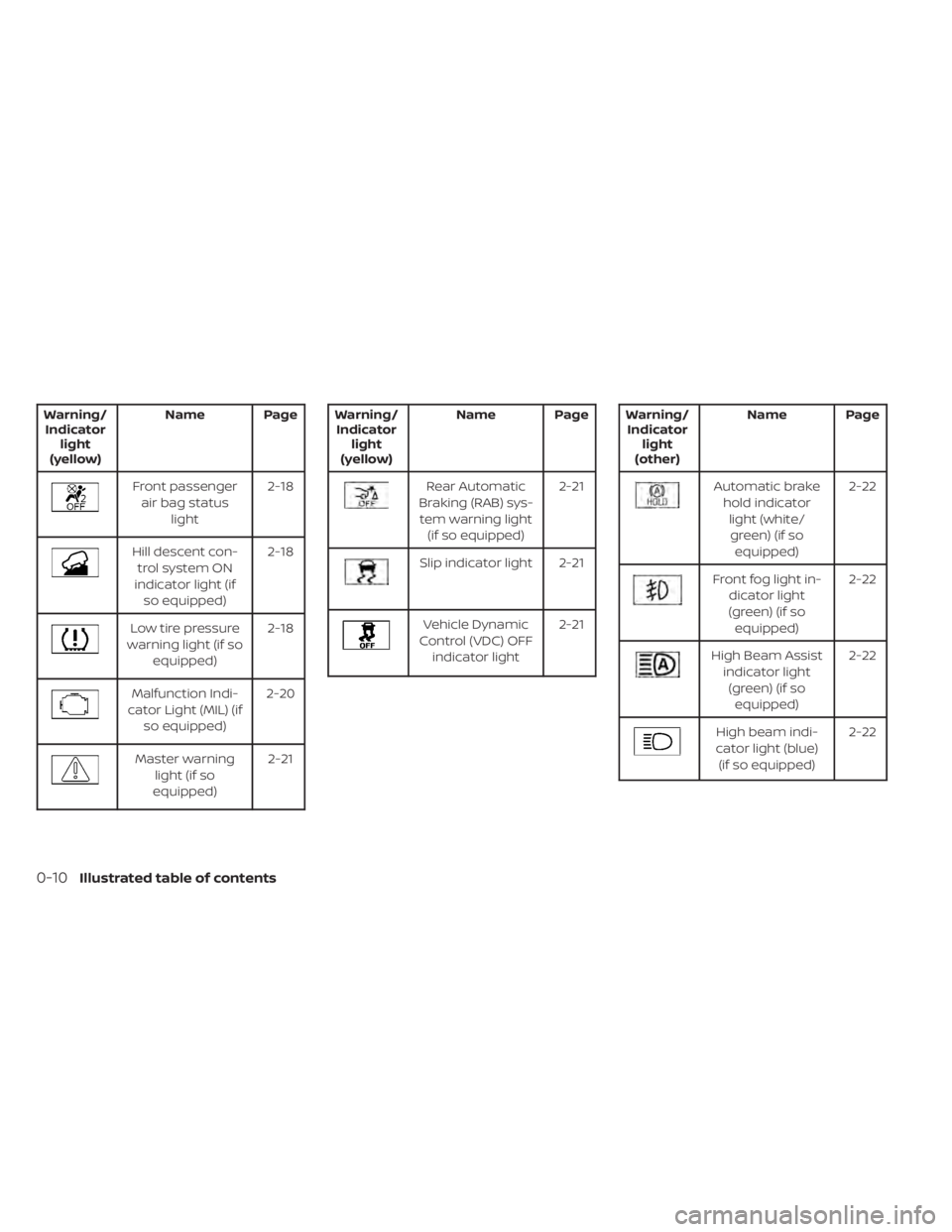
Warning/Indicator light
(yellow) Name Page
Front passenger
air bag status light 2-18
Hill descent con-
trol system ON
indicator light (if so equipped) 2-18
Low tire pressure
warning light (if so equipped) 2-18
Malfunction Indi-
cator Light (MIL) (if so equipped) 2-20
Master warning
light (if so
equipped) 2-21
Warning/
Indicator light
(yellow) Name Page
Rear Automatic
Braking (RAB) sys- tem warning light (if so equipped) 2-21
Slip indicator light 2-21
Vehicle Dynamic
Control (VDC) OFF indicator light 2-21
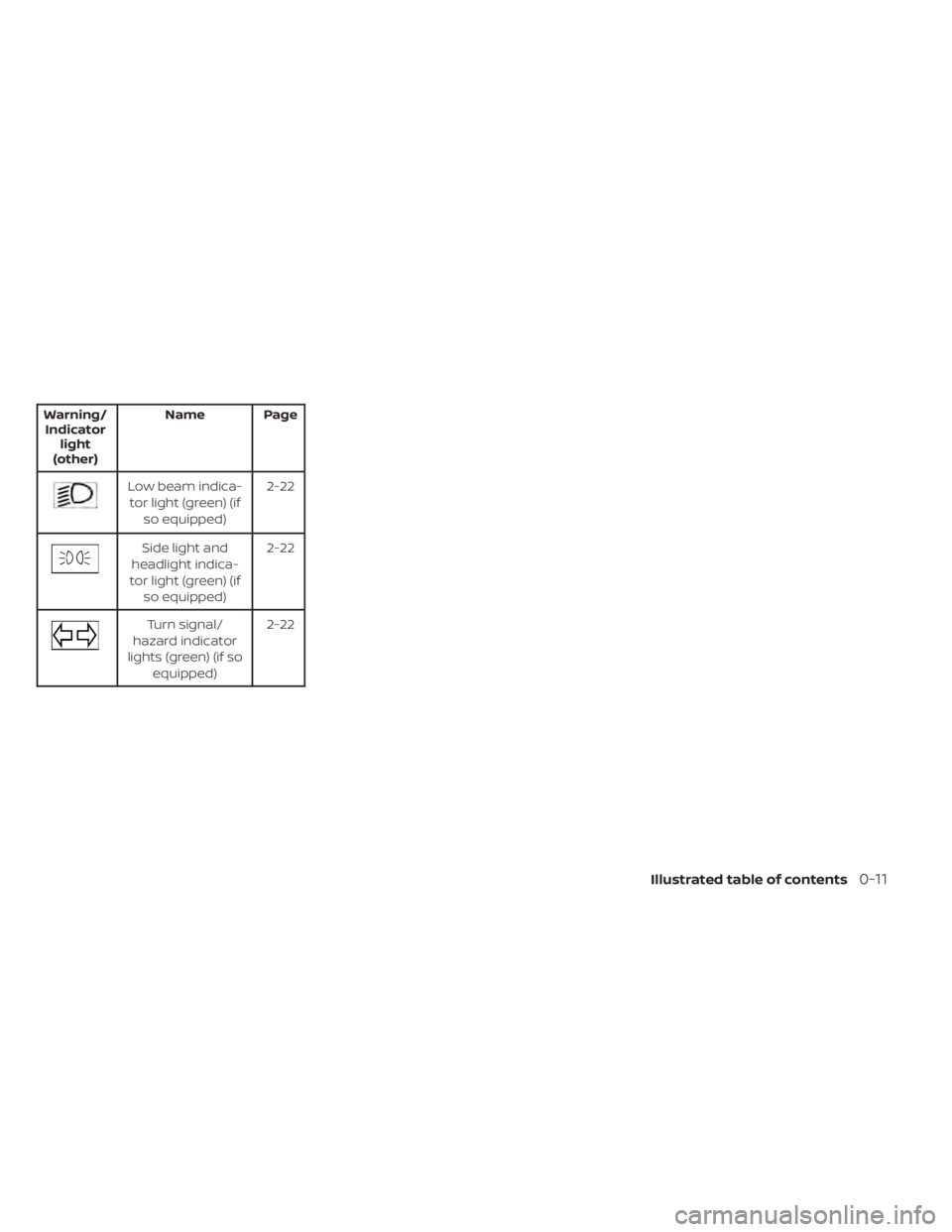
Warning/
Indicator light
(other) Name Page
Automatic brake
hold indicatorlight (white/green) (if so equipped) 2-22
Front fog light in-
dicator light
(green) (if so equipped) 2-22
High Beam Assist
indicator light(green) (if so equipped) 2-22
High beam indi-
cator light (blue) (if so equipped) 2-22
0-10Illustrated table of contents
Page 24 of 665
Warning/Indicator light
(other) Name Page
Low beam indica-
tor light (green) (if so equipped) 2-22
Side light and
headlight indica-
tor light (green) (if so equipped) 2-22
Turn signal/
hazard indicator
lights (green) (if so equipped) 2-22
Illustrated table of contents0-11
Page 25 of 665
1 Safety-Seats, seat belts and
supplemental restraint system
Seats............................................ 1-2Front manual seat adjustment
(if so equipped) ................................1-3
Front power seat adjustment
(if so equipped) ............................... 1-4
2nd row seat adjustment .................... 1-6
3rd row bench seat adjustment .............. 1-9
Armrests ..................................... 1-10
Flexible seating ............................... 1-10
Head restraints/headrests ......................1-13
Adjustable head restraint/headrest
components ................................. 1-14
Non-adjustable head restraint/
headrest components .......................1-15
Remove...................................... 1-15
Install ........................................ 1-16
Adjust ........................................ 1-17
Folding head restraint/headrest ..............1-19
Seatbelts ...................................... 1-20
Precautions on seat belt usage ..............1-20
Seat belt warning light and chime ...........1-23
Pregnant women ........................... 1-23
Injured persons ............................. 1-23
Three-point type seat belt with
retractor .................................... 1-24
Seat belt extenders ......................... 1-29Seat belt maintenance
......................1-30
Child safety .................................... 1-30
Infants ....................................... 1-31
Small children ................................ 1-31
Larger children ............................... 1-31
Child restraints ................................. 1-33
Precautions on child restraints ..............1-33
LATCH (Lower Anchors and Tethers for
CHildren) system ............................ 1-35
Rear-facing child restraint installation
using LATCH ................................. 1-41
Rear-facing child restraint installation
using the seat belts ......................... 1-43
Forward-facing child restraint
installation using LATCH .....................1-46
Forward-facing child restraint
installation using the seat belts .............1-50
Booster seats ............................... 1-56
Supplemental Restraint System (SRS) ..........1-59
Precautions on SRS ......................... 1-59
Front, 2nd row outboard, and front
central (if so equipped) seat-mounted
side-impact supplemental air bag and
roof-mounted curtain side-impact and
rollover supplemental air bag systems ......
1-75
Page 26 of 665
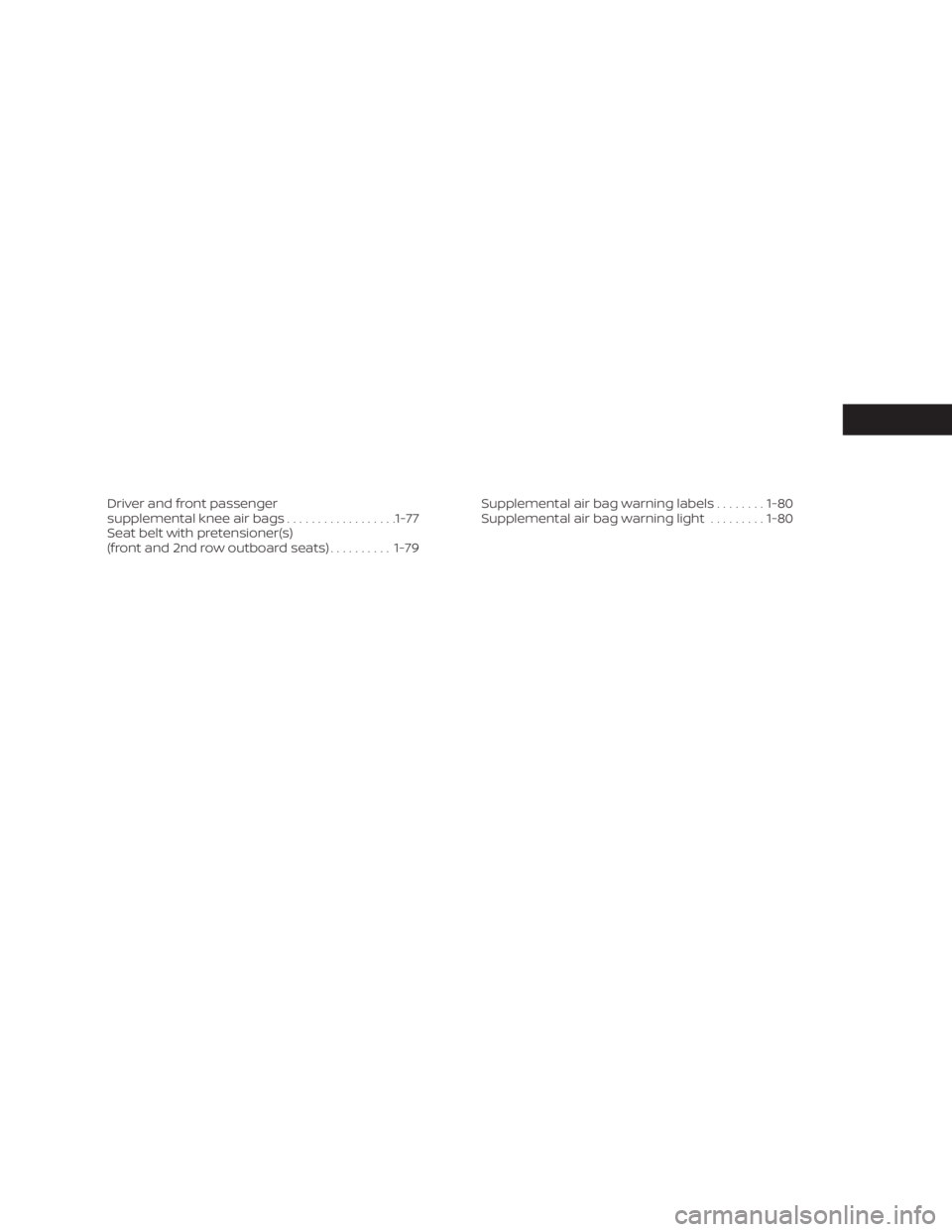
Driver and front passenger
supplemental knee air bags..................1-77
Seat belt with pretensioner(s)
(front and 2nd row outboard seats) ..........1-79 Supplemental air bag warning labels
........1-80
Supplemental air bag warning light .........1-80
Page 27 of 665
WARNING
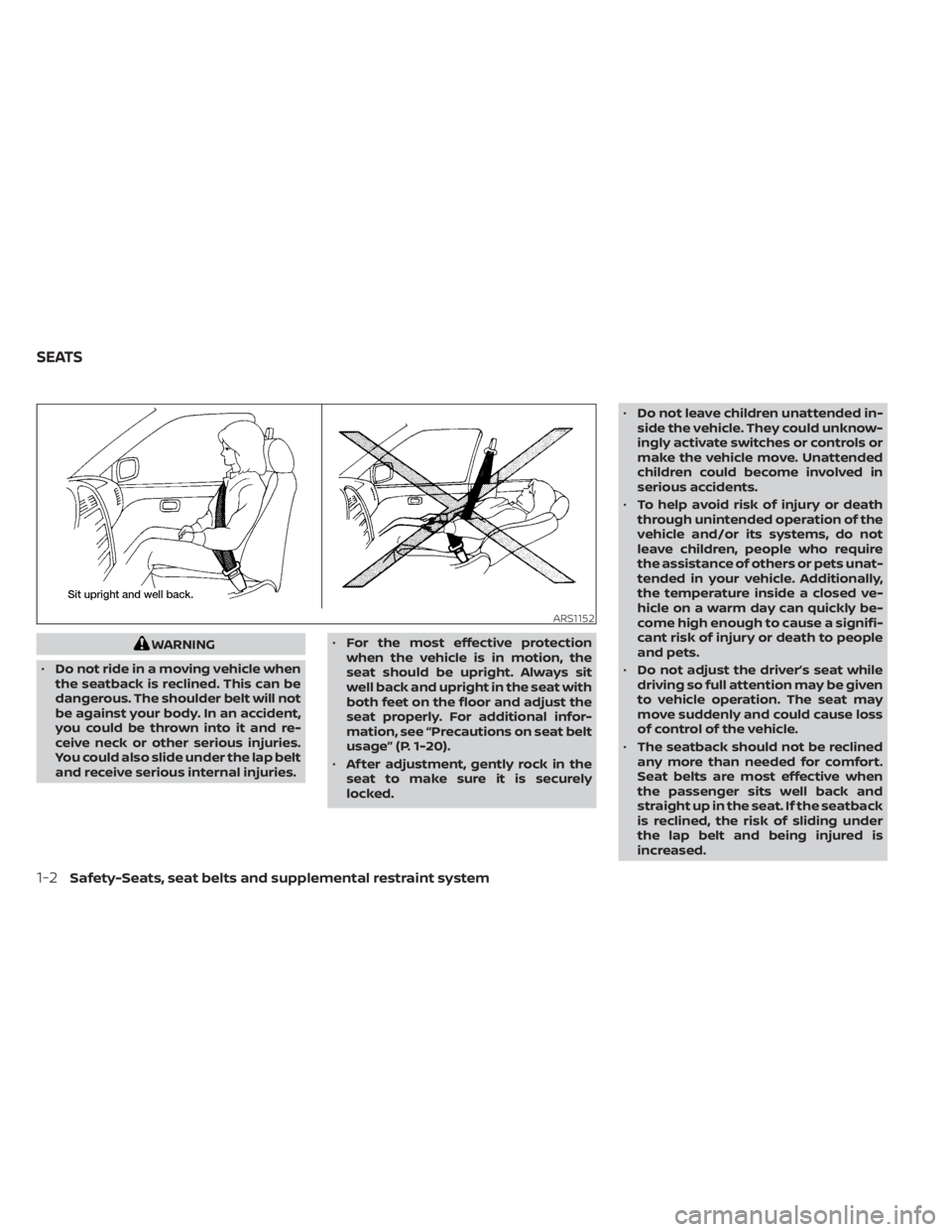
• Do not ride in a moving vehicle when
the seatback is reclined. This can be
dangerous. The shoulder belt will not
be against your body. In an accident,
you could be thrown into it and re-
ceive neck or other serious injuries.
You could also slide under the lap belt
and receive serious internal injuries. •
For the most effective protection
when the vehicle is in motion, the
seat should be upright. Always sit
well back and upright in the seat with
both feet on the floor and adjust the
seat properly. For additional infor-
mation, see “Precautions on seat belt
usage” (P. 1-20).
• Af ter adjustment, gently rock in the
seat to make sure it is securely
locked. •
Do not leave children unattended in-
side the vehicle. They could unknow-
ingly activate switches or controls or
make the vehicle move. Unattended
children could become involved in
serious accidents.
• To help avoid risk of injury or death
through unintended operation of the
vehicle and/or its systems, do not
leave children, people who require
the assistance of others or pets unat-
tended in your vehicle. Additionally,
the temperature inside a closed ve-
hicle on a warm day can quickly be-
come high enough to cause a signifi-
cant risk of injury or death to people
and pets.
• Do not adjust the driver’s seat while
driving so full attention may be given
to vehicle operation. The seat may
move suddenly and could cause loss
of control of the vehicle.
• The seatback should not be reclined
any more than needed for comfort.
Seat belts are most effective when
the passenger sits well back and
straight up in the seat. If the seatback
is reclined, the risk of sliding under
the lap belt and being injured is
increased.
ARS1152
SEATS
1-2Safety-Seats, seat belts and supplemental restraint system
Page 32 of 665
WARNING
• Af ter adjustment, gently rock in the
seat to make sure it is securely
locked.
• Do not ride in a moving vehicle when
the seatback is reclined. This can be
dangerous. The shoulder belt will not
be against your body. In an accident,
you could be thrown into it and re-
ceive neck or other serious injuries.
You could also slide under the lap belt
and receive serious internal injuries.
• For the most effective protection
when the vehicle is in motion, the
seat should be upright. Always sit
well back and upright in the seat and
adjust the seat belt properly. For ad-
ditional information, see “Precau-
tions on seat belt usage” (P. 1-20).
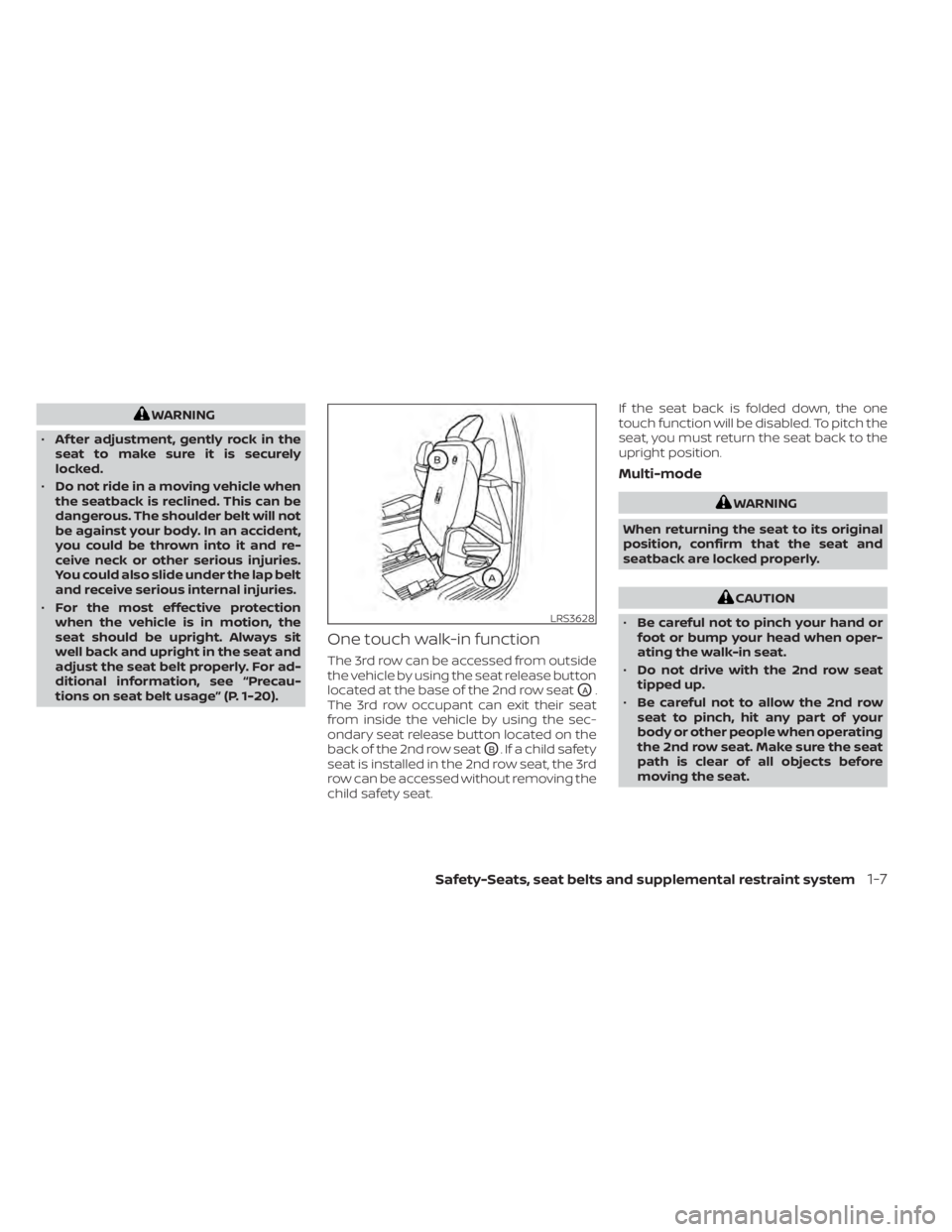
One touch walk-in function
The 3rd row can be accessed from outside
the vehicle by using the seat release button
located at the base of the 2nd row seat
OA.
The 3rd row occupant can exit their seat
from inside the vehicle by using the sec-
ondary seat release button located on the
back of the 2nd row seat
OB. If a child safety
seat is installed in the 2nd row seat, the 3rd
row can be accessed without removing the
child safety seat. If the seat back is folded down, the one
touch function will be disabled. To pitch the
seat, you must return the seat back to the
upright position.
Multi-mode
WARNING
When returning the seat to its original
position, confirm that the seat and
seatback are locked properly.
CAUTION
• Be careful not to pinch your hand or
foot or bump your head when oper-
ating the walk-in seat.
• Do not drive with the 2nd row seat
tipped up.
• Be careful not to allow the 2nd row
seat to pinch, hit any part of your
body or other people when operating
the 2nd row seat. Make sure the seat
path is clear of all objects before
moving the seat.
LRS3628
Safety-Seats, seat belts and supplemental restraint system1-7
Page 33 of 665
To enter the 3rd row from outside the ve-
hicle, push the seat release button located
at the base of the 2nd row seat
OA. To exit
the 3rd row from inside the vehicle, push
the seat release button located on the
back of the 2nd row seat
OB. Activating this
seat release switch will pitch the 2nd row
seat forward so you will be able to slide the
seat forward and backward.
Slide the entire seat forward for access to
the 3rd row.
To return the seat to a locked position,
push the upper seatback rearward until
the seat is locked.
Child seat access mode
The 2nd row seat can be slid forward for
easy entry or exit from the 3rd row bench
seat without a child safety seat being
removed.
To enter the 3rd row from outside the ve-
hicle, push the seat release button located
at the base of the 2nd row seat
OA. To exit
the 3rd row from inside the vehicle, push
the seat release button located on the
back of the 2nd row seat
OB. Activating this
seat release button allows you to pitch and
slide the seat forward and backward. Slide the entire seat forward for access to
the 3rd row seats.
To return the seat to a locked position,
push the upper seatback rearward until
the seat is locked.
WARNING
• Do not leave a child in the child safety
seat when operating the child seat
access mode.
• The 2nd row one touch buttons are
enabled during vehicles speeds less
than 1.2 mph (2 km/h). If either but-
ton is pressed, the seat may unlatch
even if the seat is occupied, and may
move or pitch. If the seat is un-
latched, occupant can be seriously
injured during driving.
• To help avoid the risk of personal in-
jury, supervise children, people who
require the assistance of others, or
pets occupying the 2nd and 3rd
rows to prevent pressing the one
touch buttons that operate the
walk-in function.
• When returning the seat to its origi-
nal position, confirm that the seat is
locked properly.
CAUTION
• Be careful not to pinch your hand or
foot or bump your head when oper-
ating the walk-in seat.
• Do not drive with the 2nd row seat
tipped up.
• Be careful not to allow the 2nd row
seat to pinch, hit any part of your
body or other people when operating
the 2nd row seat. Make sure the seat
path is clear of all objects before
moving the seat.
Exiting the 3rd row
To exit the 3rd row from either seating po-
sition, push the seatback release button.
This will release the seat, then slide the en-
tire seat forward.
The seatback release button will not oper-
ate while the vehicle is moving.
To return the seat to a locked position,
push the upper seatback rearward until
the seat and track are locked.
1-8Safety-Seats, seat belts and supplemental restraint system