2023 NISSAN MURANO check engine
[x] Cancel search: check enginePage 496 of 518
• Have your vehicle serviced more of tenthan at intervals specified in the recom-
mended Maintenance Schedule in the
“Maintenance and schedules” section of
this manual.
• When making a turn, your trailer wheels will be closer to the inside of the turn than
your vehicle wheels. To compensate for
this, make a larger than normal turning
radius during the turn.
• Crosswinds and rough roads will ad- versely affect vehicle/trailer handling,
possibly causing vehicle sway. When be-
ing passed by larger vehicles, be pre-
pared for possible changes in crosswinds
that could affect vehicle handling.
Do the following if the trailer begins to
sway:
1. Take your foot off the accelerator pedal to allow the vehicle to coast and steer as
straight ahead as the road conditions
allow. This combination will help stabilize
the vehicle
– Do not correct trailer sway by steering or applying the brakes.
2. When the trailer sway stops, gently apply the brakes and pull to the side of the
road in a safe area. 3. Try to rearrange the trailer load so it is
balanced as described in this section.
• Be careful when passing other vehicles. Passing while towing a trailer requires
considerably more distance than normal
passing. Remember, the length of the
trailer must also pass the other vehicle
before you can safely change lanes.
• Downshif t the transmission to a lower gear for engine braking when driving
down steep or long hills. This will help
slow the vehicle without applying the
brakes.
• Avoid holding the brake pedal down too long or too frequently. This could cause
the brakes to overheat, resulting in re-
duced braking efficiency.
• Increase your following distance to allow for greater stopping distances while tow-
ing a trailer. Anticipate stops and brake
gradually.
• NISSAN recommends that the cruise control not be used while towing a trailer.
• Some states or provinces have specific regulations and speed limits for vehicles
that are towing trailers. Obey the local
speed limits. • Check your hitch, trailer wiring harness
connections, and trailer wheel lug nuts
af ter 50 miles (80 km) of travel and at
every break.
• When launching a boat, don't allow the water level to go over the exhaust tail
pipe or rear bumper.
• Make sure you disconnect the trailer lights before backing the trailer into the
water or the trailer lights may burn out.
When towing a trailer, final drive gear oil
should be replaced and transmission oil/
fluid should be changed more fre-
quently. For additional information, see
“Do-it-yourself ” (P. 8-2).
FLAT TOWING FOR ALL–WHEEL
DRIVE VEHICLE (if so equipped)
Towing your vehicle with all four wheels on
the ground is sometimes called flat towing.
This method is sometimes used when
towing a vehicle behind a recreational ve-
hicle, such as a motor home.
10-28Technical and consumer information
Page 500 of 518
WARNING
A vehicle equipped with All -Wheel
Drive (AWD) should never be tested us-
ing a two wheel dynamometer (such as
the dynamometers used by some
states for emissions testing), or similar
equipment. Make sure you inform the
test facility personnel that your vehicle
is equipped with AWD before it is placed
on a dynamometer. Using the wrong
test equipment may result in drivetrain
damage or unexpected vehicle move-
ment which could result in serious ve-
hicle damage or personal injury.
Due to legal requirements in some states
and Canadian Provinces, your vehicle may
be required to be in what is called the
“ready condition” for an Inspection/
Maintenance (I/M) test of the emission
control system.
The vehicle is set to the “ready condition”
when it is driven through certain driving
patterns. Usually, the ready condition can
be obtained by ordinary usage of the
vehicle. If a powertrain system component is re-
paired or the battery is disconnected, the
vehicle may be reset to a “not ready” condi-
tion. Before taking the I/M test, check the
vehicle's inspection/maintenance test
readiness condition. Place the ignition
switch in the ON position without starting
the engine. If the Malfunction Indicator
Light (MIL) comes on steady for 20 seconds
and then blinks for 10 seconds , the I/M test
condition is “not ready”. If the MIL does not
blink af ter 20 seconds, the I/M test condi-
tion is “ready”. It is recommended that you
visit a NISSAN dealer to set the “ready con-
dition” or to prepare the vehicle for testing.
This vehicle is equipped with an Event Data
Recorder (EDR). The main purpose of an
EDR is to record, in certain crash or near
crash-like situations, such as an air bag
deployment or hitting a road obstacle, data
that will assist in understanding how a ve-
hicle's systems performed. The EDR is de-
signed to record data related to vehicle dy-
namics and safety systems for a short
period of time, typically 30 seconds or less.
The EDR in this vehicle is designed to re-
cord such data as:
• How various systems in your vehicle were
operating;
• Whether or not the driver and passenger safety belts were buckled/fastened;
• How far (if at all) the driver was depress- ing the accelerator and/or brake pedal;
and,
• How fast the vehicle was traveling.
• Sounds are not recorded.
READINESS FOR INSPECTION/
MAINTENANCE (I/M) TEST EVENT DATA RECORDERS (EDR)
10-32Technical and consumer information
Page 503 of 518
11 Index
A
Air bag (See supplemental restraint
system)........................ .1-48
Air bag system ....................1-56
Front (See supplemental front impact air
bag system) ...................1-56
Air bag warning labels ..............1-69
Air bag warning light, supplemental . . . .1-70
Airbagwarninglight.............. .1-70
Air cleaner housing filter .............8-17
Air cleaner .......................8-17
Air conditioner ....................4-30
Air conditioner operation ..........4-30
Air conditioner specification label . . .10-13
Air conditioner system refrigerant and oil
recommendations ...............10-8
Air conditioner system refrigerant
recommendations ...............10-8
Heater and air conditioner (automatic)
(if so equipped) .................4-29
Heater and air conditioner controls . .4-30
Servicing air conditioner ..........4-32
Alarm system (See vehicle security
system) .........................2-32
All-Wheel Drive ...................5 -117
Anchor point locations ..............1-32
Antenna ........................4-33
Anti-lock brake warning light .........2-10
Anti-lock Braking System (ABS) .......5-121
Antifreeze .......................5-131 Armrests........................
.1-6
Autolightswitch ..................2-39
Automatic anti-glare inside mirror .....3-34
Automatic door locks ...............3-6
Automatic Emergency Braking (AEB) with
Pedestrian Detection ..............5-88
Automatic Emergency Braking (AEB) . . .2-12
Automatic.......................2-66 Automatic power window switch . . .2-66
AWD...........................5 -117
B
Battery replacement...............8-23
Keyfob.......................8-23
NISSAN Intelligent Key® ...........8-24
Battery.........................5-131 Charge warning light .............2-10
Before starting the engine ...........5-16
Belt(Seedrivebelt) ................8-16
Blind Spot Warning (BSW) ............5-39
Booster seats ................... .1-44
Brake Assist .....................5-123
Brakefluid.......................8-11
Brake system ....................5-121
Brake..........................5-121 Anti-lock Braking System (ABS) .....5-121
Brakefluid.....................8-11
Brakelight(Seestoplight).........8-26
Brake system ..................5-121 Brakewarninglight..............2-10
Brakewearindicators ........2
-17, 8-20
Self-adjustingbrakes ............8-20
Brakes .........................8-20
Break-in schedule .................5-115
Brightness control .................2-43
Instrument panel ...............2-43
Bulb check/instrument panel ........2-10
Bulb replacement .................8-26
C
C.M.V.S.S. certification label ..........10-12
Capacities and recommended
fuel/lubricants....................10-2
Car phone or CB radio ..............4-33
Cargo (See vehicle loading
information).....................10-15
Cargoareastoragebin .............2-61
Check tire pressure ................2-29
Child restraint with top tether strap . . . .1-31
Childrestraints .................. .1-24
LATCH (Lower Anchors and Tethers for
CHildren)System................1-28
Precautions on child
restraints..............1-34, 1-40, 1-45
Top tether strap anchor point
locations..................... .1-32
Child safety rear door lock ............3-7
Cleaningexteriorandinterior .........7-2
Page 504 of 518
Coat hooks.......................2-62
Coldweatherdriving...............5-131
Console box ......................2-59
Console light ......................2-70
Continuously Variable Transmission
(CVT) ............................5-19
Continuously Variable Transmission (CVT)
fluid ..........................8-10
Driving with Continuously Variable
Transmission (CVT) ...............5-19
Controls.........................4-30 Heater and air conditioner controls. . .4-30
Coolant..........................10-2 Capacities and recommended
fuel/lubricants ..................10-2
Changing engine coolant ...........8-5
Checking engine coolant level .......8-5
Engine coolant temperature gauge . . .2-6
Corrosionprotection.................7-7
Cruisecontrol.....................5-56
Cupholders......................2-60
D
Daytime Running Light System ........2-43
Defrosterswitch...................2-37 Rear window and outside mirror defroster
switch.........................2-37
Dimensions and weights ............10-10
Dimmer switch for instrument panel . . .2-43
Door locks ........................3-5
Drivebelt ........................8-16
Drivingthevehicle..................5-18 Driving..........................5
-131
Cold weather driving .............5-131
Driving with Continuously Variable
Transmission (CVT) ...............5-19
Precautions when starting and
driving......................5-4,5-11
Dynamic driver assistance switch ......2-50
E
Eco Drive Report....................2-8
Economy - fuel ...................5 -116
Emergency call (SOS) button ..........2-51
Emergency engine shutoff ...........5-15
Emission control information label .....10-12
Emission control system warranty . . . .10-30
Engine coolant temperature gauge .....2-6
Engine ..........................5-16
Before starting the engine ..........5-16
Capacities and recommended
fuel/lubricants ..................10-2
Changing engine coolant ...........8-5
Changing engine oil filter ...........8-6
Changing engine oil ...............8-6
Checking engine coolant level .......8-5
Checking engine oil level ...........8-6
Engine compartment check
locations .......................8-3
Engine coolant temperature gauge . . .2-6
Engine cooling system .............8-4
Engine oil and oil filter
recommendation ................10-7
Engine oil pressure warning light .....2-11Engine oil viscosity
...............10-7
Engine oil .......................8-6
Engine serial number .............10-12
Engine specifications .............10-9
Starting the engine ...............5-17
EventDatarecorders...............10-32
Exhaust gas (Carbon monoxide) ........5-4
Explanation of maintenance items ......9-2
Explanation of scheduled maintenance
items........................... .9-5
Extended storage switch ............2-55
Eyeglasscase.....................2-59
F
F.M.V.S.S. certification label ...........10-12
Flashers (See hazard warning flasher
switch)...........................6-2
Flattire...........................6-3
Floor mat positioning aid .............7-6
Fluid ............................8-11 Brakefluid......................8-11
Capacities and recommended
fuel/lubricants ..................10-2
Continuously Variable Transmission (CVT)
fluid ..........................8-10
Engine coolant ...................8-4
Engine oil .......................8-6
Powersteeringfluid...............8-11
Windshield-washer fluid ...........8-12
Foglightswitch ...................2-44
Front air bag system (See supplemental
restraintsystem)...................1-56
11-2
Page 506 of 518
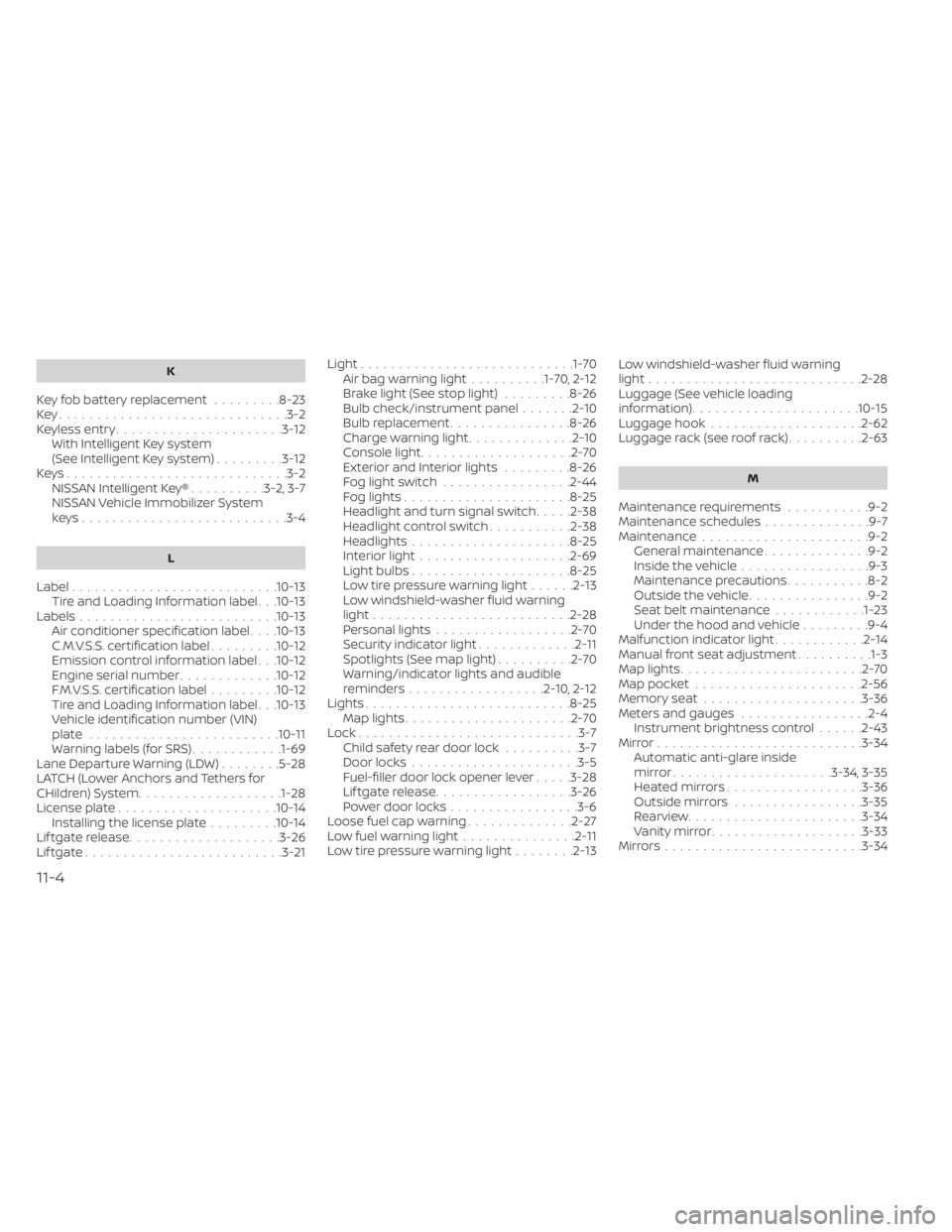
K
Key fob battery replacement.........8-23
Key..............................3-2
Keylessentry......................3-12 With Intelligent Key system
(See Intelligent Key system) .........3-12
Keys.............................3-2 NISSAN Intelligent Key® ..........3-2, 3-7
NISSAN Vehicle Immobilizer System
keys...........................3-4
L
Label ...........................10-13
Tire and Loading Information label . . .10-13
Labels ..........................10-13
Air conditioner specification label . . . .10-13
C.M.V.S.S. certification label .........10-12
Emission control information label . . .10-12
Engine serial number .............10-12
F.M.V.S.S. certification label .........10-12
Tire and Loading Information label . . .10-13
Vehicle identification number (VIN)
plate .........................10-11
Warning labels (for SRS) ............1-69
Lane Departure Warning (LDW) ........5-28
LATCH (Lower Anchors and Tethers for
CHildren)System.................. .1-28
License plate .....................10-14
Installing the license plate .........10-14
Liftgaterelease....................3-26
Liftgate..........................3-21 Light...........................
.1-70
Airbagwarninglight..........1-70, 2-12
Brakelight(Seestoplight) .........8-26
Bulb check/instrument panel .......2-10
Bulb replacement ................8-26
Charge warning light ..............2-10
Console light ....................2-70
ExteriorandInteriorlights .........8-26
Foglightswitch .................2-44
Foglights......................8-25
Headlight and turn signal switch .....2-38
Headlightcontrolswitch...........2-38
Headlights.....................8-25
Interiorlight....................2-69
Lightbulbs.....................8-25
Low tire pressure warning light ......2-13
Low windshield-washer fluid warning
light..........................2-28
Personal lights ..................2-70
Security indicator light .............2-11
Spotlights(Seemaplight)..........2-70
Warning/indicator lights and audible
reminders ..................2-10,2-12
Lights...........................8-25 Maplights......................2-70
Lock............................ .3-7
Child safety rear door lock ..........3-7
Door locks ......................3-5
Fuel-filler door lock opener lever .....3-28
Liftgaterelease..................3-26
Power door locks .................3-6
Loose fuel cap warning ..............2-27
Lowfuelwarninglight...............2-11
Low tire pressure warning light ........2-13Low windshield-washer fluid warning
light............................2-28
Luggage (See vehicle loading
information)......................10-15
Luggage hook
....................2-62
Luggage rack (see roof rack) ..........2-63
M
Maintenance requirements...........9-2
Maintenance schedules ..............9-7
Maintenance ......................9-2
General maintenance ..............9-2
Insidethevehicle.................9-3
Maintenance precautions ...........8-2
Outsidethevehicle................9-2
Seat belt maintenance ............1-23
Under the hood and vehicle .........9-4
Malfunctionindicatorlight........... .2-14
Manual front seat adjustment ..........1-3
Maplights........................2-70
Map pocket ......................2-56
Memory seat .....................3-36
Meters and gauges .................2-4
Instrument brightness control ......2-43
Mirror.......................... .3-34
Automatic anti-glare inside
mirror.....................3-34,3-35
Heatedmirrors..................3-36
Outsidemirrors .................3-35
Rearview...................... .3-34
Vanitymirror....................3-33
Mirrors..........................3-34
11-4
Page 507 of 518
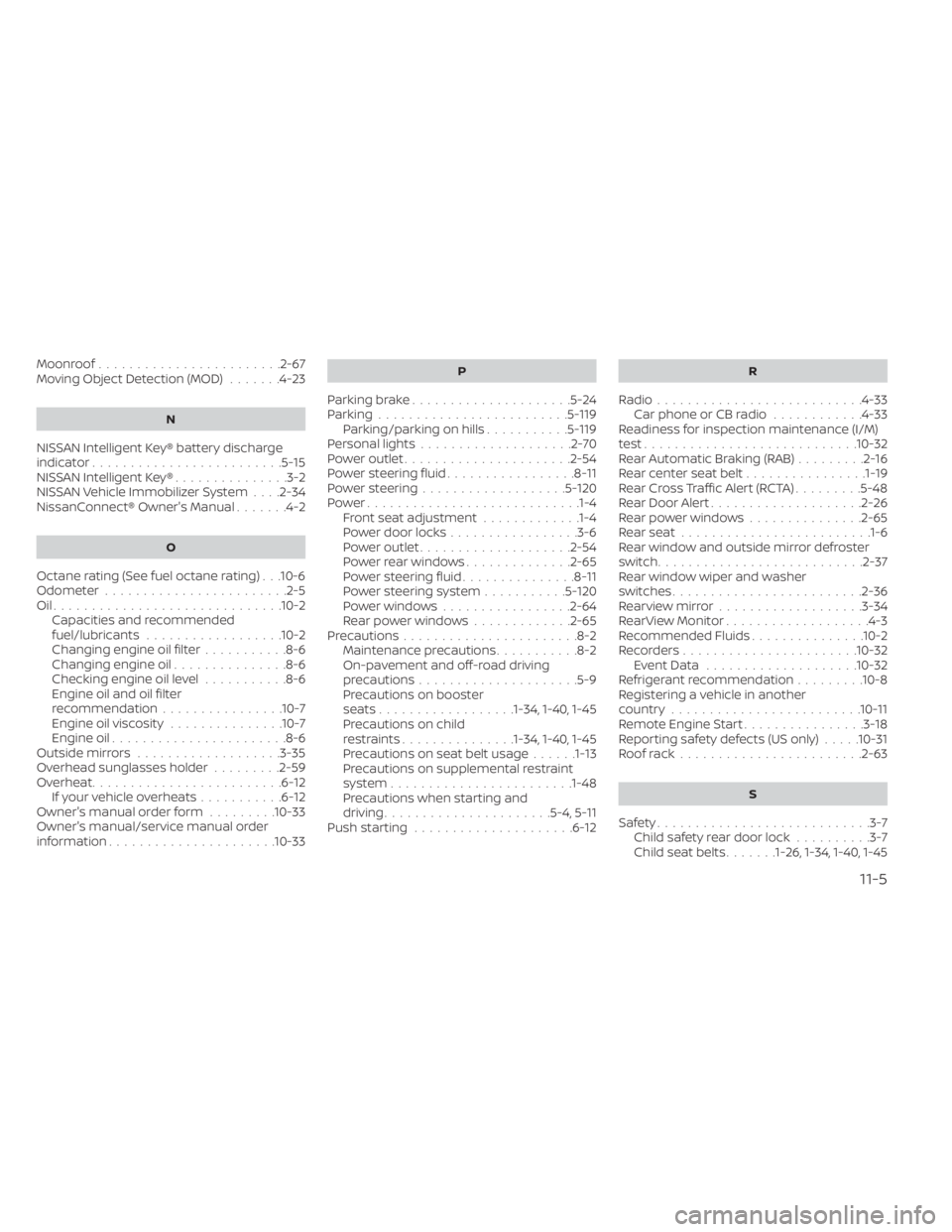
Moonroof........................2-67
Moving Object Detection (MOD) .......4-23
N
NISSAN Intelligent Key® battery discharge
indicator.........................5-15
NISSAN Intelligent Key®...............3-2
NISSAN Vehicle Immobilizer System ....2-34
NissanConnect® Owner's Manual .......4-2
O
Octane rating (See fuel octane rating) . . .10-6
Odometer........................2-5
Oil..............................10-2 Capacities and recommended
fuel/lubricants ..................10-2
Changing engine oil filter ...........8-6
Changing engine oil ...............8-6
Checking engine oil level ...........8-6
Engine oil and oil filter
recommendation ................10-7
Engine oil viscosity ...............10-7
Engine oil .......................8-6
Outsidemirrors ...................3-35
Overhead sunglasses holder .........2-59
Overheat.........................6-12 Ifyourvehicleoverheats...........6-12
Owner's manual order form .........10-33
Owner's manual/service manual order
information......................10-33
P
Parkingbrake.....................5-24
Parking.........................5 -119
Parking/parkingonhills...........5 -119
Personal lights ....................2-70
Poweroutlet......................2-54
Powersteeringfluid.................8-11
Powersteering...................5-120
Power........................... .1-4
Front seat adjustment .............1-4
Power door locks .................3-6
Poweroutlet....................2-54
Powerrearwindows..............2-65
Powersteeringfluid...............8-11
Powersteeringsystem...........5-120
Powerwindows.................2-64
Rearpowerwindows.............2-65
Precautions.......................8-2 Maintenance precautions ...........8-2
On-pavement and off-road driving
precautions.....................5-9
Precautions on booster
seats..................1-34, 1-40, 1-45
Precautions on child
restraints...............1-34, 1-40, 1-45
Precautionsonseatbeltusage......1-13
Precautions on supplemental restraint
system ....................... .1-48
Precautions when starting and
driving......................5-4,5-11
Push starting .....................6-12
R
Radio...........................4-33
Car phone or CB radio ............4-33
Readiness for inspection maintenance (I/M)
test............................10-32
Rear Automatic Braking (RAB) .........2-16
Rearcenterseatbelt................1-19
RearCrossTrafficAlert(RCTA).........5-48
Rear Door Alert ....................2-26
Rearpowerwindows...............2-65
Rearseat ........................ .1-6
Rear window and outside mirror defroster
switch...........................2-37
Rear window wiper and washer
switches .........................2-36
Rearviewmirror...................3-34
RearViewMonitor...................4-3
Recommended Fluids ...............10-2
Recorders.......................10-32 EventData ....................10-32
Refrigerant recommendation .........10-8
Registering a vehicle in another
country .........................10-11
Remote Engine Start ................3-18
Reporting safety defects (US only) .....10-31
Roofrack........................2-63
S
Safety............................3-7 Child safety rear door lock ..........3-7
Childseatbelts.......1-26, 1-34, 1-40, 1-45
11-5