2023 NISSAN LEAF power outlet
[x] Cancel search: power outletPage 17 of 612
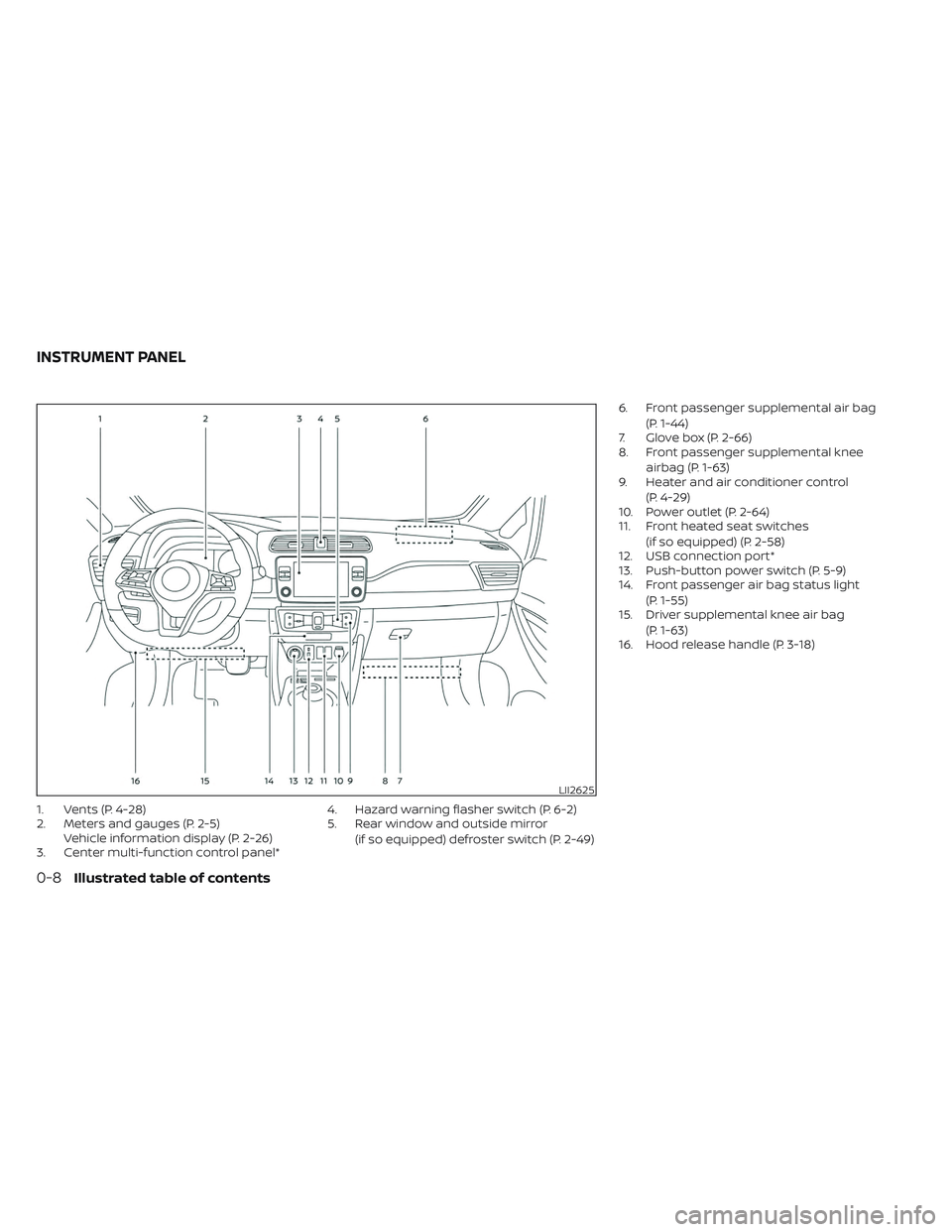
1. Vents (P. 4-28)
2. Meters and gauges (P. 2-5)Vehicle information display (P. 2-26)
3. Center multi-function control panel* 4. Hazard warning flasher switch (P. 6-2)
5. Rear window and outside mirror
(if so equipped) defroster switch (P. 2-49) 6. Front passenger supplemental air bag
(P. 1-44)
7. Glove box (P. 2-66)
8. Front passenger supplemental knee
airbag (P. 1-63)
9. Heater and air conditioner control
(P. 4-29)
10. Power outlet (P. 2-64)
11. Front heated seat switches
(if so equipped) (P. 2-58)
12. USB connection port*
13. Push-button power switch (P. 5-9)
14. Front passenger air bag status light
(P. 1-55)
15. Driver supplemental knee air bag
(P. 1-63)
16. Hood release handle (P. 3-18)
LII2625
INSTRUMENT PANEL
0-8Illustrated table of contents
Page 45 of 612
CHARGING AFTER DRIVING
Charging the Li-ion battery
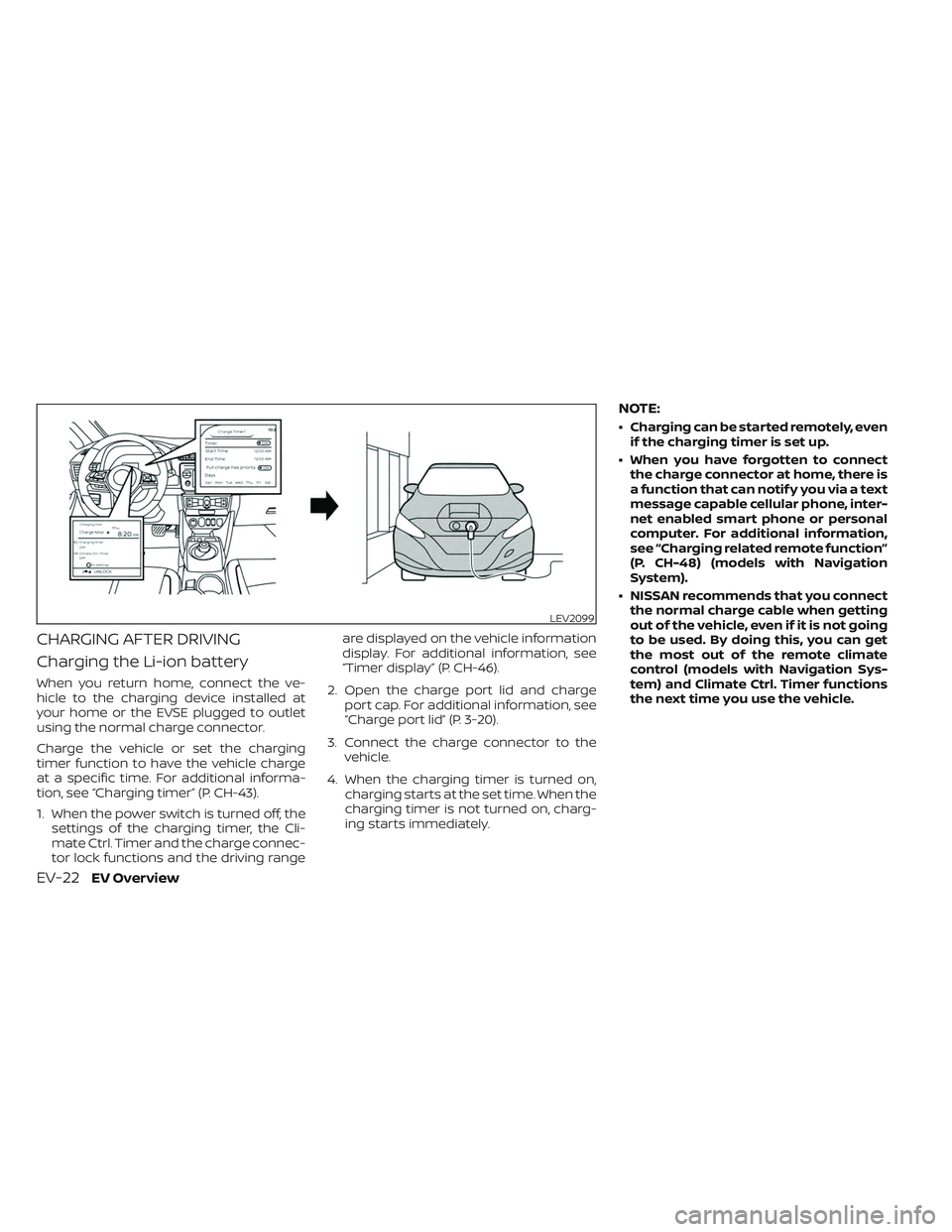
When you return home, connect the ve-
hicle to the charging device installed at
your home or the EVSE plugged to outlet
using the normal charge connector.
Charge the vehicle or set the charging
timer function to have the vehicle charge
at a specific time. For additional informa-
tion, see “Charging timer” (P. CH-43).
1. When the power switch is turned off, thesettings of the charging timer, the Cli-
mate Ctrl. Timer and the charge connec-
tor lock functions and the driving range are displayed on the vehicle information
display. For additional information, see
“Timer display” (P. CH-46).
2. Open the charge port lid and charge port cap. For additional information, see
“Charge port lid” (P. 3-20).
3. Connect the charge connector to the vehicle.
4. When the charging timer is turned on, charging starts at the set time. When the
charging timer is not turned on, charg-
ing starts immediately.
NOTE:
• Charging can be started remotely, evenif the charging timer is set up.
• When you have forgotten to connect the charge connector at home, there is
a function that can notif y you via a text
message capable cellular phone, inter-
net enabled smart phone or personal
computer. For additional information,
see “Charging related remote function”
(P. CH-48) (models with Navigation
System).
• NISSAN recommends that you connect the normal charge cable when getting
out of the vehicle, even if it is not going
to be used. By doing this, you can get
the most out of the remote climate
control (models with Navigation Sys-
tem) and Climate Ctrl. Timer functions
the next time you use the vehicle.
LEV2099
EV-22EV Overview
Page 54 of 612

CAUTION
• To prevent damage to the charging
equipment:
– Do not close the charge port lid
without closing the charge port
cap.
– Do not subject the charging
equipment to impact.
– Do not store and use charging
equipment in locations where the
temperature is over 185°F (85°C) •
Make sure the charge port cap is
closed on the charge port when
charging is finished. If the charge
port lid is closed when the charge
port cap is open, water or foreign
materials may enter the charge port.
• Do not charge when a vehicle body
cover is in use. This may cause dam-
age to the charge connector.
• Do not attempt to perform a jump
start on the 12-volt battery at the
same time that the Li-ion battery is
being charged. Doing so may dam-
age the vehicle or charging equip-
ment and could cause an injury. For
additional information, see “Jump
starting” (P. 6-10). •
In normal charging (AC 220 - 240 volt)
and trickle charging (AC 110 - 120 volt)
using the EVSE (Electric Vehicle Sup-
ply Equipment) provided with the ve-
hicle, NISSAN recommends using an
AC 220 - 240 volt, 50A and an AC 110-
120 volt, 15A dedicated electrical cir-
cuit and outlet. The dedicated circuit
is used to help prevent circuit dam-
age or the circuit breaker from trip-
ping due to the high draw of charging
the Li-ion battery. If the dedicated
circuit is not used, the circuit may
cause adverse interference on MCB
(Moulded Circuit Board) and house-
hold electrical appliances such as
televisions and audio systems. If the
circuit is shared, and another electri-
cal device is being used at the same
time the vehicle is charging, the
breaker may trip. A qualified electri-
cian should install a dedicated circuit
if one is not already available.
NOTE:
• When charging the Li-ion battery, place the power switch in the OFF position.
When the power switch is in the ON
position, the Li-ion battery will not
start charging.
LCH2136
ChargingCH-3
Page 58 of 612
The time to completely charge the vehicle
Li-ion battery varies based on the state of
charge of the Li-ion battery, condition and
age of the Li-ion battery, temperature of
the Li-ion battery, ambient temperature
and condition of the power source con-
nected to the vehicle, and whether the
electric equipment (such as the air condi-
tioner, which consumes electric power) is
used.
Normal charge
NISSAN recommends using normal charg-
ing for usual charging of the vehicle. Use of
quick charge should be minimized in order
to help prolong Li-ion battery life.
Normal charging uses L1 & L2 EVSE (Electric
Vehicle Supply Equipment), or an SAE J1772
compliant charging device connected to a
dedicated AC 220 - 240 volt circuit. L1 & L2
EVSE is provided with the vehicle (if so
equipped). The charging device is a home
charging dock installed in your home by a
qualified electrician. Contact your NISSAN
certified LEAF dealer. For additional infor-
mation, see “How to normal charge”
(P. CH-9).
Trickle charge
Trickle charging is not recommended for
regular use because it takes more timethan normal charging. Trickle charge can
be used when it is necessary to perform an
emergency charge at a destination such
as a friend’s house.
Trickle charge uses the EVSE (Electric Ve-
hicle Supply Equipment) provided with the
vehicle or an SAE J1772 compliant cord set
to connect the vehicle to an AC 110–120 volt,
15A dedicated outlet. The outlet should be
protected by a circuit breaker to avoid
overloading the circuit or other electrical
hazard.
For additional information, see “How to
trickle charge” (P. CH-11) or (P. CH-18).
Quick charge
Quick charge capability is only available on
vehicles manufactured with the quick
charge option, which includes the quick
charge port. If your vehicle does not have
such a port, quick charging cannot be
used.
A vehicle equipped with a quick charge
port is compatible with most CHAdeMO
(Japanese industry standard) connectors
on charging stations. Charging stations
using this standard are UL certified and
safe to use in the US. While supported by
NISSAN, this connector may not become
the US SAE standard.Quick charging is possible (even several
times a day). If the battery temperature is
near the red zone, in order to protect the
battery, power of the quick charging will be
limited.
Public charging:
This vehicle is compatible with any public
charging station that is SAE J1772 compli-
ant. If you attempt to charge from a non-
compliant charging station, you may not
receive a complete charge, or you may not
be able to charge at all due to hardware
and sof tware differences. NISSAN is work-
ing with states, municipalities, utility com-
panies and others to assist in the prepara-
tion of markets and infrastructure.
However, NISSAN makes no representa-
tions that public charging stations will be
available in locations where you wish to
operate the vehicle, nor can NISSAN predict
the period of time it may take for public
charging infrastructure to be developed in
your area. Depending on where you live or
drive, there may not be sufficient public
charging stations available to meet your
particular needs for driving range and
charging away from your home. Trip plan-
ning is therefore important, and you should
plan trips with these facts in mind.
ChargingCH-7
Page 65 of 612
To start trickle charging:
NOTE:
Charging timer, remote charge (models
with navigation system) and immediate
charge can be performed in the trickle
charge mode. For additional informa-
tion, see “Charging methods” (P. CH-43).
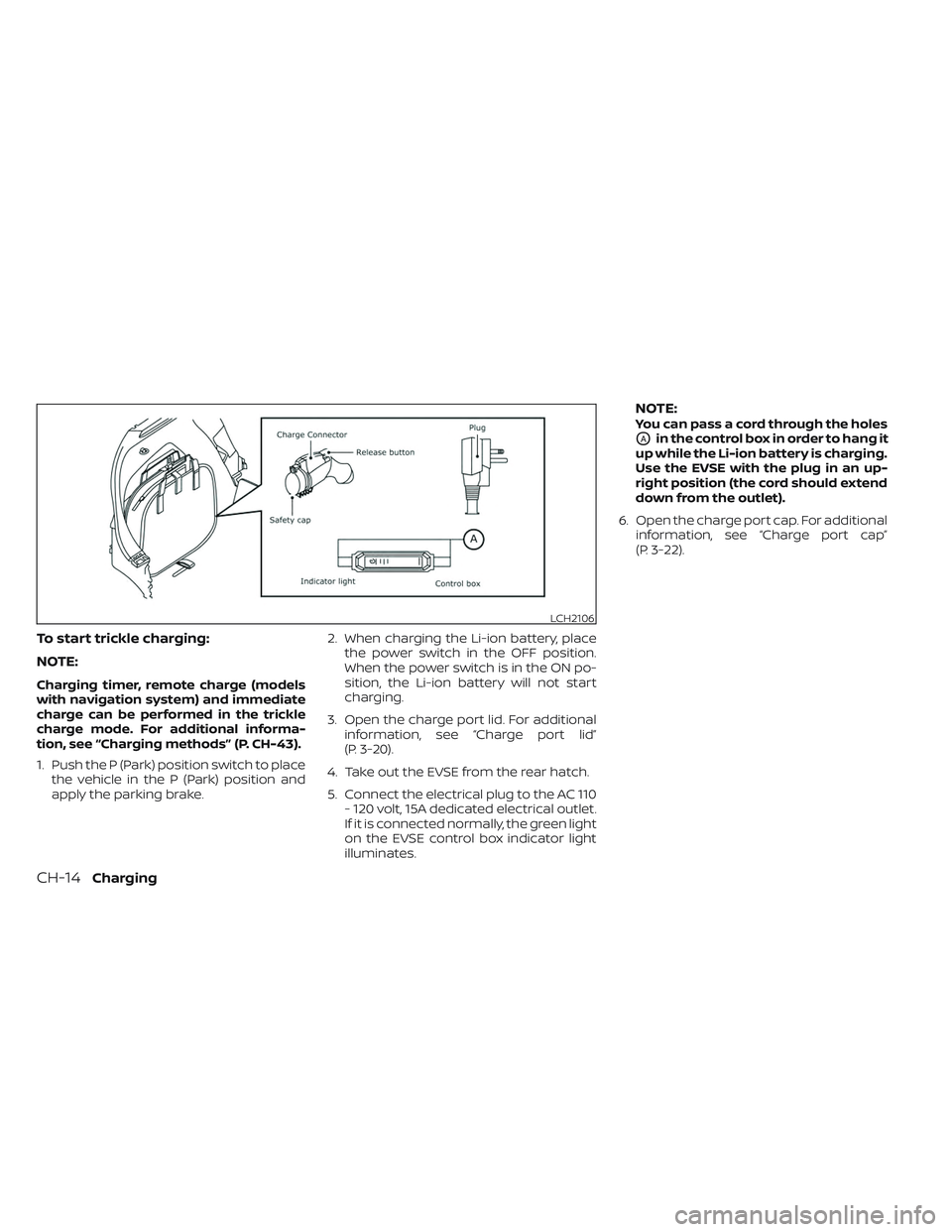
1. Push the P (Park) position switch to placethe vehicle in the P (Park) position and
apply the parking brake. 2. When charging the Li-ion battery, place
the power switch in the OFF position.
When the power switch is in the ON po-
sition, the Li-ion battery will not start
charging.
3. Open the charge port lid. For additional information, see “Charge port lid”
(P. 3-20).
4. Take out the EVSE from the rear hatch.
5. Connect the electrical plug to the AC 110 - 120 volt, 15A dedicated electrical outlet.
If it is connected normally, the green light
on the EVSE control box indicator light
illuminates.
NOTE:You can pass a cord through the holes
OAin the control box in order to hang it
up while the Li-ion battery is charging.
Use the EVSE with the plug in an up-
right position (the cord should extend
down from the outlet).
6. Open the charge port cap. For additional information, see “Charge port cap”
(P. 3-22).
LCH2106
CH-14Charging
Page 72 of 612
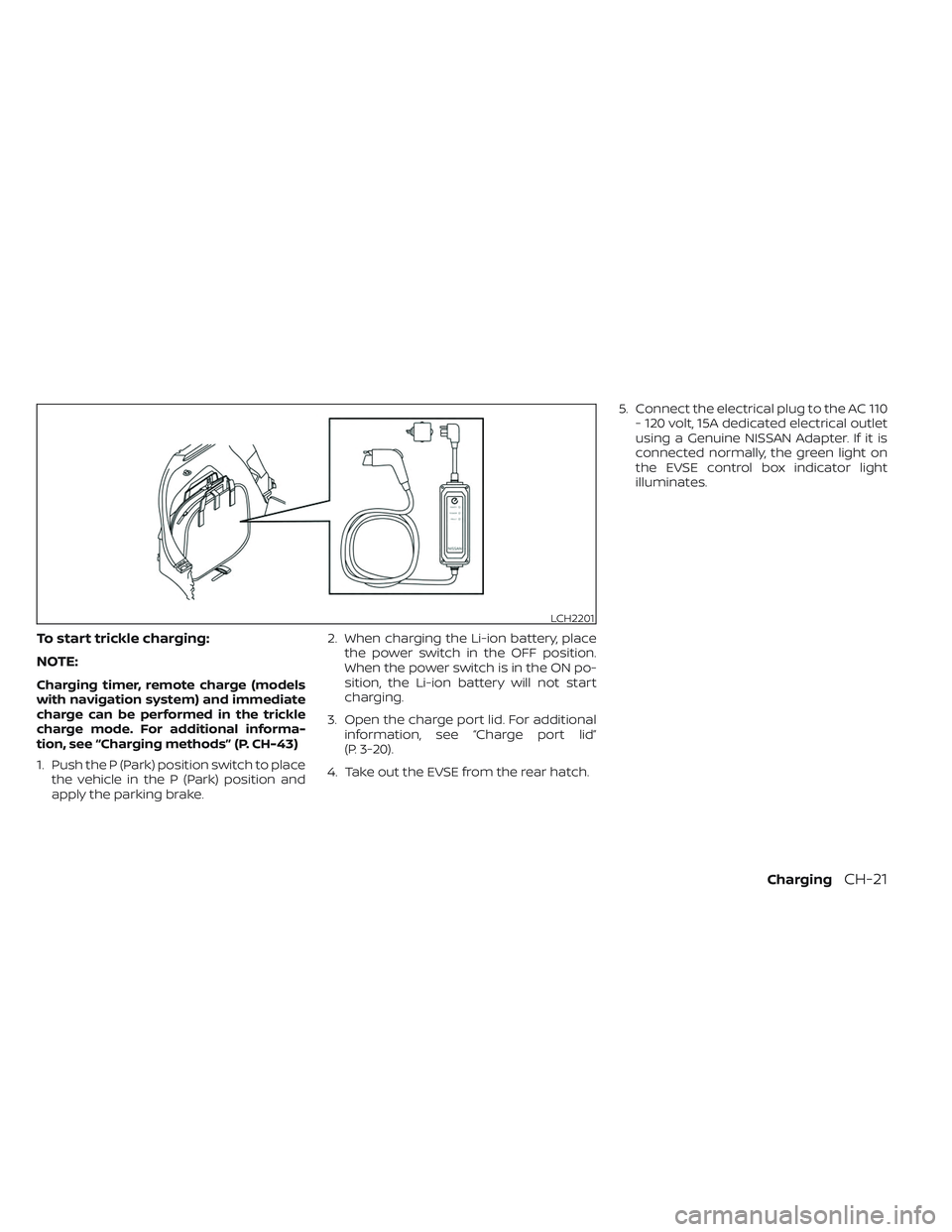
To start trickle charging:
NOTE:
Charging timer, remote charge (models
with navigation system) and immediate
charge can be performed in the trickle
charge mode. For additional informa-
tion, see “Charging methods” (P. CH-43)
1. Push the P (Park) position switch to placethe vehicle in the P (Park) position and
apply the parking brake. 2. When charging the Li-ion battery, place
the power switch in the OFF position.
When the power switch is in the ON po-
sition, the Li-ion battery will not start
charging.
3. Open the charge port lid. For additional information, see “Charge port lid”
(P. 3-20).
4. Take out the EVSE from the rear hatch. 5. Connect the electrical plug to the AC 110
- 120 volt, 15A dedicated electrical outlet
using a Genuine NISSAN Adapter. If it is
connected normally, the green light on
the EVSE control box indicator light
illuminates.
LCH2201
ChargingCH-21
Page 78 of 612
–Do not use the EVSE if the control
box, plug, the EVSE or charge con-
nector is broken, cracked, open,
corroded or shows any other indi-
cations of damage.
– Do not use the EVSE if the plug has
a loose connection with the outlet
or if the outlet is damaged or
rusted.
– Before you connect the EVSE, be
sure to check the rated current
shown on the EVSE to ensure that
the outlet and circuit have enough
current capacity to charge your
vehicle safely. If the capacity of
the outlet and circuit is not
enough, wiring may cause over-
heating or a fire.
– If in any doubt about the outlet
and circuit, consult a qualified
electrician.
– The EVSE has parts that may
spark inside. Do not use it where
gasoline, paint, or flammable liq-
uids are used or stored.
– Do not use if a malfunction occurs
or if the EVSE has been damaged
in any manner. It is recommended
that you visit a NISSAN certified
LEAF dealer for replacement. –
The EVSE contains no user ser-
viceable parts. Do not attempt to
repair the EVSE, doing so will void
your warranty.
• Pass the lower side belt of the EVSE
case securely through the fastener
on the bottom of the luggage board.
If the case suddenly becomes loose,
it may cause serious injury or death.
CAUTION
• Only charge using a standard AC 220
- 240 volt, 50A dedicated electrical
outlet (for example, do not use an
electric generator). Failure to do so
may cause charging to fail and could
cause damage to the vehicle or the
EVSE due to power surges.
• NISSAN recommends using Genuine
NISSAN charging equipment to
charge the vehicle. Using non-
NISSAN equipment could cause the
Li-ion battery to not charge correctly
and may damage the vehicle or the
EVSE.
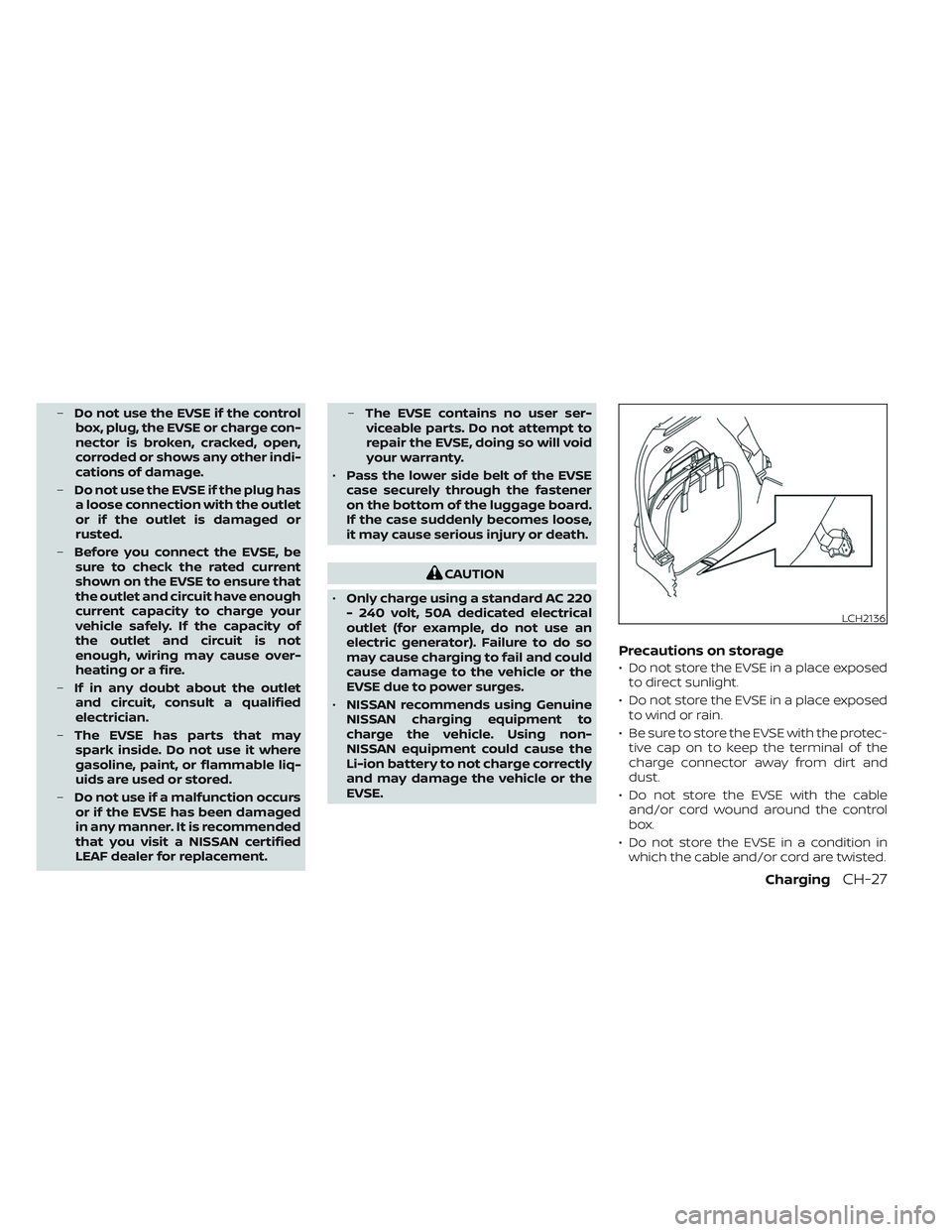
Precautions on storage
• Do not store the EVSE in a place exposed to direct sunlight.
• Do not store the EVSE in a place exposed to wind or rain.
• Be sure to store the EVSE with the protec- tive cap on to keep the terminal of the
charge connector away from dirt and
dust.
• Do not store the EVSE with the cable and/or cord wound around the control
box.
• Do not store the EVSE in a condition in which the cable and/or cord are twisted.
LCH2136
ChargingCH-27
Page 79 of 612
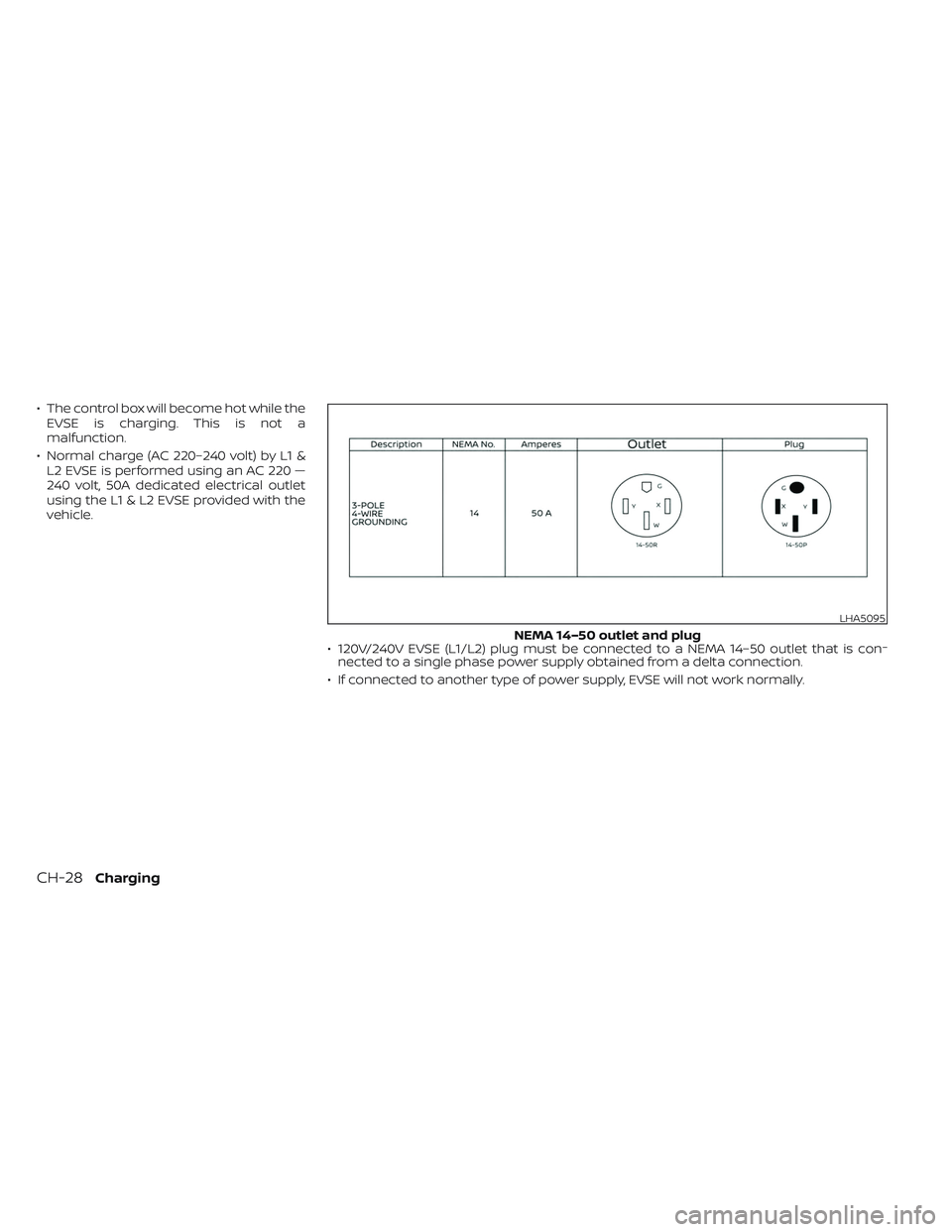
• The control box will become hot while theEVSE is charging. This is not a
malfunction.
• Normal charge (AC 220–240 volt) by L1 & L2 EVSE is performed using an AC 220 —
240 volt, 50A dedicated electrical outlet
using the L1 & L2 EVSE provided with the
vehicle.
LHA5095
NEMA 14–50 outlet and plug
• 120V/240V EVSE (L1/L2) plug must be connected to a NEMA 14–50 outlet that is con -
nected to a single phase power supply obtained from a delta connection.
• If connected to another type of power supply, EVSE will not work normally.
CH-28Charging