2023 NISSAN LEAF steering wheel
[x] Cancel search: steering wheelPage 490 of 612
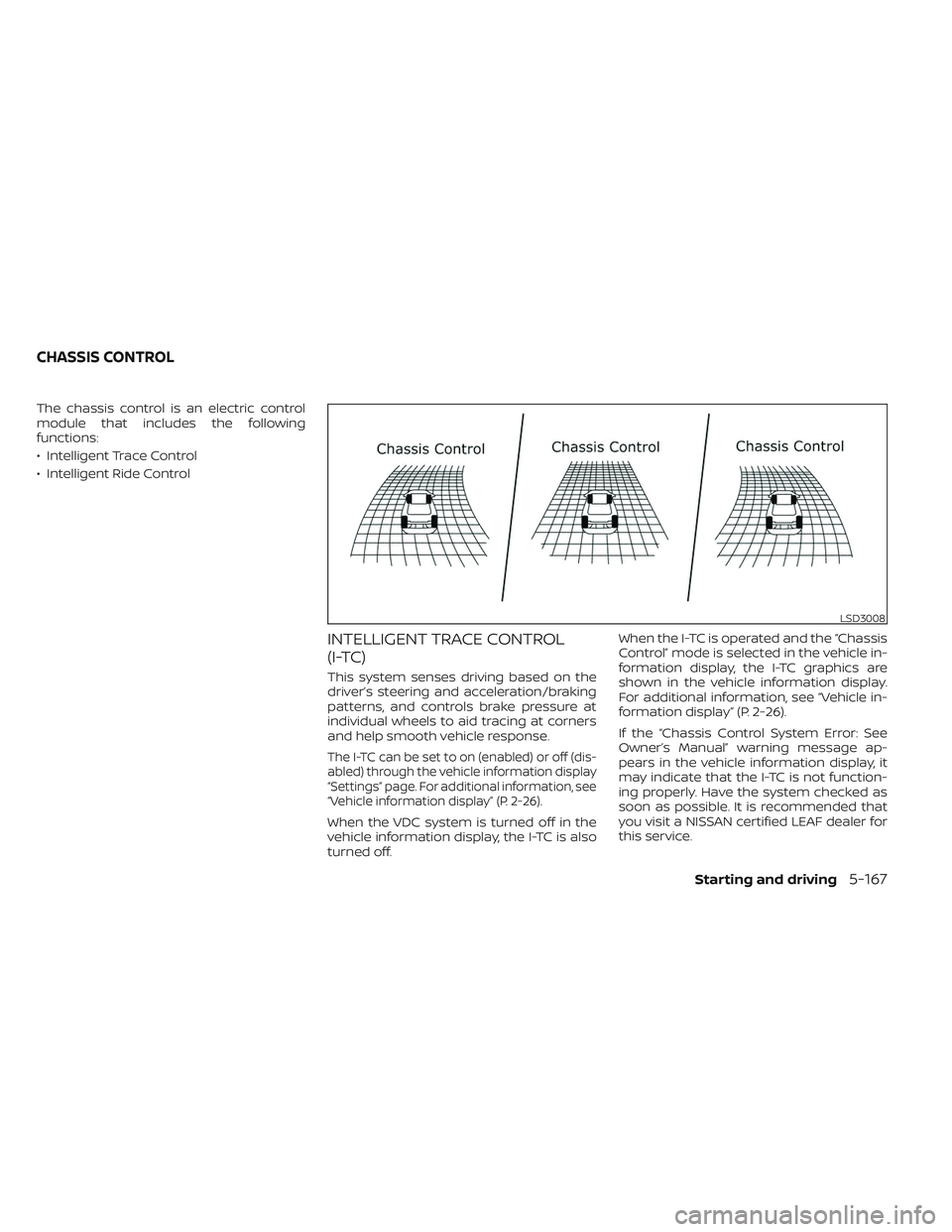
The chassis control is an electric control
module that includes the following
functions:
• Intelligent Trace Control
• Intelligent Ride Control
INTELLIGENT TRACE CONTROL
(I-TC)
This system senses driving based on the
driver’s steering and acceleration/braking
patterns, and controls brake pressure at
individual wheels to aid tracing at corners
and help smooth vehicle response.
The I-TC can be set to on (enabled) or off (dis-
abled) through the vehicle information display
“Settings” page. For additional information, see
“Vehicle information display” (P. 2-26).
When the VDC system is turned off in the
vehicle information display, the I-TC is also
turned off.When the I-TC is operated and the “Chassis
Control” mode is selected in the vehicle in-
formation display, the I-TC graphics are
shown in the vehicle information display.
For additional information, see “Vehicle in-
formation display” (P. 2-26).
If the “Chassis Control System Error: See
Owner’s Manual” warning message ap-
pears in the vehicle information display, it
may indicate that the I-TC is not function-
ing properly. Have the system checked as
soon as possible. It is recommended that
you visit a NISSAN certified LEAF dealer for
this service.
LSD3008
CHASSIS CONTROL
Starting and driving5-167
Page 506 of 612
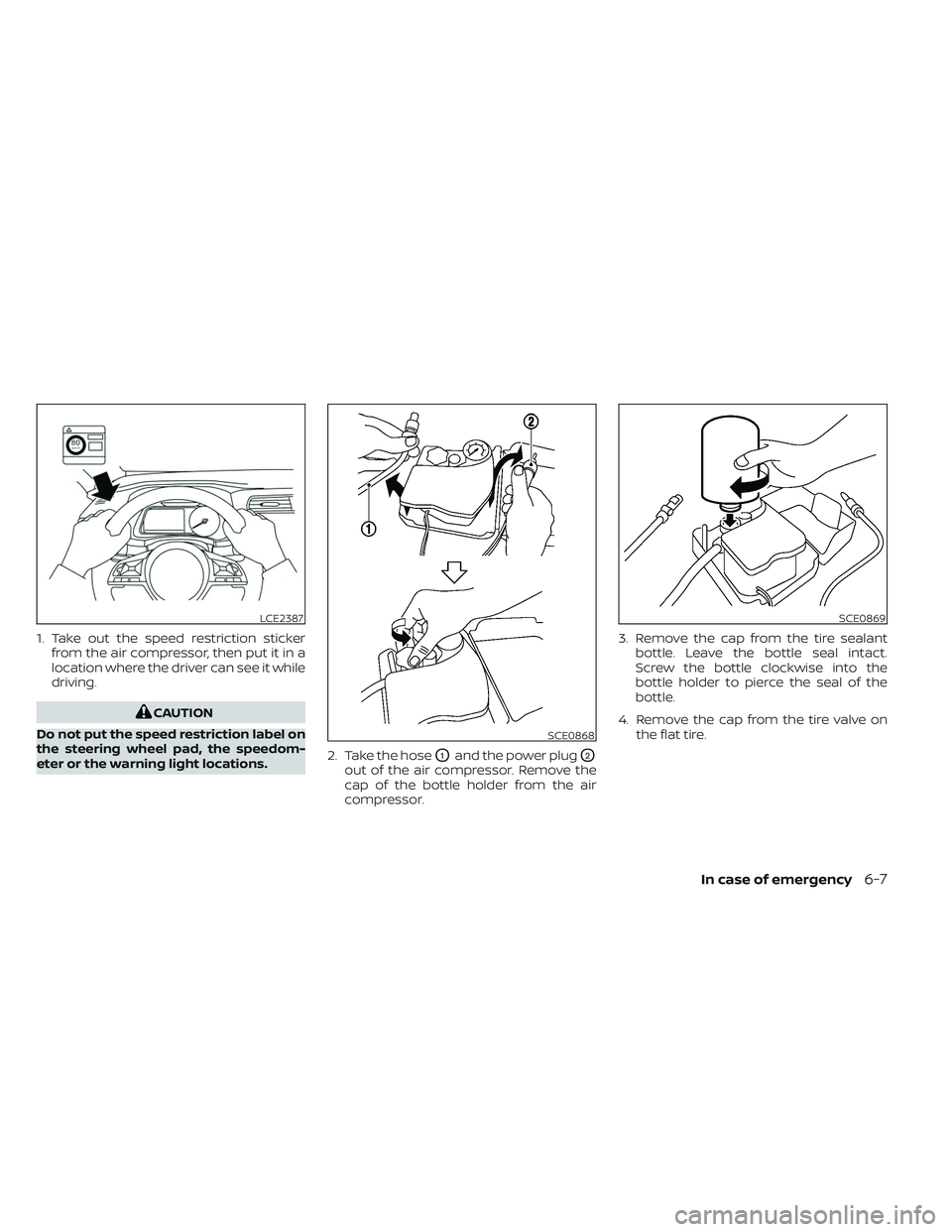
1. Take out the speed restriction stickerfrom the air compressor, then put it in a
location where the driver can see it while
driving.
CAUTION
Do not put the speed restriction label on
the steering wheel pad, the speedom-
eter or the warning light locations. 2. Take the hose
O1and the power plugO2
out of the air compressor. Remove the
cap of the bottle holder from the air
compressor.3. Remove the cap from the tire sealant
bottle. Leave the bottle seal intact.
Screw the bottle clockwise into the
bottle holder to pierce the seal of the
bottle.
4. Remove the cap from the tire valve on the flat tire.
LCE2387
SCE0868
SCE0869
In case of emergency6-7
Page 512 of 612
WARNING
If the vehicle is in the N (Neutral) posi-
tion and the Li-ion battery and the 12-
volt battery become completely dis-
charged, the vehicle cannot be placed
in the P (Park) position. If this occurs,
place suitable blocks at both the front
and back of a wheel to prevent the ve-
hicle from moving. Failure to block a
wheel may allow the vehicle to move
unexpectedly which may result in seri-
ous personal injury or death.
To place the vehicle in the READY to drive
position so the vehicle can be driven,
charge the Li-ion battery until the driving
range on the instrument panel changes
from “---” to a numeric distance.
NOTE:
• Some vibration may occur when the vehicle is stopped in case the Li-ion
battery becomes completely dis-
charged. This is not the malfunction of
the system.
• If the Li-ion battery is completely dis- charged, it is required to charge until
the low battery charge warning light
turns off (white) from on (yellow). Do not attempt to start the system by
pushing the vehicle.
CAUTION
An EV cannot be push-started or tow-
started. Attempting to do so may cause
traction motor damage. When towing your vehicle, all State (Provin-
cial in Canada) and local regulations for
towing must be followed.
Incorrect towing equipment could dam-
age your vehicle. Towing instructions are
available from a NISSAN certified LEAF
dealer. Local service operators are familiar
with the applicable laws and procedures
for towing. To assure proper towing and to
prevent accidental damage to your vehicle,
NISSAN recommends that you have a ser-
vice operator tow your vehicle. It is advis-
able to have the service operator carefully
read the following precautions.
WARNING
• Never ride in a vehicle that is being
towed.
• Never get under your vehicle af ter it
has been lif ted by a tow truck.
CAUTION
• When towing, make sure that the ax-
les, steering system and power train
are in working condition. Use dollies
or flatbed if any of the listed systems
are not working.
PUSH STARTING TOWING YOUR VEHICLE
In case of emergency6-13
Page 514 of 612
CAUTION
• Never tow with the front wheels on
the ground or four wheels on the
ground (forward or backward), as
this may cause serious and expen-
sive damage to the motor.
• When towing this vehicle with the
rear wheels on the ground (if you do
not use towing dollies): Always re-
lease the parking brake.
NOTE:
If the battery is completely drained the
transmission will not manually shif t to
other positions.
NOTE:
If your vehicle cannot be moved because
the vehicle cannot be shif ted to the N
(Neutral) position, please refer to the
LEAF Roadside Assistance Guide which is
located at www.NISSANUSA.com. If your
vehicle cannot be moved because the
parking brake cannot be released, see
“Parking brake” (P. 5-18).
VEHICLE RECOVERY (freeing a
stuck vehicle)
WARNING
To avoid vehicle damage, serious per-
sonal injury or death when recovering a
stuck vehicle:
• Contact a professional towing ser-
vice to recover the vehicle if you have
any questions regarding the recov-
ery procedure.
• Tow chains or cables must be at-
tached only to main structural mem-
bers of the vehicle.
• Do not use the vehicle tie-downs to
tow or free a stuck vehicle.
• Only use devices specifically de-
signed for vehicle recovery and fol-
low the manufacturer’s instructions.
• Always pull the recovery device
straight out from the front of the ve-
hicle. Never pull at an angle.
• Route recovery devices so they do
not touch any part of the vehicle ex-
cept the attachment point.
If your vehicle is stuck in sand, snow, mud,
etc., use a tow strap or other device de-
signed specifically for vehicle recovery. Al- ways follow the manufacturer’s instruc-
tions for the recovery device.Rocking a stuck vehicle
If the vehicle is stuck in sand, snow, mud,
etc., try to free it by following the procedure
below.
1. Turn off the Vehicle Dynamic Control
(VDC) system.
2. Make sure the area in front and behind the vehicle is clear of obstructions.
3. Turn the steering wheel lef t and right to clear an area around the front tires.
4. Slowly rock the vehicle forward and backward.
• Shif t back and forth between the R (Reverse) and D (Drive) positions.
• Apply the accelerator as little as pos- sible to maintain the rocking motion.
• Release the accelerator pedal before shif ting between R (Reverse) and D
(Drive).
• Do not spin the tires above 35 mph (55 km/h).
5. If the vehicle cannot be freed af ter a few tries, contact a professional towing ser-
vice to remove the vehicle.
In case of emergency6-15
Page 564 of 612

Outside the vehicle
The maintenance items listed here should
be performed from time to time, unless
otherwise specified.
Doors and motor hood:
Check that the
doors and motor hood operate properly.
Also ensure that all latches lock securely. Lu-
bricate hinges, latches, latch pins, rollers and
links if necessary. Make sure that the sec-
ondary latch keeps the motor hood from
opening when the primary latch is released.
When driving in areas using road salt or
other corrosive materials, check lubrica-
tion frequently.
Check that the gas stays or struts properly
and securely hold the hood, trunk, or rear
hatch fully open. If the hood, trunk, or rear
hatch is not held open, have the gas stays
or struts replaced.
Lights*: Clean the headlights on a regular
basis. Make sure that the headlights, stop
lights, tail lights, turn signal lights, and other
lights are all operating properly and in-
stalled securely. Also check headlight aim.
Road wheel nuts (lug nuts)*: When check-
ing the tires, make sure no wheel nuts are
missing, and check for any loose wheel
nuts. Tighten if necessary. Tire rotation*:
Rotate tires at the specified
interval shown in the maintenance
schedule.
Tires*: Check the pressure with a gauge
of ten and always prior to long distance
trips. If necessary, adjust the pressure in all
tires, to the pressure specified. Check care-
fully for damage, cuts or excessive wear.
Tire Pressure Monitoring System (TPMS)
tire pressure sensor: It is recommended
that you replace the TPMS tire pressure
sensor assembly when the tires are re-
placed due to wear or age.
Wheel alignment and balance: If the ve-
hicle pulls to either side while driving on a
straight and level road, or if you detect un-
even or abnormal tire wear, there may be a
need for wheel alignment.
If the steering wheel or seat vibrates at
normal highway speeds, wheel balancing
may be needed.
For additional information regarding tires,
refer to “Important Tire Safety Information”
(US) or “Tire Safety Information” (Canada) in
the Warranty Information Booklet.
Windshield: Clean the windshield on a
regular basis. Check the windshield at least
every six months for cracks or other dam- age. Have a damaged windshield repaired
by a qualified repair facility. It is recom-
mended that you have a damaged wind-
shield repaired by a NISSAN certified LEAF
dealer, or a NISSAN Certified Collision Cen-
ter. To locate a collision center in your area,
refer to http://collision.nissanusa.com.
Windshield wiper blades*:
Check for
cracks or wear if they do not wipe properly.
Inside the vehicle
The maintenance items listed here should
be checked on a regular basis, such as
when performing scheduled maintenance,
cleaning the vehicle, etc.
Accelerator pedal: Check the pedal for
smooth operation and make sure the
pedal does not catch or require uneven
effort. Keep the floor mat away from the
pedal.
Brake pedal: Check the pedal for smooth
operation. If the brake pedal suddenly goes
down further than normal, the pedal feels
spongy or the vehicle seems to take longer
to stop, it is recommended that you visit a
NISSAN certified LEAF dealer immediately.
Keep the floor mat away from the pedal.
Brakes: Check that the brakes do not pull
the vehicle to one side when applied.
Maintenance and schedules9-3
Page 565 of 612
Electric shif t P (Park) position mecha-
nism:On a steep hill check that the vehicle
is held securely while the vehicle is in the P
(Park) position without applying any
brakes.
Parking brake: Check the parking brake
operation regularly. The vehicle should be
securely held on a steep hill with only the
parking brake applied. If the parking brake
cannot keep a vehicle position, it is recom-
mended that you visit a NISSAN certified
LEAF dealer for this service.
Seats: Check seat position controls such
as seat adjusters, seatback recliner, etc., to
ensure they operate smoothly and all
latches lock securely in every position.
Check that the head restraints/headrests
move up and down smoothly and the locks
(if so equipped) hold securely in all latched
positions.
Seat belts: Check that all parts of the seat
belt system (for example, buckles, anchors,
adjusters and retractors) operate properly
and smoothly, and are installed securely.
Check the belt webbing for cuts, fraying,
wear or damage. Steering wheel:
Check for changes in the
steering conditions, such as excessive free
play, hard steering or strange noises.
Warning lights and chimes: Make sure all
warning lights and chimes are operating
properly.
Windshield defroster: Check that the air
emits from the defroster outlets properly
and in sufficient quantity when operating
the heater or air conditioner.
Windshield wiper and washer*: Check
that the wipers and washer operate prop-
erly and that the wipers do not streak.
Under the hood and vehicle
The maintenance items listed here should
be checked periodically.
12–volt battery (except for maintenance
free batteries)*: Check the fluid level in
each cell. The fluid should be at the bottom
of the filler opening. Vehicles operated in
high temperatures or under severe condi-
tions require frequent checks of the 12–volt
battery fluid level.
NOTE:
Care should be taken to avoid situations
that can lead to potential battery dis-
charge and potential no-start conditions
such as:
1. Installation or extended use of elec- tronic accessories that consume bat-
tery power when the EV system is not
running (Phone chargers, GPS, DVD
players, etc.)
2. Vehicle is not driven regularly and/or only driven short distances.
In these cases, the battery may need to
be charged to maintain battery health
Brake fluid level*: Make sure that the brake
fluid levels are between the MAX and MIN
lines on the reservoir.
Coolant level*: Check the coolant level
when the high voltage parts are cold. Make
sure that the coolant level is between the
MAX and MIN lines on the reservoir.
Fluid leaks: Check under the vehicle for
water or other fluid leaks af ter the vehicle
has been parked for a while. Water dripping
from the air conditioner af ter use is normal.
If you should notice any leaks, check for
cause and have it corrected immediately.
9-4Maintenance and schedules
Page 606 of 612
EV system...................EV-2EV unique information...........EV-25Event Data recorders............10-21EVSE
(Electric Vehicle Supply Equipment). . .CH-11Explanation of maintenance items.....9-2Explanation of scheduled maintenance
items...................... .9-5Extended storage switch..........8-19
F
F.M.V.S.S./C.M.V.S.S. certification label. . .10-8Flashers (See hazard warning flasher
switch)......................6-2Flat tire......................6-3Flat towing...................10-15Floor mat cleaning...............7-5Fluid
Brake fluid...................8-7Capacities and recommended
fuel/lubricants...............10-2Coolant................... .8-5Reduction gear fluid............8-7Windshield-washer fluid..........8-8Fog light switch................2-57Fog lights
Bulb replacement.............8-22Front and rear sonar system.......5-169Front passenger air bag status
light................... .1-55, 1-57Front-seat mounted side-impact
supplemental air bag system........1-61
Fuses.......................8-15Fusible links...................8-17
G
Gauge
Driving range................ .2-8Li-ion battery available charge
gauge.................... .2-9Li-ion battery temperature gauge. . . .2-7Odometer...................2-5Power meter.................2-7Speedometer................2-5General maintenance.............9-2Glove box................... .2-66
H
Hazard warning flasher switch........6-2Head restraints
Headrests...................1-7Headlights...................8-22Bulb replacement.............8-22Headlight switch..............2-50Heated mirrors................3-26Heated seat switches............2-58Heated seats................. .2-58Heated steering wheel............2-60Heated steering wheel switch.......2-60Heater......................4-29High voltage precautions..........EV-8Hill start....................5-168Hill start assist................5-168
Home charge.................CH-9Hood.......................3-18Horn...................... .2-58How to normal charge...........CH-9How to quick charge.......CH-35, CH-38How to trickle charge............CH-11
I
If the Li-ion battery becomes completely
discharged...................6-12Immediate charge..........CH-48, 2-61Immediate charge switch.....CH-48, 2-61Immobilizer system..............5-13Indicator lights.................2-24Indicator lights and audible reminders
(See warning/indicator lights and audible
reminders)
...................2-14Indicators for maintenance.........2-38Indicators for operation...........2-36Infants......................1-20Inside automatic anti-glare mirror. . . .3-24Instrument brightness control.......2-56Instrument panel dimmer switch.....2-56Intelligent Around View® Monitor......4-11Intelligent Cruise Control (ICC)
(for vehicles without ProPILOT Assist). . .5-67Intelligent Driver Alertness (I-DA).....5-154Intelligent Forward Collision Warning
(I-FCW).....................5-141Intelligent Key battery............8-19Intelligent Key system
Key operating range............3-8Key operation................3-9
11-3
Page 609 of 612
Repairing flat tire................6-4Repairing tire..................6-6Reporting safety defects (US only). . . .10-16Road accident precautions.........EV-9Roadside assistance program........6-2Rollover......................5-7Roof-mounted curtain side-impact
supplemental air bag system........1-61
S
Safety
Child safety rear door lock.........3-6Child seat belts...............1-19Reporting safety defects (US only). . .10-16Scene guideAt home af ter driving..........EV-22Before driving your vehicle
(models with navigation system). . .EV-14Charging the Li-ion battery......EV-12Driving the vehicle............EV-18Parking the vehicle............EV-21Starting your vehicle...........EV-17Seat beltChild safety.................1-19Infants....................1-20Injured person................1-15Larger children...............1-20Precautions on seat belt usage.....1-11Pregnant women..............1-15Rear center seat belt............1-18Seat belt cleaning..............7-6Seat belt extenders............1-18
Seat belt maintenance..........1-19Seat belt warning light..........2-18Seat belts...................1-11Seat belts with pretensioners......1-64Shoulder belt height adjustment. . . .1-18Small children................1-20Three-point type..............1-15Seat belt warning light............1-14Seats........................1-2Heated seats................2-58Security system................2-44Security system (NISSAN Vehicle Immobilizer
System), EV system start.......2-46, 5-13Servicing climate control..........4-43Shif tingElectric shif t control system.......5-14Shoulder belt height adjustment......1-18Shoulder belt height adjustment, For front
seats.......................1-18Speedometer................. .2-5Stability control................5-164Standard maintenance............9-7Starting
Before starting system..........5-13Jump starting................6-10Precautions when starting and
driving.................... .5-4Push starting................6-13Starting the traction motor.......5-14Status light, Front passenger
air bag...................1-55, 1-57Steering
Heated steering wheel..........2-60Power steering system.........5-161
Steering assist switch (models with
ProPILOT assist)................2-62Steering wheel.................3-22Stopping the vehicle..............6-5Storage.................... .2-65Stowing golf bags...............2-69Sun visors....................3-23Sunglasses holder..............2-66Supplemental air bag warning labels. . .1-65Supplemental air bag warning
light....................1-66, 2-18Supplemental restraint system
Precautions on supplemental restraint
system
................... .1-44Supplemental Restraint System (SRS). . .1-44Switch
Autolight switch..............2-51ECO switch................ .2-58Fog light switch..............2-57Hazard warning flasher switch......6-2Headlight switch..............2-50Immediate charge switch. . .CH-48, 2-61Instrument brightness control.....2-56Power door lock switch..........3-5Rear window and outside mirror defroster
switch................... .2-49Rear window wiper and washer
switches...................2-48Turn signal switch.............2-56Wiper and washer switch........2-47
11-6