2023 NISSAN LEAF cooling
[x] Cancel search: coolingPage 524 of 612
8 Do-it yourself
Maintenance precautions.......................8-2
Motor compartment check locations ...........8-4
Cooling system .................................8-5
Checking coolant level .......................8-6
Changing coolant ............................8-6
Reduction gear fluid .............................8-7
Brake fluid .......................................8-7
Windshield-washer fluid .........................8-8
12-volt battery ...................................8-9
Jump starting ................................ 8-11
Windshield wiper blades ........................8-12
Cleaning .................................... 8-12
Replacing ................................... 8-12
Rear window wiper blade ...................8-14
Brakes ......................................... 8-14
Brake pad wear warning ....................8-14Fuses
.......................................... 8-15
Motor compartment ........................ 8-15
Passenger compartment ...................8-18
NISSAN Intelligent Key® battery replacement . . . 8-19
Lights .......................................... 8-21
Headlights .................................. 8-22
Fog lights (if so equipped) ...................8-22
Exterior and interior lights ...................8-23
Wheels and tires ............................... 8-25
Tire pressure ................................ 8-25
Tire labeling ................................. 8-29
Types of tires ................................ 8-33
Tire chains .................................. 8-34
Changing wheels and tires ..................8-35
Emergency tire puncture repair kit ..........8-38
Page 525 of 612
When performing any inspection or main-
tenance work on your vehicle, always take
care to prevent serious accidental injury to
yourself or damage to the vehicle. The fol-
lowing are general precautions that should
be closely observed.
WARNING
• The EV system uses high voltage up
to approximately DC 400 volt. The
system can be hot during and af ter
starting and when the vehicle is shut
off. Be careful of both the high volt-
age and the high temperature. Obey
the labels that are attached to the
vehicle.
• Never disassemble, remove or re-
place high-voltage parts and cables
as well as their connectors. High-
voltage cables are colored orange.
• Disassembling, removing or replac-
ing those parts or cables can cause
severe burns or electric shock that
may result in serious injury or death.
The vehicle high-voltage system has
no user serviceable parts. It is recom-
mended that you visit a NISSAN cer-
tified LEAF dealer for any necessary
maintenance. •
Park the vehicle on a level surface,
apply the parking brake securely and
chock the wheels to prevent the ve-
hicle from moving. Push the P (Park)
position switch on the shif t lever or
place the vehicle into the N (Neutral)
position.
• If you must work with the EV (Electric
Vehicle) system is turned on, keep
hands, clothing, hair and tools away
from moving fans and any other
moving parts.
• Make sure that the power switch is in
the OFF or LOCK position when per-
forming any part replacement or
repairs.
• It is advisable to secure or remove
any loose clothing and remove any
jewelry, such as rings, watches, etc.
before working on your vehicle.
• Always wear eye protection when-
ever you work on your vehicle.
• Never get under the vehicle while it is
supported only by a jack. If it is nec-
essary to work under the vehicle,
support it with safety stands.
• Keep smoking materials, flames and
sparks away from the 12-volt battery.
CAUTION
• Do not work under the hood while
the motor compartment is hot. Push
the power switch in the OFF position
and wait until it cools down.
• Avoid direct contact with used cool-
ant. Improperly disposed coolant
and/or other vehicle fluids can dam-
age the environment. Always con-
form to local regulations for the dis-
posal of vehicle fluids.
• Never connect or disconnect the bat-
tery or any transistorized compo-
nent while the power switch is in the
ON position.
• Your vehicle is equipped with an au-
tomatic cooling fan. It may come on
at any time without warning, even if
the power switch is not in the ACC, ON
or READY to drive position. To avoid
injury, always disconnect the nega-
tive 12-volt battery cable before
working near the fan.
• Before performing any electrical
maintenance work on the vehicle
such as the battery, fuses or bulb re-
placement, confirm the following:
– The charge connector is removed
from the vehicle.
MAINTENANCE PRECAUTIONS
8-2Do-it yourself
Page 528 of 612
The cooling system is filled at the factory
with a pre-diluted mixture of 50% Genuine
NISSAN Long Life Antifreeze/Coolant (blue)
and 50% water to provide year-round anti-
freeze and coolant protection. The anti-
freeze solution contains rust and corrosion
inhibitors. Additional cooling system addi-
tives are not necessary.
WARNING
• Never remove the coolant reservoir
cap when the motor compartment is
hot. Wait until the motor compart-
ment cools down.
• The coolant reservoir is equipped
with a pressure type coolant reser-
voir cap. To prevent damage to the
motor compartment, use only a
Genuine NISSAN coolant reservoir
cap.
CAUTION
• Never use any additives in the cool-
ant such as radiator sealer in the
cooling system. This may cause
damage to electrical equipment
such as the motor and inverter. •
When adding or replacing coolant, be
sure to use only a Genuine NISSAN
Long Life Antifreeze/Coolant (blue)
or equivalent. Genuine NISSAN Long
Life Antifreeze/Coolant (blue) is pre-
diluted to provide antifreeze protec-
tion to −34°F (−37°C) . If additional
freeze protection is needed due to
the weather conditions where you
operate your vehicle, add Genuine
NISSAN Long Life Antifreeze/Coolant
(blue) concentrate following the di-
rections on the container. If an
equivalent coolant other than
Genuine NISSAN Long Life
Antifreeze/Coolant (blue) is used, fol-
low the coolant manufacturer's in-
structions to maintain minimum an-
tifreeze protection to −34°F (−37°C).
The use of other types of coolant so-
lutions other than Genuine NISSAN
Long Life Antifreeze/Coolant (blue)
or equivalent may damage the cool-
ing system. •
The life expectancy of the factory-fill
coolant is 125,000 miles (200,000
km) or 15 years. Mixing any other type
of coolant other than Genuine
NISSAN Long Life Antifreeze/Coolant
(blue)(or equivalent coolant), includ-
ing Genuine NISSAN Long Life
Antifreeze/Coolant (green), or the
use of non-distilled water may re-
duce the life expectancy of the
factory-filled coolant. For additional
information, refer to the “Mainte-
nance and schedules” section of this
manual.
COOLING SYSTEM
Do-it yourself8-5
Page 529 of 612
CHECKING COOLANT LEVEL
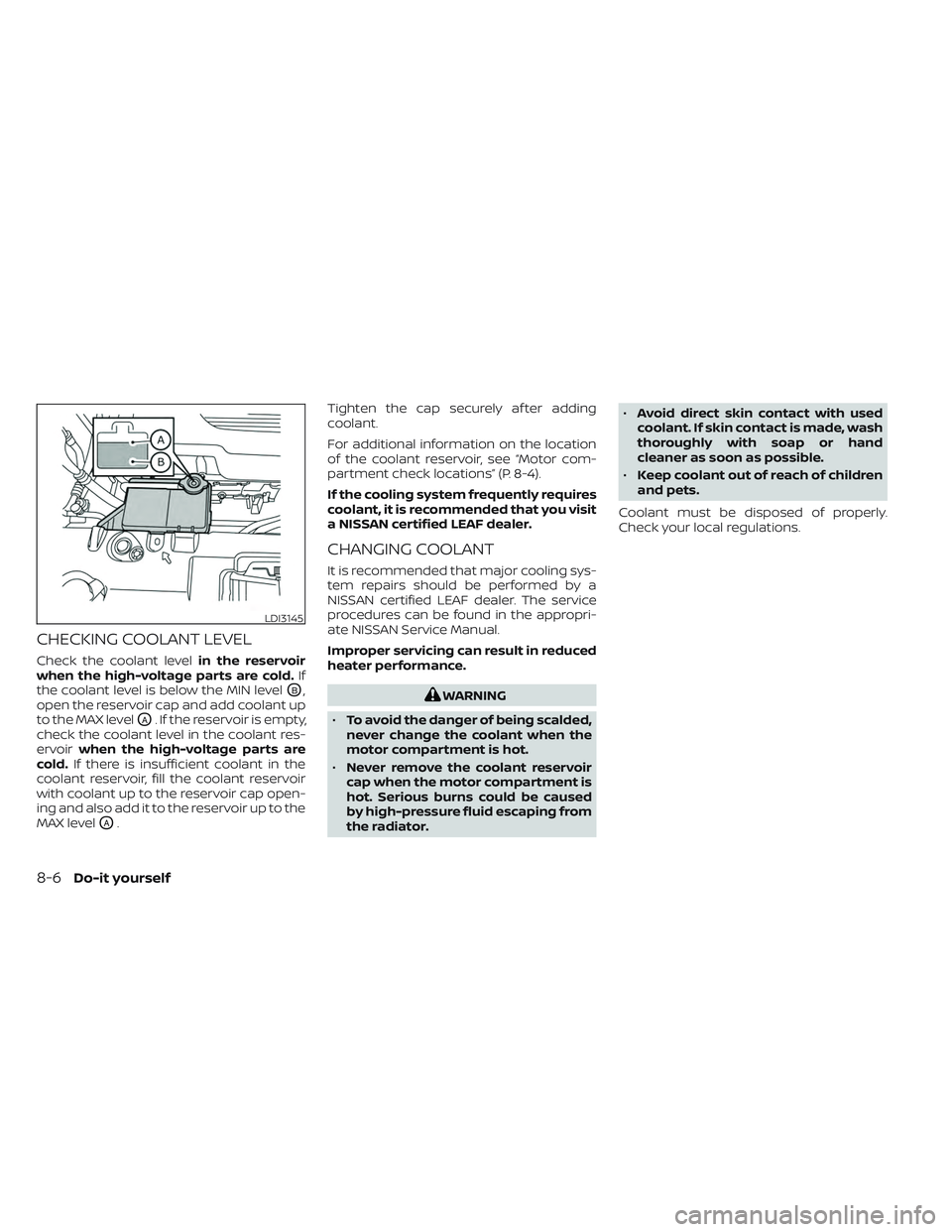
Check the coolant levelin the reservoir
when the high-voltage parts are cold. If
the coolant level is below the MIN level
OB,
open the reservoir cap and add coolant up
to the MAX level
OA. If the reservoir is empty,
check the coolant level in the coolant res-
ervoir when the high-voltage parts are
cold. If there is insufficient coolant in the
coolant reservoir, fill the coolant reservoir
with coolant up to the reservoir cap open-
ing and also add it to the reservoir up to the
MAX level
OA. Tighten the cap securely af ter adding
coolant.
For additional information on the location
of the coolant reservoir, see “Motor com-
partment check locations” (P. 8-4).
If the cooling system frequently requires
coolant, it is recommended that you visit
a NISSAN certified LEAF dealer.
CHANGING COOLANT
It is recommended that major cooling sys-
tem repairs should be performed by a
NISSAN certified LEAF dealer. The service
procedures can be found in the appropri-
ate NISSAN Service Manual.
Improper servicing can result in reduced
heater performance.
WARNING
• To avoid the danger of being scalded,
never change the coolant when the
motor compartment is hot.
• Never remove the coolant reservoir
cap when the motor compartment is
hot. Serious burns could be caused
by high-pressure fluid escaping from
the radiator. •
Avoid direct skin contact with used
coolant. If skin contact is made, wash
thoroughly with soap or hand
cleaner as soon as possible.
• Keep coolant out of reach of children
and pets.
Coolant must be disposed of properly.
Check your local regulations.
LDI3145
8-6Do-it yourself
Page 579 of 612
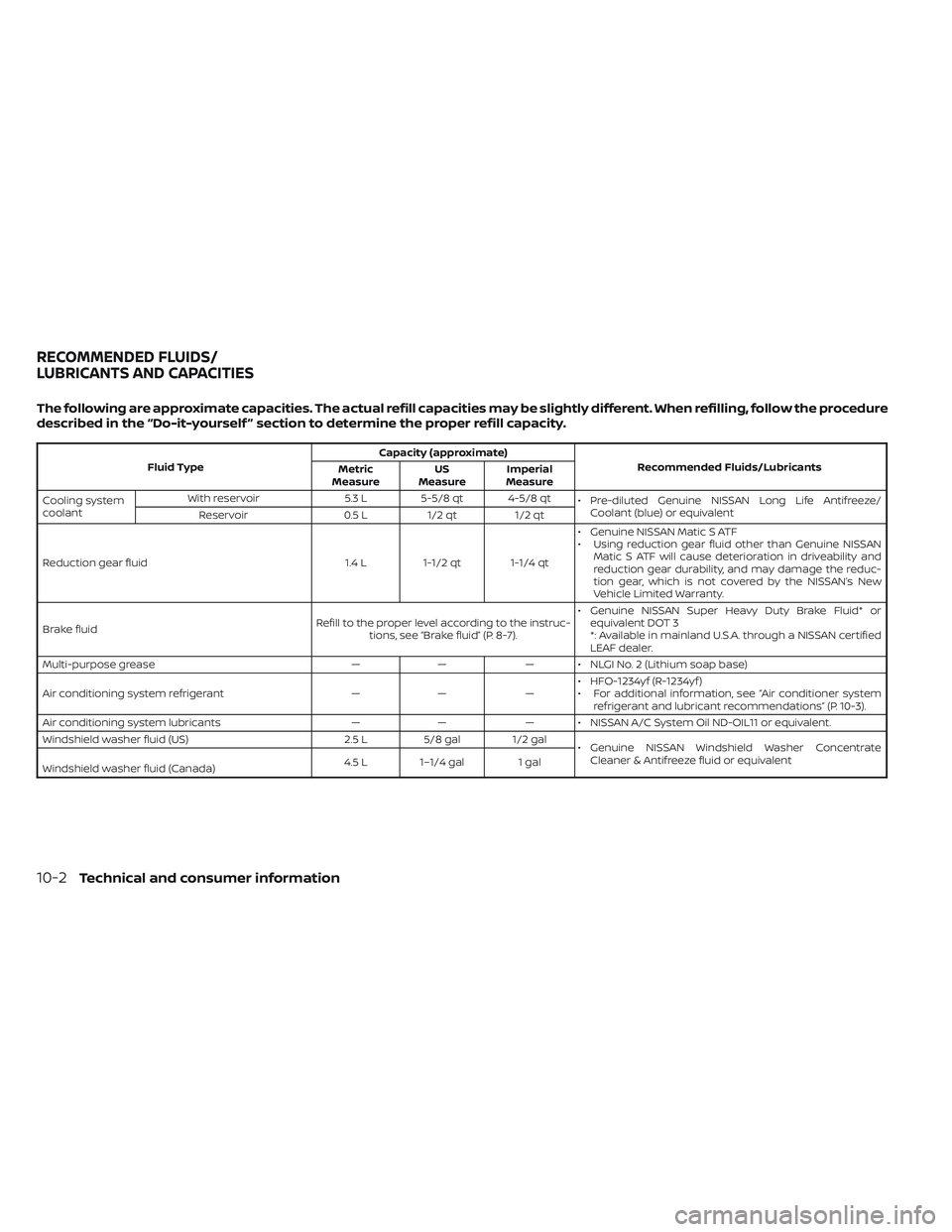
The following are approximate capacities. The actual refill capacities may be slightly different. When refilling, follow the procedure
described in the “Do-it-yourself ” section to determine the proper refill capacity.
Fluid TypeCapacity (approximate)
Recommended Fluids/Lubricants
Metric
Measure US
Measure Imperial
Measure
Cooling system
coolant With reservoir
5.3 L 5-5/8 qt 4-5/8 qt
• Pre-diluted Genuine NISSAN Long Life Antifreeze/
Coolant (blue) or equivalent
Reservoir 0.5 L1/2 qt 1/2 qt
Reduction gear fluid 1.4 L1-1/2 qt 1-1/4 qt • Genuine NISSAN Matic S ATF
• Using reduction gear fluid other than Genuine NISSAN
Matic S ATF will cause deterioration in driveability and
reduction gear durability, and may damage the reduc-
tion gear, which is not covered by the NISSAN’s New
Vehicle Limited Warranty.
Brake fluid Refill to the proper level according to the instruc-
tions, see “Brake fluid” (P. 8-7). • Genuine NISSAN Super Heavy Duty Brake Fluid* or
equivalent DOT 3
*: Available in mainland U.S.A. through a NISSAN certified
LEAF dealer.
Multi-purpose grease —— — • NLGI No. 2 (Lithium soap base)
Air conditioning system refrigerant —— —• HFO-1234yf (R-1234yf )
• For additional information, see “Air conditioner system
refrigerant and lubricant recommendations” (P. 10-3).
Air conditioning system lubricants —— — • NISSAN A/C System Oil ND-OIL11 or equivalent.
Windshield washer fluid (US) 2.5 L5/8 gal 1/2 gal
• Genuine NISSAN Windshield Washer Concentrate
Cleaner & Antifreeze fluid or equivalent
Windshield washer fluid (Canada) 4.5 L 1–1/4 gal 1 gal
RECOMMENDED FLUIDS/
LUBRICANTS AND CAPACITIES
10-2Technical and consumer information
Page 605 of 612
Ceiling light...................2-73Center console................2-66Charge port lid.................3-20Charge port lid switch............2-61ChargingCharge port lid...............3-20Charging related indicator light. . .CH-49Normal charge..............CH-9Precautions on charging........CH-2Quick charge..........CH-35, CH-38Specifications................10-4Trickle charge...............CH-11Charging information............10-23Charging methods.............CH-43Charging related indicator light.....CH-49Charging related remote function. . .CH-48Charging status indicator light.....CH-49Charging the Li-ion battery........EV-12Charging troubleshooting guide. . . .CH-56CheckingChecking bulbs...............2-16Checking coolant level...........8-6Child restraint with top tether strap. . . .1-27Child restraints..............1-22,1-24Booster seats................1-40LATCH (Lower Anchors and Tethers for
CHildren) System..............1-24Precautions on child restraints.....1-22Top tether strap...............1-27Child safety...................1-19Child safety rear door lock..........3-6Chimes, audible reminders.........2-25Circuit breaker, fusible link..........8-17Cleaning exterior and interior......7-2,7-4
ClimateClimate control system refrigerant and
lubricant recommendations
......4-43Climate controlClimate control service..........4-43Climate control systemAir conditioner...............4-29Climate control operation........4-29Heater....................4-29Climate Ctrl. Timer..............4-38Clock.......................2-12Cold tire pressures..............10-25Cold weather driving............5-173ConsoleCenter console...............2-66CoolantCapacities and recommended
fuel/lubricants
...............10-2Changing coolant..............8-6Checking coolant level...........8-6Cooling system................ .8-5Corrosion protection..............7-7Cruise control.................5-65Cup holders................. .2-67
D
Defroster switch
Rear window and outside mirror defroster
switch
................... .2-49Dimensions and weights..........10-6Dimmer switch for instrument panel. . .2-56
Display
Information display............2-26Door locks................... .3-4Driving
Cold weather driving...........5-173Driving vehicle...............5-14Precautions when starting and
driving.................... .5-4Driving range..................2-8Driving the vehicle..............EV-18Driving vehicle.................5-14Dynamic driver assistance switch.....2-61e-Pedal......................2-13e-Pedal system................5-21
E
ECO
ECO switch................ .2-58Eco Drive Report...............5-157ECO mode...............2-13,5-157ECO switch.................. .2-58Efficient use of your vehicle........EV-23Electric shif t control system........5-14Electronic parking brake...........5-19Emblem light..................2-57Emergency call (SOS) button........2-60Emergency charge.............CH-11Emergency EV (Electric Vehicle)
shut off...................5-12,6-3Emergency shutoff system........EV-10Emission control information label. . . .10-8EV Characteristics..............EV-11
11-2