2023 NISSAN ALTIMA automatic transmission
[x] Cancel search: automatic transmissionPage 320 of 644
Each time the engine is started, or when
the shif t lever is shif ted to any position
other than D (Drive), the drive sport mode
will automatically turn off.
Accelerator downshif t
— in D (Drive) position —
For passing or hill climbing, depress the
accelerator pedal to the floor. This shif ts
the transmission down into a lower gear,
depending on the vehicle speed.
High fluid temperature protection
mode
This transmission has a high fluid tem-
perature protection mode. If the fluid tem-
perature becomes too high (for example,
when climbing steep grades in high tem-
peratures with heavy loads, such as when
towing a trailer), engine power and, under
some conditions, vehicle speed will be de-
creased automatically to reduce the
chance of transmission damage. Vehicle
speed can be controlled with the accelera-
tor pedal, but the engine and vehicle speed
may be limited.
Fail-safe
If the vehicle is driven under extreme
conditions, such as excessive wheel
spinning and subsequent hard braking,
the fail-safe system may be activated.
The Malfunction Indicator Light (MIL)
may come on to indicate the fail-safe
mode is activated. For additional infor-
mation, see “Malfunction Indicator Light
(MIL)” (P. 2-15). This will occur even if all
electrical circuits are functioning prop-
erly. In this case, place the ignition switch
in the OFF position and wait for 10 sec-
onds. Then push the switch back to the
ON position. The vehicle should return to
its normal operating condition. If it does
not return to its normal operating condi-
tion, have the transmission checked. It is
recommended that you visit a NISSAN
dealer for this service.
WARNING
When the high fluid temperature pro-
tection mode or fail-safe operation oc-
curs, vehicle speed may be gradually
reduced. The reduced speed may be
lower than other traffic, which could in-
crease the chance of a collision. Be es-
pecially careful when driving. If neces-
sary, pull to the side of the road at a safe
place and allow the transmission to re-
turn to normal operation, or have it re-
paired if necessary.
5-24Starting and driving
Page 475 of 644
When the vehicle is stopped on a hill, the hill
start assist system automatically keeps
the brakes applied to help prevent the ve-
hicle from rolling backward in the time it
takes the driver to release the brake pedal
and apply the accelerator.
The hill start assist system will operate au-
tomatically under the following conditions:
• The transmission is shif ted to a forwardor reverse gear.
• The vehicle is stopped completely on a hill by applying the brake. The maximum
holding time is 2 seconds. Af ter 2 sec-
onds the vehicle will begin to roll back and
the hill start assist system will stop oper-
ating completely.
The hill start assist system will not operate
when the shif t lever is placed in the N (Neu-
tral) or P (Park) position or on a flat and level
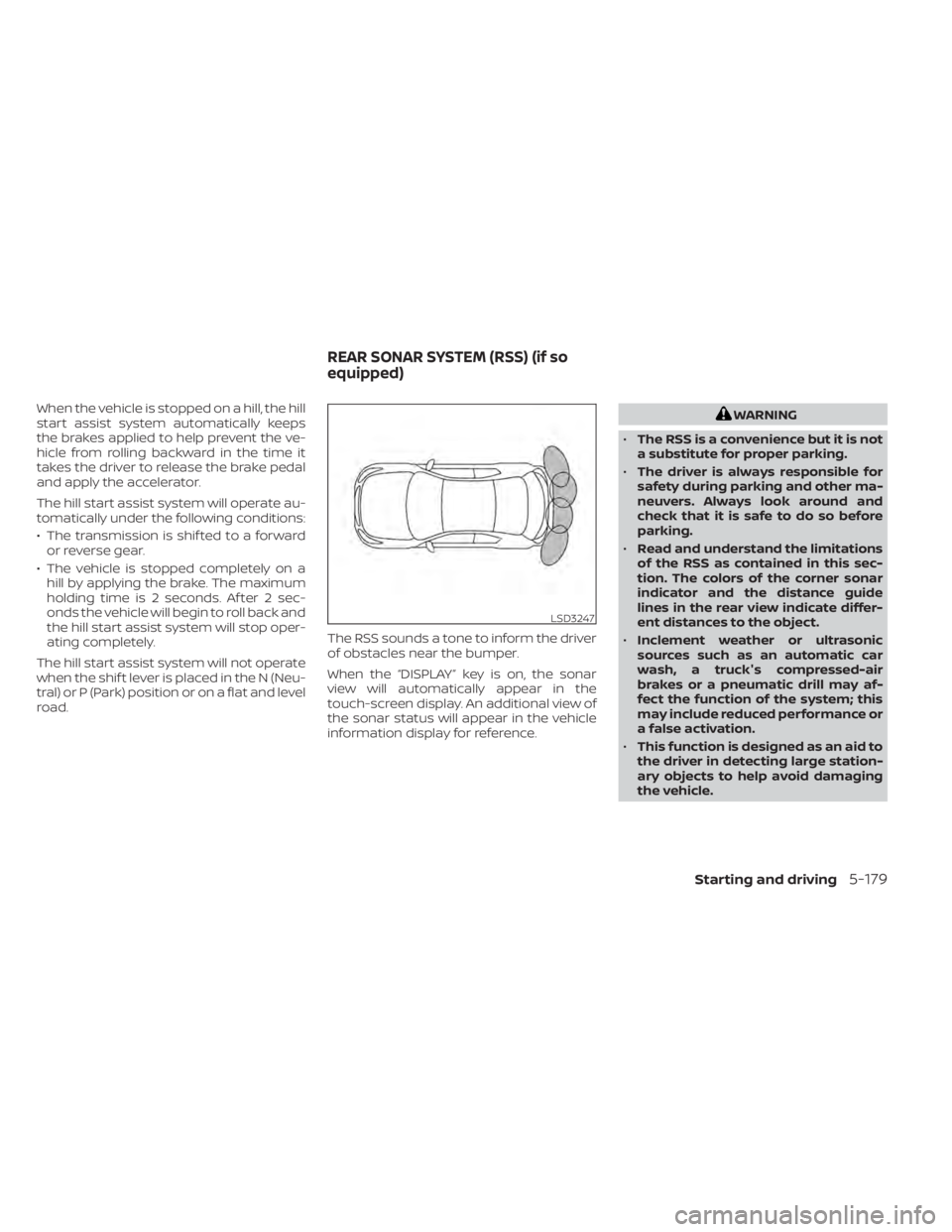
road. The RSS sounds a tone to inform the driver
of obstacles near the bumper.
When the “DISPLAY” key is on, the sonar
view will automatically appear in the
touch-screen display. An additional view of
the sonar status will appear in the vehicle
information display for reference.WARNING
• The RSS is a convenience but it is not
a substitute for proper parking.
• The driver is always responsible for
safety during parking and other ma-
neuvers. Always look around and
check that it is safe to do so before
parking.
• Read and understand the limitations
of the RSS as contained in this sec-
tion. The colors of the corner sonar
indicator and the distance guide
lines in the rear view indicate differ-
ent distances to the object.
• Inclement weather or ultrasonic
sources such as an automatic car
wash, a truck's compressed-air
brakes or a pneumatic drill may af-
fect the function of the system; this
may include reduced performance or
a false activation.
• This function is designed as an aid to
the driver in detecting large station-
ary objects to help avoid damaging
the vehicle.
LSD3247
REAR SONAR SYSTEM (RSS) (if so
equipped)
Starting and driving5-179
Page 528 of 644
CAUTION
• NISSAN recommends using Genuine
NISSAN CVT Fluid NS-3 (or equiva-
lent) ONLY in NISSAN CVTs. Do not mix
with other fluids.
• Do not use Automatic Transmission
Fluid (ATF) or manual transmission
fluid in a NISSAN CVT, as it may dam-
age the CVT. Damage caused by the
use of fluids other than as recom-
mended is not covered under
NISSAN's New Vehicle Limited War-
ranty outlined in your Warranty Infor-
mation Booklet.
• Using fluids that are not equivalent
to Genuine NISSAN CVT Fluid NS-3
may also damage the CVT. Damage
caused by the use of fluids other than
as recommended is not covered un-
der NISSAN's New Vehicle Limited
Warranty outlined in your Warranty
Information Booklet.
When checking or replacement of CVT fluid
is required, it is recommended that you visit
a NISSAN dealer for this service. For additional information on brake fluid
specification, see “Recommended fluids/
lubricants and capacities” (P. 10-2).
WARNING
• Use only new fluid from a sealed con-
tainer. Old, inferior or contaminated
fluid may damage the brake system.
The use of improper fluids can dam-
age the brake system and affect the
vehicle's stopping ability.
• Clean the filler cap before removing. •
Brake fluid is poisonous and should
be stored carefully in marked con-
tainers out of reach of children.
CAUTION
Do not spill the fluid on any painted sur-
faces. This will damage the paint. If fluid
is spilled, immediately wash the sur-
face with water.
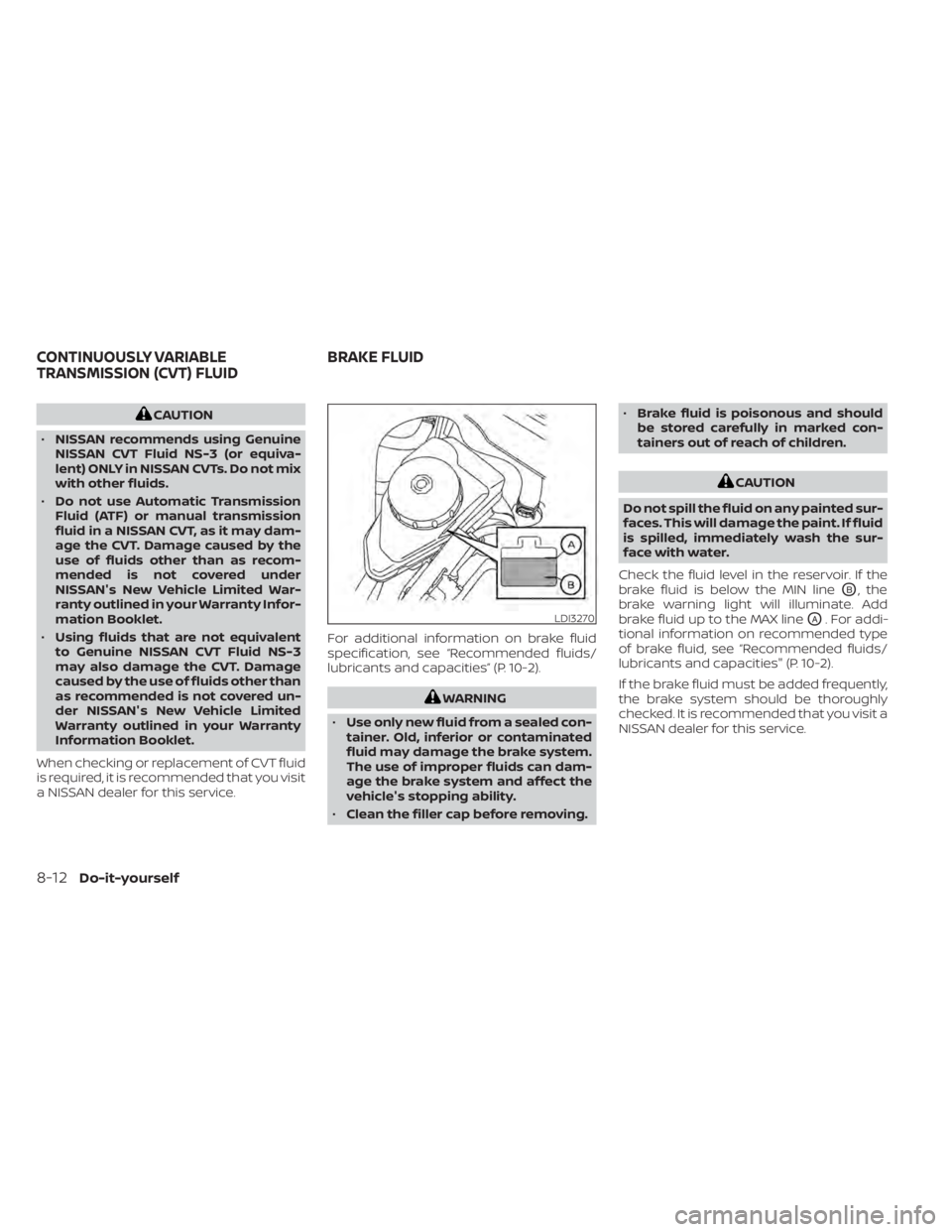
Check the fluid level in the reservoir. If the
brake fluid is below the MIN line
OB, the
brake warning light will illuminate. Add
brake fluid up to the MAX line
OA. For addi-
tional information on recommended type
of brake fluid, see “Recommended fluids/
lubricants and capacities" (P. 10-2).
If the brake fluid must be added frequently,
the brake system should be thoroughly
checked. It is recommended that you visit a
NISSAN dealer for this service.LDI3270
CONTINUOUSLY VARIABLE
TRANSMISSION (CVT) FLUID BRAKE FLUID
8-12Do-it-yourself
Page 629 of 644
Starting the engine............5-16Engine Block Heater.............5-186Engine coolant temperature gauge. . . .2-6Event Data recorders........10-24, 10-25Exhaust gas (Carbon monoxide)......5-4Explanation of maintenance items.....9-2Explanation of scheduled maintenance
items.......................9-5Extended storage switch..........2-70Eyeglass case.................2-73
F
F.M.V.S.S. certification label.........10-13Flashers (See hazard warning flasher
switch)......................6-2Flat tire...................6-3, 6-4Floor mat positioning aid...........7-6Fluid
Brake fluid..................8-12Capacities and recommended
fuel/lubricants...............10-2Continuously Variable Transmission (CVT)
fluid......................8-12Engine coolant................8-5Engine oil...................8-7Windshield-washer fluid.........8-13Fog light switch................2-63Front air bag system (See supplemental
restraint system)...............1-54Front power seat adjustment........1-4Front seats....................1-2Front-door pocket...............2-71
FuelCapacities and recommended
fuel/lubricants
...............10-2Fuel economy...............5-168Fuel gauge..................2-7Fuel octane rating.............10-6Fuel recommendation..........10-4Fuel-filler door and cap..........3-25Fuel-filler door lock opener lever. . . .3-25Loose fuel cap warning......2-30, 2-46Fuel efficient driving tips..........5-167Fuel gauge....................2-7Fuel-filler door.................3-25Fuses.......................8-21Fusible links..................8-22
G
Garage door opener, HomeLink® Universal
Transceiver............2-81, 2-83, 2-84Gas cap.....................3-25GaugeEngine coolant temperature gauge. . .2-6Fuel gauge..................2-7Speedometer................2-4Tachometer................ .2-6Trip odometer................2-5General maintenance.............9-2Glove box....................2-72Glove box lock.................2-72
H
Hands-free phone system, Bluetooth®. .4-67Hazard warning flasher switch........6-2Head restraints.................1-8Headlight and turn signal switch.....2-57Headlight control switch...........2-57Headlights...................8-25Heated seat switches............2-64Heated steering wheel............2-65Heater
Heater and air conditioner
controls
................4-33, 4-41Heater operation..........4-34, 4-42Hill start assist system...........5-178HomeLink® Universal
Transceiver............2-81, 2-83, 2-84Hood.......................3-22Horn...................... .2-64
I
Ignition switch
Push-button ignition switch.......5-13Immobilizer system..........2-54, 5-16Important vehicle information label. . .10-13In-cabin microfilter..............8-18Increasing fuel economy..........5-168IndicatorNISSAN Intelligent Key® battery discharge
indicator
...................5-15Inside automatic anti-glare mirror. . . .3-29Instrument brightness control.......2-62
11-3
Page 633 of 644
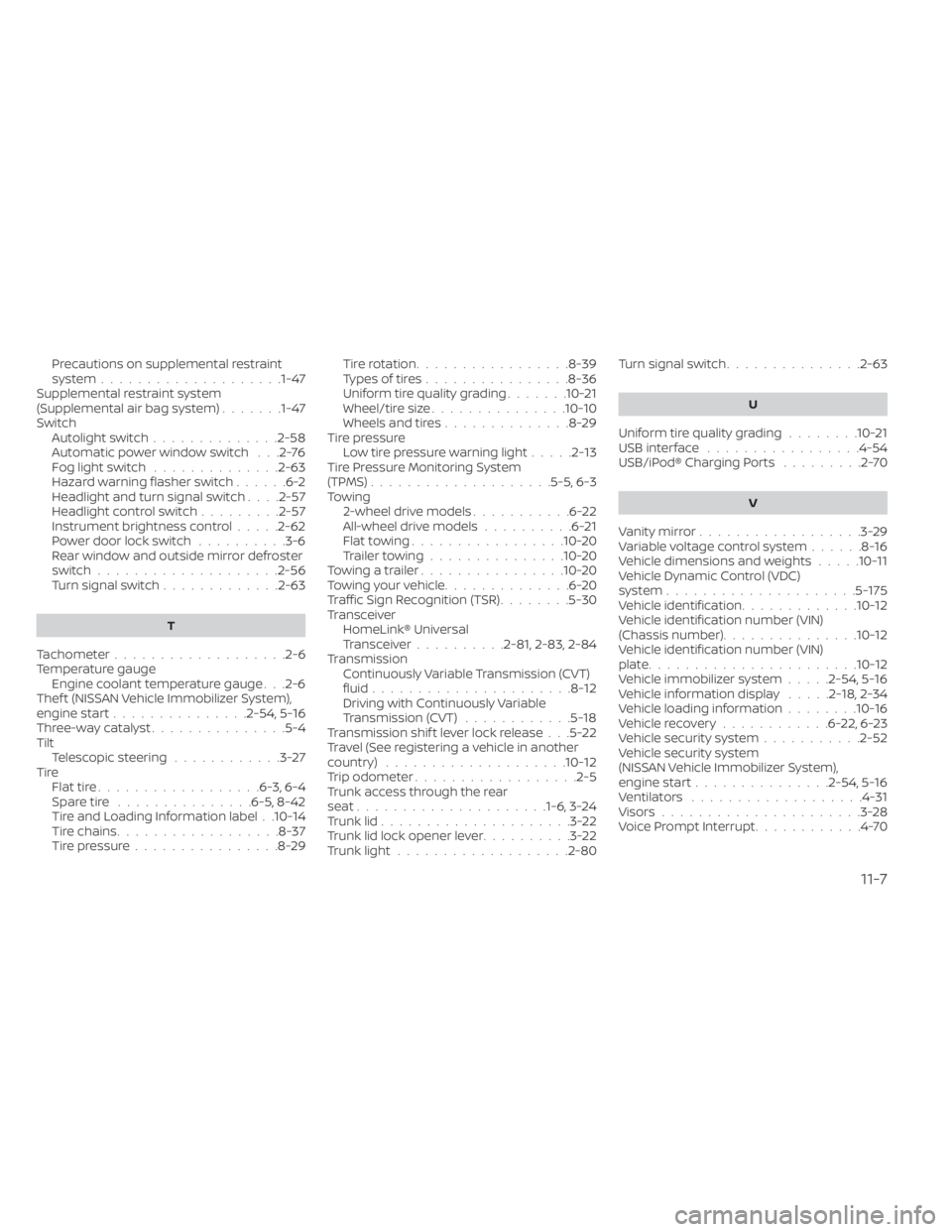
Precautions on supplemental restraint
system....................1-47Supplemental restraint system
(Supplemental air bag system).......1-47Switch
Autolight switch..............2-58Automatic power window switch. . .2-76Fog light switch..............2-63Hazard warning flasher switch......6-2Headlight and turn signal switch. . . .2-57Headlight control switch.........2-57Instrument brightness control.....2-62Power door lock switch..........3-6Rear window and outside mirror defroster
switch................... .2-56Turn signal switch.............2-63
T
Tachometer...................2-6Temperature gauge
Engine coolant temperature gauge. . .2-6Thef t (NISSAN Vehicle Immobilizer System),
engine start...............2-54, 5-16Three-way catalyst...............5-4TiltTelescopic steering............3-27TireFlat tire................. .6-3, 6-4Spare tire...............6-5, 8-42Tire and Loading Information label. .10-14Tire chains..................8-37Tire pressure................8-29
Tire rotation.................8-39Types of tires................8-36Uniform tire quality grading.......10-21Wheel/tire size...............10-10Wheels and tires..............8-29Tire pressure
Low tire pressure warning light.....2-13Tire Pressure Monitoring System
(TPMS)................... .5-5, 6-3Towing
2-wheel drive models...........6-22All-wheel drive models..........6-21Flat towing................ .10-20Trailer towing...............10-20Towing a trailer................10-20Towing your vehicle..............6-20Traffic Sign Recognition (TSR)........5-30Transceiver
HomeLink® Universal
Transceiver
..........2-81, 2-83, 2-84TransmissionContinuously Variable Transmission (CVT)
fluid
......................8-12Driving with Continuously Variable
Transmission (CVT)............5-18Transmission shif t lever lock release. . .5-22Travel (See registering a vehicle in another
country)................... .10-12Trip odometer..................2-5Trunk access through the rear
seat.................... .1-6, 3-24Trunk lid.....................3-22Trunk lid lock opener lever..........3-22Trunk light...................2-80
Turn signal switch...............2-63
U
Uniform tire quality grading........10-21USB interface.................4-54USB/iPod® Charging Ports.........2-70
V
Vanity mirror..................3-29Variable voltage control system......8-16Vehicle dimensions and weights.....10-11Vehicle Dynamic Control (VDC)
system.....................5-175Vehicle identification.............10-12Vehicle identification number (VIN)
(Chassis number)...............10-12Vehicle identification number (VIN)
plate...................... .10-12Vehicle immobilizer system.....2-54, 5-16Vehicle information display.....2-18,2-34Vehicle loading information........10-16Vehicle recovery............6-22,6-23Vehicle security system...........2-52Vehicle security system
(NISSAN Vehicle Immobilizer System),
engine start
...............2-54, 5-16Ventilators.................. .4-31Visors......................3-28Voice Prompt Interrupt............4-70
11-7