2023 MAZDA MX5 MIATA driver
[x] Cancel search: driverPage 53 of 503

Do not sit too close to the driver and passenger air bags:
Sitting too close to the driver and passenger air bag modules or placing hands or feet on them
is extremely dangerous. The driver and passeng er air bags inflate with great force and speed.
Serious injuries could occur if someone is too close. The driver should always hold onto only
the rim of the steering wheel. The passenger should keep both feet on the floor. Seat
occupants should adjust their seats as far back as possible and always sit upright against the
seatbacks with seat belts worn properly.
Do not sit too close to a door or lean against doors in vehicles with side air bags:
Sitting too close to the side air bag module s or placing hands on them is extremely
dangerous. A side air bag inflates with great force and speed directly out of the outboard
shoulder of the seat and expands along the door on the side the car is hit. Serious injury could
occur if someone is sitting too close to the d oor or leaning against a window in the seats.
Furthermore, sleeping up against the door or hanging out the driver-side window while
driving could block the side air bag and eliminate the advantages of supplemental
protection. Give the side air bags room to work by sitting in the center of the seat while the
vehicle is moving with seat belts worn properly.
Sit in the center of the seat and wear seat belts properly:
Sitting too close to the side air bag modules or placing hands on them, or sleeping up against
the door or hanging out the windows is extremely dangerous. The side air bags
inflate with
great force and speed directly expanding along th e door on the side the car is hit. Serious
injury could occur if someone is sitting too clos e to the door. Give the side air bags room to
work by sitting in the center of the seat while the vehicle is moving with seat belts worn
properly.
Do not attach objects on or around the area where air bags deploy:
Attaching objects to the air bags or placing something in the area where the air bags deploy
is dangerous. In an accident, an object coul d interfere with air bag inflation and injure the
occupants. Furthermore, the bag could be da maged causing gases to release. Always keep
the deployment area of the air bag modules free of any obstructions.
For example, you should not do any of the following as it may interfere with air bag
deployment.
Do not put a covering on or lean anything against areas such as the dashboard and lower
portion of the instrument panel that blocks the passenger front air bag.
Do not use seat covers on the front seats equipped with in-seat side air bags.
Do not hang any backpacks, bags or pouches that cover the sides of the seats that block the
side air bags.
Essential Safety Equipment
SRS Air Bags
2-38
MX-5_8LE7-EA-22K_Edition1_old 2022-8-4 8:12:24
Page 57 of 503

Supplemental Restraint System Components
Driver/Passenger inflators and air bags
Crash sensors, and diagnostic module (SAS unit)
Seat belt pretensioners (page 2-18)
Front air bag sensors
Side crash sensors
Air bag/seat belt pretensioner system warning light (page 4-27)
Side inflators and air bags
Passenger air bag deactivation indicator light (page 2-49)
Passenger occupant classification sensor (page 2-49)
Passenger occupant classification module
Essential Safety Equipment
SRS Air Bags
2-42
MX-5_8LE7-EA-22K_Edition1_old 2022-8-4 8:12:24
Page 58 of 503

How the SRS Air Bags Work
Your Mazda is equipped with the following types of SRS air bags. SRS air bags are
designed to work together with the seat belts to help to reduce injuries during an accident.
The SRS air bags are designed to provide further protection for passengers in addition to the
seat belt functions. Be sure to wear seat belts properly.
▼ Seat Belt Pretensioners
The seat belt pretensioners are designed to deploy in moderate or severe frontal, near frontal
collisions.
In addition, during a side collision, the pr
etensioner operates. The pretensioners operate
differently depending on what types of air bags are equipped. For more details about seat
belt pretensioner operation, refer to the SRS Air Bag Deployment Criteria (page 2-46).
▼ Driver Air Bag
The driver's air bag is mounted in the steering wheel.
When air bag crash sensors detect a frontal impact of greater than moderate force, the
driver's air bag inflates quickly
helping to reduce injury mainly to the driver's head or chest
caused by directly hitting the steering wheel.
For more details about air bag deployment, refer to "SRS Air Bag Deployment Criteria"
(page 2-46).
(Except Mexico)
The driver's dual-stage air bag controls air bag inflation in two energy stages. During an
impact of moderate severity, the driver's ai r bag deploys with lesser energy, whereas during
more severe impacts, it de ploys with more energy.
Essential Safety Equipment
SRS Air Bags
2-43
MX-5_8LE7-EA-22K_Edition1_old 2022-8-4 8:12:24
Page 59 of 503

▼Passenger Air Bag
The passenger air bag is mounted in the passenger dashboard.
The inflation mechanism for the passenger air bag is the same as the driver's air bag.
For more details about air bag deployment,
refer to "SRS Air Bag Deployment Criteria"
(page 2-46).
In addition, the passenger air bag is designed to only deploy when the passenger occupant
classification sensor detects a passenger sitting on the passenger's seat. For details, refer to
the passenger occupant classification system (page 2-49).
▼ Side Air Bags
The side air bags are mounted in the outboard sides of the seatbacks.
When the air bag crash sensors detect a side impact of greater than moderate force, the
system inflates the side air bag only on the side in which the vehicle was hit. The side air
bag inflates quickly to reduce
injury to the driver or passenger's head and chest caused by
directly hitting interior parts such as a door or window.
For more details about air bag deployment, refer to "SRS Air Bag Deployment Criteria"
(page 2-46).
In addition, the passenger side air bag is designed to only deploy when the passenger
occupant classification sensor detects a passenger sitting on the passenger's seat. For details,
refer to the passenger occupant classification system (page 2-49).
Essential Safety Equipment
SRS Air Bags
2-44
MX-5_8LE7-EA-22K_Edition1_old 2022-8-4 8:12:24
Page 61 of 503

SRS Air Bag Deployment Criteria
This chart indicates the applicable SRS equipment that will deploy depending on the type of
collision.
(The illustrations are the representative cases of collisions.)
SRS equip‐
ment Types of collision
A severe frontal/near frontal collision A severe side collision
*2A rear collision
Seat belt
pretensioner X*1X*1
No air bag and seat belt
pretensioner will be activat ‐
ed in a rear collision.
Driver air
bag X
Passenger air bag X
*1
Side air bag
X*1 (impact side only)
X : The SRS air bag equipment is designed to deploy in a collision.*1 The passenger front and side air bags and the seat belt pretensioner are designed to deploy when the passenger
occupant classification sensor detects a passenger sitting on the passenger's seat.
*2 In a side collision, the seat belt pretensioners and the side air bags deploy.
NOTEIn a frontal offset collision, the equipped air bags and pretensioners may all deploy depending on the direction,
angle, and rate of impact.
Essential Safety Equipment
SRS Air Bags
2-46
MX-5_8LE7-EA-22K_Edition1_old 2022-8-4 8:12:24
Page 68 of 503

Luggage or other items placed under the passe nger seat or between the passenger seat and
driver seat that push up the passenger seat bottom.
An object, such as a seat cushion, is put on the passenger's seat or between the passenger's
back and the seatback.
A seat cover is put on the passenger's seat.
Luggage or other items are placed on the seat with the child in the child-restraint system.
The seat is washed.
Liquids are spilled on the seat.
The passenger seat is moved backward, pushing into luggage or other items placed behind
it.
Luggage or other items are placed between the passenger seat and driver seat.
An electric device is put on the passenger's seat.
An additional electrical device, such as a seat warmer is installed to the surface of the
passenger seat.
The passenger front and side air bags and seat belt pretensioner systems will deactivate if the
passenger air bag deactivation indicator light turns on.
CAUTION
To assure proper deployment of the front air bag and to prevent damage to the sensor in
the seat cushion:
Do not place sharp objects on the seat cushion or leave heavy luggage on them.
Do not spill any liquids on the seats or under the seats.
To allow the sensors to function pr operly, always perform the following:
Adjust the seats as far back as possible an d always sit upright against the seatbacks with
seat belts worn properly.
If you place your child on the passenger seat , secure the child-restraint system properly
and slide the passenger seat as far back as possible.
Essential Safety Equipment
SRS Air Bags
2-53
MX-5_8LE7-EA-22K_Edition1_old 2022-8-4 8:12:24
Page 73 of 503
Keys
WA R N I N G
Do not leave the key in your vehicle with
children and keep them in a place where
your children will not find or play with
them:
Leaving children in a vehicle with the key is
dangerous. This could result in someone
being badly injured or even killed. Children
may find these keys to be an interesting toy
to play with and could cause the power
windows or other controls to operate, or
even make the vehicle move.
CAUTION
Because the key (transmitter) uses
low-intensity radio waves, it may not
function correctly under the following
conditions:
The key is carried with communication
devices such as cellular phones.
The key contacts or is covered by a
metal object.
The key is near electronic devices such
as personal computers.
Non-Mazda genuine electronic
equipment is installed in the vehicle.
There is equipment which discharges
radio waves near the vehicle.
The key (transmitter) may consume
battery power excessively if it receives
high-intensity radio waves. Do not place
the key near electronic devices such as
televisions or personal computers.
To avoid damage to the key
(transmitter), DO NOT:
Drop the key.
Get the key wet.
Disassemble the key.
Expose the key to high temperatures
on places such as the dashboard or
hood, under direct sunlight.
Expose the key to any kind of magnetic
field.
Place heavy objects on the key.
Put the key in an ultrasonic cleaner.
Put any magnetized objects close to
the key.
NOTE
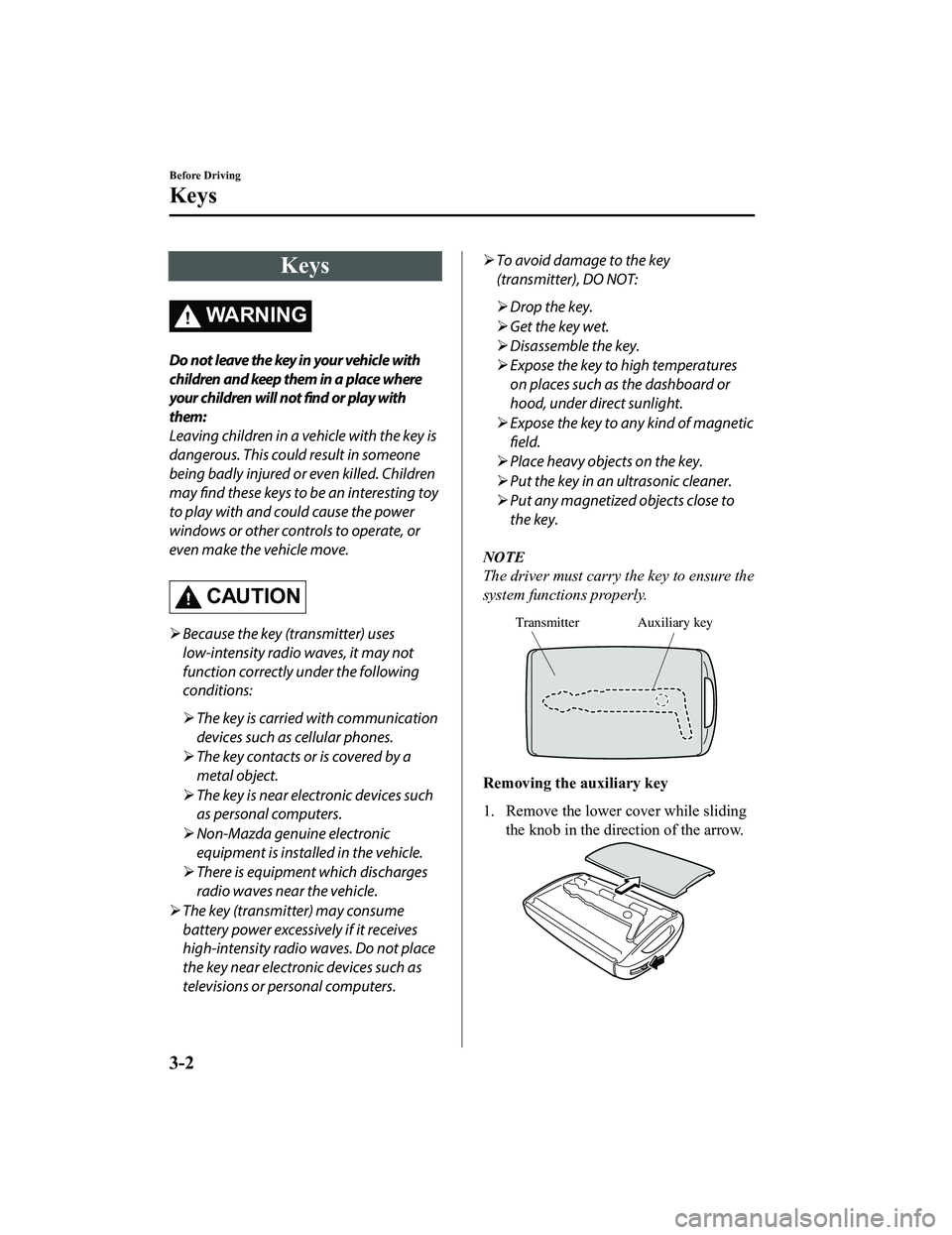
The driver must carry the key to ensure the
system functions properly.
Auxiliary key
Transmitter
Removing the auxiliary key
1. Remove the lower cover while sliding
the knob in the direction of the arrow.
Before Driving
Keys
3-2
MX-5_8LE7-EA-22K_Edition1_old 2022-8-4 8:12:24
Page 77 of 503

Use the following procedure to change the
setting.
1. Switch the ignition off and close bothof the doors and the trunk lid.
2. Open the driver's door.
3. Within 30 seconds of opening the
driver's door, press and hold the LOCK
button on the key for 5 seconds or
longer (Both of the doors and the
fuel-filler lid are locked and unlocked
when the LOCK button on the key is
pressed and held for five seconds.).
The beep sound activates at the
currently set volume. The setting
changes each time the LOCK button on
the key is pressed and the beep sound
activates at the set volume. (If the beep
sound has been set to not activate, it
will not activate.)
4. The setting change is completed by doing any one of the following:
Switching the ignition to ACC or
ON.
Closing the driver's door.
Opening the trunk lid.
Not operating the key for 10
seconds.
Pressing any button except the
LOCK button on the key.
Pressing a request switch.
The operation indicato r light flashes when
the buttons are pressed.
Lock button
To lock the doors and the fuel-filler lid,
press the lock button and the hazard
warning lights will flash once.
A beep sound will be heard once.
To confirm that both doors and the
fuel-filler lid have been locked, press the
lock button again within 5 seconds. If they
are closed and locked, the horn will sound.
NOTE
The doors and the fuel-filler lid can be
locked by pressing the lock button while
any other door or the trunk lid is open.
The hazard warning lights will not flash.
When the lock button is pressed while
any door is open and then the door is
closed, both the doors and the fuel-filler
lid are locked.
Confirm that both doors and the
fuel-filler lid are locked visually or
audibly by use of the double click.
Make sure both doors and the fuel-filler
lid are locked after pressing the button.
(With theft-deterrent system)
When the doors are locked by pressing
the lock button on the key while the
theft-deterrent system is armed, the
hazard warning lights will flash once to
indicate that the system is armed.
Before Driving
Keys
3-6
MX-5_8LE7-EA-22K_Edition1_old 2022-8-4 8:12:24