Page 157 of 583

This is for improved exhaust gaspurification and does not indicate
any parts defect.
Engine-starting is controlled by the
spark ignition system.
This system meets all Canadian
Interference-Causing Equipment
Standard requirements regulating the
impulse electrical field strength of
radio noise.
1. Make sure you are carrying the key.
2. Occupants should fasten their seat belts.
3. Make sure the parking brake is on.
4. Continue to depress the brake pedal firmly until the engine has
completely started.
5. Put the vehicle in park (P). If you must restart the engine while the
vehicle is moving, shift into neutral
(N).
NOTE
The starter will not operate if the
selector lever is not in P or N
position and the brake pedal is not
depressed sufficiently.
6. Make sure that the KEY indicator light (green) in the instrument
cluster and push button start
indicator light (green) turns on.
1. Indicator light
2. Push button start
NOTE
If the push button start indicator
light (green) flashes, make sure
that the key is being carried.
If the push button start indicator
light (green) flashes with the key
being carried, touch the key to
the push button start and start
the engine.
Refer to Engine Start Function
When Key Battery is Dead on
page 4-7.
CAUTION
If the KEY warning indication (red)
is displayed, or the push button
start indicator light (amber) flashes,
this could indicate a problem with
the engine starting system. This may
prevent the engine from starting or
from switching the ignition to ACC
or ON.
Refer to KEY Warning Indication/
Warning Light (Red) on page
7-26.
Have your vehicle inspected at an
Authorized Mazda Dealer as soon
as possible.
NOTE
Under the following conditions,
the KEY warning indication (red)
is displayed after the push button
start is pressed. This informs the
driver that the push button start
will not switch to ACC, even if it
is pressed from off (page 7-26).
The key battery is dead.The key is out of operational
range.
The key is placed in areas where
it is difficult for the system to
detect the signal (page 3-7).
When Driving
Start/Stop Engine
4-6
CX-50_8KB8-EA-22A_Edition2_new 2022-1-6 14:55:18
Page 465 of 583
No.FUSE RAT-
ING PROTECTED COMPONENT
F41 30 A Audio
*
F4220 A Windshield wipers
F43 30 A
Cooling fan
*
F44 30 A Starter
F45 10 A Engine control system
F46 15 A Audio
F47 15 A For protection of various circuits
F48 7.5 A Air bag
F49 15 A Instrument cluster
F50 15 A Room light
F51 15 A
Panorama sunroof
*
F52 15 A
Panorama sunroof*
F53 15 A Engine control system
F54 15 A i-ACTIVSENSE
F55 50 A For protection of various circuits
F56 ――
Maintenance and Care
Owner Maintenance
6-40*Some models.
CX-50_8KB8-EA-22A_Edition2_new 2022-1-6 14:55:18
Page 489 of 583
Route the jumper cables away from parts that will be moving:
Connecting a jumper cable near or to moving parts (cooling fans, belts) is
dangerous. The cable could get caught when the engine starts and cause serious
injury.
CAUTION
Use only a 12 V booster system. You can dama ge a 12 V starter, ignition system, and
other electrical parts beyond repair with a 24 V power supply (two 12 V batteries in
series or a 24 V motor generator set).
1. Move the booster vehicle so that its battery is as close as possible to your
vehicle's battery.
2. Make sure that the power such as for th e headlights and air conditioner is turned
off.
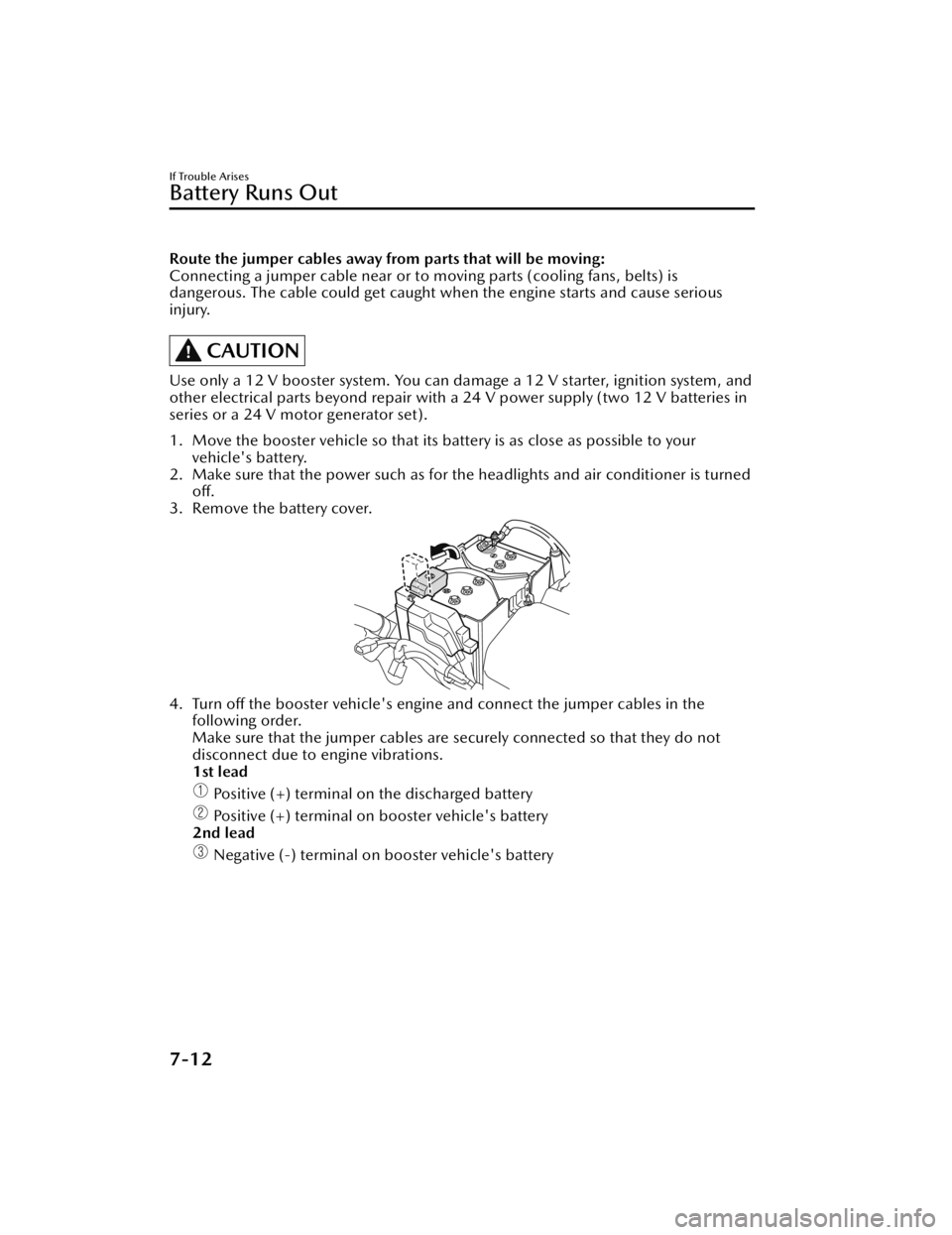
3. Remove the battery cover.
4. Turn off the booster vehicle's engine and connect the jumper cables in the following order.
Make sure that the jumper cables are se curely connected so that they do not
disconnect due to engine vibrations.
1st lead
Positive (+) terminal on the discharged battery
Positive (+) terminal on booster vehicle's battery
2nd lead
Negative (-) terminal on booster vehicle's battery
If Trouble Arises
Battery Runs Out
7-12
CX-50_8KB8-EA-22A_Edition2_new 2022-1-6 14:55:18
