Page 264 of 595

WARNING
Do not rely completely on DAA and
always drive carefully:
The DAA detects driver fatigue and
decreased attentiveness and
encourages the driver to take a rest,
however, it is not designed to prevent
the vehicle from straying. If you rely too
much on the DAA it could lead to an
accident. Drive carefully and operate
the steering wheel appropriately.
In addition, the system may not be
able to detect driver fatigue and
decreased attentiveness correctly
depending on the traffic and driving
conditions. The driver must take
sufficient rest in order to drive safely.
NOTE
The DAA operates when all of the
following conditions are met.
The vehicle speed is about 65 to
140 km/h (41 to 86 mph).
The system detects white (yellow)
lane lines.
The system has completed learning
of the driver’s driving data after 60
minutes have passed since the
driver began driving vehicle.
The DAA does not operate under the
following conditions.
The vehicle speed is less than
about 65 km/h (41 mph).
The vehicle speed exceeds about
140 km/h (86 mph).
The vehicle is making a sharp turn.The vehicle is changing lanes.The system cannot detect white
(yellow) lane lines.
The DAA may not operate normally
under the following conditions.
White (yellow) lane lines are less
visible because of dirt or fading/
patchiness.
The vehicle is jolted or swayed
continuously by strong winds or
rough roads.
The vehicle is driven aggressively.When making frequent lane
changes.
The vehicle is making a curve.The DAA detects driver fatigue and
decreased attentiveness based on
the driving data when the vehicle is
driven at about 65 to 140 km/h (41
to 86 mph) for about 20 minutes.
The driving data will be reset under
the following conditions.
The vehicle is stopped for 15
minutes or longer.
The vehicle is driven at less than
about 65 km/h (41 mph) for
about 30 minutes.
The ignition is switched
off.After the DAA has displayed the first
message encouraging rest, it does
not display the next one until 60
minutes have passed.
When Driving
i-ACTIVSENSE
4-117
CX-30_8LD3-EA-22J_Edition1_new 2022-6-7 13:06:59
Page 284 of 595

Tra ffi c J a m A s s i s t ( TJ A )*
▼Tra ffi c
Jam Assist (TJA)
The TJA is a system which consists of a
headway control function and a
steering assist function for reducing
driver fatigue during traffic jams when
driving on expressways or highways.
This system performs headway control
to maintain a constant distance
between your vehicle and a vehicle
ahead at a preset vehicle speed
without you having to use the
accelerator or brake pedal. Even
further, with the steering assist
function, when vehicle lane lines are
detected, the function assists the driver
in keeping the vehicle within the lane
lines. If lane lines are not detected, the
function provides the driver driving
assistance in keeping the vehicle along
the motion path with the vehicle
ahead.
WARNING
Do not rely completely on
TJ A :
The TJA is not an automated driving
system. In addition, the functions
have limitations. Do not rely
completely on the system and always
stay on course using the steering
wheel.
Set a vehicle speed within the speed
limit according to the road
conditions and the weather
conditions.
The TJA may not be able to detect a
vehicle ahead depending on the type
of vehicle ahead and its conditions,
the weather conditions, and the road
conditions. Additionally, the system
might be unable to decelerate
sufficiently if a vehicle ahead applies
the brakes suddenly, another vehicle
cuts into the driving lane, or the difference in vehicle speed between
your vehicle and the vehicle ahead is
larger, which could result in an
accident. Check the surrounding
conditions and always drive carefully
while keeping a safe distance from
vehicles ahead and on-coming
vehicles.
For the purposes of safety, switch the
TJA off when it is not being used.
Leaving the TJA turned on when it is
not in use is dangerous as it could
operate unexpectedly, resulting in an
accident.
Do not use the TJA under the
following conditions. Otherwise, it
may result in an accident.
General roads other than
expressways or highways (Driving
under these conditions using the TJA
is not possible.)
Roads with sharp curves and where
vehicle traffic is heavy with
insufficient space between vehicles,
or roads where frequent and
repetitive acceleration and
deceleration occur (Driving under
these conditions using the TJA is not
possible).
When Driving
i-ACTIVSENSE
*Some models.4-137
CX-30_8LD3-EA-22J_Edition1_new 2022-6-7 13:06:59
Page 438 of 595
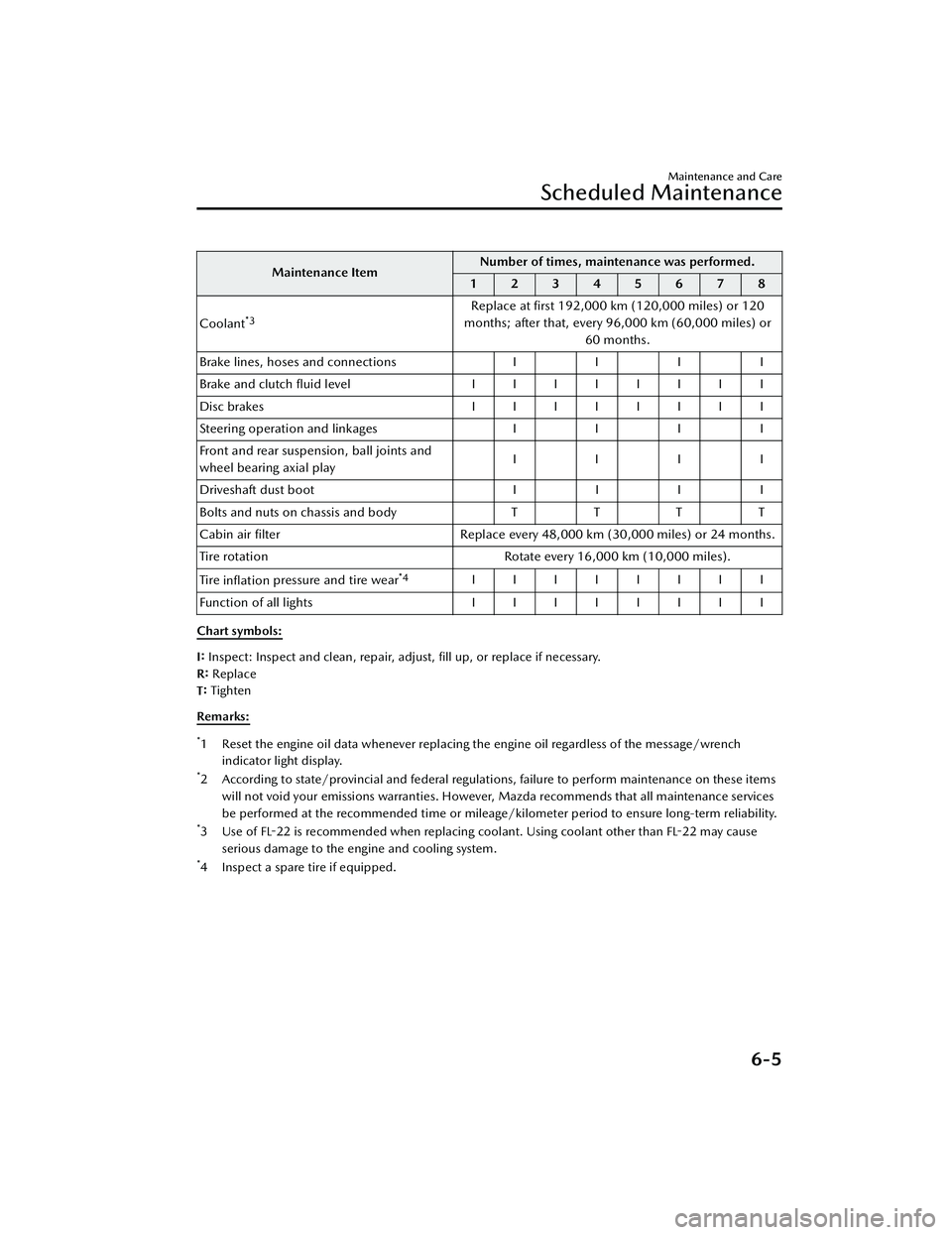
Maintenance ItemNumber of times, maintenance was performed.
12345678
Coolant
*3Replace at first 192,000 km (120,000 miles) or 120
months; after that, every 96,000 km (60,000 miles) or 60 months.
Brake lines, hoses and connections I I I I
Brake and clutch fluid level IIIIIIII
Disc brakes IIIIIIII
Steering operation and linkages I I I I
Front and rear suspension, ball joints and
wheel bearing axial play IIII
Driveshaft dust boot I I I I
Bolts and nuts on chassis and body T T T T
Cabin air filter Replace every 48,000 km (30,000 miles) or 24 months.
Tire rotation Rotate every 16,000 km (10,000 miles).
Tire inflation pressure and tire wear
*4IIIIIIII
Function of all lights IIIIIIII
Chart symbols:
I: Inspect: Inspect and clean, repair, adjust,
fill up, or replace if necessary.
R: Replace
T: Tighten
Remarks:
*1 Reset the engine oil data whenever replacing the engine oil regardless of the message/wrench indicator light display.
*2 According to state/provincial and federal regulations, failure to perform maintenance on these itemswill not void your emissions warranties. However, Mazda recommends that all maintenance services
be performed at the recommended time or mileage/kilometer period to ensure long-term reliability.
*3Use of FL-22 is recommended when replacing coolant. Using coolant other than
FL-22 may cause
serious damage to the engine and cooling system.
*4 Inspect a spare tire if equipped.
Maintenance and Care
Scheduled Maintenance
6-5
CX-30_8LD3-EA-22J_Edition1_new 2022-6-7 13:06:59