Page 6 of 241
Horn 68Drive Selector 69Using the Drive Selector 69
Vehicle Creep 69
Drive Modes 70
Using Neutral 70
Drive Modes 70
Limited Power Mode 70
Mirrors 72
Adjusting the Exterior Side Mirror Position 72
Interior Rear View Mirror 72
Exterior Lights 73
Exterior Lights Control 73
High Beam Headlights 73
Rear Fog Light 74 Turn Signals 74Hazard Warning Lights 75
Interior Lights 76
Interior Lights 76
Ambient Lighting 76
Wipers and Washers 77
Wipers 77
Washers 77
Brakes 78Braking Systems 78
Anti-Lock Braking System (ABS) 78
Regenerative Braking 79
Vehicle Hold 80
Parking Brake 80
Brake Pad Wear 81
Lucid Stability Control 82
Lucid Stability Control 82
Getting Maximum Range 83
Driving Tips to Maximize Range 83
Heating, Ventilation Air Conditioning 84
Temperature Control 84
Defrost 85
Interior Equipment 86
Sun Visors 86
Glove Box 86
Page 87 of 241
To turn on the high beam headlights, push the
left steering column lever away from you. To
cancel, pull the lever towards you.
The high beam indicator displays
on the Instrument Cluster whenever
high beams are On.
Headlight High Beam Flash
You can flash the headlight high beams even
if the low beams are OFF by pulling the lever
towards you and releasing it.
See High Beam Assist on page 103 for more
information on High Beam assistance.
Rear Fog Light
Note: Regulations concerning the use of fog
lights vary by country.
The rear fog light is considerably brighter than
ordinary tail lights and should only be used to help other road users see your vehicle in
low-visibility conditions such as fog or heavy
snowfall.
Use the left Cockpit Panel to turn the rear fog
lamp On or Off.
The rear fog light indicator is
displayed on the Cockpit Panel
whenever the rear fog light is On.
Note: The rear fog light is automatically turned
Off each time the vehicle is powered On, and
will need to manually turned On if required.
Note: The rear fog lights can be turned on only
when the headlights are manually turned on
or in AUTO mode at night.
Turn Signals
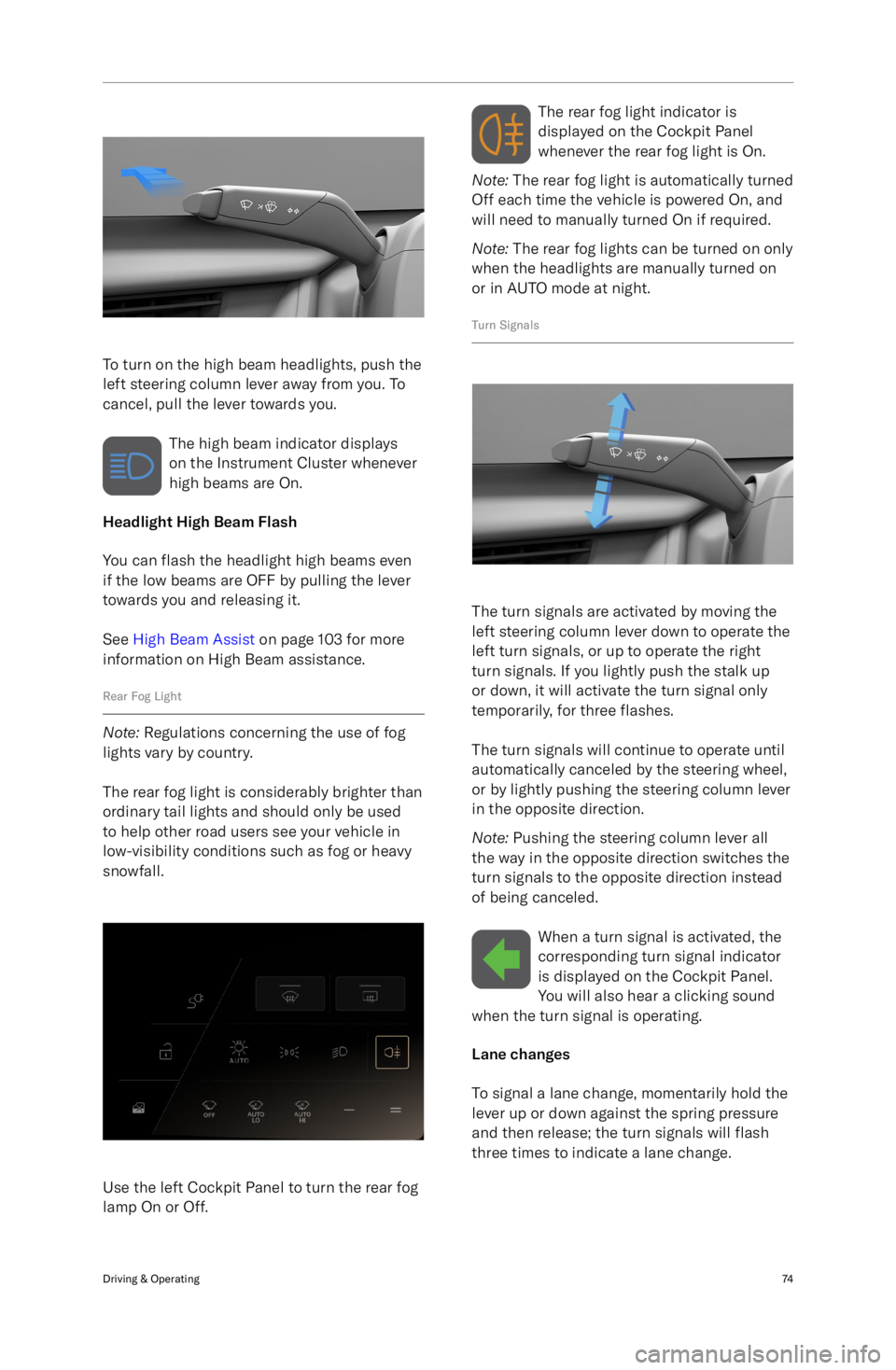
The turn signals are activated by moving the
left steering column lever down to operate the
left turn signals, or up to operate the right
turn signals. If you lightly push the stalk up
or down, it will activate the turn signal only
temporarily, for three flashes.
The turn signals will continue to operate until
automatically canceled by the steering wheel,
or by lightly pushing the steering column lever
in the opposite direction.
Note: Pushing the steering column lever all
the way in the opposite direction switches the
turn signals to the opposite direction instead
of being canceled.
When a turn signal is activated, thecorresponding turn signal indicator
is displayed on the Cockpit Panel.
You will also hear a clicking sound
when the turn signal is operating.
Lane changes
To signal a lane change, momentarily hold the
lever up or down against the spring pressure
and then release; the turn signals will flash
three times to indicate a lane change.
Driving & Operating74
Page 214 of 241

Vehicle Fire
FirefightingWARNING: When a fire is involved,
consider the entire vehicle to be
energized. Always wear full personal
protective equipment (PPE), including
a self-contained breathing apparatus
(SCBA).WARNING: Extinguishing any vehicle
fire is best accomplished by
firefighting professionals. Contact
your local authorities or fire
department for help.
A vehicle battery fire presents a risk of
exposure to high heat or toxic gases. It
can take copious amounts of water applied
directly to the battery to extinguish and cool a
battery fire. Establish or request an additional
water supply from nearby sources.
In the absence of a water supply, use dry
chemicals, such as Carbon dioxide (CO2), foam, or any other typical fire-extinguishing
agent, to fight the fire until a water supply is
available.
Extinguishing smaller fires that do not involve
a high-voltage battery follows the standard
firefighting procedures.
A burning or a heated battery releases toxic
vapors. Responders should always protect
themselves with full PPE (including a SCBA)
and take appropriate measures to protect
civilians from the incident. Use fog streams
or positive-pressure ventilation fans (PPV) to
direct smoke and vapors away from other
responders and civilians.
After knock down
Make sure any fires are knocked down before
entering a hot zone. Heat combined with
flames can compromise the airbag inflators,
stored gas inflation cylinders, gas struts, and
other components, resulting in an unexpected
explosion.
During vehicle inspections, always use
insulated tools and do not make contact with
any high-voltage components.
Use a thermal imaging camera to measure the temperature of the high-voltage battery
and monitor heating or cooling trends.
Before releasing the vehicle to second
responders (such as law enforcement or vehicle transporters) or otherwise leaving the
incident, completely cool the battery with no
fire, smoke, or heating present for at least one
hour. Always notify second responders of the
risk of battery re-ignition.Roadside Assistance & Emergency Information201
