2023 JEEP WRANGLER fuel filter
[x] Cancel search: fuel filterPage 313 of 396

SERVICING AND MAINTENANCE311
MAINTENANCE PLAN — DIESEL FUEL UP TO B5 BIODIESEL
Refer to the maintenance plan for the required maintenance intervals.
At Every Oil Change Interval As Indicated By Oil Change Indicator System
Change oil and filter.
Completely fill the Diesel Exhaust Fluid tank.
Drain water from fuel filter assembly.
Rotate the tires. Rotate at the first sign of irregular wear, even if it occurs before the oil indicator system turns on.
Inspect battery and clean and tighten terminals as required.
Inspect the CV/Universal joints.
Inspect brake pads, shoes, rotors, drums, hoses and parking brake.
Inspect engine cooling system protection and hoses.
Inspect exhaust system.
Inspect engine air cleaner filter if using in dusty or off-road conditions; replace engine air cleaner filter if necessary.
At Every Second Oil Change Interval As Indicated By Oil Change Indicator System
Change fuel filter.8
23_JL_OM_EN_USC_t.book Page 311
Page 314 of 396

312SERVICING AND MAINTENANCE
Mileage Or Time Passed (Whichever Comes First)
10,000
20,000
30,000
40,000
50,000
60,000
70,000
80,000
90,000
100,000
110,000
120,000
130,000
140,000
150,000
Or Years: 1 2 3 4 5 6 7 8 9 10 11 12 13 14 15
Or Kilometers:
16,000
32,000
48,000
64,000
80,000
96,000
112,000
128,000
144,000
160,000
176,000
192,000
208,000
224,000
240,000
Additional Inspections
Completely fill the Diesel Exhaust Fluid tank. X X X X X X X X X X X X X X X
Inspect the CV/Universal joints. X X X X X X X X X X X X X X X
Inspect front suspension, tie rod ends, and replace if necessary. XXXXXXX
Inspect the front and rear axle fluid, change if using your vehicle for
police, taxi, fleet, off-road or frequent trailer towing. X
XXXXXX
Inspect the brake linings, parking brake function. XXXXXXX
Inspect transfer case fluid. XXX X
Additional Maintenance
Drain water from fuel filter assembly. X X X X X X X X X X X X X X X
Replace fuel filters and drain water from the fuel filter assembly. Under normal conditions the diesel fuel filter should be replaced every other oil change and must not
exceed 20,000 miles (32,000 km) if using diesel fuel up to B5. If the vehicle is being used in severe operating conditions, or in certain geographical areas of the country (Pennsylvania, New York, Ohio, Maryland, West Virginia, Arkansas, Oklahoma, Kansas, Iowa, Missouri and Nebraska) due to fuel
cleanliness issues, it is recommended to replace the fuel filter every oil change and must not exceed 10,000 miles.
Replace engine air cleaner filter. XXXXX
Replace the cabin air filter. To be replaced every 12,000 miles (19,000 km).
23_JL_OM_EN_USC_t.book Page 312
Page 315 of 396

SERVICING AND MAINTENANCE313
ADDITIONAL MAINTENANCE — B6 TO B20 BIODIESEL
NOTE:
Under no circumstances should oil change intervals exceed 8,000 miles (12,875 km) or six months, whichever comes first when using biodiesel blends greater than 5% (B5).
The owner is required to monitor mileage for B6-B20 biodiesel, the automatic oil change indicator system does not reflect the use of biofuels.
Fuel filter change interval is maintained at every second oil change. This is especially important with biodiesel usage.
For more information on using biodiesel
Úpage 371.
Flush and replace the engine coolant at 10 years or 150,000 miles
(240,000 km) whichever comes first.
X
X
Replace accessory drive belt(s). X
Change transfer case fluid. X
Mileage Or Time Passed (Whichever Comes First)
10,000
20,000
30,000
40,000
50,000
60,000
70,000
80,000
90,000
100,000
110,000
120,000
130,000
140,000
150,000
Or Years: 1 2 3 4 5 6 7 8 9 10 11 12 13 14 15
Or Kilometers:
16,000
32,000
48,000
64,000
80,000
96,000
112,000
128,000
144,000
160,000
176,000
192,000
208,000
224,000
240,000
WARNING!
You can be badly injured working on or around a motor vehicle. Do only service work for which you have the knowledge and the right equipment. If you have any doubt about your
ability to perform a service job, take your vehicle to a competent mechanic.
Failure to properly inspect and maintain your vehicle could result in a component malfunction and affect vehicle handling and performance. This could cause an accident.
8
23_JL_OM_EN_USC_t.book Page 313
Page 323 of 396
SERVICING AND MAINTENANCE321
DRAINING FUEL/WATER SEPARATOR
F
ILTER — DIESEL ENGINE
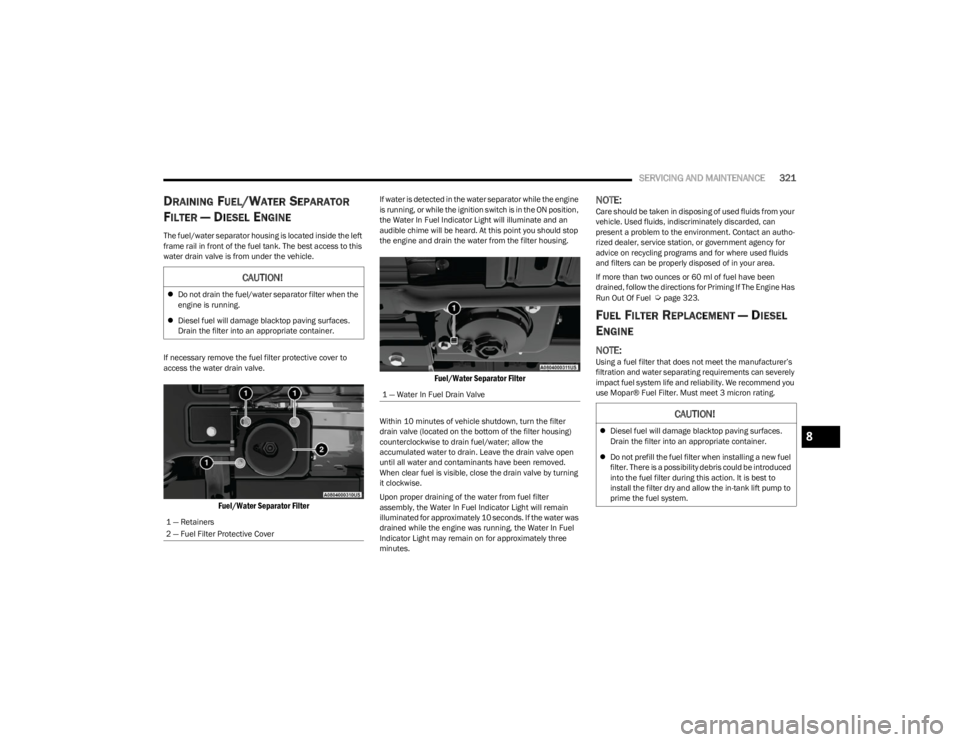
The fuel/water separator housing is located inside the left
frame rail in front of the fuel tank. The best access to this
water drain valve is from under the vehicle.
If necessary remove the fuel filter protective cover to
access the water drain valve.
Fuel/Water Separator Filter
If water is detected in the water separator while the engine
is running, or while the ignition switch is in the ON position,
the Water In Fuel Indicator Light will illuminate and an
audible chime will be heard. At this point you should stop
the engine and drain the water from the filter housing.
Fuel/Water Separator Filter
Within 10 minutes of vehicle shutdown, turn the filter
drain valve (located on the bottom of the filter housing)
counterclockwise to drain fuel/water; allow the
accumulated water to drain. Leave the drain valve open
until all water and contaminants have been removed.
When clear fuel is visible, close the drain valve by turning
it clockwise.
Upon proper draining of the water from fuel filter
assembly, the Water In Fuel Indicator Light will remain
illuminated for approximately 10 seconds. If the water was
drained while the engine was running, the Water In Fuel
Indicator Light may remain on for approximately three
minutes.
NOTE:Care should be taken in disposing of used fluids from your
vehicle. Used fluids, indiscriminately discarded, can
present a problem to the environment. Contact an autho-
rized dealer, service station, or government agency for
advice on recycling programs and for where used fluids
and filters can be properly disposed of in your area.
If more than two ounces or 60 ml of fuel have been
drained, follow the directions for Priming If The Engine Has
Run Out Of Fuel
Úpage 323.
FUEL FILTER REPLACEMENT — DIESEL
E
NGINE
NOTE:Using a fuel filter that does not meet the manufacturer’s
filtration and water separating requirements can severely
impact fuel system life and reliability. We recommend you
use Mopar® Fuel Filter. Must meet 3 micron rating.
CAUTION!
Do not drain the fuel/water separator filter when the
engine is running.
Diesel fuel will damage blacktop paving surfaces.
Drain the filter into an appropriate container.
1 — Retainers
2 — Fuel Filter Protective Cover
1 — Water In Fuel Drain Valve
CAUTION!
Diesel fuel will damage blacktop paving surfaces.
Drain the filter into an appropriate container.
Do not prefill the fuel filter when installing a new fuel
filter. There is a possibility debris could be introduced
into the fuel filter during this action. It is best to
install the filter dry and allow the in-tank lift pump to
prime the fuel system.8
23_JL_OM_EN_USC_t.book Page 321
Page 324 of 396

322SERVICING AND MAINTENANCE
1. Ensure engine is turned off.
2. Remove the fuel filter protective cover to access the
fuel filter assembly.
Fuel Filter Assembly
3. Place drain pan under the fuel filter assembly.
4. Open the water drain valve, and let any accumulated water and fuel drain.
5. Close the water drain valve.
Fuel Filter Assembly
6. Wipe clean the underside of the filter housing to prevent contamination from entering fuel system
during service.
7. Remove the fuel filter cap and filter from the housing using a socket. Rotate counterclockwise for removal.
Fuel Filter Assembly
8. Remove the used fuel filter cartridge from the cap and dispose of according to your local regulations.
9. Wipe clean the sealing surfaces of the cap and housing.
1 — Retainers
2 — Fuel Filter Protective Cover
1 — Water Drain Valve1 — Fuel Filter Cap
2 — Socket Adapter
CAUTION!
Take care when handling the new fuel filter to prevent
contamination from entering the fuel system.
23_JL_OM_EN_USC_t.book Page 322
Page 325 of 396

SERVICING AND MAINTENANCE323
10. Lubricate o-ring on the cap with clean engine oil.
11. Install the new fuel filter cartridge onto the cap.
12. Insert the cap and filter into the housing with
clockwise rotation, use a socket to tighten.
13. Push the ignition switch twice without your foot on the brake to place vehicle in RUN position. This will
activate the in tank fuel pump for approximately 30
seconds. Repeat this process twice to prime the fuel
system. Start the engine using the Normal Starting
procedure. After engine start, verify the fuel filter cap
does not leak.
PRIMING IF THE ENGINE HAS RUN OUT
O
F FUEL — DIESEL ENGINE
1. Add a substantial amount of fuel to the tank, approx -
imately 2 to 5 gal (8L to 19L).
2. Push ignition switch twice without your foot on brake to put vehicle in RUN position. This will activate the in
tank fuel pump for approximately 30 seconds.
Repeat this process twice to prime the fuel system.
3. Start the engine using the Normal Starting procedure
Úpage 130.
NOTE:The engine may run rough until the air is forced from all
the fuel lines.
NOTE:
Use of biodiesel mixture in excess of 20% can nega -
tively impact the fuel filter's ability to separate water
from the fuel, resulting in high pressure fuel system
corrosion or damage.
In addition, commercially available fuel additives are
not necessary for the proper operation of your diesel
engine.
For extreme cold conditions, "Mopar® Premium Diesel
Fuel Treatment" is recommended to assist with cold
starting.
INTERVENTION REGENERATION
S
TRATEGY — MESSAGE PROCESS FLOW
This engine meets all required diesel engine emissions
standards. To achieve these emissions standards, your
vehicle is equipped with a state-of-the-art engine and
exhaust system. These systems are seamlessly integrated
into your vehicle and managed by the Powertrain Control
Module (PCM). The PCM manages engine combustion to
allow the exhaust system’s catalyst to trap and burn
Particulate Matter (PM) pollutants, with no input or
interaction on your part.
Additionally, your vehicle has the ability to alert you to
additional maintenance required on your vehicle or
engine.
Refer to Instrument Cluster Display for further information
Úpage 108.
DIESEL EXHAUST FLUID
Diesel Exhaust Fluid (DEF) sometimes known simply by
the name of its active component, UREA—is a key
component of Selective Catalytic Reduction (SCR)
systems, which help diesel vehicles meet stringent
emission regulations. DEF is a liquid reducing agent that
WARNING!
Do not open the high pressure fuel system with the
engine running. Engine operation causes high fuel
pressure. High pressure fuel spray can cause serious
injury or death.
CAUTION!
The starter motor will engage for approximately
30 seconds at a time. Allow two minutes between
cranking intervals.
WARNING!
Do not use alcohol or gasoline as a fuel blending agent.
They can be unstable under certain conditions and be
hazardous or explosive when mixed with diesel fuel.
CAUTION!
Due to lack of lubricants in alcohol or gasoline, the use
of these fuels can cause damage to the fuel system.WARNING!
A hot exhaust system can start a fire if you park over
materials that can burn. Such materials might be grass
or leaves coming into contact with your exhaust system.
Do not park or operate your vehicle in areas where your
exhaust system can contact anything that can burn.
8
23_JL_OM_EN_USC_t.book Page 323
Page 373 of 396

TECHNICAL SPECIFICATIONS371
FUEL REQUIREMENTS – DIESEL ENGINE
Federal law requires that you must fuel this vehicle with
Ultra Low Sulfur Highway Diesel fuel (15 ppm Sulfur
maximum) and prohibits the use of Low Sulfur Highway
Diesel fuel (500 ppm Sulfur maximum) to avoid damage to
the emissions control system.
Use good quality diesel fuel from a reputable supplier in
your vehicle. For most year-round service, No. 2 diesel fuel
meeting ASTM (formerly known as the American Society
for Testing and Materials) specification D-975 Grade S15
will provide good performance. If the vehicle is exposed to
extreme cold (below 20°F or -7°C), or is required to
operate at colder-than-normal conditions for prolonged
periods, use climatized No. 2 diesel fuel or dilute the No.
2 diesel fuel with 50% No. 1 diesel fuel. This will provide
better protection from fuel gelling or wax-plugging of the
fuel filters.
Diesel fuel is seldom completely free of water. To prevent
fuel system trouble, drain the accumulated water from the
fuel/water separator using the fuel/water separator drain
provided on the fuel filter housing. If you buy good quality
fuel and follow the cold weather advice above, fuel
conditioners should not be required in your vehicle. If
available in your area, a high cetane “premium” diesel fuel
may offer improved cold-starting and warm-up
performance.
DIESEL FUEL SPECIFICATIONS
This diesel engine has been developed to take advantage
of the high energy content and generally lower cost No. 2
Ultra Low Sulfur diesel fuel or No. 2 Ultra Low Sulfur
climatized diesel fuels.
NOTE:
If you accidentally fill the fuel tank with gasoline on your
diesel vehicle, do not start the engine. Damage to the
engine and fuel system could occur. Please call an
authorized dealer for service.
A maximum blend of 5% biodiesel meeting ASTM spec -
ification D-975 may be used with your diesel engine
without any adjustments to regular service schedules.
Commercially available fuel additives are not neces -
sary for the proper operation of your diesel engine.
No. 1 Ultra Low Sulfur diesel fuel should only be used
where extended arctic conditions (-10°F or -23°C)
exist.
BIODIESEL FUEL REQUIREMENTS
A maximum blend of 5% biodiesel meeting ASTM
specification D975 is recommended for use with your
diesel engine. If frequent operation with Biodiesel blends
that are between 6% and 20% (B6–B20) is desired, the
maintenance schedule is subject to shorter intervals. The oil and filter change along with fuel filter replacement
is subject to shorter intervals when operating your engine
on biodiesel greater than 5%. Do not use biodiesel greater
than 20%.
For regular use of biodiesel blends between 6% and 20%
(B6–B20) it is important that you understand and comply
with these requirements
Úpage 311.
Biodiesel is a fuel produced from renewable resources
typically derived from animal fat, rapeseed oil (Rapeseed
Methyl Ester (RME) base), or soybean oil (Soy Methyl Ester
(SME or SOME) base).
Biodiesel fuel has inherent limitations which require that
you understand and adhere to the following requirements
if you use blends of Biodiesel between 6% and 20%
(B6–B20). There are no unique restrictions for the use of
B5.
WARNING!
Do not use alcohol or gasoline as a fuel blending agent.
They can be unstable under certain conditions and
hazardous or explosive when mixed with diesel fuel.
CAUTION!
If the Water in Fuel Indicator Light remains on, DO NOT
START engine before you drain the water from the fuel
filter(s) to avoid engine damage
Úpage 321.
CAUTION!
Failure to comply with Oil Change requirements for
vehicles operating on biodiesel blends between 6% and
20% (B6–B20) will result in premature engine wear.
Such wear is not covered by the New Vehicle Limited
Warranty.
CAUTION!
Use of blends greater than 20% is not approved. Use of
blends greater than 20% can result in engine damage.
Such damage is not covered by the New Vehicle Limited
Warranty.
9
23_JL_OM_EN_USC_t.book Page 371
Page 374 of 396

372TECHNICAL SPECIFICATIONS
Biodiesel Fuel Properties — Low Ambient
Temperatures
Biodiesel fuel may gel or solidify at low ambient
temperatures, which may pose problems for both storage
and operation. Precautions can be necessary at low
ambient temperatures, such as storing the fuel in a
heated building or a heated storage tank, or using cold
temperature additives.
Fuel Quality — Must Comply With ASTM
Standards
The quality of Biodiesel fuel may vary widely. Only fuel
produced by a BQ9000 supplier to the following
specifications may be blended to meet Biodiesel blend
B6 – B20 fuel meeting ASTM specification D-7467:
Petrodiesel fuel meeting ASTM specification D-975
and Biodiesel fuel (B100) meeting ASTM specification
D-6751
Fuel Oxidation Stability — Must Use Fuel
Within Six Months Of Manufacture
Biodiesel fuel has poor oxidation stability which can result
in long term storage problems. Fuel produced to approved
ASTM standards, if stored properly, provides for protection
against fuel oxidation for up to six months.
Fuel Water Separation — Must Use
Mopar® Approved Fuel Filter Elements
Biodiesel fuel has a natural affinity to water and water
accelerates microbial growth. Your Mopar® filtration
system is designed to provide adequate fuel water
separation capabilities.
Fuel In Oil Dilution — Must Adhere To
Required Oil Change Interval
Fuel dilution of lubricating oil has been observed with the
use of Biodiesel fuel. Fuel in oil must not exceed 5%. To
ensure this limit is met your oil change interval must be
maintained within the suggested schedule. The regular
use of biodiesel between 6% and 20% requires intervals
shorter than the outlined 10,000 miles (16,000 km) and
must not exceed the suggested schedule. When routinely
operating on biodiesel between 6% and 20%, oil and filter
replacement intervals must not exceed 8,000 miles
(12,875 km) or six months, whichever comes first.
Biodiesel Fuel Filter Change Intervals
The use of biodiesel requires more frequent fuel filter
change intervals. When operating on biodiesel between
6% and 20%, fuel filter replacement intervals should be
every second oil change, and must not exceed
16,000 miles (25,750 km).
NOTE:Under no circumstances should oil change intervals
exceed 8,000 miles (12,875 km) or 6 months, if regular
operation occurs with 6% - 20% biodiesel blends. Under no
circumstances should fuel filter replacement intervals
exceed every second oil change and must not exceed
16,000 miles (25,750 km), if regular operation occurs
with 6% - 20% biodiesel blends. Failure to comply with
these Oil Change and fuel filter requirements for vehicles
operating on biodiesel blends up to B20 may result in
premature engine wear. Such wear is not covered by the
New Vehicle Limited Warranty. The engine may suffer
severe damage if operated with concentrations of
biodiesel higher than 20%.
CAUTION!
In the event that the vehicle is filled with biodiesel and
not used for more than a month, the fuel should either
be used up by driving (up to quarter tank) and filled with
standard diesel blends with less than 5% that is
normally available. This will help prevent the fuel filter
clogging and potential damage to the fuel injection
system due to degraded biodiesel, which is not covered
by the New Vehicle Limited Warranty.
23_JL_OM_EN_USC_t.book Page 372