2023 JEEP GLADIATOR ignition
[x] Cancel search: ignitionPage 374 of 448

372SERVICING AND MAINTENANCE
(Continued)
ACCESSORY DRIVE BELT INSPECTION
When inspecting accessory drive belts small
cracks, that run across ribbed surface of belt from
rib to rib, are considered normal. This is not a
reason to replace the belt. However, cracks
running along a rib (not across) are not normal. Any
belt with cracks running along a rib must be
replaced. In addition, have the belt replaced if it
has excessive wear, frayed cords, or severe
glazing.
Accessory Belt (Serpentine Belt)
Conditions that would require replacement:
Rib chunking (one or more ribs has separated
from belt body)
Rib or belt wear
Longitudinal belt cracking (cracks between two
ribs)
Belt slips
Groove jumping (belt does not maintain correct
position on pulley)
Belt broken
Noise (objectionable squeal, squeak, or rumble
is heard or felt while drive belt is in operation)
NOTE:Identify and correct problem before new belt is
installed.
Some conditions can be caused by a faulty
component such as a belt pulley. Belt pulleys
should be carefully inspected for damage and
proper alignment.
Belt replacement on some models requires the
use of special tools, we recommend having your
vehicle serviced at an authorized dealer.
AIR CONDITIONER MAINTENANCE
For best possible performance, your air conditioner
should be checked and serviced by an authorized
dealer at the start of each warm season. This
service should include cleaning of the condenser
fins and a performance test. Drive belt tension
should also be checked at this time.
WARNING!
Do not attempt to inspect an accessory drive
belt with vehicle running.
When working near the radiator cooling fan,
disconnect the fan motor lead. The fan is
temperature controlled and can start at any
time regardless of ignition mode. You could be
injured by the moving fan blades.
You can be badly injured working on or around
a motor vehicle. Only do service work for which
you have the knowledge and the proper equip -
ment. If you have any doubt about your ability
to perform a service job, take your vehicle to a
competent mechanic.
WARNING!
Use only refrigerants and compressor lubri -
cants approved by the manufacturer for your
air conditioning system. Some unapproved
refrigerants are flammable and can explode,
injuring you. Other unapproved refrigerants or
lubricants can cause the system to fail,
requiring costly repairs. Refer to Warranty
Information Book, located online, for further
warranty information.
23_JT_OM_EN_USC_t.book Page 372
Page 375 of 448
SERVICING AND MAINTENANCE373
Refrigerant Recovery And Recycling
R-1234yf
R-1234yf Air Conditioning Refrigerant is a Hydroflu -
oroolefin (HFO) that is endorsed by the
Environmental Protection Agency and is an
ozone-friendly substance with a low
global-warming potential. The manufacturer
recommends that air conditioning service be
performed by an authorized dealer using recovery
and recycling equipment.
NOTE:Use only manufacturer approved A/C system PAG
compressor oil, and refrigerants.
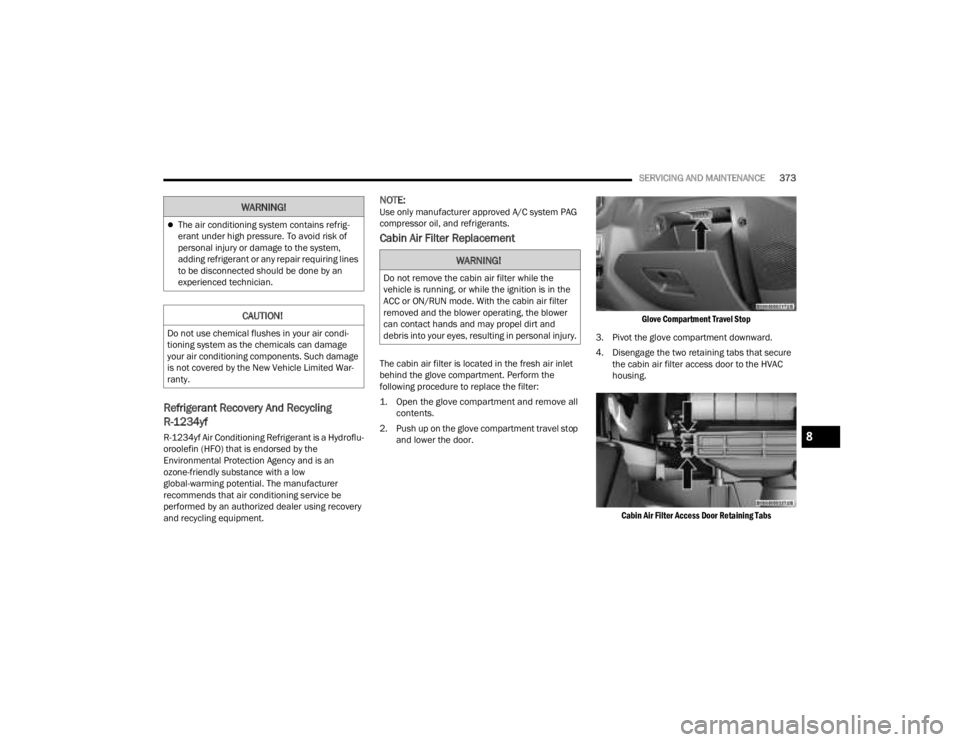
Cabin Air Filter Replacement
The cabin air filter is located in the fresh air inlet
behind the glove compartment. Perform the
following procedure to replace the filter:
1. Open the glove compartment and remove all contents.
2. Push up on the glove compartment travel stop and lower the door.
Glove Compartment Travel Stop
3. Pivot the glove compartment downward.
4. Disengage the two retaining tabs that secure the cabin air filter access door to the HVAC
housing.
Cabin Air Filter Access Door Retaining Tabs
The air conditioning system contains refrig -
erant under high pressure. To avoid risk of
personal injury or damage to the system,
adding refrigerant or any repair requiring lines
to be disconnected should be done by an
experienced technician.
CAUTION!
Do not use chemical flushes in your air condi -
tioning system as the chemicals can damage
your air conditioning components. Such damage
is not covered by the New Vehicle Limited War -
ranty.
WARNING!
WARNING!
Do not remove the cabin air filter while the
vehicle is running, or while the ignition is in the
ACC or ON/RUN mode. With the cabin air filter
removed and the blower operating, the blower
can contact hands and may propel dirt and
debris into your eyes, resulting in personal injury.
8
23_JT_OM_EN_USC_t.book Page 373
Page 378 of 448

376SERVICING AND MAINTENANCE
(Continued)
EXHAUST SYSTEM
The best protection against carbon monoxide entry
into the vehicle body is a properly maintained
engine exhaust system.
If you notice a change in the sound of the exhaust
system, or if the exhaust fumes can be detected
inside the vehicle, or when the underside or rear of
the vehicle is damaged, have an authorized
technician inspect the complete exhaust system
and adjacent body areas for broken, damaged,
deteriorated, or mispositioned parts. Open seams
or loose connections could permit exhaust fumes
to seep into the passenger compartment. In
addition, have the exhaust system inspected each
time the vehicle is raised for lubrication or oil
change. Replace as required. Under normal operating conditions, the catalytic
converter will not require maintenance. However, it
is important to keep the engine properly tuned to
ensure proper catalyst operation and prevent
possible catalyst damage.
NOTE:Intentional tampering with emissions control
systems can result in civil penalties being
assessed against you.
In unusual situations involving grossly
malfunctioning engine operation, a scorching odor
may suggest severe and abnormal catalyst
overheating. If this occurs, stop the vehicle, turn off
the engine and allow it to cool. Service, including a
tune-up to manufacturer's specifications, should
be obtained immediately.
To minimize the possibility of catalytic converter
damage:
Do not interrupt the ignition when the transmis
-
sion is in gear and the vehicle is in motion.
Do not try to start the vehicle by pushing or
towing the vehicle.
Do not idle the engine with any ignition compo -
nents disconnected or removed, such as when
diagnostic testing, or for prolonged periods
during very rough idle or malfunctioning oper -
ating conditions.
WARNING!
Exhaust gases can injure or kill. They contain
Carbon Monoxide (CO), which is colorless and
odorless. Breathing it can make you uncon -
scious and can eventually poison you. To
avoid breathing CO see Ú page 328.
A hot exhaust system can start a fire if you
park over materials that can burn, such as
grass or leaves, and those items that come
into contact with your exhaust system. Do not
park or operate your vehicle in areas where
your exhaust system can contact anything that
can burn.
CAUTION!
The catalytic converter requires the use of
unleaded fuel only. Leaded gasoline will
destroy the effectiveness of the catalyst as an
emissions control device, may seriously
reduce engine performance and cause
serious damage to the engine.
Damage to the catalytic converter can result if
your vehicle is not kept in proper operating
condition. In the event of engine malfunction,
particularly involving engine misfire or other
apparent loss of performance, have your
vehicle serviced promptly. Continued opera -
tion of your vehicle with a severe malfunction
could cause the converter to overheat,
resulting in possible damage to the converter
and vehicle.
WARNING!
23_JT_OM_EN_USC_t.book Page 376
Page 379 of 448

SERVICING AND MAINTENANCE377
COOLING SYSTEM
Coolant Checks
Check the engine coolant (antifreeze) protection
every 12 months (before the onset of freezing
weather, where applicable). If the engine coolant is
dirty or rusty in appearance, the system should be
drained, flushed, and refilled with fresh Organic
Additive Technology (OAT) coolant (conforming to MS.90032) by an authorized dealer. Check the
front of the A/C condenser (if equipped) or radiator
for any accumulation of bugs, leaves, etc. If dirty,
clean by gently spraying water from a garden hose
vertically down the face of the A/C condenser (if
equipped) or the back of the radiator core.
Check the engine cooling system hoses for brittle
rubber, cracking, tears, cuts, and tightness of the
connection at the coolant recovery bottle and
radiator. Inspect the entire system for leaks. DO
NOT REMOVE THE COOLANT PRESSURE CAP
WHEN THE COOLING SYSTEM IS HOT.
Cooling System — Drain, Flush, And Refill
Some vehicles require special tools to add coolant
properly. Failure to fill these systems properly
could lead to severe internal engine damage. If any
coolant is needed to be added to the system
please contact an authorized dealer.
If the engine coolant (antifreeze) is dirty or
contains visible sediment, have an authorized
dealer clean and flush with OAT coolant
(conforming to MS.90032).
For the proper maintenance intervals see
Ú
page 354 for gas engines or Ú page 358 for
diesel engines.
Selection Of Coolant
For further information Ú page 424.
NOTE:
Mixing of engine coolant (antifreeze), other than
specified Organic Additive Technology (OAT)
engine coolant, may result in engine damage
and may decrease corrosion protection. OAT
engine coolant is different and should not be
mixed with Hybrid Organic Additive Technology
(HOAT) engine coolant or any “globally compat -
ible” coolant. If a non-OAT engine coolant is
introduced into the cooling system in an emer -
gency, the cooling system will need to be
drained, flushed, and refilled with fresh OAT
coolant (conforming to MS.90032), by an autho -
rized dealer as soon as possible.
Do not use water alone or alcohol-based engine
coolant products. Do not use additional rust
inhibitors or anti-rust products, as they may not
be compatible with the radiator engine coolant
and may clog the radiator.
This vehicle has not been designed for use with
propylene glycol-based engine coolant. Use of
propylene glycol-based engine coolant is not
recommended.
Some vehicles require special tools to add
coolant properly. Failure to fill these systems
properly could lead to severe internal engine
damage. If any coolant is needed to be added to
the system please contact an authorized dealer.
WARNING!
You or others can be badly burned by hot
engine coolant (antifreeze) or steam from your
radiator. If you see or hear steam coming from
under the hood, do not open the hood until the
radiator has had time to cool. Never open a
cooling system pressure cap when the radi -
ator or coolant bottle is hot.
Keep hands, tools, clothing, and jewelry away
from the radiator cooling fan when the hood is
raised. The fan starts automatically and may
start at any time, whether the engine is
running or not.
When working near the radiator cooling fan,
disconnect the fan motor lead or turn the igni -
tion to the OFF position. The fan is tempera -
ture controlled and can start at any time the
ignition is in the ON position.
8
23_JT_OM_EN_USC_t.book Page 377
Page 384 of 448

382SERVICING AND MAINTENANCE
(Continued)
Fluid Level Check
The fluid level is preset at the factory and does not
require adjustment under normal operating
conditions. Routine fluid level checks are not
required; therefore the transmission has no
dipstick. An authorized dealer can check your
transmission fluid level using special service tools.
If you notice fluid leakage or transmission
malfunction, visit an authorized dealer
immediately to have the transmission fluid level
checked. Operating the vehicle with an improper
fluid level can cause severe transmission damage.
Fluid And Filter Changes
Under normal operating conditions, the fluid
installed at the factory will provide satisfactory
lubrication for the life of the vehicle.Routine fluid and filter changes are not required.
However, change the fluid and filter if the fluid
becomes contaminated (with water, etc.), or if the
transmission is disassembled for any reason.
Selection Of Lubricant
It is important to use the proper transmission fluid
to ensure optimum transmission performance and
life. Use only manufacturer's specified
transmission fluid Ú
page 426. It is important to
maintain the transmission fluid at the correct level
using the recommended fluid.
NOTE:No chemical flushes should be used in any trans -
mission; only the approved lubricant should be
used.
FUSES
General Information
CAUTION!
If a transmission fluid leak occurs, visit an
authorized dealer immediately. Severe transmis -
sion damage may occur. An authorized dealer
has the proper tools to adjust the fluid level
accurately.
CAUTION!
Using a transmission fluid other than
manufacturer’s recommended fluid may cause
deterioration in transmission shift quality and/or
torque converter shudder Ú page 426.
WARNING!
When replacing a blown fuse, always use an
appropriate replacement fuse with the same
amp rating as the original fuse. Never replace
a fuse with another fuse of higher amp rating.
The use of a fuse with a rating other than indi -
cated may result in a dangerous electrical
system overload. If a properly rated fuse
continues to blow, it indicates a problem in the
circuit that must be corrected. Never replace a
blown fuse with metal wires or any other mate -
rial. Failure to use proper fuses may result in
serious personal injury, fire and/or property
damage.
Before replacing a fuse, make sure that the
ignition is off and that all the other services
are switched off and/or disengaged.
If the replaced fuse blows again, contact an
authorized dealer.
23_JT_OM_EN_USC_t.book Page 382
Page 388 of 448

386SERVICING AND MAINTENANCE
CavityCartridge Fuse Micro Fuse Description
* If Equipped
F01 ––Spare*
F02 40 Amp Green –Starter
F03 –5 Amp Tan Intelligent Battery Sensor (IBS)
F04 –20 Amp Yellow Fuel Pump MTR/FPCM
F05 –5 Amp Tan Security Gateway
F06 ––Spare*
F07 ––Spare*
F08 –15 Amp Blue Trans Control Module TCM-8HP CYGNUS
F09 ––Spare*
F10 –15 Amp BlueKeyless Ignition Node (KIN)/Radio Frequency Hub (RFHUB)/
Electric Steering Column Lock (ESCL)
F11 –10 Amp Red UCI Port (USB & AUX)
F12 –25 Amp Clear HIFI Amplifier
F13 ––Spare*
F14 ––Spare*
F15 –15 Amp BlueInstrument Panel Cluster (IPC)/Switch Bank-Heavy Duty
Electrical Pkg (SWITCH BANK-HD ELEC)
F16 ––Spare*
F17 ––Spare*
F18 –10 Amp Red Air Conditioning Clutch (AC CLUTCH)
F19 ––Spare*
23_JT_OM_EN_USC_t.book Page 386
Page 413 of 448

SERVICING AND MAINTENANCE411
STORING THE VEHICLE If you are storing your vehicle for more than 3
weeks, we recommend that you take the following
steps to minimize the drain on your vehicle's
battery:
Disconnect the negative cable from the battery.
If your vehicle is equipped with Stop/Start
system then disconnect both the main and
supplemental negative battery cables.
Any time you store your vehicle or keep it out of
service (i.e., vacation) for two weeks or more,
run the air conditioning system at idle for about
five minutes in the fresh air and high blower
setting. This will ensure adequate system lubri-
cation to minimize the possibility of compressor
damage when the system is started again.
If assistance is needed to disconnect the
battery system, see an authorized dealer.
Battery Cable Disconnect
NOTE:
You must isolate the supplemental battery
connection point, as well as the main battery
terminal from the post, as shown in the image,
to fully de-energize both batteries for storage. If
assistance is needed to disconnect the battery
system, see an authorized dealer.
Do not disconnect the Intelligent Battery Sensor
(IBS), or your Stop/Start system may not func -
tion for up to 24 hours, due to the IBS being set
into learn mode.
BODYWORK
PROTECTION FROM ATMOSPHERIC
A
GENTS
Vehicle body care requirements vary according to
geographic locations and usage. Chemicals that
make roads passable in snow and ice and those
that are sprayed on trees and road surfaces during
other seasons are highly corrosive to the metal in
your vehicle. Outside parking, which exposes your
vehicle to airborne contaminants, road surfaces on
WARNING!
Take care to avoid the radiator cooling fan
whenever the hood is raised. It can start
anytime the ignition switch is ON. You can be
injured by moving fan blades.
Remove any metal jewelry such as rings,
watch bands and bracelets that could make
an inadvertent electrical contact. You could be
seriously injured.
Vehicles with the Stop/Start system will be
equipped with two batteries. Both the main
and the supplemental batteries must be
disconnected to completely de-energize the
12 Volt electrical system.
Serious injury or death could result if you do
not disconnect both batteries. To learn how to
properly disconnect, see an authorized dealer.
CAUTION!
If the negative battery cables are not isolated
properly it can cause a potential power spike or
surge in the system, resulting in damage to
essential electrical components.
1 — Supplemental Negative Battery Cable
2 — Main Negative Battery Cable
3 — Main Negative Battery Terminal
4 — Intelligent Battery Sensor (IBS)
8
23_JT_OM_EN_USC_t.book Page 411
Page 422 of 448

420TECHNICAL SPECIFICATIONS
(Continued)
GASOLINE/OXYGENATE BLENDS
Some fuel suppliers blend unleaded gasoline with
oxygenates such as ethanol.
Problems that result from using gasoline
containing more than 15% ethanol (E-15) or
gasoline containing methanol are not the
responsibility of the manufacturer and may void
the New Vehicle Limited Warranty.
DO NOT USE E-85 IN NON-FLEX FUEL
V
EHICLES
Non-Flex Fuel Vehicles (FFV) are compatible with
gasoline containing up to 15% ethanol (E-15). Use
of gasoline with higher ethanol content may void
the New Vehicle Limited Warranty. If a Non-FFV vehicle is inadvertently fueled with
E-85 fuel, the engine will have some or all of these
symptoms:
Operate in a lean mode.
OBD II Malfunction Indicator Light on.
Poor engine performance.
Poor cold start and cold drivability.
Increased risk for fuel system component corro
-
sion.
CNG AND LP FUEL SYSTEM
M
ODIFICATIONS
Modifications that allow the engine to run on
Compressed Natural Gas (CNG) or Liquid Propane
(LP) may result in damage to the engine,
emissions, and fuel system components. Problems
that result from running CNG or LP are not the
responsibility of the manufacturer and may void
the New Vehicle Limited Warranty.
METHYLCYCLOPENTADIENYL
M
ANGANESE TRICARBONYL (MMT) IN
G
ASOLINE
MMT is a manganese-containing metallic additive
that is blended into some gasolines to increase
octane. Gasoline blended with MMT provides no
performance advantage beyond gasoline of the
same octane number without MMT. Gasoline blended with MMT reduces spark plug life and
reduces emissions system performance in some
vehicles. The manufacturer recommends that
gasoline without MMT be used in your vehicle. The
MMT content of gasoline may not be indicated on
the gasoline pump; therefore, you should ask your
gasoline retailer whether the gasoline contains
MMT. MMT is prohibited in Federal law and
California reformulated gasoline.
FUEL SYSTEM CAUTIONS
CAUTION!
DO NOT use E-85, gasoline containing methanol,
or gasoline containing more than 15% ethanol
(E-15). Use of these blends may result in starting
and drivability problems, damage critical fuel
system components, cause emissions to exceed
the applicable standard, and/or cause the
Malfunction Indicator Light to illuminate. Please
observe pump labels as they should clearly
communicate if a fuel contains greater than
15% ethanol (E-15).
CAUTION!
Follow these guidelines to maintain your
vehicle’s performance:
The use of leaded gasoline is prohibited by
Federal law. Using leaded gasoline can impair
engine performance and damage the emis
-
sions control system.
An out-of-tune engine, certain fuel or ignition
malfunctions can cause the catalytic
converter to overheat. If you notice a pungent
burning odor or some light smoke, your engine
may be out-of-tune or malfunctioning and may
require immediate service. Contact an autho -
rized dealer for service assistance.
23_JT_OM_EN_USC_t.book Page 420