2023 JEEP COMPASS power steering
[x] Cancel search: power steeringPage 258 of 344

256IN CASE OF EMERGENCY
2. The pump will start to inject air into
the tire immediately after the
Sealant Bottle is empty. Continue to
operate the pump and inflate the tire
to the cold tire inflation pressure found on the
tire and loading information label located in
the driver-side door opening. Check the tire
pressure by looking at the Pressure Gauge.
If the tire does not inflate to at least 26 psi
(1.8 Bar) pressure within 15 minutes:
The tire is too badly damaged. Do not attempt to
drive the vehicle further. Call for assistance.
If the tire inflates to the recommended pressure or
is at least 26 psi (1.8 Bar) pressure within
15 minutes:
NOTE:If the tire becomes overinflated, push the Deflation
Button to reduce the tire pressure to the recom -
mended inflation pressure before continuing.
1. Push the Power Button to turn off
the Tire Service Kit.
2. Remove the speed limit label from
the Tire Service Kit and place sticker
on the steering wheel. 3. Immediately disconnect the Sealant Hose
from the valve stem, reinstall the cap on the
fitting at the end of the hose, and place the Tire
Service Kit in the vehicle storage location.
Drive Vehicle: Immediately after injecting sealant
and inflating the tire, drive the vehicle
5 miles (8 km) or 10 minutes to ensure distribution of the Tire Service Kit Sealant
within the tire. Do not exceed 50 mph (80 km/h). After Driving:
Pull over to a safe location.
1. Uncoil the Sealant Hose, and then remove the
cap from the fitting at the end of the hose.
2. Place the Tire Service Kit flat on the ground next to the deflated tire.
3. Remove the cap from the valve
stem, and then screw the fitting at
the end of the Sealant Hose onto the
valve stem.
4. Uncoil the power plug and insert
the plug into the vehicle's 12 Volt
power outlet.
5. Uncoil the Hose and screw the
fitting at the end of the hose onto the
valve stem.
6. Turn the Mode Select Knob and
turn to the Air Mode position.
7. Check the pressure in the tire by reading the Pressure Gauge.
WARNING!
The Tire Service Kit is not a permanent flat tire
repair. Have the tire inspected and repaired or
replaced after using the Tire Service Kit. Do not
exceed 50 mph (80 km/h) until the tire is
repaired or replaced. Failure to follow this
warning can result in injuries that are serious or
fatal to you, your passengers, and others around
you. Have the tire checked as soon as possible
at an authorized dealer.
22_MP_OM_EN_USC_t.book Page 256
Page 259 of 344

IN CASE OF EMERGENCY257
If tire pressure is less than 19 psi (1.3 Bar):
The tire is too badly damaged. Do not attempt to
drive the vehicle further. Call for assistance.
If the tire pressure is 19 psi (1.3 Bar) or higher:
1. Push the Power Button to turn on
Tire Service Kit and inflate the tire to
the cold tire inflation pressure found
on the tire and loading information
label located in the driver-side door opening.
NOTE:If the tire becomes overinflated, push the Deflation
Button to reduce the tire pressure to the recom -
mended inflation pressure before continuing.
2. Disconnect the Tire Service Kit from the valve stem, reinstall the cap on the valve stem and
unplug from 12 Volt outlet.
3. Place the Tire Service Kit in its proper storage area in the vehicle.
4. Have the tire inspected and repaired or replaced at the earliest opportunity at an
authorized dealer or tire service center. 5. Remove the Speed Limit sticker from the
steering wheel after the tire has been repaired.
6. Replace the Sealant Bottle at an authorized dealer as soon as possible.
NOTE:When having the tire serviced, advise the autho -
rized dealer or service center that the tire has been
sealed using the Tire Service Kit.
Sealant Bottle Replacement:
1. Unwrap the power cord.
2. Unwrap the hose.
Unwrap The Hose
3. Remove the bottle cover.
Remove The Bottle Cover
4. Rotate the bottle up beyond vertical to release.
Rotate The Bottle Up
7
22_MP_OM_EN_USC_t.book Page 257
Page 268 of 344

266IN CASE OF EMERGENCY
EMERGENCY TOW HOOKS —
I
F EQUIPPED
If your vehicle is equipped with tow hooks, there
will be one in the rear and two mounted on the
front of the vehicle. The rear hook will be located
on the driver's side of the vehicle.
NOTE:For off-road recovery, it is recommended to use
both of the front tow hooks to minimize the risk of
damage to the vehicle.
Front Tow Hooks Location Rear Tow Hook Location
Vehicles With Keyless Enter ‘n Go™
Place the ignition in the ON/RUN position, and
subsequently in OFF, without opening the door.
During towing, remember that not having the aid of
the power brakes and the electromechanical
power steering will require greater force when
applying the brakes and steering of the vehicle.ENHANCED ACCIDENT RESPONSE SYSTEM
(EARS)
This vehicle is equipped with an Enhanced
Accident Response System.
This feature is a communication network that
takes effect in the event of an impact Úpage 224.
EVENT DATA RECORDER (EDR)
This vehicle is equipped with an event data
recorder (EDR). The main purpose of an EDR is to
record data that will assist in understanding how a
vehicle’s systems performed under certain crash
or near crash-like situations, such as an air bag
deployment or hitting a road obstacle Úpage 227.
WARNING!
Do not use a chain for freeing a stuck vehicle.
Chains may break, causing serious injury or
death.
Stand clear of vehicles when pulling with tow
hooks. Tow straps may become disengaged,
causing serious injury.
CAUTION!
Tow hooks are for emergency use only, to rescue
a vehicle stranded off road. Do not use tow
hooks for tow truck hookup or highway towing.
You could damage your vehicle.
22_MP_OM_EN_USC_t.book Page 266
Page 286 of 344
284SERVICING AND MAINTENANCE
(Continued)
FUSES
General Information
The fuses protect electrical systems against
excessive current.
When a device does not work, you must check the
fuse element inside the blade fuse for a break/
melt.
Also, please be aware that using power outlets for
extended periods of time with the engine off may
result in vehicle battery discharge.
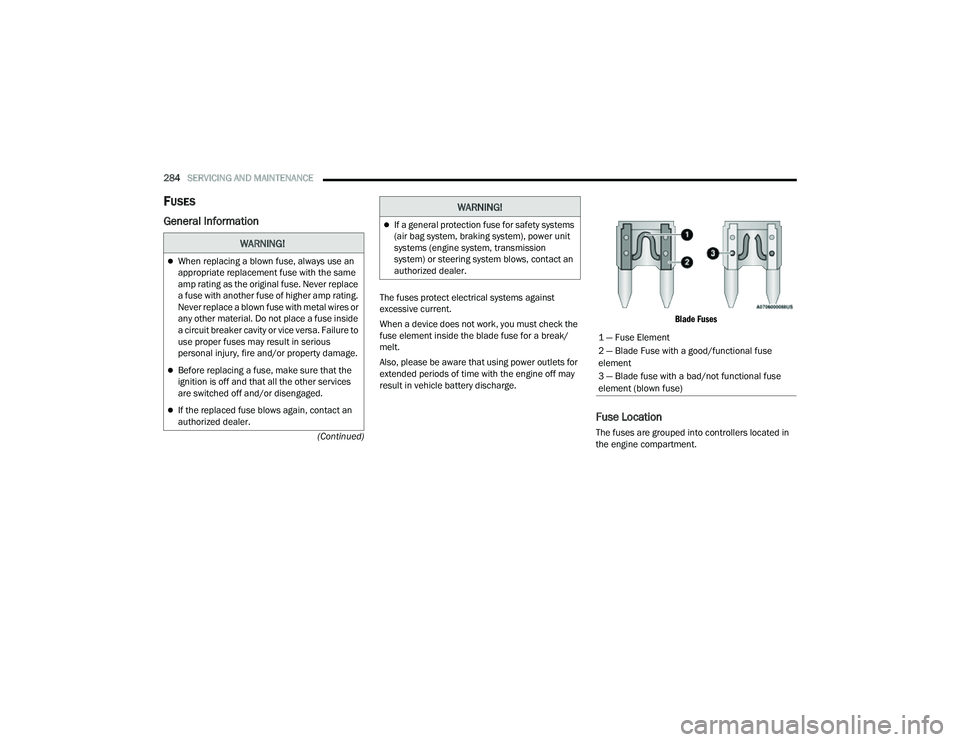
Blade Fuses
Fuse Location
The fuses are grouped into controllers located in
the engine compartment.
WARNING!
When replacing a blown fuse, always use an
appropriate replacement fuse with the same
amp rating as the original fuse. Never replace
a fuse with another fuse of higher amp rating.
Never replace a blown fuse with metal wires or
any other material. Do not place a fuse inside
a circuit breaker cavity or vice versa. Failure to
use proper fuses may result in serious
personal injury, fire and/or property damage.
Before replacing a fuse, make sure that the
ignition is off and that all the other services
are switched off and/or disengaged.
If the replaced fuse blows again, contact an
authorized dealer.
If a general protection fuse for safety systems
(air bag system, braking system), power unit
systems (engine system, transmission
system) or steering system blows, contact an
authorized dealer.
WARNING!
1 — Fuse Element
2 — Blade Fuse with a good/functional fuse
element
3 — Blade fuse with a bad/not functional fuse
element (blown fuse)
22_MP_OM_EN_USC_t.book Page 284
Page 292 of 344

290SERVICING AND MAINTENANCE
Interior Fuses
The interior fuse panel is located in the passenger compartment on the left side dash panel under the instrument panel.
CavityBlade Fuse Description
*If Equipped
F31 7.5 Amp Brown Occupant Restraint Controller
F33 20 Amp Yellow Window Motor Passenger
F34 20 Amp Yellow Window Motor Driver
F36 20 Amp YellowIntrusion Module/Siren, Radio, UCI/USB Port, VSU, Climate Control,
Electronic Steering Lock, Power Folding Mirrors, Security Gateway/DTV
F37 10 Amp RedInstrument Panel Cluster, Drivetrain Control Module, Adaptive Cruise,
ECC (HVAC) Blower
F38 20 Amp Yellow Door Lock/Unlock, Liftgate Release
F42 7.5 Amp Brown Brake System Module, Electric Power Steering
F43 20 Amp Yellow Washer Pump Front And Rear
F47 20 Amp Yellow Rear Left Window Lifter
F48 20 Amp Yellow Rear Right Window Lifter
F49 7.5 Amp BrownPark Assist, Blind Spot, Voltage Stabilizer, Humidity Sensor, Electronic Steering Lock,
Temp Sense, Mirror, Heated Seats, Light And Rain Sensor, Start Stop Switch
F50 7.5 Amp Brown Occupant Restraint Controller
F51 7.5 Amp BrownElectronic Climate Control, Occupant Classification, Rear View Camera, Climate Control,
Headlamp Leveling, Terrain Select, Heated Rear Window, Trailer Tow, Haptic Lane Mod
F53 7.5 Amp Brown Keyless Ignition Node Module, Electric Park Brake, RF Hub, Cluster
F94 15 Amp Blue Lumbar Adjust Driver Seat, Power Outlets
22_MP_OM_EN_USC_t.book Page 290
Page 315 of 344

SERVICING AND MAINTENANCE313
(Continued)
TIRE ROTATION RECOMMENDATIONS
The tires on the front and rear of your vehicle
operate at different loads and perform different
steering, handling, and braking functions. For
these reasons, they wear at unequal rates.
These effects can be reduced by timely rotation of
tires. The benefits of rotation are especially
worthwhile with aggressive tread designs such as
those on On/Off Road type tires. Rotation will
increase tread life, help to maintain mud, snow,
and wet traction levels, and contribute to a
smooth, quiet ride.
For the proper maintenance intervals Úpage 268.
The reasons for any rapid or unusual wear should
be corrected prior to rotation being performed. The suggested rotation method is the “forward
cross” shown in the following diagram. This
rotation pattern does not apply to some directional
tires that must not be reversed.
Tire Rotation (Forward Cross)
CAUTION!
To avoid damage to your vehicle or tires, observe
the following precautions:
Because of restricted traction device clearance
between tires and other suspension compo -
nents, it is important that only traction devices
in good condition are used. Broken devices can
cause serious damage. Stop the vehicle imme -
diately if noise occurs that could indicate
device breakage. Remove the damaged parts
of the device before further use.
Install device as tightly as possible and then
retighten after driving about ½ mile (0.8 km).
Autosock traction devices do not require
retightening.
Do not exceed 30 mph (48 km/h).
Drive cautiously and avoid severe turns and
large bumps, especially with a loaded vehicle.
Do not drive for a prolonged period on dry
pavement.
Observe the traction device manufacturer’s
instructions on the method of installation,
operating speed, and conditions for use.
Always use the suggested operating speed of
the device manufacturer’s if it is less than
30 mph (48 km/h).
Do not use traction devices on a compact
spare tire.
CAUTION!
CAUTION!
Proper operation of four-wheel drive vehicles
depends on tires of equal size, type and
circumference on each wheel. Any difference in
tire size can cause damage to the power transfer
unit. Tire rotation schedule should be followed to
balance tire wear.
8
22_MP_OM_EN_USC_t.book Page 313
Page 335 of 344

333
Key Fob Programming
(Remote Keyless Entry)
................................... 16Keyless Enter 'n Go™................................ 14, 23Keys................................................................. 14
L
Lane Change And Turn Signals................. 43, 46Lane Change Assist.................................. 43, 46Lane Management System............................ 145LaneSense...................................................... 96Lap/Shoulder Belts....................................... 206Latches.......................................................... 242Hood........................................................... 66Leaks, Fluid................................................... 242Life Of Tires................................................... 308Liftgate..................................................... 66, 67Hands-Free.................................................. 69Liftgate Window Wiper/Washer....................... 49Light Bulbs..................................................... 242Lights............................................................. 2424WD Lock.................................................... 964WD Low..................................................... 96Active Speed Limiter Fault........................... 96Air Bag.......................................89, 213, 241Anti Lock Brake System............................... 92Automatic Headlights.................................. 45Automatic High Beam.................................. 97Battery Charge............................................ 90Battery Saver............................................... 46Brake Assist Warning................................ 191
Brake Warning............................................. 90Bulb Replacement.................................... 291Cruise................................................... 97, 98Daytime Running.................................. 43, 44Dimmer Switch, Headlight.................... 43, 44Door Open................................................... 90Drowsiness Detected.................................. 91Electric Power Steering Fault....................... 91Electronic Park Brake.................................. 93Electronic Stability Control........................... 93Electronic Throttle Control........................... 91Engine Temperature.................................... 91Exterior..................................................... 242Fog....................................................... 46, 96Forward Collision Warning........................... 96Fuel Cutoff................................................... 93Headlight Switch.......................................... 44Headlights............................................ 43, 44High Beam............................................ 44, 97High Beam/Low Beam Select............... 43, 44Hill Descent Control..................................... 97Hill Descent Control Indicator................... 191Hood Open.................................................. 91Immobilizer Fail VPS Electrical Alarm.......... 96Instrument Cluster................................ 43, 44Intensity Control................................... 46, 47Interior......................................................... 46LaneSense.................................... 93, 96, 97Liftgate Open............................................... 91Lights On Reminder.............................. 43, 45
Low Coolant Level........................................93Low Fuel......................................................93Low Washer Fluid........................................93Malfunction Indicator (Check Engine)..........93Oil Pressure.................................................91Oil Temperature...........................................92Park.............................................................96Passing.................................................43, 45Seat Belt Reminder.....................................92Security Alarm.............................................92Service...................................................... 291Service 4WD................................................94Service Forward Collision Warning...............94Service Stop Start........................................94Stop Start Active..........................................97Tire Pressure Monitoring (TPMS)....... 94, 201Towing Hook Breakdown.............................95Traction Control........................................ 191Transmission Fault......................................92Transmission Temperature..........................92Turn Signals......................... 43, 46, 97, 242Vanity Mirror................................................38Load Floor, Cargo.............................................70Loading Vehicle............................................. 153Tires.......................................................... 303Locks Auto Unlock.................................................25Child Protection...........................................25Power Door..................................................23Low Tire Pressure System............................. 201
11
22_MP_OM_EN_USC_t.book Page 333