2023 INFINITI QX50 oil capacities
[x] Cancel search: oil capacitiesPage 439 of 548

Removal of engine protectors
1. Remove clipsOAand under-engine
protector.
Engine oil and filter
1. Place a large drain pan under the drain plug and oil filter.
2. Remove the oil filler cap.
3. Remove the drain plug with a wrench by turning it counterclockwise and com-
pletely drain the oil.
CAUTION
Be careful not to burn yourself, as the en-
gine oil is hot.
WARNING
• Prolonged and repeated contact with
used engine oil may cause skin cancer.
• Try to avoid direct skin contact with
used oil. If skin contact is made, wash
thoroughly with soap or hand cleaner as
soon as possible.
• Keep used engine oil out of reach of
children.
4. Loosen the oil filter with an oil filter wrench by turning it counterclockwise.
Remove the oil filter by turning it by hand.
5. Wipe the engine oil filter mounting sur- face with a clean rag.
CAUTION
Be sure to remove any old gasket material
remaining on the sealing surface of the en-
gine. Failure to do so could lead to an oil
leak and engine damage. •
The dipstick must be inserted in place to
prevent oil spillage from the dipstick hole
when filling the engine with oil.
6. Coat the gasket on the new filter with clean engine oil.
7. Screw in the oil filter clockwise until a slight resistance is felt, then tighten addi-
tionally more than 2/3 turn.
Oil filter tightening torque: 11 to 15 ft-lb (14.7 to 20.6 N·m)
8. Clean and re-install the drain plug with a new washer. Securely tighten the drain
plug with a wrench. Do not use excessive
force.
Drain plug tightening torque: 22 to 29 ft-lb (29.4 to 39.2 N·m)
9. Refill the engine with the recommended oil through the oil filler opening, and install
the oil filler cap securely.
For additional information about drain and
refill capacity, see “Recommended fluids/
lubricants and capacities” (P. 10-2). The drain
and refill capacity depends on the oil tem-
perature and drain time. Use these specifica-
tions for reference only. Always use the dip-
stick to determine the proper amount of oil in
the engine.
LDI3445
Do-it-yourself8-9
Page 499 of 548

10 Technical and consumer information
Recommended fluids/lubricants and capacities . . 10-2Fuel recommendation ....................... 10-4
Engine oil and oil filter recommendations .....10-6
Air conditioner system refrigerant and oil
recommendations ........................... 10-7
Specifications .................................. 10-9
Engine ...................................... 10-9
Wheels and tires ........................... 10-10
Dimensions and weights ...................10-10
When traveling or registering in another
country ....................................... 10-11
Vehicle identification .......................... 10-11
Vehicle Identification Number (VIN) plate . . . 10-11
Vehicle identification number (chassis
number) ................................... 10-11
Engine serial number ....................... 10-12
F.M.V.S.S./C.M.V.S.S. certification label .....10-12
Emission control information label ..........10-12
Tire and Loading Information label ..........10-13
Air conditioner specification label ...........10-13
Installing front license plate ....................10-14
Vehicle loading information ....................10-17
Terms ..................................... 10-17Vehicle load capacity
....................... 10-18
Securing the load .......................... 10-20
Loading tips ............................... 10-21
Measurement of weights ...................10-21
Towing a trailer ............................... 10-22
Maximum load limits ....................... 10-23
Towing load/specification ..................10-26
Towing safety ............................. 10-27
Flat towing for all–wheel drive vehicle
(if so equipped) ............................ 10-31
Flat towing for front wheel drive vehicle
(if so equipped) ............................ 10-32
Uniform tire quality grading ...................10-32
Emission control system warranty .............10-33
Reporting safety defects ......................10-34
Readiness for Inspection/Maintenance (I/M)
test .......................................... 10-35
Event Data Recorders (EDR) ..................
10-36
Additional
Data Recording (on vehicles
equipped with optional ProPILOT Assist) . . . 10-36
Owner's Manual/Service Manual order
information ................................... 10-37
Page 500 of 548

The following are approximate capacities. The actual refill capacities may be slightly different. When refilling, follow the procedure described
in the “Do-it-yourself” section to determine the proper refill capacity.
Fluid TypeCapacity (approximate)
Recommended Fluids/Lubricants
Metric
Measure US
Measure Imperial
Measure
Fuel 60 L 15-7/8 gal 13-1/4 gal • For additional information, see “Fuel recommendation” (P. 10-4).
Engine oil*1
Drain and refill
*1 For additional information,
see “Engine oil” (P. 8-6). With oil filter
change 4.7 L 5 qt 4-1/8 qt • Genuine “NISSAN Motor Oil 0W-20 SP” (or equivalent) is recom-
mended.
• If the above motor oil (or engine oil) is not available, a synthetic
SAE 0W-20 GF-6 SP motor oil (or engine oil) may be used. Damage
caused by the use of motor oil (or engine oil) other than as recom-
mended is not covered under INFINITI’s New Vehicle Limited War-
ranty. For additional information, see “Engine oil and oil filter recom-
mendations” (P. 10-6).
Without oil filter
change 4.6 L 4-7/8 qt 4 qt
Engine coolant
(with reservoir) 7.7 L 2 gal 1-3/4 gal• Pre-diluted Genuine NISSAN Long Life Antifreeze/Coolant (blue) or
equivalent
Continuously Variable Transmission (CVT) fluid —— —• Genuine NISSAN CVT Fluid NS-3
• INFINITI recommends using Genuine NISSAN CVT Fluid NS-3
(or equivalent) ONLY in INFINITI CVTs. Do not mix with other fluids.
Using fluids that are not equivalent to Genuine NISSAN CVT Fluid
NS-3 may damage the CVT. Damage caused by the use of fluids other
than as recommended is not covered under INFINITI’s New Vehicle
Limited Warranty outlined in your Warranty Information Booklet.
Differential gear oil —— — • Genuine NISSAN HYPOID FLUID•S1 GL-5 75W-80 or equivalent
Transfer oil —— —• Genuine NISSAN Differential Oil Hypoid Super GL-5 80W-90 or
equivalent conventional (non-synthetic) oil
Brake fluid —— —• Genuine NISSAN Super Heavy Duty Brake Fluid*2 or equivalent
DOT 3
*2: Available in mainland U.S.A. through an INFINITI retailer
RECOMMENDED FLUIDS/
LUBRICANTS AND CAPACITIES
10-2Technical and consumer information
Page 504 of 548

Incorrect ignition timing may result in spark
knock, after-run and/or overheating, which
may cause excessive fuel consumption or en-
gine damage. If any of the above symptoms
are encountered, have your vehicle checked.
It is recommended that you visit an INFINITI
retailer.
However, now and then you may notice light
spark knock for a short time while accelerat-
ing or driving up hills. This is not a cause for
concern, because you get the greatest fuel
benefit when there is light spark knock for a
short time under heavy engine load.
ENGINE OIL AND OIL FILTER
RECOMMENDATIONS
Selecting the correct oil
It is essential to choose the correct grade, qual-
ity and viscosity engine oil to ensure satisfac-
tory engine life and performance. For addi-
tional information, see "Recommended fluids/
lubricants and capacities" (P. 10-2). INFINITI
recommends the use of an energy conserving
oil in order to improve fuel economy.
Select only engine oils that meet the Ameri-
can Petroleum Institute (API) certification or
International Lubricant Standardization andApproval Committee (ILSAC) certification
and SAE viscosity standard. These oils have
the API certification mark on the front of the
container. Oils which do not have the speci-
fied quality label should not be used as they
could cause engine damage.
Oil additives
INFINITI does not recommend the use of oil
additives. The use of an oil additive is not
necessary when the proper oil type is used
and maintenance intervals are followed.
Oil which may contain foreign matter or has
been previously used should not be used.
LTI2587
10-6Technical and consumer information
Page 537 of 548
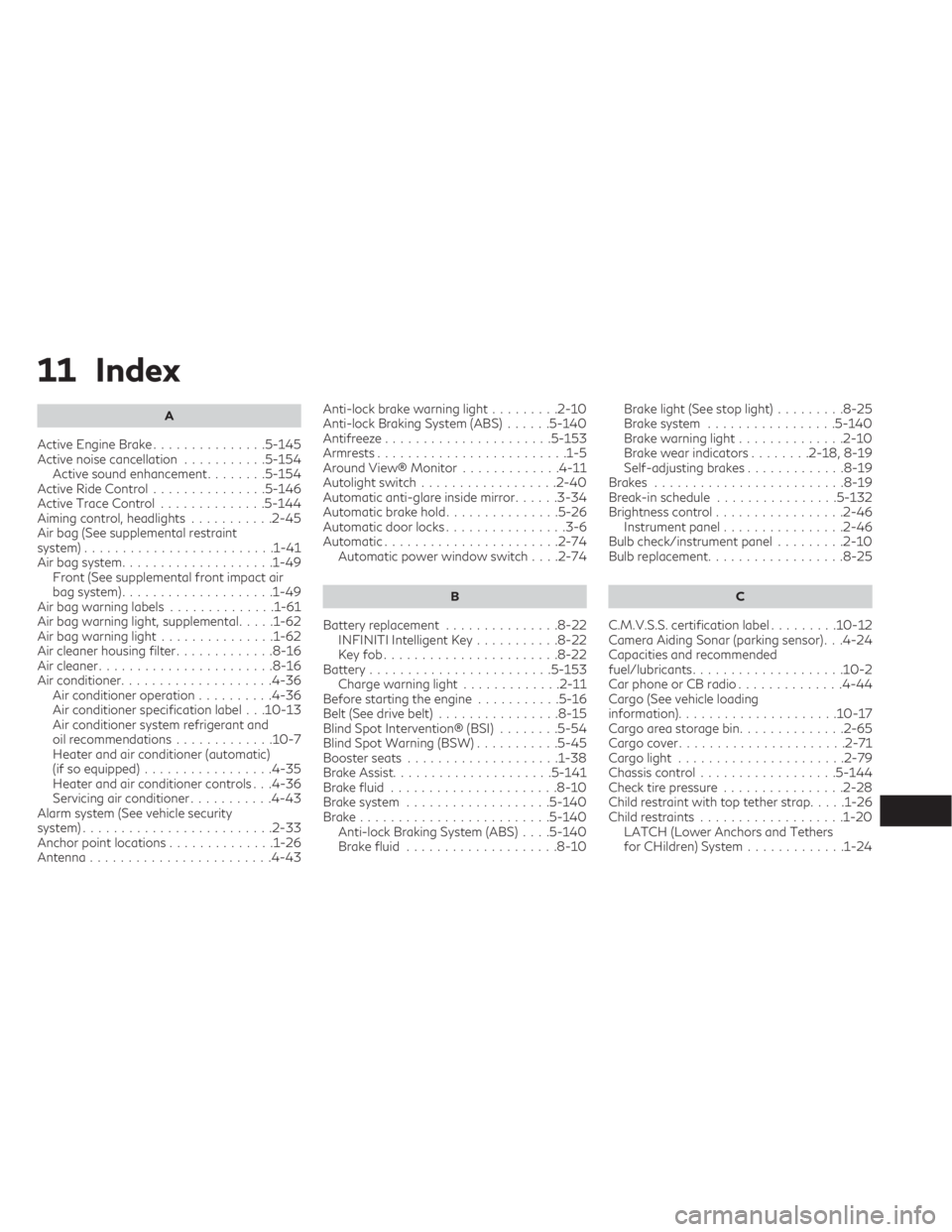
11 Index
A
Active Engine Brake...............5-145
Activenoisecancellation ...........5-154 Active sound enhancement ........5-154
ActiveRideControl...............5-146
ActiveTraceControl ..............5-144
Aiming control, headlights ...........2-45
Air bag (See supplemental restraint
system).........................1-41
Air bag system ....................1-49
Front (See supplemental front impact air
bagsystem)....................1-49
Air bag warning labels ..............1-61
Air bag warning light, supplemental .....1-62
Airbagwarninglight...............1-62
Air cleaner housing filter .............8-16
Air cleaner .......................8-16
Air conditioner ....................4-36
Air conditioner operation ..........4-36
Air conditioner specification label . . .10-13
Air conditioner system refrigerant and
oil recommendations .............10-7
Heater and air conditioner (automatic)
(if so equipped) .................4-35
Heater and air conditioner controls . . .4-36
Servicing air conditioner ...........4-43
Alarm system (See vehicle security
system).........................2-33
Anchor point locations ..............1-26
Antenna ........................4-43 Anti-lock brake warning ligh
t.........2-10
Anti-lock Braking System (ABS) ......5-140
Antifreeze ......................5-153
Armrests.........................1-5
Around View® Monitor .............4-11
Autolightswitch..................2-40
Automatic anti-glare inside mirror ......3-34
Automaticbrakehold...............5-26
Automatic door locks ................3-6
Automatic.......................2-74 Automatic power window switch ....2-74
B
Battery replacement...............8-22
INFINITI Intelligent Key ...........8-22
Keyfob.......................8-22
Battery........................5-153 Charge warning light .............2-11
Before starting the engine ...........5-16
Belt (See drive belt) ................8-15
Blind Spot Intervention® (BSI) ........5-54
Blind Spot Warning (BSW) ...........5-45
Boosterseats ....................1-38
Brake Assist .....................5-141
Brakefluid ......................8-10
Brakesystem ...................5-140
Brake.........................5-140 Anti-lock Braking System (ABS) ....5-140
Brakefluid ....................8-10 Brakelight(Seestoplight).........
8-25
Brake system .................5-140
Brakewarninglight..............2-10
Brake wear indicators ........2-18,8-19
Self-adjusting brakes .............8-19
Brakes .........................8-19
Break-in schedule ................5-132
Brightnesscontrol.................2-46 Instrument panel ................2-46
Bulb check/instrument panel .........2-10
Bulb replacement .................. 8-25
C
C.M.V.S.S. certification label .........10-12
Camera Aiding Sonar (parking sensor) . . .4-24
Capacities and recommended
fuel/lubricants....................10-2
Car phone or CB radio ..............4-44
Cargo (See vehicle loading
information).....................10-17
Cargoareastoragebin.............. 2-65
Cargocover...................... 2-71
Cargolight ......................2-79
Chassis control ..................5-144
Check tire pressure ................ 2-28
Child restraint with top tether strap .....1-26
Child restraints ...................1-20
LATCH (Lower Anchors and Tethers
forCHildren)System.............1-24
Page 538 of 548

Precautions on child
restraints.........1-22,1-29,1-34,1-38
Top tether strap anchor point
locations.......................1-26
Child safety rear door lock .............3-6
Cleaning exterior and interior ...........7-2
Climate control seat switch ...........2-48
Cold weather driving ...............5-153
Console box ......................2-62
Console light ......................2-78
Continuously Variable Transmission
(CVT) ...........................5-18
Continuously Variable Transmission (CVT)
fluid..........................8-10
Driving with Continuously Variable
Transmission (CVT) ...............5-18
Controls.........................4-36 Heater and air conditioner controls . . .4-36
Coolant .........................10-2
Capacities and recommended
fuel/lubricants ..................10-2
Changing engine coolant ............8-5
Checking engine coolant level ........8-5
Engine coolant temperature gauge .....2-6
Corrosion protection .................7-7
Cupholders ......................2-63
D
Dimensions and weights ............10-10
Dimmer switch for instrument panel .....2-46
Door locks ........................3-4
Drive belt ........................8-15 Driving the vehicle
..................5-18
Driving.........................5-153 Cold weather driving .............5-153
Driving with Continuously Variable
Transmission (CVT) ...............5-18
Precautions when starting and
driving .....................5-4,5-10
Dual power moonroof ...............2-75
E
E-call (SOS) Button.................2-54
Eco Drive Report ...................5-31
Economy - fuel ...................5-133
Electronic parking brake .............5-24
Emergency engine shutoff ............5-15
Emission control information label .....10-12
Emission control system warranty .....10-33
Engine coolant temperature gauge .......2-6
Engine ..........................5-16
Before starting the engine ..........5-16
Capacities and recommended
fuel/lubricants ..................10-2
Changing engine coolant ............8-5
Changing engine oil filter ............8-7
Changing engine oil ................8-7
Checking engine coolant level ........8-5
Checking engine oil level ............8-6
Engine compartment check locations . . .8-3
Engine coolant temperature gauge .....2-6
Engine cooling system ..............8-4
Engine oil and oil filter
recommendation .................10-6 Engine oil pressure warning light
.....2-12
Engine oil viscosity ...............10-7
Engine oil .......................8-6
Engine serial number .............10-12
Engine specifications ..............10-9
Starting the engine ...............5-16
Event Data recorders ..............10-36
Exhaust gas (Carbon monoxide) .........5-4
Explanation of maintenance items .......9-2
Explanation of scheduled maintenance
items............................9-5
Extended storage switch .............2-60
F
F.M.V.S.S. certification label ..........10-12
Flashers (See hazard warning flasher
switch) ...........................6-2
Flat tire ..........................6-3
Floor mat positioning aid ..............7-6
Fluid ...........................8-10 Brakefluid.....................8-10
Capacities and recommended
fuel/lubricants .................. 10-2
Continuously Variable Transmission
(CVT) fluid .....................8-10
Engine coolant ...................8-4
Engine oil .......................8-6
Windshield-washerfluid ...........8-11
Foglightswitch ...................2-47
ForwardDrivingAids................ 2-31
System Temporarily Unavailable ......2-31
11-2
Page 541 of 548

Mirrors..........................3-34
Moonroof ........................2-75
Moving Object Detection (MOD) .......4-29
O
Octane rating (See fuel octane rating) . . .10-5
Odometer.........................2-5
Oil.............................10-2 Capacities and recommended
fuel/lubricants ..................10-2
Changing engine oil filter ............8-7
Changing engine oil ................8-7
Checking engine oil level ............8-6
Engine oil and oil filter
recommendation .................10-6
Engine oil viscosity ...............10-7
Engine oil .......................8-6
Outside mirrors ....................3-35
Overhead sunglasses holder ..........2-63
Overheat .........................6-7
If your vehicle overheats ............6-7
Owner's manual order form ..........10-37
Owner's manual/service manual order
information......................10-37
P
Parking brake .....................2-11
Parking .........................5-136
Parking/parking on hills ...........5-136
Personal lights ....................2-79
Power outlet .....................2-59 Power steering
...................5-137
Power ...........................3-5
Power door locks .................3-5
Power outlet ...................2-59
Power rear windows ..............2-74
Power steering system ......5-137, 5-138
Power windows .................2-72
Rear power windows .............2-74
Precautions .......................8-2 Maintenance precautions ...........8-2
On-pavement and off-road driving
precautions .....................5-8
Precautions on booster
seats............1-22,1-29,1-34,1-38
Precautions on child
restraints .........1-22,1-29,1-34,1-38
Precautionsonseatbeltusage.......1-12
Precautions on supplemental restraint
system ........................1-41
Precautions when starting and
driving .....................5-4,5-10
Predictive Forward Collision Warning
(PFCW)........................5-120
ProPILOT Assist ...................5-73
Push starting ......................6-7
R
Radio...........................4-44
Car phone or CB radio ............4-44
Rainsensor.......................2-37
Readiness for inspection maintenance
(I/M)test.......................10-35 Rear Automatic Braking (RAB)
.........2-17
Rear bench seat adjustment ............1-5
Rear Cross Traffic Alert (RCTA) ........5-66
Rear Door Alert ...................2-25
Rear power sunshade ...............2-75
Rear power windows ...............2-74
Rear window defroster, outside mirror
defroster,andwiperdeicerswitch......2-39
Rear window wiper and washer
switches.........................2-38
RearView Monitor ..................4-3
Recommended Fluids ...............10-2
Recorders.......................10-36 EventData....................10-36
Refrigerant recommendation ..........10-7
Registering a vehicle in another
country.........................10-11
Remote Engine Start ................3-18
Reporting safety defects (US only) .....10-34
Roadside assistance program ...........6-2
Roof rack ........................2-66
S
Safety ...........................3-6
Child safety rear door lock ...........3-6
Childseatbelts ....1-22,1 -29, 1-34, 1-38
Reporting safety defects (US only) . . .10-34
Seat adjustment ....................1-3
Front power seat adjustment .........1-3
Rear bench seats ..................1-5
Seat belt extenders .................1-19
Seat belt warning light ...............1-15
11-5
Page 546 of 548

FUEL RECOMMENDATION:
Use unleaded premium gasoline with an oc-
tane rating of at least 91 AKI (Anti-Knock
Index) number (Research octane number 96).
If unleaded premium gasoline is not available,
unleaded regular gasoline with an octane rat-
ing of at least 87 AKI number (Research oc-
tane number 91) may be temporarily used,
but only under the following precautions:
• Have the fuel tank filled only partially withunleaded regular gasoline, and fill up with
unleaded premium gasoline as soon as
possible.
• Avoid full throttle driving and abrupt acceleration.
Use unleaded premium gasoline for maxi-
mum vehicle performance.
CAUTION
• Using a fuel other than that specified
could adversely affect the emission con-
trol system, and may also affect the war-
ranty coverage.
• Under no circumstances should a leaded
gasoline be used, because this will dam-
age the three-way catalyst. •
Do not use a fuel containing more than
15% ethanol in your vehicle. Your vehicle
is not designed to run on a fuel contain-
ing more than 15% ethanol. Using a fuel
containing more than 15% ethanol in a
vehicle not specifically designed for a
fuel containing more than 15% ethanol
can adversely affect the emission control
devices and systems of the vehicle. Dam-
age caused by such fuel is not covered
by the INFINITI New Vehicle Limited
Warranty.
• Do not use fuel that contains the octane
booster methylcyclopentadienyl man-
ganese tricarbonyl (MMT). Using fuel
containing MMT may adversely affect
vehicle performance and vehicle emis-
sions. Not all fuel dispensers are labeled
to indicate MMT content, so you may
have to consult your gasoline retailer for
more details. Note that Federal and
California laws prohibit the use of MMT
in reformulated gasoline.
•
U.S. government regulations require
ethanol dispensing pumps to be identified
by a small, square, orange and black label
with the common abbreviation or the ap-
propriate percentage for that region.
For additional information, see “Recom-
mended fluids/lubricants and capacities”
(P. 10-2).
ENGINE OIL
RECOMMENDATION:
See “Recommended fluids/lubricants and ca-
pacities” (P. 10-2).
COLD TIRE PRESSURE:
For additional information, see “Tire and
Loading Information label” (P. 10-13).
The label is typically located on the driver side
center pillar or on the driver's door. For addi-
tional information, see “Wheels and tires”
(P. 8-27).
RECOMMENDED NEW VEHICLE
BREAK-IN PROCEDURE:
During the first 1,200 miles (2,000 km) of
vehicle use, follow the break-in procedure
recommendations for the future reliability
and economy of your new vehicle. For addi-
tional information, see “Break-in schedule”
(P. 5-132). Failure to follow these recom-
mendations may result in vehicle damage or
shortened engine life.
GAS STATION INFORMATION