2023 INFINITI QX50 park assist
[x] Cancel search: park assistPage 363 of 548

If the parking sensors and peripheral areas
are deformed in an accident, etc., have the
sensors checked. It is recommended that
you visit an INFINITI retailer for this service.
• Do not install any stickers (including trans- parent stickers) or accessories on the park-
ing sensors
O1and their surrounding areas.
This may cause a malfunction or improper
operation.
WARNING
Failure to follow the warnings and instruc-
tions for proper use of the FEB with Pedes-
trian Detection system could result in seri-
ous injury or death.
• The FEB with Pedestrian Detection sys-
tem is a supplemental aid to the driver. It
is not a replacement for the driver’s at-
tention to traffic conditions or responsi-
bility to drive safely. It cannot prevent
accidents due to carelessness or danger-
ous driving techniques.
• The FEB with Pedestrian Detection sys-
tem does not function in all driving, traf-
fic, weather and road conditions.
The FEB with Pedestrian Detection system
can assist the driver when there is a risk of a
forward collision with the vehicle ahead in the
traveling lane or with a pedestrian ahead in
the traveling lane. The FEB with Pedestrian Detection system
uses a radar sensor
OAlocated on the front of
the vehicle to measure the distance to the
vehicle ahead in the same lane. For pedestri-
ans, the FEB with Pedestrian Detection sys-
tem uses a camera
OBinstalled behind the
windshield in addition to the radar sensor.
LSD2954
FORWARD EMERGENCY BRAKING
(FEB) WITH PEDESTRIAN
DETECTION SYSTEM
Starting and driving5-109
Page 391 of 548

• HEADED UPHILL OR DOWNHILL,NO CURB
OC:
Turn the wheels toward the side of the
road so the vehicle will move away from
the center of the road if it moves.
4. Place the ignition switch in the LOCK position.ELECTRIC POWER STEERING
TYPE
WARNING
• If the engine is not running or is turned
off while driving, the power assist for the
steering will not work. Steering will be
harder to operate.
• When the power steering warning light
illuminates with the engine running,
there will be no power assist for the
steering. You will still have control of the
vehicle, but the steering will be harder to
operate. Have the power steering sys-
tem checked. It is recommended that you
visit an INFINITI retailer for this service.
The power steering system is designed to
provide power assist while driving to operate
the steering wheel with light force.
When the steering wheel is operated repeat-
edly or continuously while parking or driving
at a very low speed, the power assist for the
steering wheel will be reduced. This is to pre-
vent overheating of the power steering sys-
tem and protect it from getting damaged. While the power assist is reduced, steering
wheel operation will become heavy. When
the temperature of the power steering sys-
tem goes down, the power assist level will
return to normal. Avoid repeating such steer-
ing wheel operations that could cause the
power steering system to overheat.
You may hear a sound when the steering
wheel is operated quickly. However, this is
not a malfunction.
If the power steering warning light illumi-
nates while the engine is running, it may indi-
cate the power steering system is not func-
tioning properly and may need servicing.
Have the power steering system checked. It is
recommended that you visit an INFINITI re-
tailer for this service.
When the power steering warning light illu-
minates with the engine running, there will be
no power assist for the steering, but you will
still have control of the vehicle. At this time,
greater steering effort is required to operate
the steering wheel, especially in sharp turns
and at low speeds.
For additional information, see “Power steer-
ing warning light” (P. 2-16).
POWER STEERING
Starting and driving5-137
Page 393 of 548

steering wheel will return to the normal posi-
tion after the protection mechanism is
deactivated.
Condition A:
• When the engine is stalled or likely to bestalled
• When the steering wheel is held in the full lock position or when the front tire touches
an obstruction
• When the battery is discharged
To return the steering wheel to the normal
position, stop the vehicle in a safe location
and stop operating the steering wheel. Then
drive the vehicle for a short period of time.
Condition B:
• When the steering wheel is operated re- peatedly or continuously while parking or
driving at a very low speed. In this case, the
power assist for the steering wheel will be
reduced.
To return the steering wheel to the normal
position, stop the vehicle in a safe location
and wait for a period of time, without oper-
ating the steering wheel, until the tempera-
ture of Direct Adaptive Steering cools down.
Avoid repeated steering wheel operations
that could cause Direct Adaptive Steering to
overheat. When the vehicle is tested on the 2–wheel
dynamometer, the power steering warning
light may illuminate. To turn off the power
steering warning light, stop the vehicle in a
safe location, turn the engine off, restart the
engine, and then drive the vehicle for a period
of time.
The following conditions do not indicate a
malfunction of Direct Adaptive Steering:
• You may notice wider steering play when
the ignition switch is in the OFF or AUTO
ACC position compared to when it is in the
ON position.
• After the engine is started, the steering wheel may turn slightly even when driving a
straight road. To return to the normal posi-
tion, drive the vehicle on a straight road for
a period of time.
• After the engine is started, the steering wheel may move if the steering wheel was
turned to the fully locked position while the
ignition switch was in the OFF position.
• After the vehicle is tested on the 4–wheel dynamometer, the steering wheel may turn
slightly even when driving on a straight
road. To return the steering wheel to the
normal position, drive the vehicle on a
straight road for a period of time. You may hear a noise under the following
conditions. However, this is not a malfunc-
tion.
• When the engine is started or stopped.
• When the steering wheel is turned in the full
lock position.
Starting and driving5-139
Page 394 of 548

The brake system has two separate hydraulic
circuits. If one circuit malfunctions, you will
still have braking at two wheels.
BRAKE PRECAUTIONS
Vacuum assisted brakes
The brake booster aids braking by using en-
gine vacuum. If the engine stops, you can
stop the vehicle by depressing the brake
pedal. However, greater foot pressure on the
brake pedal will be required to stop the ve-
hicle and stopping distance will be longer.
Using the brakes
Avoid resting your foot on the brake pedal
while driving. This will overheat the brakes,
wear out the brake pads faster, and reduce
gas mileage.
To help reduce brake wear and to prevent the
brakes from overheating, reduce speed and
downshift to a lower gear before going down
a slope or long grade. Overheated brakes
may reduce braking performance and could
result in loss of vehicle control.
WARNING
• While driving on a slippery surface, be
careful when braking, accelerating or
downshifting. Abrupt braking or accel-
erating could cause the wheels to skid
and result in an accident.
• If the engine is not running or is turned
off while driving, the power assist for the
brakes will not work. Braking will be
harder.
Wet brakes
When the vehicle is washed or driven through
water, the brakes may get wet. As a result,
your braking distance will be longer and the
vehicle may pull to one side during braking.
To dry the brakes, drive the vehicle at a safe
speed while lightly pressing the brake pedal
to heat up the brakes. Do this until the brakes
return to normal. Avoid driving the vehicle
at high speeds until the brakes function
correctly.
Parking brake break-in
Break in the parking brake shoes whenever
the stopping effect of the parking brake is
weakened or whenever the parking brake
shoes and/or rotors are replaced, in order to
assure the best brake performance.
This procedure is described in the INFINITI
Service Manual. It is recommended that you
visit an INFINITI retailer for this service.
ANTI-LOCK BRAKING SYSTEM
(ABS)
WARNING
• The ABS is a sophisticated device, but it
cannot prevent accidents resulting from
careless or dangerous driving tech-
niques. It can help maintain vehicle con-
trol during braking on slippery surfaces.
Remember that stopping distances on
slippery surfaces will be longer than on
normal surfaces even with ABS. Stop-
ping distances may also be longer on
rough, gravel or snow covered roads, or
if you are using tire chains. Always main-
tain a safe distance from the vehicle in
front of you. Ultimately, the driver is
responsible for safety.
BRAKE SYSTEM
5-140Starting and driving
Page 401 of 548

When the vehicle is stopped on a hill, the hill
start assist system automatically keeps the
brakes applied to help prevent the vehicle
from rolling backward in the time it takes the
driver to release the brake pedal and apply
the accelerator.
The hill start assist system will operate auto-
matically under the following conditions:
• The transmission is shifted to a forward orreverse gear.
• The vehicle is stopped completely on a hill by applying the brake. The maximum hold-
ing time is 2 seconds. After 2 seconds the
vehicle will begin to roll back and the hill
start assist system will stop operating
completely.
The hill start assist system will not operate
when the shift lever is placed in the N (Neu-
tral), the Park button is pressed to place the
vehicle in the P (Park) position or on a flat and
level road.
The Hill Start Assist function status can be
checked in the “Chassis Control” mode in the
vehicle information display. For additional in-
formation, see “Vehicle information display”
(P. 2-19). The sonar system sounds a tone to inform the
driver of obstacles near the bumper.
When the sonar system is turned on, the
sonar view will automatically appear in the
center display when the camera is activated.
WARNING
Failure to follow the warnings and instruc-
tions for proper use of the sonar system
could result in serious injury or death.
• The sonar system is not a replacement
for proper driving procedures and is not
designed to prevent contact with ve-
hicles or objects.
LSD4794LSD2993
FRONT AND REAR SONAR SYSTEM
(if so equipped)
Starting and driving5-147
Page 412 of 548

Push the switch on to warn other drivers
when you must stop or park under emer-
gency conditions. All turn signal lights flash.
WARNING
• If stopping for an emergency, be sure to
move the vehicle well off the road.
• Do not use the hazard warning flashers
while moving on the highway unless un-
usual circumstances force you to drive so
slowly that your vehicle might become a
hazard to other traffic.
• Turn signals do not work when the haz-
ard warning flasher lights are on. The flashers will operate with the ignition
switch placed in any position.
Some jurisdictions may prohibit the use of
the hazard warning flasher switch while
driving.
In the event of a roadside emergency, road-
side assistance service is available to you.
Please refer to your Warranty Information
Booklet (U.S.) or the Warranty & Roadside
Assistance Information Booklet (Canada) for
details.
LIC0394
HAZARD WARNING FLASHER
SWITCH
ROADSIDE ASSISTANCE PROGRAM
6-2In case of emergency
Page 424 of 548

In order to maintain the appearance of your
vehicle, it is important to take proper care
of it.
To protect the paint surfaces, wash your ve-
hicle as soon as you can:
• After a rainfall to prevent possible damagefrom acid rain.
• After driving on coastal roads.
• When contaminants such as soot, bird droppings, tree sap, metal particles or bugs
get on the paint surface.
• When dust or mud builds up on the surface.
Whenever possible, store or park your vehicle
inside a garage or in a covered area.
When it is necessary to park outside, park in a
shady area or protect the vehicle with a body
cover.
Be careful not to scratch the paint surface
when putting on or removing the body cover.
WASHING
Wash dirt off with a wet sponge and plenty
of water. Clean the vehicle thoroughly using a
mild soap, a special vehicle soap or general
purpose dishwashing liquid mixed with clean,
lukewarm (never hot) water.
CAUTION
• Do not concentrate water spray directly
on the sonar sensors (if so equipped) on
the bumper as this will result in damage
to the sensors. Do not use pressure
washers capable of spraying water over
1,200 psi (8,274 kPa) to wash your ve-
hicle. Use of high-pressure washers over
1,200 psi (8,274 kPa) can result in dam-
age to or removal of paint or graphics.
Avoid using a high-pressure washer
closer than 12 inches (30 cm) to the ve-
hicle. Always use a wide-angle nozzle
only, keep the nozzle moving and do not
concentrate the water spray on any one
area.
• Do not use car washes that use acid in the
detergent. Some car washes, especially
brushless ones, use some acid for clean-
ing. The acid may react with some plastic
vehicle components, causing them to
crack. This could affect their appear-
ance, and also could cause them not to
function properly. Always check with
your car wash to confirm that acid is not
used.
• Do not wash the vehicle with strong
household soap, strong chemical deter-
gents, gasoline or solvents. •
Do not wash the vehicle in direct sunlight
or while the vehicle body is hot, as the
surface may become water-spotted.
• Avoid using tight-napped or rough
cloths, such as washing mitts. Care must
be taken when removing caked-on dirt
or other foreign substances so the paint
surface is not scratched or damaged.
Rinse the vehicle thoroughly with plenty of
clean water.
Inside edges, seams and folds on the doors,
hatches and hood are particularly vulnerable
to the effects of road salt. Therefore, these
areas must be cleaned regularly. Take care
that the drain holes in the lower edge of the
door are open. Spray water under the body
and in the wheel wells to loosen the dirt and
wash away road salt.
A damp chamois can be used to dry the ve-
hicle to avoid water spots.
WAXING
Regular waxing protects the paint surface
and helps retain new vehicle appearance.
Polishing is recommended to remove built-up
wax residue and to avoid a weathered ap-
pearance before re-applying wax.
An INFINITI retailer can assist you in choos-
ing the proper product.
CLEANING EXTERIOR
7-2Appearance and care
Page 537 of 548
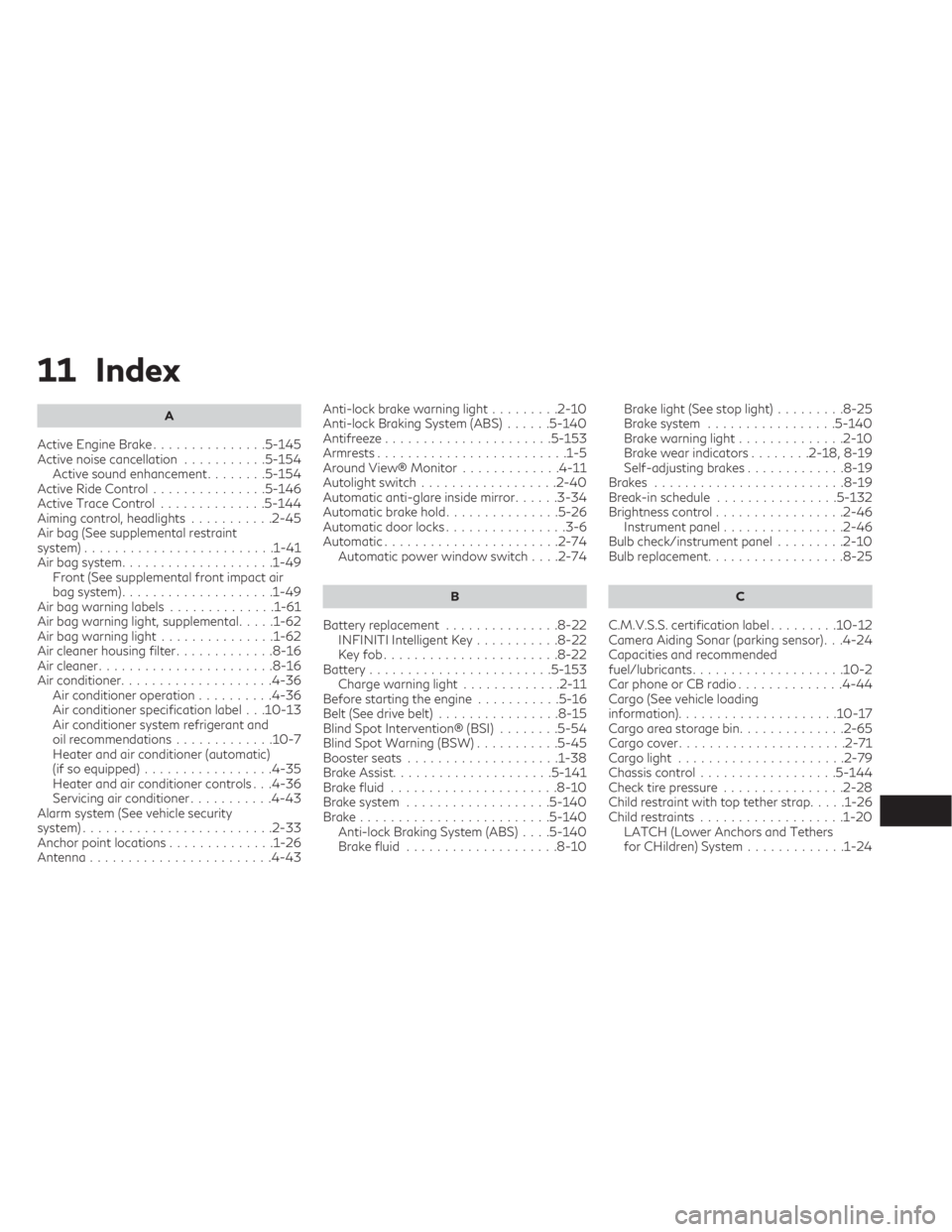
11 Index
A
Active Engine Brake...............5-145
Activenoisecancellation ...........5-154 Active sound enhancement ........5-154
ActiveRideControl...............5-146
ActiveTraceControl ..............5-144
Aiming control, headlights ...........2-45
Air bag (See supplemental restraint
system).........................1-41
Air bag system ....................1-49
Front (See supplemental front impact air
bagsystem)....................1-49
Air bag warning labels ..............1-61
Air bag warning light, supplemental .....1-62
Airbagwarninglight...............1-62
Air cleaner housing filter .............8-16
Air cleaner .......................8-16
Air conditioner ....................4-36
Air conditioner operation ..........4-36
Air conditioner specification label . . .10-13
Air conditioner system refrigerant and
oil recommendations .............10-7
Heater and air conditioner (automatic)
(if so equipped) .................4-35
Heater and air conditioner controls . . .4-36
Servicing air conditioner ...........4-43
Alarm system (See vehicle security
system).........................2-33
Anchor point locations ..............1-26
Antenna ........................4-43 Anti-lock brake warning ligh
t.........2-10
Anti-lock Braking System (ABS) ......5-140
Antifreeze ......................5-153
Armrests.........................1-5
Around View® Monitor .............4-11
Autolightswitch..................2-40
Automatic anti-glare inside mirror ......3-34
Automaticbrakehold...............5-26
Automatic door locks ................3-6
Automatic.......................2-74 Automatic power window switch ....2-74
B
Battery replacement...............8-22
INFINITI Intelligent Key ...........8-22
Keyfob.......................8-22
Battery........................5-153 Charge warning light .............2-11
Before starting the engine ...........5-16
Belt (See drive belt) ................8-15
Blind Spot Intervention® (BSI) ........5-54
Blind Spot Warning (BSW) ...........5-45
Boosterseats ....................1-38
Brake Assist .....................5-141
Brakefluid ......................8-10
Brakesystem ...................5-140
Brake.........................5-140 Anti-lock Braking System (ABS) ....5-140
Brakefluid ....................8-10 Brakelight(Seestoplight).........
8-25
Brake system .................5-140
Brakewarninglight..............2-10
Brake wear indicators ........2-18,8-19
Self-adjusting brakes .............8-19
Brakes .........................8-19
Break-in schedule ................5-132
Brightnesscontrol.................2-46 Instrument panel ................2-46
Bulb check/instrument panel .........2-10
Bulb replacement .................. 8-25
C
C.M.V.S.S. certification label .........10-12
Camera Aiding Sonar (parking sensor) . . .4-24
Capacities and recommended
fuel/lubricants....................10-2
Car phone or CB radio ..............4-44
Cargo (See vehicle loading
information).....................10-17
Cargoareastoragebin.............. 2-65
Cargocover...................... 2-71
Cargolight ......................2-79
Chassis control ..................5-144
Check tire pressure ................ 2-28
Child restraint with top tether strap .....1-26
Child restraints ...................1-20
LATCH (Lower Anchors and Tethers
forCHildren)System.............1-24