2023 HYUNDAI TUCSON service
[x] Cancel search: servicePage 557 of 638
09
9 -7
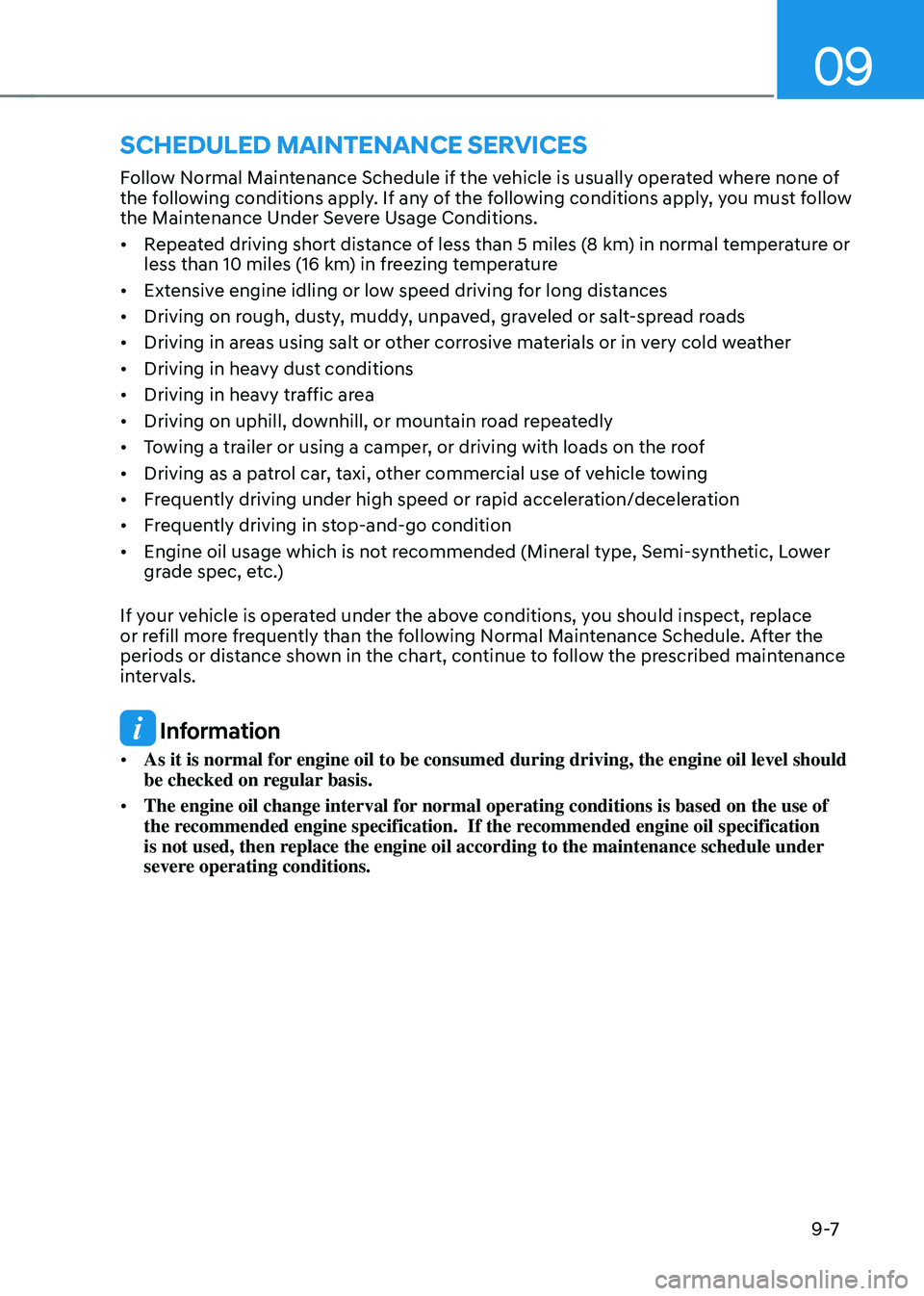
Follow Normal Maintenance Schedule if the vehicle is usually operated where none of
the following conditions apply. If any of the following conditions apply, you must follow
the Maintenance Under Severe Usage Conditions.
• Repeated driving short distance of less than 5 miles (8 km) in normal temperature or
less than 10 miles (16 km) in freezing temperature
• Extensive engine idling or low speed driving for long distances
• Driving on rough, dusty, muddy, unpaved, graveled or salt-spread roads
• Driving in areas using salt or other corrosive materials or in very cold weather
• Driving in heavy dust conditions
• Driving in heavy traffic area
• Driving on uphill, downhill, or mountain road repeatedly
• Towing a trailer or using a camper, or driving with loads on the roof
• Driving as a patrol car, taxi, other commercial use of vehicle towing
• Frequently driving under high speed or rapid acceleration/deceleration
• Frequently driving in stop-and-go condition
• Engine oil usage which is not recommended (Mineral type, Semi-synthetic, Lower
grade spec, etc.)
If your vehicle is operated under the above conditions, you should inspect, replace
or refill more frequently than the following Normal Maintenance Schedule. After the
periods or distance shown in the chart, continue to follow the prescribed maintenance
intervals.
Information
• As it is normal for engine oil to be consumed during driving, the engine oil level should
be checked on regular basis.
• The engine oil change interval for normal operating conditions is based on the use of
the recommended engine specification. If the recommended engine oil specification
is not used, then replace the engine oil according to the maintenance schedule under
severe operating conditions.
SCHEDULED MAINTENANCE SERVICES
Page 561 of 638
09
9-11
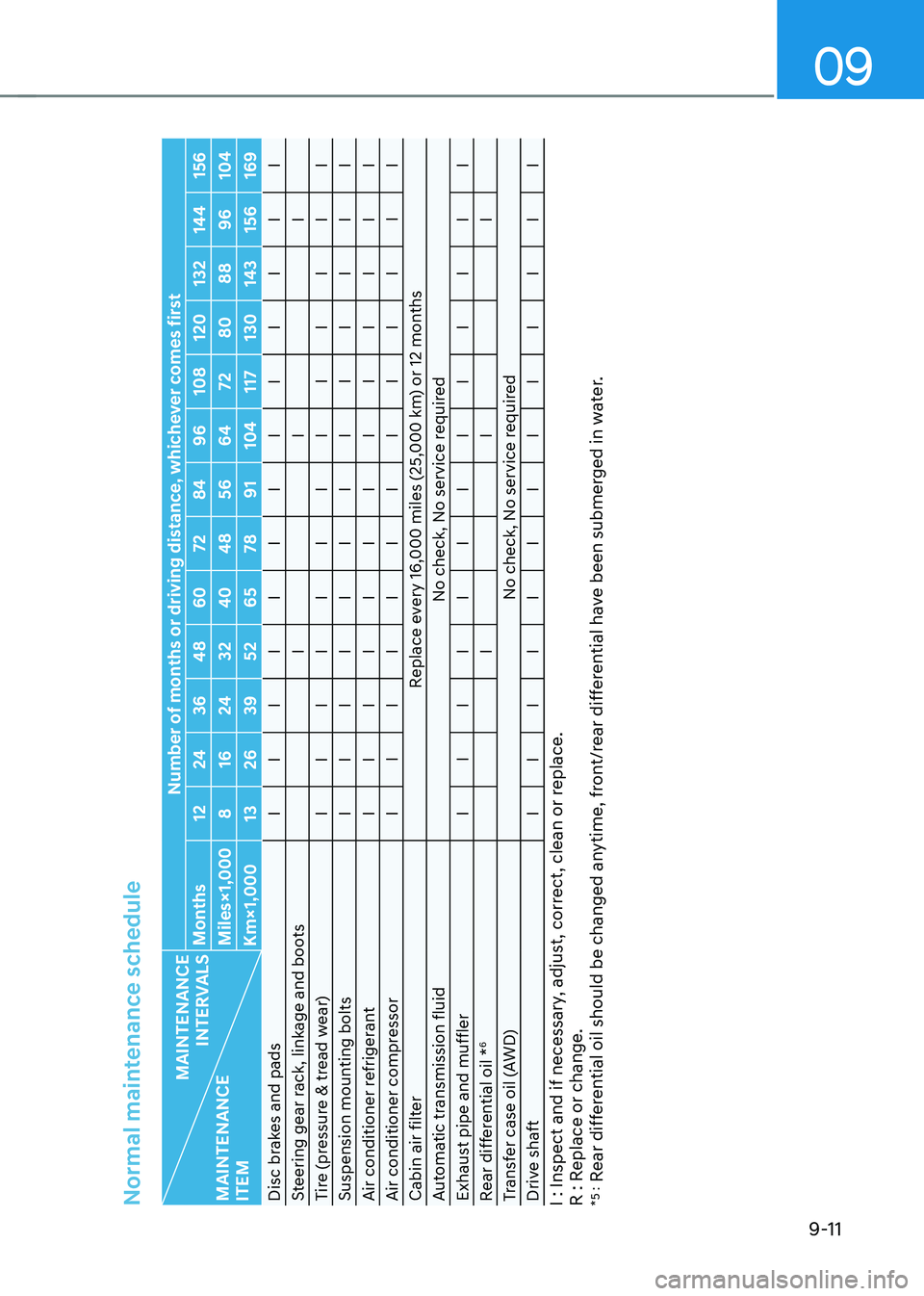
Normal maintenance schedule
MAINTENANCE
INTERVALS
MAINTENANCE
ITEM Number of months or driving distance, whichever comes first
Months 1224 3648 60 7284 96108 120 132144 156
Miles×1,000 816 24 3240 48 5664 7280 8896104
Km×1,000 1326 39 5265 78 91104 117130 143156169
Engine coolant At first, replace at 120,000 miles (200,000 km) or 120 months.
After that, replace every 24,000 miles (40,000 km) or 24 months
Battery condition IIIIIIIIIIIII
Brake lines, hoses and connections IIIIIIIIIIIII
Brake pedal IIIIII
Parking brake (if equipped) IIIIII
Brake fluid Inspect every 8,000 miles (13,000 km) or 12 months,
Replace every 48,000 miles (78,000 km) or 48 monthsI : Inspect and if necessary, adjust, correct, clean or replace.
R : Replace or change.Normal maintenance schedule
MAINTENANCE
INTERVALS
MAINTENANCE
ITEM Number of months or driving distance, whichever comes first
Months 1224 3648 60 7284 96108 120 132144 156
Miles×1,000 816 24 3240 48 5664 7280 8896104
Km×1,000 1326 39 5265 78 91104 117130 143156169
Disc brakes and pads IIIIIIIIIIIII
Steering gear rack, linkage and boots III
Tire (pressure & tread wear) IIIIIIIIIIIII
Suspension mounting bolts IIIIIIIIIIIII
Air conditioner refrigerant IIIIIIIIIIIII
Air conditioner compressor IIIIIIIIIIIII
Cabin air filter Replace every 16,000 miles (25,000 km) or 12 months
Automatic transmission fluid No check, No service required
Exhaust pipe and muffler IIIIIIII
IIIII
Rear differential oil *
6
I II
Transfer case oil (AWD) No check, No service required
Drive shaft IIIIIIIIIIIII
I : Inspect and if necessary, adjust, correct, clean or replace.
R : Replace or change.*5 : Rear differential oil should be changed anytime, front/rear differential have been submerged in water.
Page 562 of 638

Maintenance
9-12
Maintenance under severe usage conditions
The following items must be serviced more frequently on cars mainly used under
severe driving conditions. Refer to the chart below for the appropriate maintenance
intervals.
R : Replace
I : Inspect and if necessary, adjust, correct, clean or replace
Maintenance itemMaintenance
operation Maintenance intervals Driving
condition
Engine oil and engine oil
filter*
1R Replace every 5,000 miles
(8,000 km) or 6 months A, B, C, D, E,
F, G, H, I, J, K, L
Air cleaner filter RReplace more frequently
depending on the condition C, E
Spark plugs RReplace more frequently
depending on the condition A, B, F, G, H,
I, K
Steering gear box, linkage &
boots / lower arm ball joint,
upper arm ball joint IInspect more frequently
depending on the condition C, D, E, F, G,
H, I
Disc brakes and pads, calipers
and rotors IInspect more frequently
depending on the condition C, D, G, H,
J, K
*1 : Requires
engine oil (mineral oil including Semi-synthetic) is used, then the engine oil and engine
oil filter must be replaced as indicated severe maintenance condition.
Page 563 of 638
09
9-13
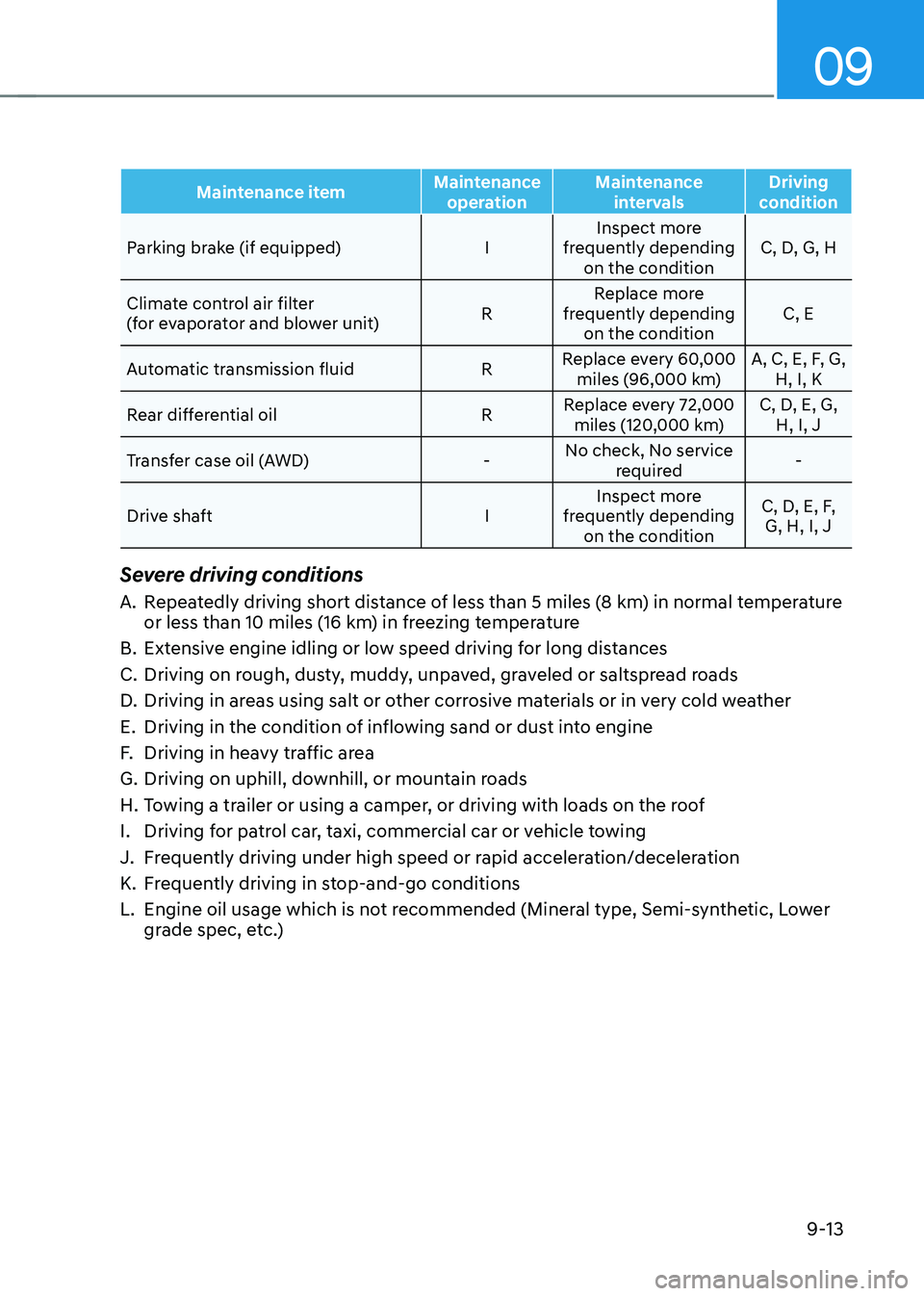
Maintenance itemMaintenance
operation Maintenance
intervals Driving
condition
Parking brake (if equipped) IInspect more
frequently depending on the condition C, D, G, H
Climate control air filter
(for evaporator and blower unit) RReplace more
frequently depending on the condition C, E
Automatic transmission fluid RReplace every 60,000
miles (96,000 km) A, C, E, F, G,
H, I, K
Rear differential oil RReplace every 72,000
miles (120,000 km) C, D, E, G,
H, I, J
Transfer case oil (AWD) -No check, No service
required -
Drive shaft IInspect more
frequently depending on the condition C, D, E, F,
G, H, I, J
Severe driving conditions
A. Repeatedly driving short distance of less than 5 miles (8 km) in normal temperature
or less than 10 miles (16 km) in freezing temperature
B. Extensive engine idling or low speed driving for long distances
C. Driving on rough, dusty, muddy, unpaved, graveled or saltspread roads
D. Driving in areas using salt or other corrosive materials or in very cold weather
E. Driving in the condition of inflowing sand or dust into engine
F. Driving in heavy traffic area
G. Driving on uphill, downhill, or mountain roads
H. Towing a trailer or using a camper, or driving with loads on the roof
I. Driving for patrol car, taxi, commercial car or vehicle towing
J. Frequently driving under high speed or rapid acceleration/deceleration
K. Frequently driving in stop-and-go conditions
L. Engine oil usage which is not recommended (Mineral type, Semi-synthetic, Lower
grade spec, etc.)
Page 566 of 638
Maintenance
9-16
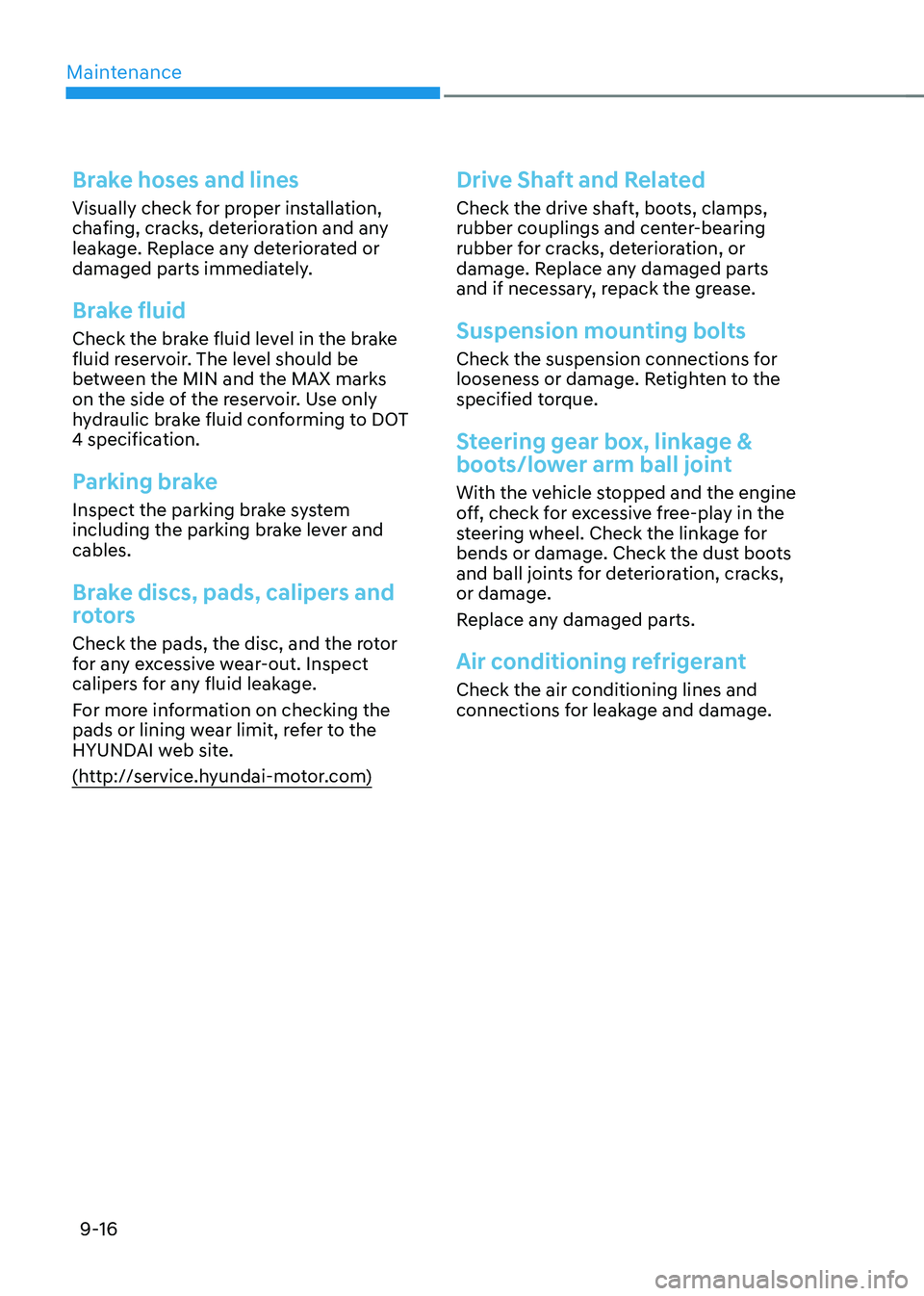
Brake hoses and lines
Visually check for proper installation,
chafing, cracks, deterioration and any
leakage. Replace any deteriorated or
damaged parts immediately.
Brake fluid
Check the brake fluid level in the brake
fluid reservoir. The level should be
between the MIN and the MAX marks
on the side of the reservoir. Use only
hydraulic brake fluid conforming to DOT
4 specification.
Parking brake
Inspect the parking brake system
including the parking brake lever and
cables.
Brake discs, pads, calipers and
rotors
Check the pads, the disc, and the rotor
for any excessive wear-out. Inspect
calipers for any fluid leakage.
For more information on checking the
pads or lining wear limit, refer to the
HYUNDAI web site.
(http://service.hyundai-motor.com)
Drive Shaft and Related
Check the drive shaft, boots, clamps,
rubber couplings and center-bearing
rubber for cracks, deterioration, or
damage. Replace any damaged parts
and if necessary, repack the grease.
Suspension mounting bolts
Check the suspension connections for
looseness or damage. Retighten to the
specified torque.
Steering gear box, linkage &
boots/lower arm ball joint
With the vehicle stopped and the engine
off, check for excessive free-play in the
steering wheel. Check the linkage for
bends or damage. Check the dust boots
and ball joints for deterioration, cracks,
or damage.
Replace any damaged parts.
Air conditioning refrigerant
Check the air conditioning lines and
connections for leakage and damage.
Page 578 of 638
Maintenance
9-28
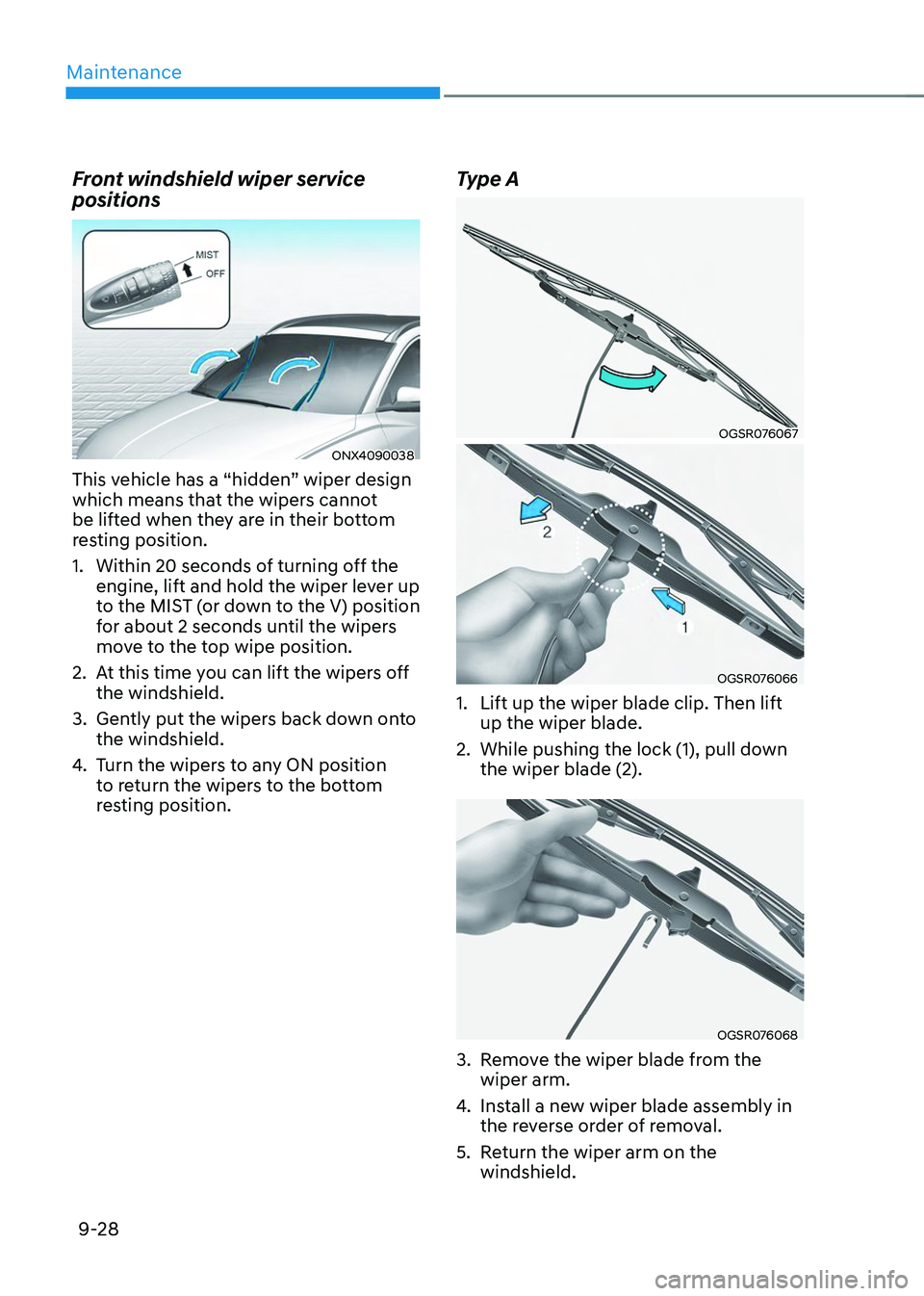
Front windshield wiper service
positions
ONX4090038
This vehicle has a “hidden” wiper design
which means that the wipers cannot
be lifted when they are in their bottom
resting position.
1. Within 20 seconds of turning off the
engine, lift and hold the wiper lever up
to the MIST (or down to the V) position
for about 2 seconds until the wipers
move to the top wipe position.
2. At this time you can lift the wipers off
the windshield.
3. Gently put the wipers back down onto
the windshield.
4. Turn the wipers to any ON position
to return the wipers to the bottom
resting position.
Type A
OGSR076067
OGSR076066
1. Lift up the wiper blade clip. Then lift
up the wiper blade.
2. While pushing the lock (1), pull down
the wiper blade (2).
OGSR076068
3. Remove the wiper blade from the
wiper arm.
4. Install a new wiper blade assembly in
the reverse order of removal.
5. Return the wiper arm on the
windshield.
Page 583 of 638
09
9-33
For best battery service
ONX4E090050
• Keep the battery securely mounted.
• Keep the battery top clean and dry.
• Keep the terminals and connections
clean, tight, and coated with
petroleum jelly or terminal grease.
• Rinse any spilled electrolyte from the
battery immediately with a solution of
water and baking soda.
• If the vehicle is not going to be used
for an extended time, disconnect the
battery cables.
Information
To check the batteries, open the cover (B).
For 7-seater, the clips (A) must be
removed first to open the cover.
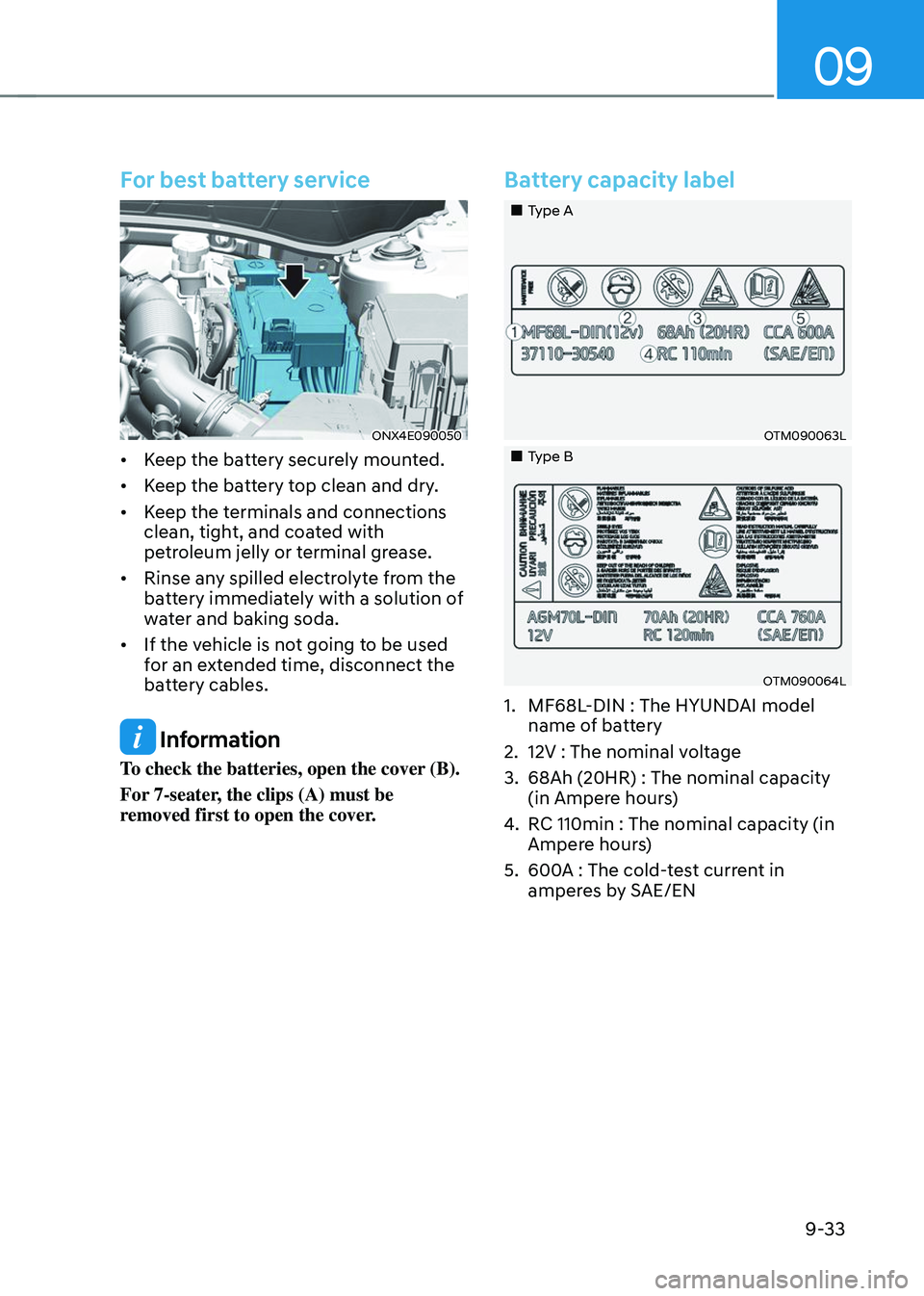
Battery capacity label
„„Type A
OTM090063L
„„Type B
OTM090064L
1. MF68L-DIN : The HYUNDAI model
name of battery
2. 12V : The nominal voltage
3. 68Ah (20HR) : The nominal capacity
(in Ampere hours)
4. RC 110min : The nominal capacity (in
Ampere hours)
5. 600A : The cold-test current in
amperes by SAE/EN
Page 584 of 638
Maintenance
9-34
Battery recharging
By battery charger
Your vehicle has a maintenance-free,
calcium-based battery.
• If the battery becomes discharged
over a short time (because, for
example, the headlamps or interior
lights were left on while the vehicle
was not in use), recharge it by slow
charging (trickle) for 10 hours.
• If the battery gradually discharges
because of high electrical load while
the vehicle is being used, recharge it
at 20-30A for two hours.
WARNING
Always follow these instructions when
recharging your vehicle’s battery to
avoid the risk of SERIOUS INJURY or
DEATH from explosions or acid burns:
• Before performing maintenance or
recharging the battery, turn off all
accessories and stop the engine.
• Keep all flames, sparks, or smoking
materials away from the battery.
• Always work outdoors or in an area
with plenty of ventilation.
• Wear eye protection when checking
the battery during charging.
• The battery must be removed from
the vehicle and placed in a well
ventilated area.
• Watch the battery during charging,
and stop or reduce the charging
rate if the battery cells begin boiling
violently.
• The negative battery cable must
be removed first and installed last
when the battery is disconnected.
Disconnect the battery charger in the
following order:
1. Turn off the battery charger main
switch.
2. Unhook the negative clamp from
the negative battery terminal.
3. Unhook the positive clamp from
the positive battery terminal.
• We recommend that you use
batteries for replacement from an
authorized HYUNDAI dealer.
NOTICE
AGM battery (if equipped)
• Absorbent Glass Matt (AGM)
batteries are maintenance-free
and we recommend that the AGM
battery be serviced by an authorized
HYUNDAI dealer. For charging
your AGM battery, use only fully
automatic battery chargers that
are specially developed for AGM
batteries.
• When replacing the AGM battery,
we recommend that you use parts
for replacement from an authorized
HYUNDAI dealer.
• Do not open or remove the cap on
top of the battery. This may cause
leaks of internal electrolyte that
could result in severe injury.