2023 HYUNDAI SONATA brake sensor
[x] Cancel search: brake sensorPage 436 of 555
![HYUNDAI SONATA 2023 Owners Manual 06
6-149
OHI058319L
[A] : Structure, [B] : Wall • Pulling into the parking space where
there is a structure
The system may not operate properly
when pulling in the vehicle to the
parking spac](/manual-img/35/56185/w960_56185-435.png "HYUNDAI SONATA 2023 Owners Manual 06
6-149
OHI058319L
[A] : Structure, [B] : Wall • Pulling into the parking space where
there is a structure
The system may not operate properly
when pulling in the vehicle to the
parking spac")
06
6-149
OHI058319L
[A] : Structure, [B] : Wall • Pulling into the parking space where
there is a structure
The system may not operate properly
when pulling in the vehicle to the
parking space where there is a
structure at the back or side of your
vehicle.
In certain instances, when backing
into the parking space, the system
may not detect the vehicle moving
in front of your vehicle. In this case,
the warning or brake may not operate
properly.
Always pay attention to the parking space while driving.OHI058320L
• When the vehicle is parked rearward
If the vehicle is parked rearward and
the radar sensor detects the another
vehicle in the rear area of the parking
space, the system can warn or control
braking. Always pay attention to the parking space while driving.
Information
This device complies with Industry Canada RSS-210 standard. Operation is subject to the following two conditions: 1. This device may not cause harmful
interference.
2. This device must accept any
interference received, including
interference that may cause undesired operation.
Page 460 of 555
Emergency Situations
7-12
Each wheel is equipped with a tire
pressure sensor mounted inside the tire
behind the valve stem (except for the
spare tire). You must use TPMS specific
wheels. It is recommended that you
always have your tires serviced by an
authorized HYUNDAI dealer.
You may not be able to identify a tire
with low pressure by simply looking at it.
Always use a good quality tire pressure
gauge to measure the tire’s inflation
pressure. Please note that a tire that is
hot (from being driven) will have a higher
pressure measurement than a tire that is cold.
A cold tire means the vehicle has been
sitting for 3 hours and driven for less
Than 1.6 km (1 mile) in that 3 hour period.
Allow the tire to cool before measuring
the inflation pressure. Always be sure
the tire is cold before inflating to the
recommended pressure.
WARNING
• The TPMS cannot alert you to severe
and sudden tire damage caused by
external factors such as nails or road debris.
• If you feel any vehicle instability,
immediately take your foot off
the accelerator, apply the brakes
gradually with light force, and slowly
move to a safe position off the road.
WARNING
Tampering with, modifying, or disabling
the Tire Pressure Monitoring System
(TPMS) components may interfere
with the system’s ability to warn the
driver of low tire pressure conditions
and/or TPMS malfunctions. Tampering
with, modifying, or disabling the Tire
Pressure Monitoring System (TPMS)
components may void the warranty for
that portion of the vehicle.
Information
This device complies with Industry Canada RSS-210 standard.
Operation is subject to the following three conditions: 1. This device may not cause harmful
interference.
2. This device must accept any
interference received, including
interference that may cause undesired operation.
3. Changes or modifications not expressly
approved by the party responsible
for compliance could void the user’s authority to operate the device.
Page 468 of 555
Emergency Situations
7-20
WARNING
If your vehicle is equipped with a
rollover sensor, place the ignition
switch in the LOCK/OFF or ACC position
when the vehicle is being towed. The side impact and curtain air bag
may deploy if the sensor detects the
situation as a rollover.
When towing your vehicle in an
emergency without wheel dollies:
1. Place the ignition switch in the ACC position.
2. Place the shift button in N (Neutral).
3. Release the parking brake.
CAUTION
Failure to place the shift button in N
(Neutral) when being towed with the
front wheels on the ground can cause
internal damage to the transmission.
Emergency Towing
If towing is necessary, we recommend
you have it done by an authorized
HYUNDAI dealer or a commercial tow truck service.
Page 524 of 555
Maintenance
8-54
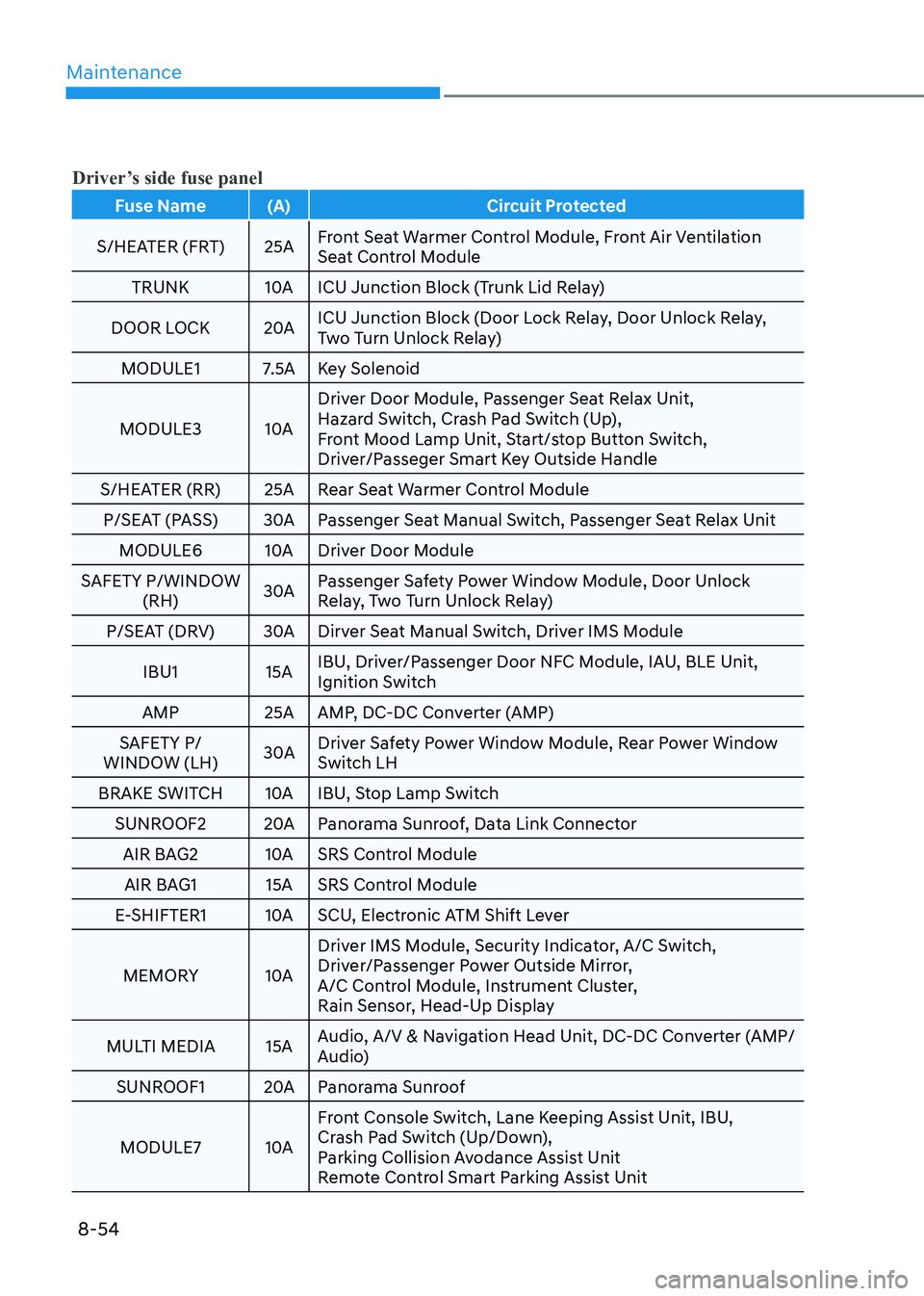
Driver’s side fuse panel
Fuse Name (A) Circuit Protected
S/HEATER (FRT) 25A Front Seat Warmer Control Module, Front Air Ventilation
Seat Control Module
TRUNK 10A ICU Junction Block (Trunk Lid Relay)
DOOR LOCK 20A ICU Junction Block (Door Lock Relay, Door Unlock Relay,
Two Turn Unlock Relay)
MODULE1 7.5A Key Solenoid
MODULE3 10A Driver Door Module, Passenger Seat Relax Unit,
Hazard Switch, Crash Pad Switch (Up),
Front Mood Lamp Unit, Start/stop Button Switch,
Driver/Passeger Smart Key Outside Handle
S/HEATER (RR) 25A Rear Seat Warmer Control Module P/SEAT (PASS) 30A Passenger Seat Manual Switch, Passenger Seat Relax Unit MODULE6 10A Driver Door Module
SAFETY P/WINDOW (RH) 30A Passenger Safety Power Window Module, Door Unlock
Relay, Two Turn Unlock Relay)
P/SEAT (DRV) 30A Dirver Seat Manual Switch, Driver IMS Module
IBU1 15A IBU, Driver/Passenger Door NFC Module, IAU, BLE Unit,
Ignition Switch
AMP 25A AMP, DC-DC Converter (AMP)
SAFETY P/
WINDOW (LH) 30A Driver Safety Power Window Module, Rear Power Window
Switch LH
BRAKE SWITCH 10A IBU, Stop Lamp Switch SUNROOF2 20A Panorama Sunroof, Data Link Connector
AIR BAG2 10A SRS Control Module AIR BAG1 15A SRS Control Module
E-SHIFTER1 10A SCU, Electronic ATM Shift Lever
MEMORY 10A Driver IMS Module, Security Indicator, A/C Switch,
Driver/Passenger Power Outside Mirror,
A/C Control Module, Instrument Cluster,
Rain Sensor, Head-Up Display
MULTI MEDIA 15A Audio, A/V & Navigation Head Unit, DC-DC Converter (AMP/
Audio)
SUNROOF1 20A Panorama Sunroof
MODULE7 10A Front Console Switch, Lane Keeping Assist Unit, IBU,
Crash Pad Switch (Up/Down),
Parking Collision Avodance Assist Unit
Remote Control Smart Parking Assist Unit
Page 527 of 555
08
8-57
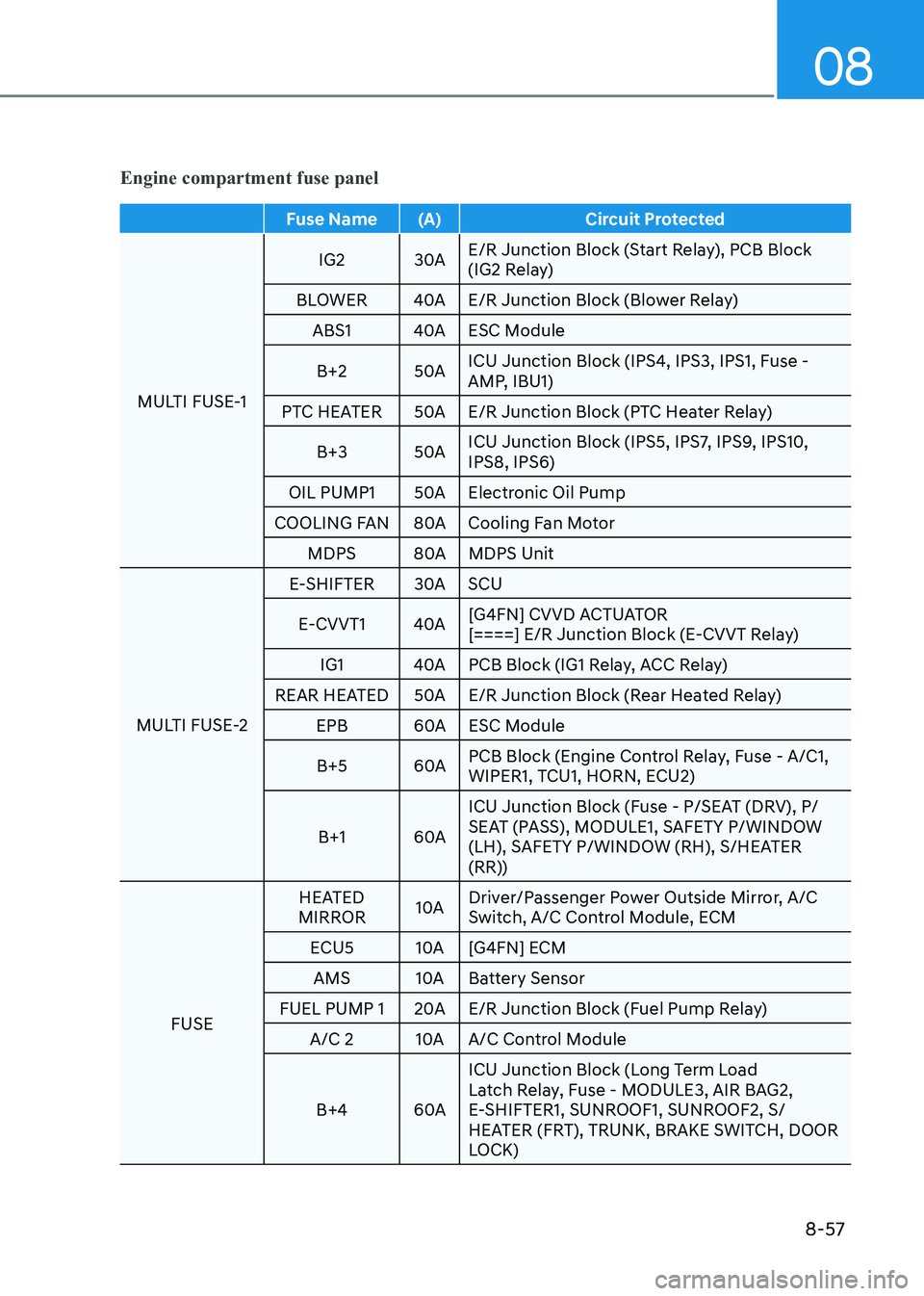
Engine compartment fuse panel
Fuse Name (A) Circuit Protected
MULTI FUSE-1 IG2 30A
E/R Junction Block (Start Relay), PCB Block
(IG2 Relay)
BLOWER 40A E/R Junction Block (Blower Relay) ABS1 40A ESC Module
B+2 50A ICU Junction Block (IPS4, IPS3, IPS1, Fuse -
AMP, IBU1)
PTC HEATER 50A E/R Junction Block (PTC Heater Relay)
B+3 50A ICU Junction Block (IPS5, IPS7, IPS9, IPS10, IPS8, IPS6)
OIL PUMP1 50A Electronic Oil Pump
COOLING FAN 80A Cooling Fan Motor MDPS 80A MDPS Unit
MULTI FUSE-2 E-SHIFTER 30A SCU
E-CVVT1 40A [G4FN] CVVD ACTUATOR
[====] E/R Junction Block (E-CVVT Relay)
IG1 40A PCB Block (IG1 Relay, ACC Relay)
REAR HEATED 50A E/R Junction Block (Rear Heated Relay)
EPB 60A ESC Module
B+5 60A PCB Block (Engine Control Relay, Fuse - A/C1,
WIPER1, TCU1, HORN, ECU2)
B+1 60A ICU Junction Block (Fuse - P/SEAT (DRV), P/
SEAT (PASS), MODULE1, SAFETY P/WINDOW
(LH), SAFETY P/WINDOW (RH), S/HEATER
(RR))
FUSE HEATED
MIRROR 10A Driver/Passenger Power Outside Mirror, A/C
Switch, A/C Control Module, ECM
ECU5 10A [G4FN] ECM AMS 10A Battery Sensor
FUEL PUMP 1 20A E/R Junction Block (Fuel Pump Relay) A/C 2 10A A/C Control Module
B+4 60A ICU Junction Block (Long Term Load
Latch Relay, Fuse - MODULE3, AIR BAG2,
E-SHIFTER1, SUNROOF1, SUNROOF2, S/
HEATER (FRT), TRUNK, BRAKE SWITCH, DOOR
LOCK)
Page 534 of 555
Maintenance
8-64
Exterior Care
Exterior general caution
It is very important to follow the label
directions when using any chemical
cleaner or polish. Read all warning and
caution statements that appear on the label.
High-pressure washing • When using high-pressure washers,
make sure to maintain sufficient
distance from the vehicle. Insufficient
clearance or excessive pressure can
lead to component damage or water
penetration.
• Do not spray the camera, sensors or
its surrounding area directly with a
high pressure washer. Shock applied
from high pressure water may cause
the device to not operate normally.
• Do not bring the nozzle tip close to
boots (rubber or plastic covers) or
connectors as they may be damaged
if they come into contact with high
pressure water.
• Do not use any high-pressure nozzles,
which induce either one-direct water
stream or water swirling.
Protecting your vehicle’s finish
Washing
To help protect your vehicle’s finish from
rust and deterioration, wash it thoroughly
and frequently at least once a month
with lukewarm or cold water.
If you use your vehicle for off-road
driving, you should wash it after each
off-road trip. Pay special attention to the
removal of any accumulation of salt, dirt,
mud, and other foreign materials. Make
sure the drain holes in the lower edges
of the doors and rocker panels are kept clear and clean.
Insects, tar, tree sap, bird droppings,
industrial pollution and similar deposits
can damage your vehicle’s finish if not
removed immediately.
Even prompt washing with plain water
may not completely remove all these
deposits. A mild soap, safe for use on
painted surfaces, should be used.
After washing, rinse the vehicle
thoroughly with lukewarm or cold water.
Do not allow soap to dry on the finish.
WARNING
After washing the vehicle, test the
brakes while driving slowly to see
if they have been affected by water
before getting on the road. If braking
performance is impaired, dry the
brakes by applying them lightly while
maintaining a slow forward speed.
NOTICE
• Do not use strong soap, chemical
detergents or hot water, and do not
wash the vehicle in direct sunlight
or when the body of the vehicle is
warm.
• Be careful when washing the side
windows of your vehicle.
Especially, with high-pressure water,
water may leak through the windows
and wet the interior.
• To prevent damage to the plastic
parts, do not clean with chemical
solvents or strong detergents.
appEaranCE CarE
Page 545 of 555
I
I-3
B
Basic Troubleshooting Guide .............................................................................. 7-20
Battery ................................................................................................................. 8-36
Battery Recharging ........................................................................................... 8-37
For Best Battery Service .................................................................................. 8-36
Reset Features .................................................................................................. 8-37
Before Driving ....................................................................................................... 6-5
Before Entering the Vehicle ............................................................................... 6-5
Before Starting ................................................................................................... 6-5
Blind View Monitor (BVM) ............................................................................. 6-104
Blind-Spot Collision Warning (BCW) /
Blind-Spot Collision-Avoidance Assist (BCA) ...................................................6-77
Detecting Sensors (Front View Camera and Rear Corner Radar) ....................6-82
Limitations of the System ................................................................................ 6-85
System Description .......................................................................................... 6-77
System Setting and Activation ......................................................................... 6-78
Warning and System Control ........................................................................... 6-80
Brake Fluid .......................................................................................................... 8-29
Checking the Brake Fluid Level ....................................................................... 8-29
Brake System ....................................................................................................... 6-30
Anti-Lock Brake System (ABS) ...................................................................... 6-37
Auto Hold ......................................................................................................... 6-34
Disc Brakes Wear Indicator .............................................................................. 6-30
Electronic Parking Brake (EPB) ...................................................................... 6-31
Electronic Stability Control (ESC) ................................................................... 6-39
Good Braking Practices .................................................................................... 6-42
Hill-Start Assist Control (HAC) ....................................................................... 6-42
Power Brakes .................................................................................................... 6-30
Vehicle Stability Management (VSM) .............................................................6-41
Bulb Wattage ........................................................................................................ 2-11
C Child Restraint System (CRS) ............................................................................. 3-29
Children Always in the Rear ............................................................................ 3-29
Installing a Child Restraint System (CRS) .......................................................3-31
Selecting a Child Restraint System (CRS) .......................................................3-30
Climate Control Additional Features ................................................................. 5-130
Automatic Ventilation .................................................................................... 5-130
Sunroof Inside Air Recirculation ................................................................... 5-130
Page 547 of 555
I
I-5
E Emission Control System .................................................................................... 8-70
Engine Compartment ..................................................................................... 2-8/ 8-3
Engine Coolant .................................................................................................... 8-26
Changing Engine Coolant ................................................................................ 8-28
Checking the Engine Coolant Level ................................................................. 8-26
Engine Number .................................................................................................... 2-17
Engine Oil ............................................................................................................ 8-23
Checking the Engine Oil and Filter .................................................................. 8-25
Checking the Engine Oil Level ........................................................................ 8-23
Engine Specification ............................................................................................ 2-10
Explanation of Scheduled Maintenance Items ....................................................8-20
Exterior Features .................................................................................................. 5-50
Emergency Trunk Safety Release..................................................................... 5-52
Fuel Filler Door ................................................................................................ 5-56
Hood ................................................................................................................. 5-50
Trunk ................................................................................................................ 5-51
Exterior Overview ................................................................................................. 2-2
F
Forward Collision – Avoidance Assist (FCA) - Sensor Fusion ...........................6-50
FCA Sensor ...................................................................................................... 6-55
FCA Warning Message And Brake Control .....................................................6-52
Forward Collision-Avoidance Assist - Junction Turning ................................6-65
Limitations of The System ............................................................................... 6-58
System Malfunction ......................................................................................... 6-57
System Setting and Activation ......................................................................... 6-50
Forward/Reverse Parking Distance Warning (PDW) ..........................................5-86
Forward/Reverse Parking Distance Warning System Precautions ...................5-90
Non-Operational Conditions of Forward/Reverse Parking Distance
Warning System ............................................................................................. 5-89
Operation of Forward/Reverse Parking Distance Warning System .................5-87
Fuel Requirements ................................................................................................. 1-5
Fuses .................................................................................................................... 8-50
Engine Compartment Panel Fuse Replacement ...............................................8-52
Fuse/Relay Panel Description .......................................................................... 8-53
Instrument Panel Fuse Replacement ................................................................ 8-51