2023 HYUNDAI KONA EV rear occupant
[x] Cancel search: rear occupantPage 80 of 548
3
3. Safety system
Important safety precautions ........................................................................... 3-2
Always wear your seat belt .......................................................................................... 3-2
Restrain all children ...................................................................................................... 3-2
Air bag hazards ............................................................................................................. 3-2
Driver distraction .......................................................................................................... 3-2
Control your speed ....................................................................................................... 3-2
Keep your vehicle in safe condition ............................................................................ 3-2
Seats .................................................................................................................. 3-3
Safety precautions ....................................................................................................... 3-4
Front seats .................................................................................................................... 3-5
Rear seats ................................................................................................................... 3-10
Headrest.......................................................................................................................3-13
Seat warmers and air ventilation seats ...................................................................... 3-17
Seat belts ......................................................................................................... 3-20
Seat belt safety precautions ...................................................................................... 3-20
Seat belt warning light ................................................................................................ 3-21
Seat belt restraint system .......................................................................................... 3-22
Additional seat belt safety precautions .................................................................... 3-28
Care of seat belts........................................................................................................3-30
Child Restraint System (CRS) .......................................................................... 3-31
Children always in the rear ......................................................................................... 3-31
Selecting a Child Restraint System (CRS) .................................................................3-32
Installing a Child Restraint system (CRS)..................................................................3-34
Air bag - supplemental restraint system .......................................................3-42
Where are the air bags? ............................................................................................ 3-44
How does the air bags system operate? ................................................................... 3-47
What to expect after an air bag inflates ................................................................... 3-51
Occupant Classification System (OCS) ..................................................................... 3-51
Why didn’t my air bag go off in a collision? ..............................................................3-57
Why didn’t my air bag go off in a collision? ..............................................................3-58
SRS care ...................................................................................................................... 3-63
Additional safety precautions................................................................................... 3-64
Air bag warning labels............................................................................................... 3-64
This chapter provides you with important information about how to protect yourself and your
passengers. It explains how to properly use your seats and seat belts, and how your air bags work.
Additionally, this chapter explains how to properly restrain infants and children in your vehicle.
Page 81 of 548
Safety system
3-2
You will find many safety precautions
and recommendations throughout this
section, and throughout this manual.
The safety precautions in this section are
among the most important.
Always wear your seat belt
A seat belt is your best protection in all
types of accidents. Air bags are designed
to supplement seat belts, not replace
them. So even though your vehicle is
equipped with air bags, ALWAYS make
sure you and your passengers wear your
seat belts, and wear them properly.
Restrain all children
All children under age 13 should ride
in your vehicle properly restrained in a
rear seat, not the front seat. Infants and
small children should be restrained in
an appropriate Child Restraint System.
Larger children should use a booster
seat with the lap/shoulder belt until they
can use the seat belt properly without a
booster seat.
Air bag hazards
While air bags can save lives, they can
also cause serious or fatal injuries to
occupants who sit too close to them, or
who are not properly restrained. Infants,
young children, and short adults are at
the greatest risk of being injured by an
inflating air bag. Follow all instructions
and warnings in this manual.
Driver distraction
Driver distraction presents a serious and
potentially deadly danger, especially for
inexperienced drivers. Safety should be
the first concern when behind the wheel
and drivers need to be aware of the wide
array of potential distractions, such as
drowsiness, reaching for objects, eating,
personal grooming, other passengers, and using cellular phones.
Drivers can become distracted when
they take their eyes and attention off
the road or their hands off the wheel to
focus on activities other than driving.
To reduce your risk of distraction and an
accident: •
ALWAYS set up your mobile devices
(i.e., MP3 players, phones, navigation
units, etc.) when your vehicle is
parked or safely stopped.
• ONLY use your mobile device when
allowed by laws and conditions permit
safe use. NEVER text or email while
driving. Most countries have laws
prohibiting drivers from texting. Some
countries and cities also prohibit
drivers from using handheld phones.
• NEVER let the use of a mobile device
distract you from driving. You have a
responsibility to your passengers and
others on the road to always drive
safely, with your hands on the wheel
as well as your eyes and attention on
the road.
Control your speed
Excessive speed is a major factor in crash
injuries and deaths. Generally, the higher
the speed, the greater the risk, but
serious injuries can also occur at lower
speeds. Never drive faster than is safe
for current conditions, regardless of the
maximum speed posted.
Keep your vehicle in safe
condition
Having a tire blowout or a mechanical
failure can be extremely hazardous. To
reduce the possibility of such problems,
check your tire pressures and condition
frequently, and perform all regularly
scheduled maintenance.
Important safety precautIons
Page 84 of 548
03
3-5
Seat belts
Always fasten your seat belt before
starting any trip. At all times, passengers
should sit upright and be properly
restrained. Infants and small children
must be restrained in appropriate Child
Restraint Systems. Children who have
outgrown a booster seat and adults must
be restrained using the seat belts.
WARNING
Take the following precautions when
adjusting your seat belt: • NEVER use one seat belt for more
than one occupant.
• Always position the seatback upright
with the lap portion of the seat belt
snug and low across the hips.
• NEVER allow children or small infants
to ride on a passenger’s lap.
• Do not route the seat belt across your
neck, across sharp edges, or reroute
the shoulder strap away from your
body.
• Do not allow the seat belt to become
caught or jammed.
Front seats
The front seat can be adjusted by using
the control lever (or knob) or switches
located on the outside of the seat
cushion. Before driving, adjust the seat
to the proper position so that you can
easily control the steering wheel, foot
pedals and controls on the instrument panel.
WARNING
Take the following precautions when
adjusting your seat: • NEVER attempt to adjust the seat
while the vehicle is moving. The seat
could respond with unexpected
movement and may cause loss
of vehicle control resulting in an
accident.
• Do not place anything under the
front seats. Loose objects in the
driver’s foot area could interfere
with the operation of the foot pedals,
causing an accident.
• Do not allow anything to interfere
with the normal position and proper
locking of the seatback.
• Do not place a cigarette lighter on
the floor or seat. When you operate
the seat, gas may exit out of the
lighter causing a fire.
• Use extreme caution when picking
up small objects trapped under the
seats or between the seat and the
center console. Your hands might be
cut or injured by the sharp edges of
the seat mechanism.
• If there are occupants in the rear
seats, be careful while adjusting the
front seat position.
• Make sure that the seat is locked in
place after the adjustment. If not,
the seat might move unexpectedly
resulting in an accident.
Page 89 of 548
Safety system
3-10
OOS037008
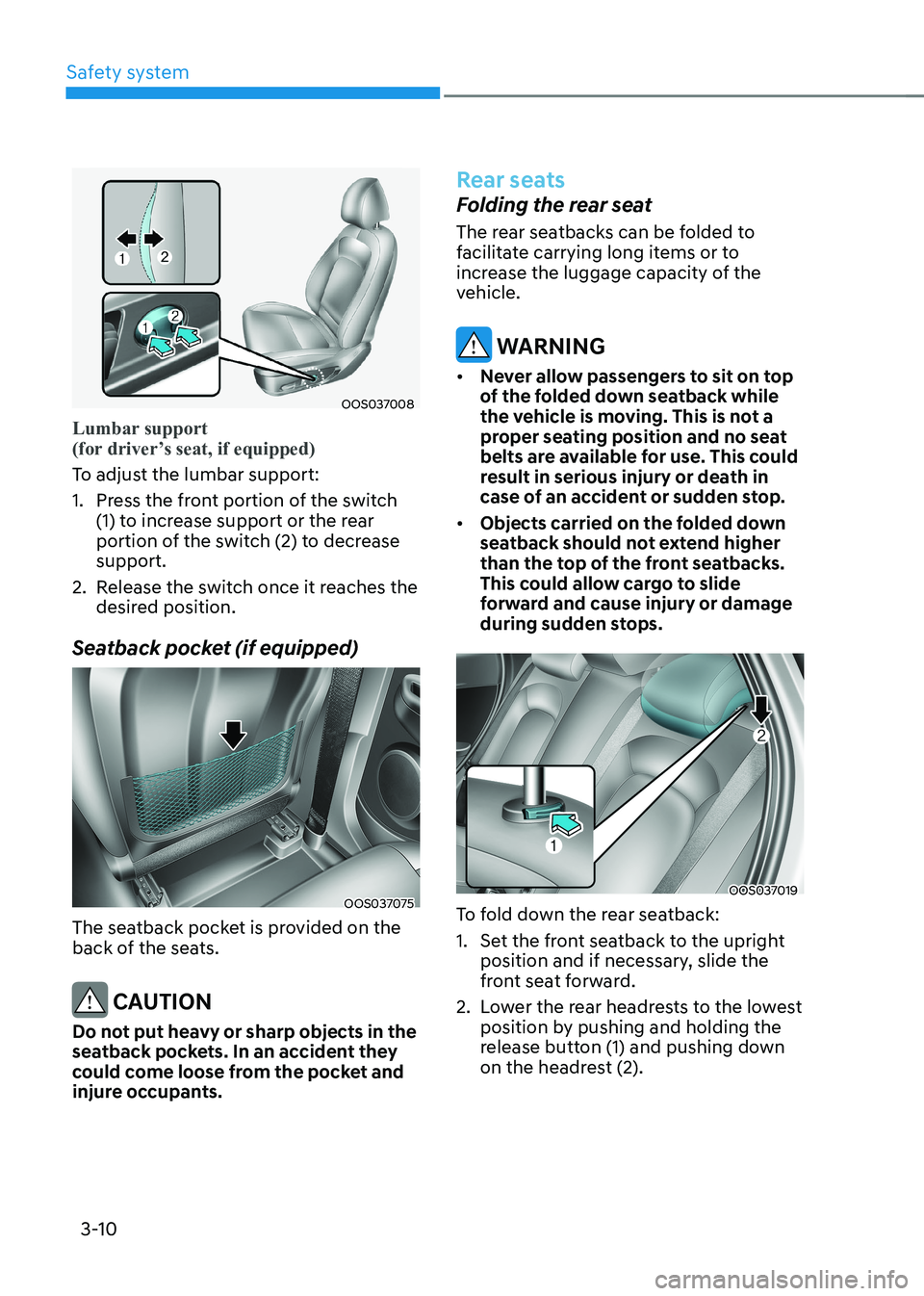
Lumbar support
(for driver’s seat, if equipped)
To adjust the lumbar support:
1. Press the front portion of the switch (1) to increase support or the rear
portion of the switch (2) to decrease support.
2. Release the switch once it reaches the desired position.
Seatback pocket (if equipped)
OOS037075
The seatback pocket is provided on the
back of the seats.
CAUTION
Do not put heavy or sharp objects in the
seatback pockets. In an accident they
could come loose from the pocket and
injure occupants.
Rear seats
Folding the rear seat
The rear seatbacks can be folded to
facilitate carrying long items or to
increase the luggage capacity of the
vehicle.
WARNING
• Never allow passengers to sit on top
of the folded down seatback while
the vehicle is moving. This is not a
proper seating position and no seat
belts are available for use. This could
result in serious injury or death in
case of an accident or sudden stop.
• Objects carried on the folded down
seatback should not extend higher
than the top of the front seatbacks.
This could allow cargo to slide
forward and cause injury or damage
during sudden stops.
OOS037019
To fold down the rear seatback:
1. Set the front seatback to the upright position and if necessary, slide the
front seat forward.
2. Lower the rear headrests to the lowest position by pushing and holding the
release button (1) and pushing down
on the headrest (2).
Page 90 of 548
03
3-11
OOS037020
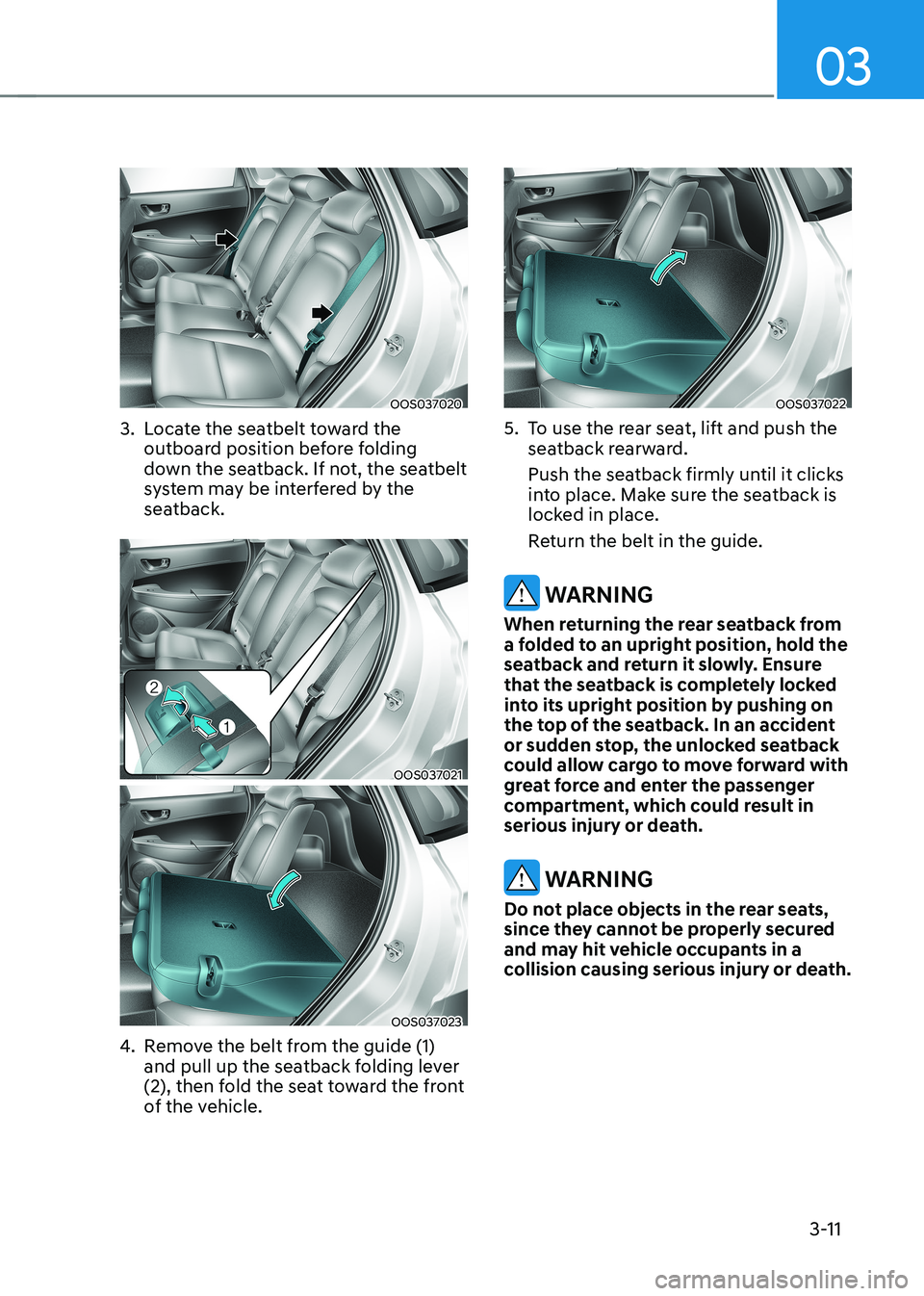
3. Locate the seatbelt toward the outboard position before folding
down the seatback. If not, the seatbelt
system may be interfered by the
seatback.
OOS037021
OOS037023
4. Remove the belt from the guide (1)
and pull up the seatback folding lever
(2), then fold the seat toward the front
of the vehicle.
OOS037022
5. To use the rear seat, lift and push the seatback rearward.
Push the seatback firmly until it clicks
into place. Make sure the seatback is
locked in place.
Return the belt in the guide.
WARNING
When returning the rear seatback from
a folded to an upright position, hold the
seatback and return it slowly. Ensure
that the seatback is completely locked
into its upright position by pushing on
the top of the seatback. In an accident
or sudden stop, the unlocked seatback
could allow cargo to move forward with
great force and enter the passenger
compartment, which could result in
serious injury or death.
WARNING
Do not place objects in the rear seats,
since they cannot be properly secured
and may hit vehicle occupants in a
collision causing serious injury or death.
Page 91 of 548
Safety system
3-12
CAUTION
Damaging rear seat belt buckles
When you fold the rear seatback, insert
the buckle in the pocketbetween the
rear seatback and cushion. Doing so
can prevent the buckle from being
damaged by the rear seatback.
WARNING
Make sure the vehicle is off, the vehicle
is shifted to P (Park), and the parking
brake is securely applied whenever
loading or unloading cargo. Failure to
take these steps may allow the vehicle
to move if the shift lever is inadvertently
moved to another position.
CAUTION
• Be careful when loading cargo
through the rear passenger seats
to prevent damage to the vehicle
interior.
• When cargo is loaded through the
rear passenger seats, ensure the
cargo is properly secured to prevent
it from moving while driving.
• Unsecured cargo in the passenger
compartment can cause damage
to the vehicle or injury to it’s
occupants.
WARNING
Cargo should always be secured to
prevent it from being thrown about the
vehicle in a collision and causing injury
to the vehicle occupants. Do not place
objects in the rear seats, since they
cannot be properly secured and may hit
the front seat occupants in a collision. Armrest (if equipped)
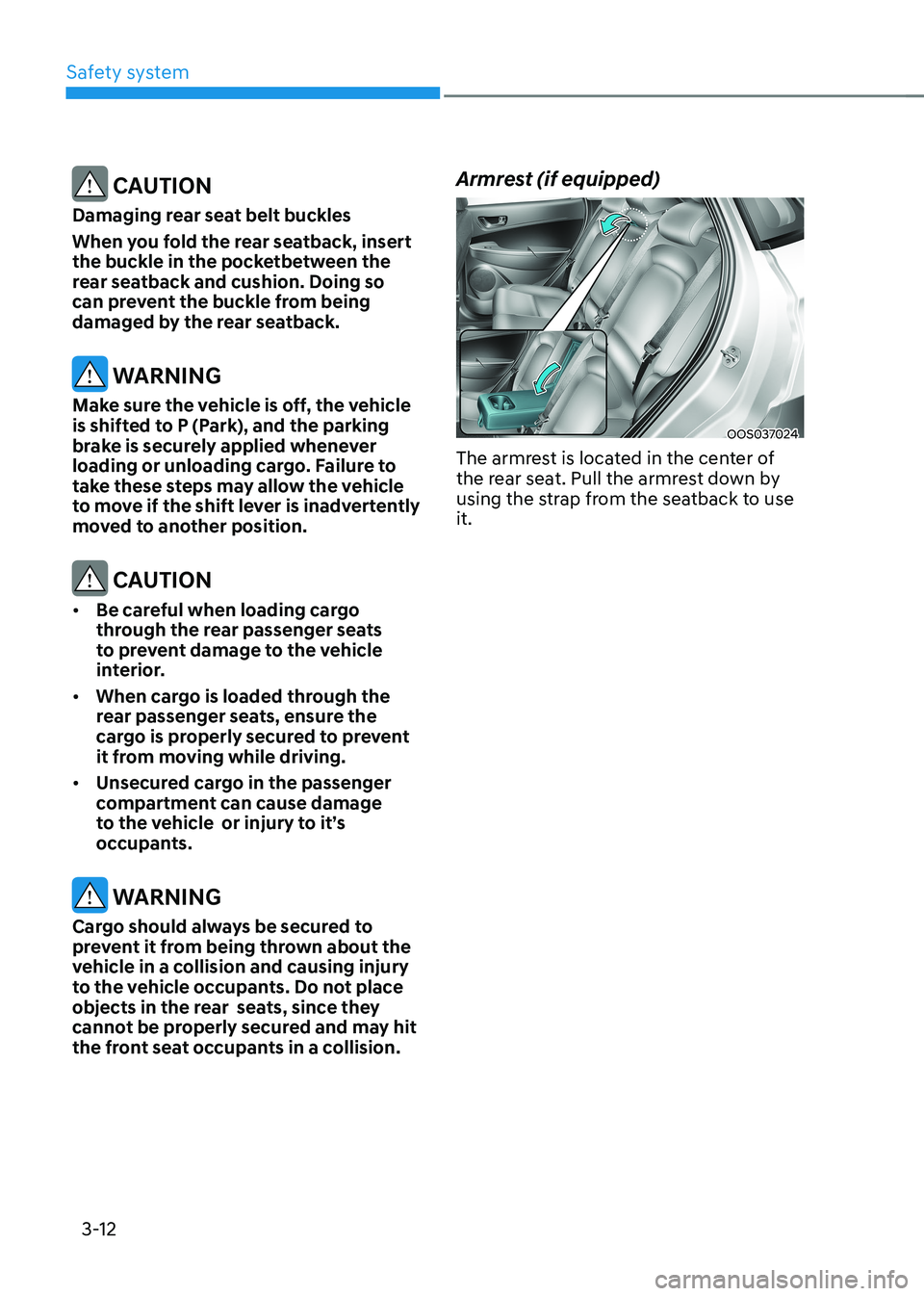
OOS037024
The armrest is located in the center of
the rear seat. Pull the armrest down by
using the strap from the seatback to use it.
Page 92 of 548
03
3-13
Headrest
The vehicle’s front and rear seats have
adjustable headrests. The headrests
provide comfort for passengers, but
more importantly they are designed to
help protect passengers from whiplash
and other neck and spinal injuries during
an accident, especially in a rear impact collision.
WARNING
To reduce the risk of serious injury or
death in an accident, take the following
precautions when adjusting your
headrests: • Always properly adjust the headrests
for all passengers BEFORE starting
the vehicle.
• NEVER let anyone ride in a seat with
the headrest removed or reversed.
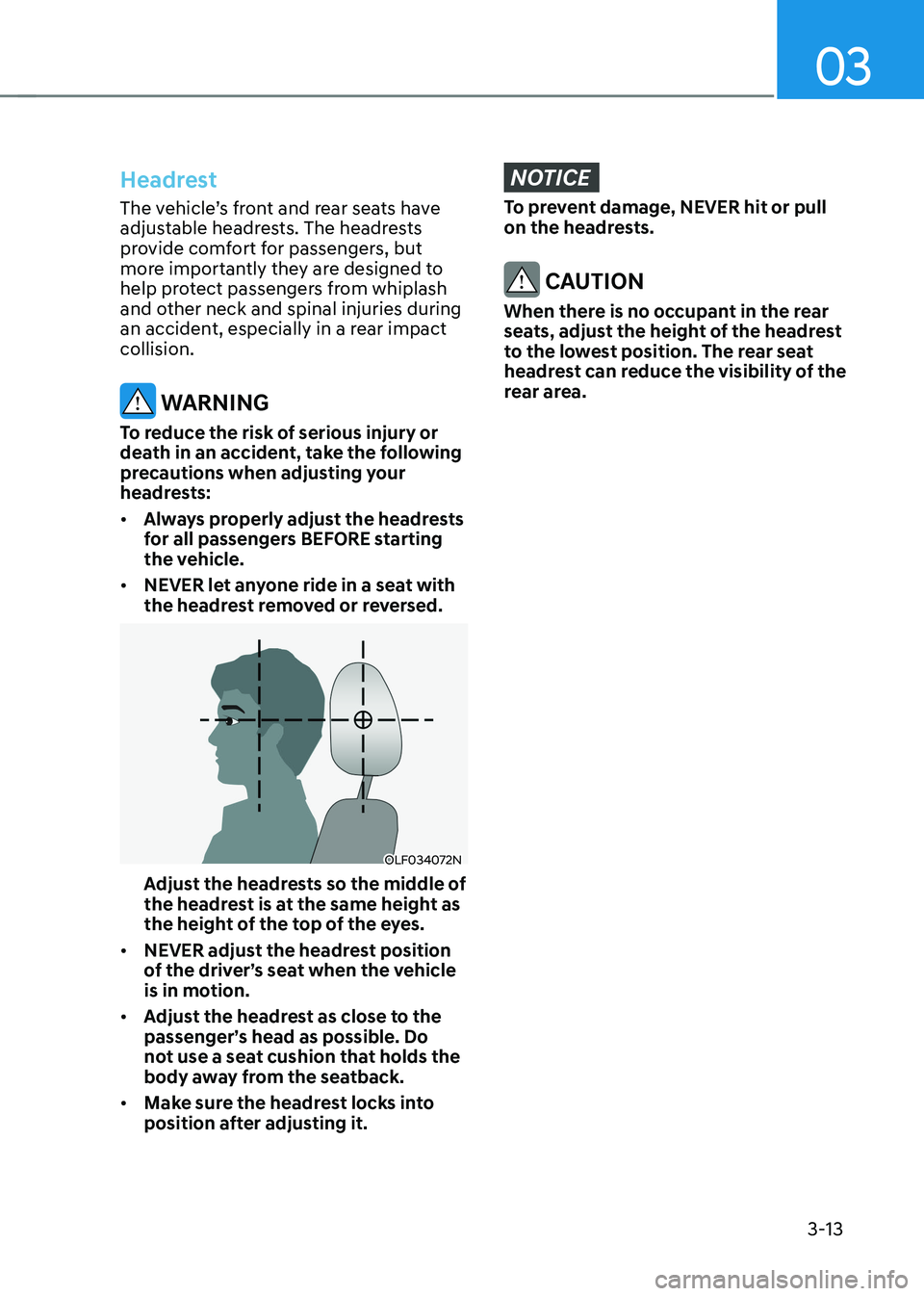
OLF034072N
Adjust the headrests so the middle of
the headrest is at the same height as
the height of the top of the eyes.
• NEVER adjust the headrest position
of the driver’s seat when the vehicle
is in motion.
• Adjust the headrest as close to the
passenger’s head as possible. Do
not use a seat cushion that holds the
body away from the seatback.
• Make sure the headrest locks into
position after adjusting it.
NOTICE
To prevent damage, NEVER hit or pull
on the headrests.
CAUTION
When there is no occupant in the rear
seats, adjust the height of the headrest
to the lowest position. The rear seat
headrest can reduce the visibility of the
rear area.
Page 99 of 548
Safety system
3-20
seat Belts
This section describes how to use the
seat belts properly. It also describes
some of the things not to do when using
seat belts.
Seat belt safety precautions
Always fasten your seat belt and make
sure all passengers have fastened their
seat belts before starting any trip. Air
bags are designed to supplement the
seat belt as an additional safety device,
but they are not a substitute. Most
countries require all occupants of a
vehicle to wear seat belts.
WARNING
Seat belts must be used by ALL
passengers whenever the vehicle is
moving. Take the following precautions
when adjusting and wearing seat belts: • Children under the age of 13 should
be properly restrained in the rear
seats.
• Never allow children to ride in the
front passenger seat, unless the air
bag is deactivated. If a child is seated
in the front passenger seat, move
the seat as far back as possible and
properly restrain them in the seat.
• NEVER allow an infant or child to be
carried on an occupant’s lap.
• NEVER ride with the seatback
reclined when the vehicle is moving.
• Do not allow children to share a seat
or seat belt.
• Do not wear the shoulder belt under
your arm or behind your back. •
Never wear a seat belt over fragile
objects. If there is a sudden stop or
impact, the seat belt can damage it.
• Do not use the seat belt if it is
twisted. A twisted seat belt will not
protect you properly in an accident.
• Do not use a seat belt if the webbing
or hardware is damaged.
• Do not latch the seat belt into the
buckles of other seats.
• NEVER unfasten the seat belt
while driving. This may cause loss
of vehicle control resulting in an
accident.
• Make sure there is nothing in the
buckle interfering with the seat belt
latch mechanism. This may prevent
the seat belt from fastening securely.
• No modifications or additions
should be made by the user which
will either prevent the seat belt
adjusting devices from operating to
remove slack, or prevent the seat
belt assembly from being adjusted to
remove slack.
WARNING
Damaged seat belts and seat belt
assemblies will not operate properly.
Always replace: • Frayed, contaminated, or damaged
webbing.
• Damaged hardware.
• The entire seat belt assembly after it
has been worn in an accident, even
if damage to webbing or assembly is
not apparent.