Page 57 of 548
Foreword / Electric Vehicle System Overview
1-52
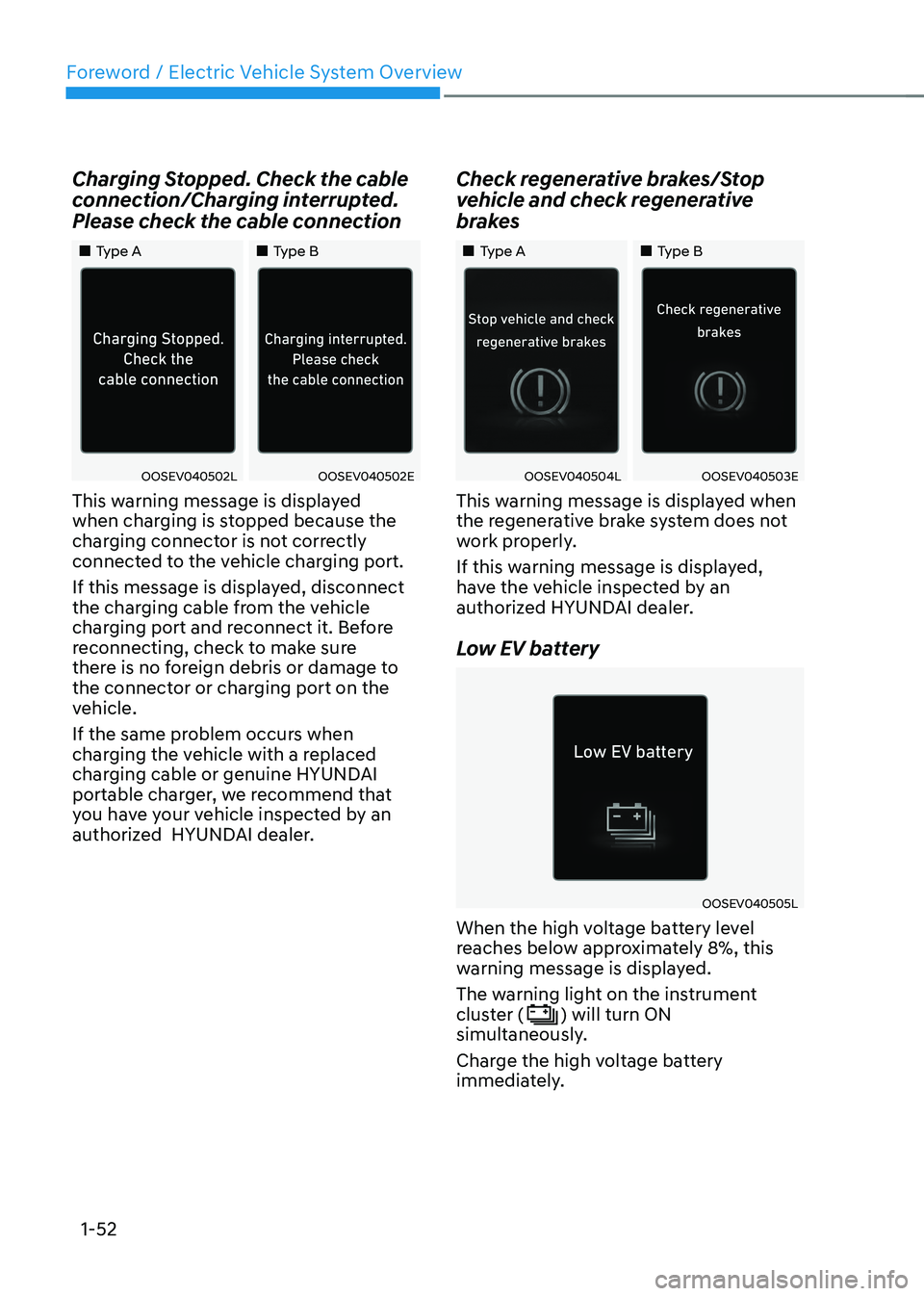
Charging Stopped. Check the cable
connection/Charging interrupted.
Please check the cable connection
„„Type A
„„Type B
OOSEV040502LOOSEV040502E
This warning message is displayed
when charging is stopped because the
charging connector is not correctly
connected to the vehicle charging port.
If this message is displayed, disconnect
the charging cable from the vehicle
charging port and reconnect it. Before
reconnecting, check to make sure
there is no foreign debris or damage to
the connector or charging port on the
vehicle.
If the same problem occurs when
charging the vehicle with a replaced
charging cable or genuine HYUNDAI
portable charger, we recommend that
you have your vehicle inspected by an
authorized HYUNDAI dealer. Check regenerative brakes/Stop
vehicle and check regenerative
brakes
„„Type A
„„Type B
OOSEV040504LOOSEV040503E
This warning message is displayed when
the regenerative brake system does not
work properly.
If this warning message is displayed,
have the vehicle inspected by an
authorized HYUNDAI dealer.
Low EV battery
OOSEV040505L
When the high voltage battery level
reaches below approximately 8%, this
warning message is displayed.
The warning light on the instrument
cluster (
) will turn ON
simultaneously.
Charge the high voltage battery
immediately.
Page 61 of 548
Foreword / Electric Vehicle System Overview
1-56
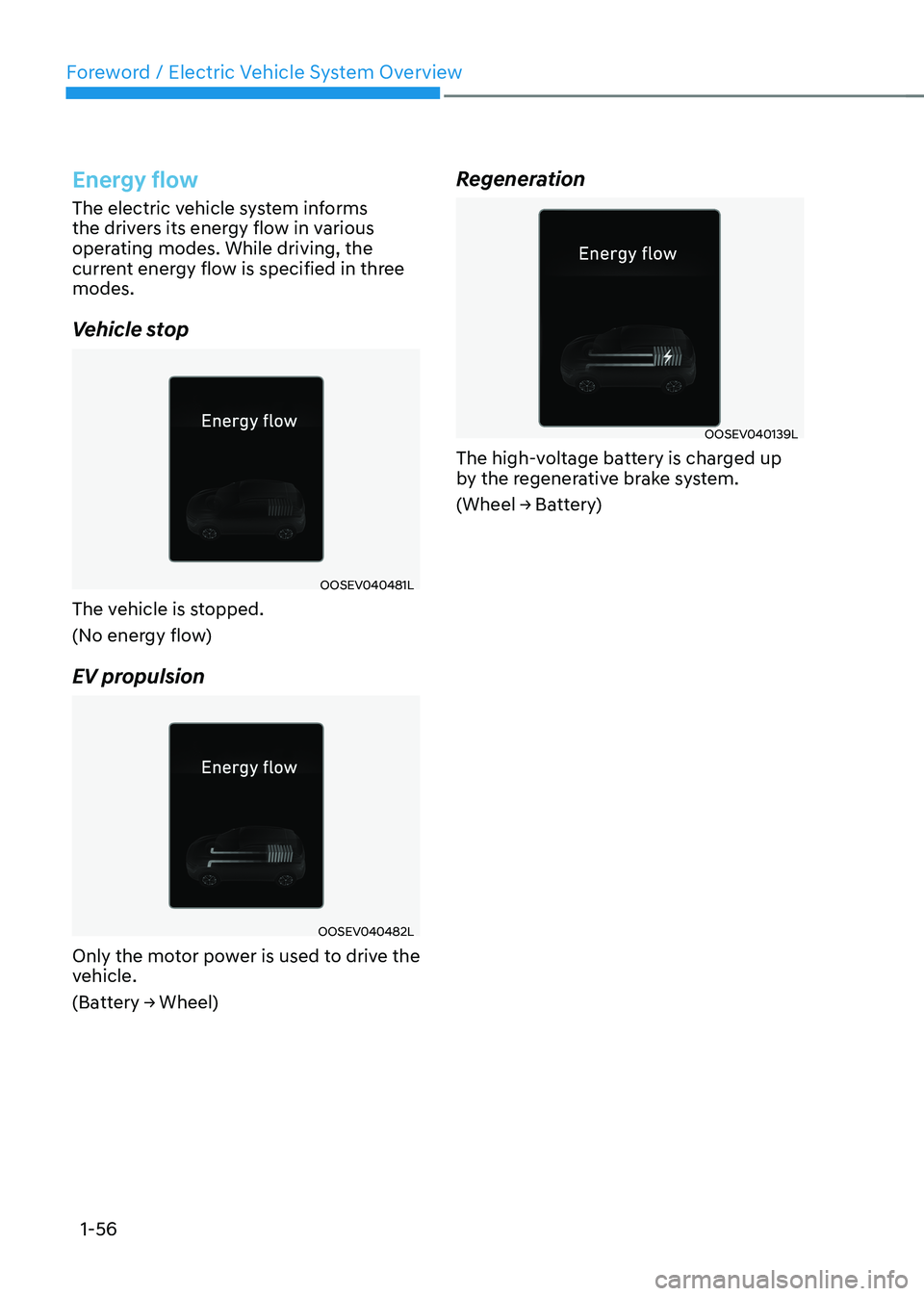
Energy flow
The electric vehicle system informs
the drivers its energy flow in various
operating modes. While driving, the
current energy flow is specified in three modes.
Vehicle stop
OOSEV040481L
The vehicle is stopped.
(No energy flow)
EV propulsion
OOSEV040482L
Only the motor power is used to drive the
vehicle.
(Battery → Wheel) Regeneration
OOSEV040139L
The high-voltage battery is charged up
by the regenerative brake system.
(Wheel → Battery)
Page 64 of 548
01
1-59
WARNING
OOSEV068009
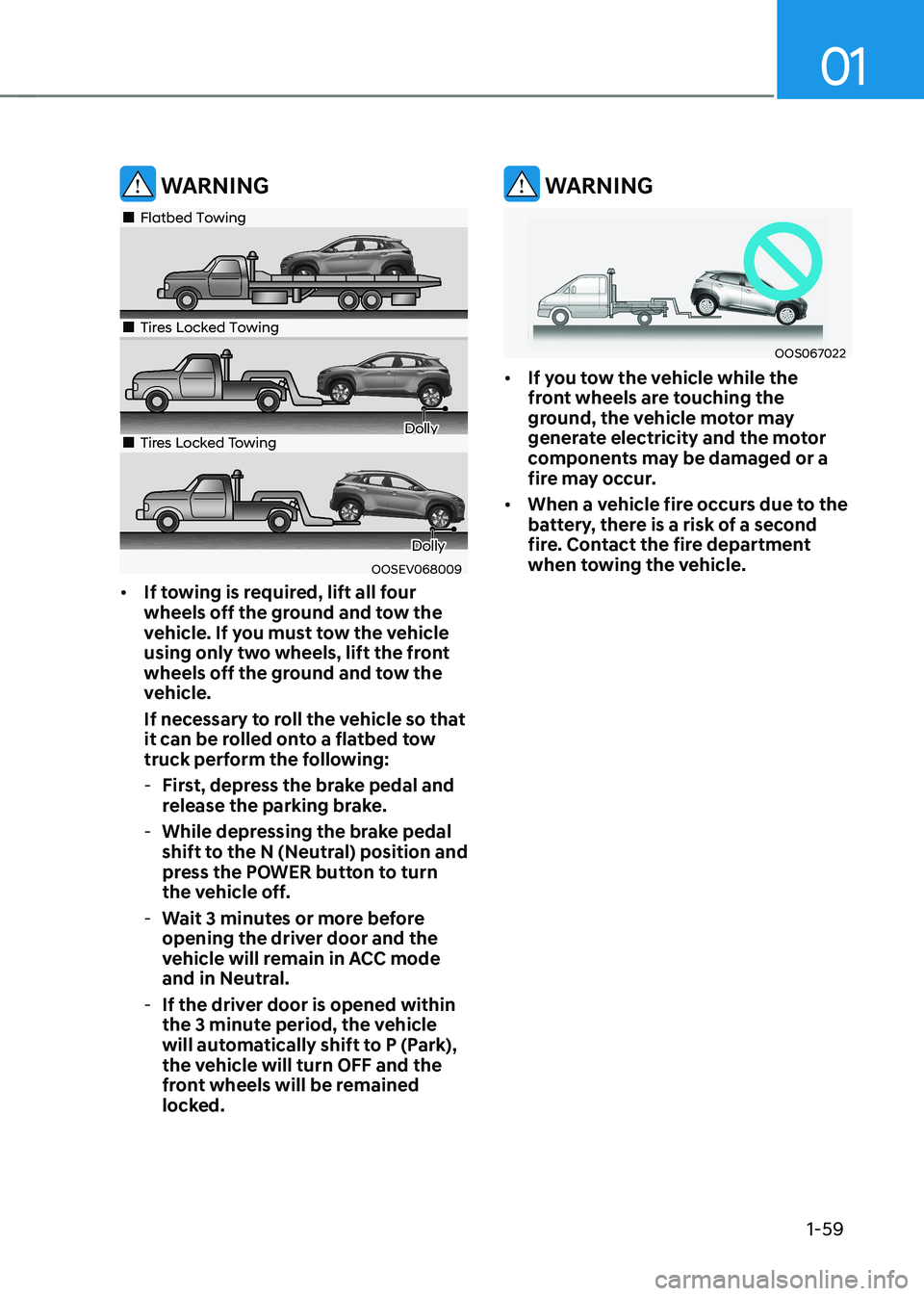
„„Flatbed Towing
„„Tires Locked Towing
Dolly„„Tires Locked Towing
Dolly
• If towing is required, lift all four
wheels off the ground and tow the
vehicle. If you must tow the vehicle
using only two wheels, lift the front
wheels off the ground and tow the
vehicle.
If necessary to roll the vehicle so that
it can be rolled onto a flatbed tow
truck perform the following:
- First, depress the brake pedal and
release the parking brake.
- While depressing the brake pedal
shift to the N (Neutral) position and
press the POWER button to turn
the vehicle off.
- Wait 3 minutes or more before
opening the driver door and the
vehicle will remain in ACC mode
and in Neutral.
- If the driver door is opened within
the 3 minute period, the vehicle
will automatically shift to P (Park),
the vehicle will turn OFF and the
front wheels will be remained
locked.
WARNING
OOS067022
• If you tow the vehicle while the
front wheels are touching the
ground, the vehicle motor may
generate electricity and the motor
components may be damaged or a
fire may occur.
• When a vehicle fire occurs due to the
battery, there is a risk of a second
fire. Contact the fire department
when towing the vehicle.
Page 70 of 548
2-5
02
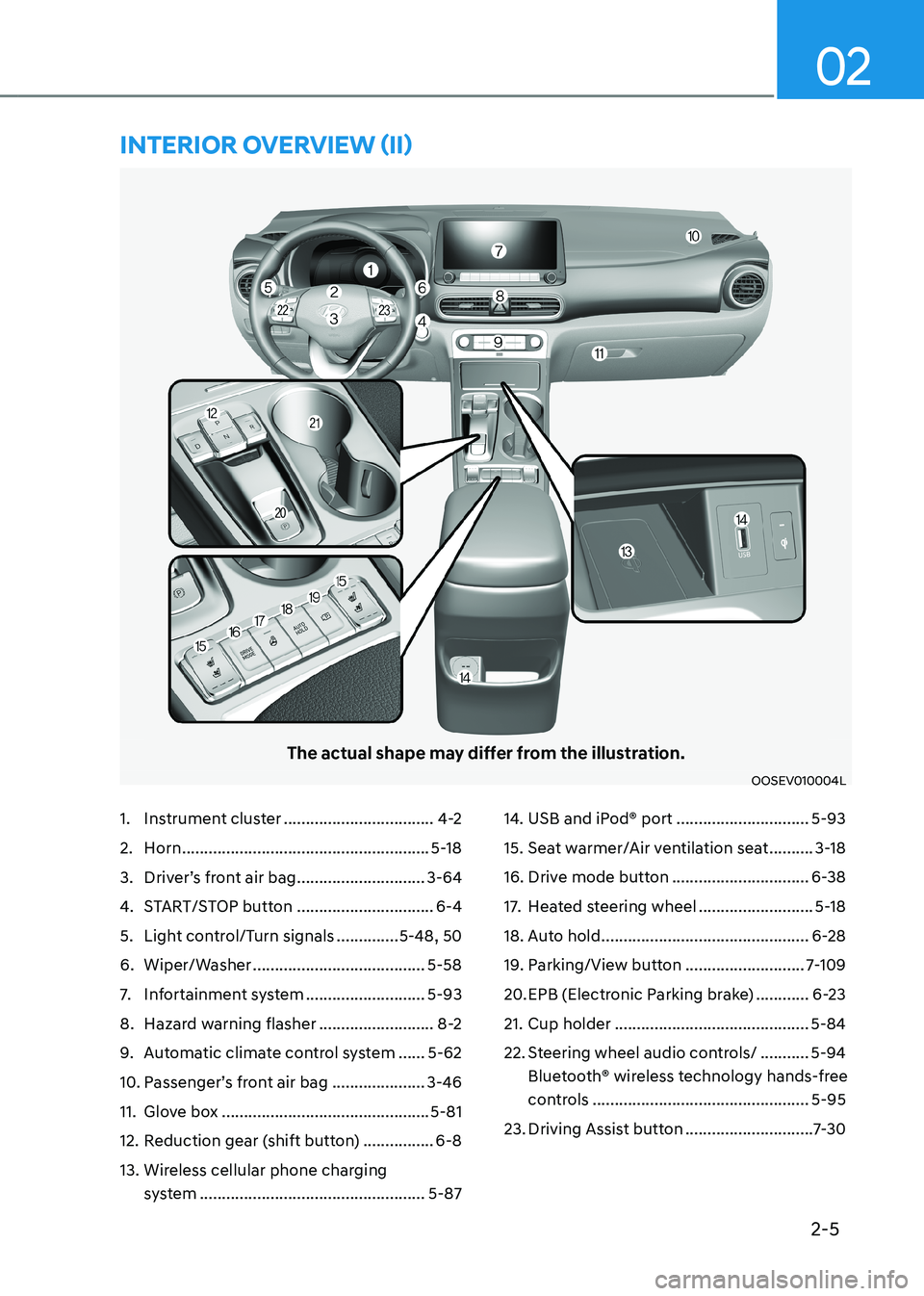
The actual shape may differ from the illustration.
OOSEV010004L
1. Instrument cluster ..................................4-2
2. Horn ........................................................ 5-18
3. Driver’s front air bag .............................3-64
4. START/STOP button ...............................6-4
5. Light control/Turn signals ..............5-48, 50
6. Wiper/Washer ....................................... 5-58
7. Infortainment system ...........................5-93
8. Hazard warning flasher ..........................8-2
9. Automatic climate control system ......5-62
10. Passenger’s front air bag ..................... 3-46
11. Glove box ............................................... 5-81
12. Reduction gear (shift button) ................6-8
13. Wireless cellular phone charging system ................................................... 5-8714. USB and iPod® port
..............................5-93
15. Seat warmer/Air ventilation seat ..........3-18
16. Drive mode button ...............................6-38
17. Heated steering wheel ..........................5-18
18. Auto hold ............................................... 6-28
19. Parking/View button ...........................7-109
20. EPB (Electronic Parking brake) ............6-23
21. Cup holder ............................................ 5-84
22. Steering wheel audio controls/ ...........5-94
Bluetooth® wireless technology hands-free
controls ................................................. 5-95
23. Driving Assist button .............................7-30
intErior ovErviEw (ii)
Page 71 of 548
2-6
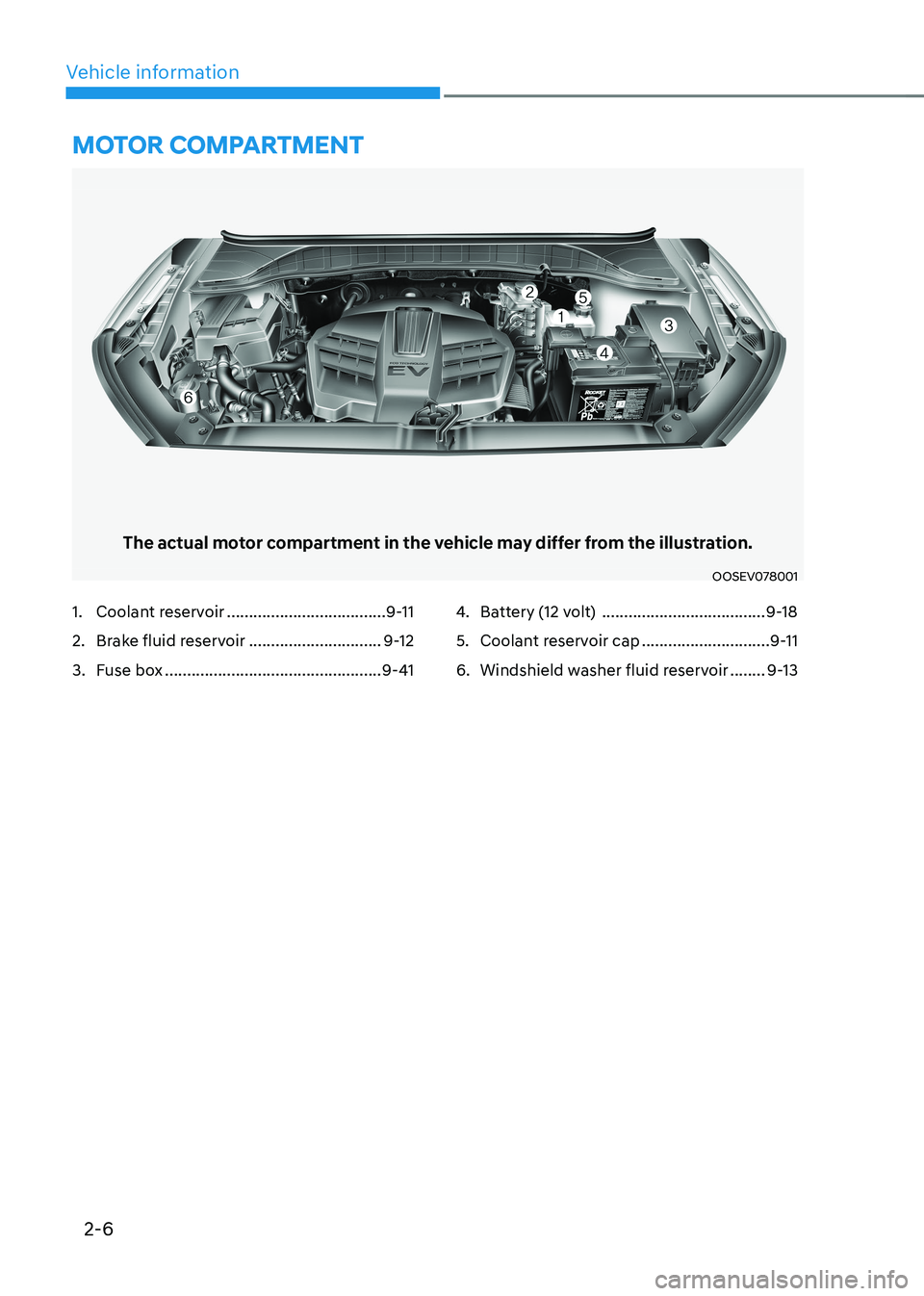
Vehicle informationMotor coMpartMent
The actual motor compartment in the vehicle may differ from the illustration.
OOSEV078001
1. Coolant reservoir .................................... 9-11
2. Brake fluid reservoir ..............................9-12
3. Fuse box ................................................. 9-414.
Battery (12 volt) ..................................... 9-18
5. Coolant reservoir cap .............................9-11
6. Windshield washer fluid reservoir ........9-13
Page 76 of 548
02
2-11
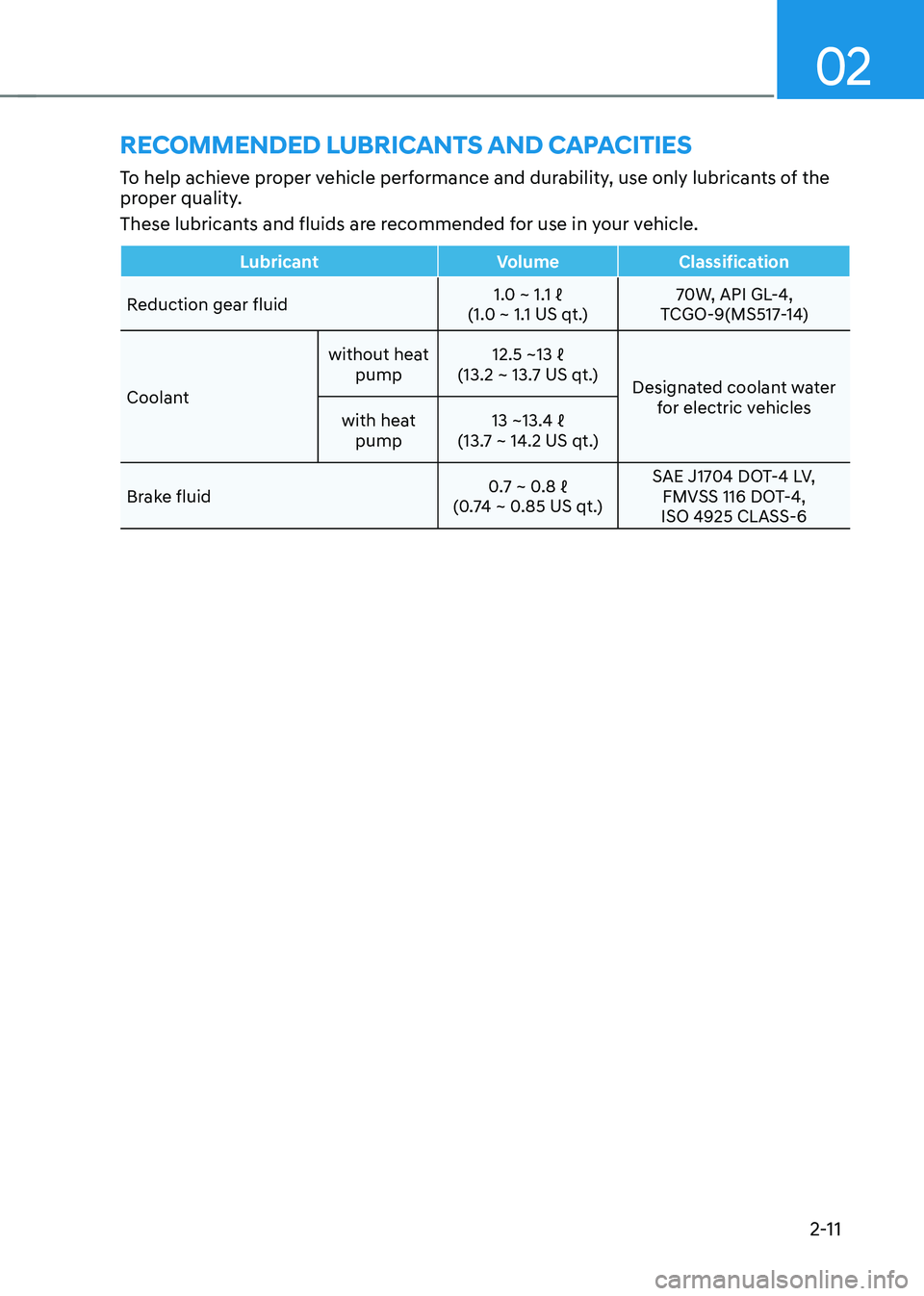
To help achieve proper vehicle performance and durability, use only lubricants of the
proper quality.
These lubricants and fluids are recommended for use in your vehicle.
Lubricant Volume Classification
Reduction gear fluid
1.0 ~ 1.1 ℓ
(1.0 ~ 1.1 US qt.) 70W, API GL-4,
TCGO-9(MS517-14)
Coolant without heat
pump 12.5 ~13 ℓ
(13.2 ~ 13.7 US qt.) Designated coolant water
for electric vehicles
with heat
pump 13 ~13.4 ℓ
(13.7 ~ 14.2 US qt.)
Brake fluid 0.7 ~ 0.8 ℓ
(0.74 ~ 0.85 US qt.) SAE J1704 DOT-4 LV,
FMVSS 116 DOT-4,
ISO 4925 CLASS-6
recoMMenDeD LuBricants anD capacities
Page 91 of 548
Safety system
3-12
CAUTION
Damaging rear seat belt buckles
When you fold the rear seatback, insert
the buckle in the pocketbetween the
rear seatback and cushion. Doing so
can prevent the buckle from being
damaged by the rear seatback.
WARNING
Make sure the vehicle is off, the vehicle
is shifted to P (Park), and the parking
brake is securely applied whenever
loading or unloading cargo. Failure to
take these steps may allow the vehicle
to move if the shift lever is inadvertently
moved to another position.
CAUTION
• Be careful when loading cargo
through the rear passenger seats
to prevent damage to the vehicle
interior.
• When cargo is loaded through the
rear passenger seats, ensure the
cargo is properly secured to prevent
it from moving while driving.
• Unsecured cargo in the passenger
compartment can cause damage
to the vehicle or injury to it’s
occupants.
WARNING
Cargo should always be secured to
prevent it from being thrown about the
vehicle in a collision and causing injury
to the vehicle occupants. Do not place
objects in the rear seats, since they
cannot be properly secured and may hit
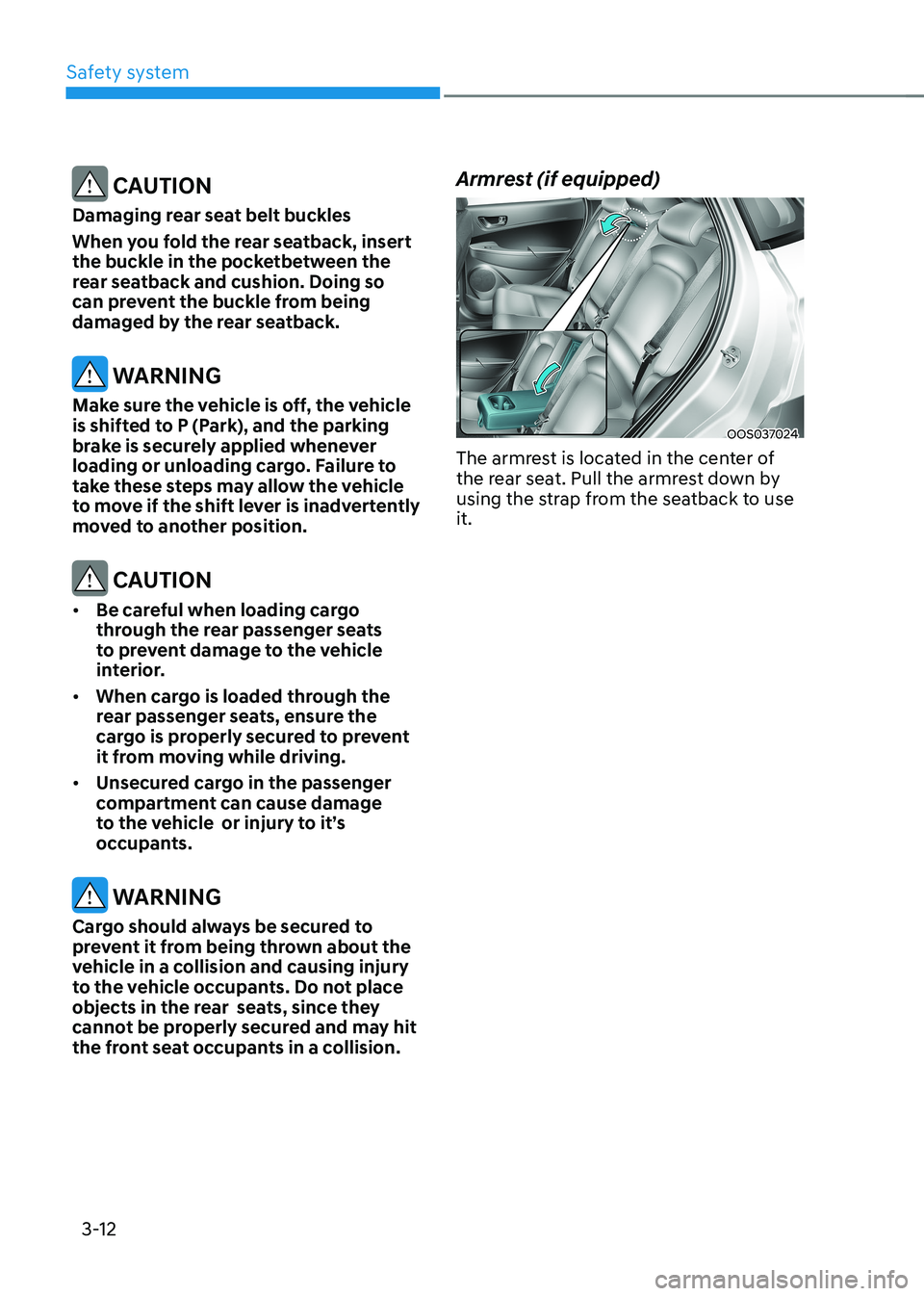
the front seat occupants in a collision. Armrest (if equipped)
OOS037024
The armrest is located in the center of
the rear seat. Pull the armrest down by
using the strap from the seatback to use it.
Page 141 of 548
Safety system
3-62
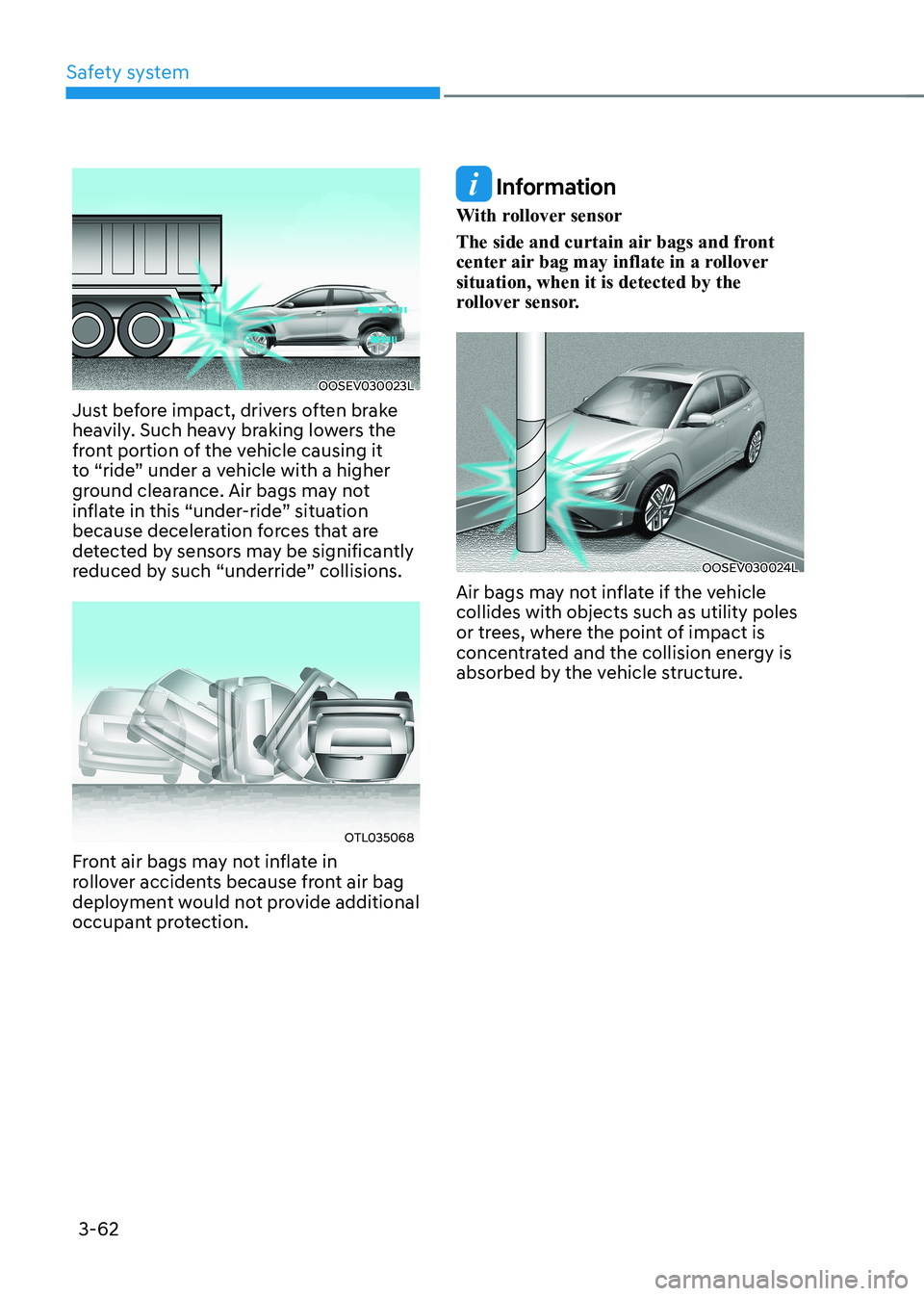
OOSEV030023L
Just before impact, drivers often brake
heavily. Such heavy braking lowers the
front portion of the vehicle causing it
to “ride” under a vehicle with a higher
ground clearance. Air bags may not
inflate in this “under-ride” situation
because deceleration forces that are
detected by sensors may be significantly
reduced by such “underride” collisions.
OTL035068
Front air bags may not inflate in
rollover accidents because front air bag
deployment would not provide additional
occupant protection.
Information
With rollover sensor
The side and curtain air bags and front
center air bag may inflate in a rollover situation, when it is detected by the
rollover sensor.
OOSEV030024L
Air bags may not inflate if the vehicle collides with objects such as utility poles
or trees, where the point of impact is
concentrated and the collision energy is
absorbed by the vehicle structure.