Page 528 of 533
8-7
Specifications & Consumer information
R RE
EC
CO
OM
MM
ME
EN
ND
DE
ED
D
L
LU
UB
BR
RI
IC
CA
AN
NT
TS
S
A
AN
ND
D
C
CA
AP
PA
AC
CI
IT
TI
IE
ES
S
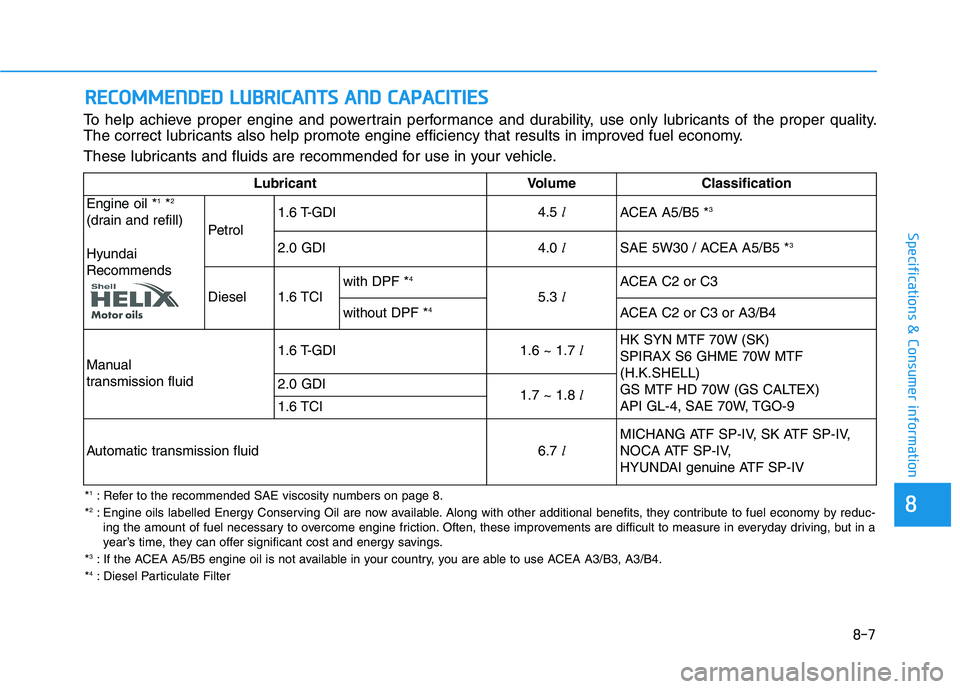
To help achieve proper engine and powertrain performance and durability, use only lubricants of the proper quality.
The correct lubricants also help promote engine efficiency that results in improved fuel economy.
These lubricants and fluids are recommended for use in your vehicle.
Lubricant Volume Classification
Engine oil *
1*2
(drain and refill)
Hyundai
RecommendsPetrol1.6 T-GDI4.5 l
ACEA A5/B5 *3
2.0 GDI4.0 l
SAE 5W30 / ACEA A5/B5 *3
Diesel 1.6 TCIwith DPF *
4
5.3 lACEA C2 or C3
without DPF *4ACEA C2 or C3 or A3/B4
Manual
transmission fluid1.6 T-GDI1.6 ~ 1.7 lHK SYN MTF 70W (SK)
SPIRAX S6 GHME 70W MTF
(H.K.SHELL)
GS MTF HD 70W (GS CALTEX)
API GL-4, SAE 70W, TGO-9 2.0 GDI
1.7 ~ 1.8 l
1.6 TCI
Automatic transmission fluid6.7 lMICHANG ATF SP-IV, SK ATF SP-IV,
NOCA ATF SP-IV,
HYUNDAI genuine ATF SP-IV
8*1: Refer to the recommended SAE viscosity numbers on page 8.
*2: Engine oils labelled Energy Conserving Oil are now available. Along with other additional benefits, they contribute to fuel economy by reduc-
ing the amount of fuel necessary to overcome engine friction. Often, these improvements are difficult to measure in everyday driving, but in a
year’s time, they can offer significant cost and energy savings.
*
3: If the ACEA A5/B5 engine oil is not available in your country, you are able to use ACEA A3/B3, A3/B4.
*4: Diesel Particulate Filter
Page 529 of 533
8-8
Specifications & Consumer information
Lubricant Volume Classification
Dual clutch transmission fluid1.9 ~ 2.0 lHK SYN DCTF 70W (SK)
SPIRAX S6 GHME 70W DCTF (H.K.SHELL)
GS DCTF HD 70W (GS CALTEX)
API GL-4, SAE 70W
Coolant1.6 T-GDIM/T6.2 l
Mixture of antifreeze and distilled water
(Ethylene-glycol with phosphate based coolant for
aluminium radiator) DCT6.2 l
2.0 GDIM/T5.9 l
A/T5.8 l
1.6 TCI6.8 l
Brake/clutch fluid0.7 ~ 0.8 lSAE J1704 DOT-4 LV, FMVSS 116 DOT-4,
ISO4925 CLASS-6
Fuel50 l
Refer to “Fuel Requirements” in the Introduction chapter.
Always be sure to clean the area around any filler plug, drain plug, or dipstick before checking or draining
any lubricant. This is especially important in dusty or sandy areas and when the vehicle is used on unpaved
roads. Cleaning the plug and dipstick areas will prevent dirt and grit from entering the engine and other
mechanisms that could be damaged.
CAUTION
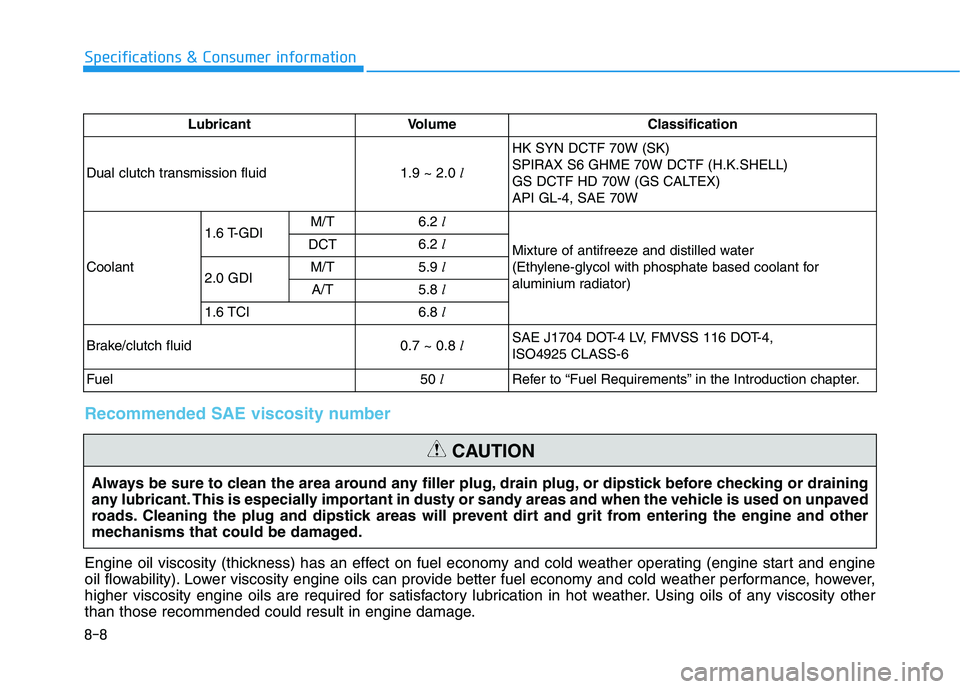
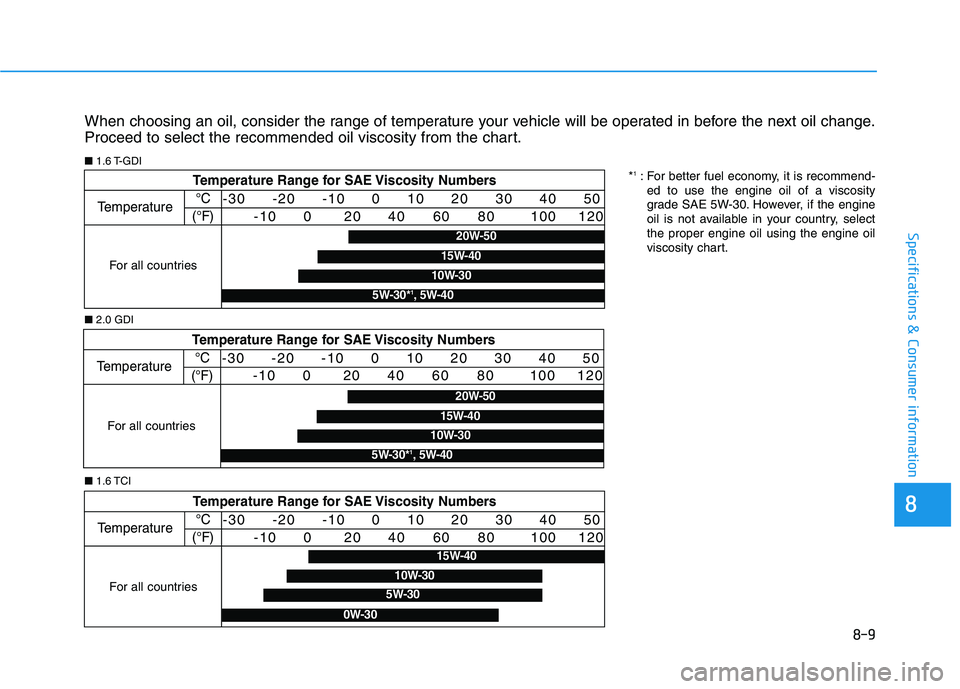
Recommended SAE viscosity number
Engine oil viscosity (thickness) has an effect on fuel economy and cold weather operating (engine start and engine
oil flowability). Lower viscosity engine oils can provide better fuel economy and cold weather performance, however,
higher viscosity engine oils are required for satisfactory lubrication in hot weather. Using oils of any viscosity other
than those recommended could result in engine damage.
Page 530 of 533
8-9
8
Specifications & Consumer information
When choosing an oil, consider the range of temperature your vehicle will be operated in before the next oil change.
Proceed to select the recommended oil viscosity from the chart.
*1: For better fuel economy, it is recommend-
ed to use the engine oil of a viscosity
grade SAE 5W-30. However, if the engine
oil is not available in your country, select
the proper engine oil using the engine oil
viscosity chart.
■2.0 GDI
Temperature Range for SAE Viscosity Numbers
Temperature
For all countries
°C
(°F)-30 -20 -10 0 10 20 30 40 50
-10 0 20 40 60 80 100 120
20W-50
10W-30
15W-40
5W-30*1, 5W-40
Temperature Range for SAE Viscosity Numbers
Temperature
For all countries
°C
(°F)-30 -20 -10 0 10 20 30 40 50
-10 0 20 40 60 80 100 120
20W-50
10W-30
15W-40
5W-30*1, 5W-40
■1.6 T-GDI
Temperature Range for SAE Viscosity Numbers
Temperature°C
(°F)-30 -20 -10 0 10 20 30 40 50
-10 0 20 40 60 80 100 120
5W-30
15W-40
10W-30
0W-30
For all countries
■1.6 TCI
Page 531 of 533
8-10
Specifications & Consumer information
V VE
EH
HI
IC
CL
LE
E
C
CE
ER
RT
TI
IF
FI
IC
CA
AT
TI
IO
ON
N
L LA
AB
BE
EL
L
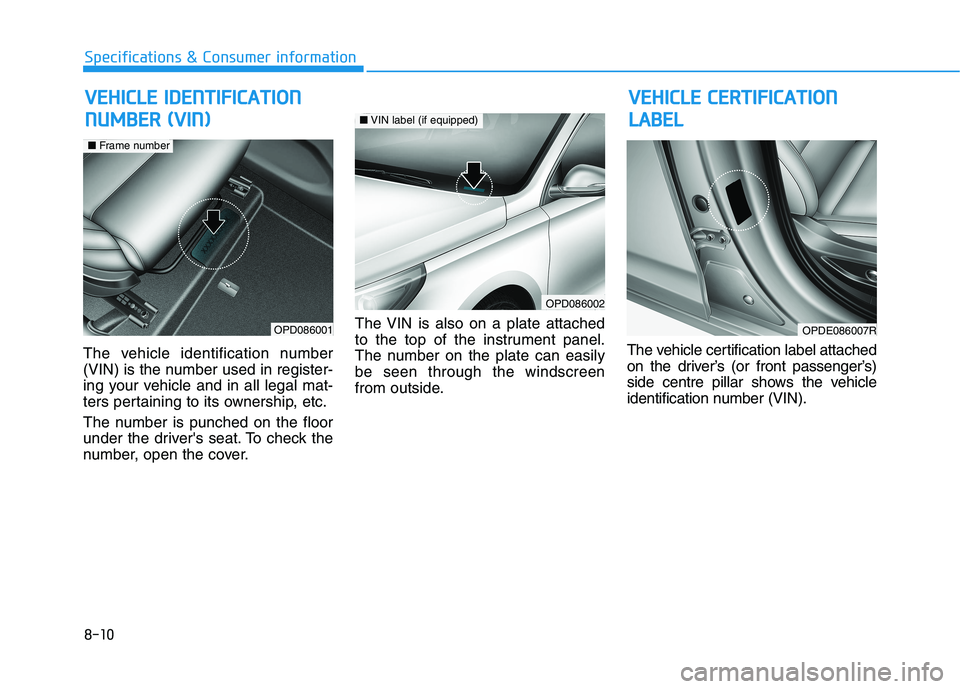
The vehicle identification number
(VIN) is the number used in register-
ing your vehicle and in all legal mat-
ters pertaining to its ownership, etc.
The number is punched on the floor
under the driver's seat. To check the
number, open the cover.The VIN is also on a plate attached
to the top of the instrument panel.
The number on the plate can easily
be seen through the windscreen
from outside.The vehicle certification label attached
on the driver’s (or front passenger’s)
side centre pillar shows the vehicle
identification number (VIN).
OPDE086007ROPD086001
■Frame number
V
VE
EH
HI
IC
CL
LE
E
I
ID
DE
EN
NT
TI
IF
FI
IC
CA
AT
TI
IO
ON
N
N NU
UM
MB
BE
ER
R
(
(V
VI
IN
N)
)
OPD086002
■VIN label (if equipped)
Page 532 of 533
8-11
8
Specifications & Consumer information
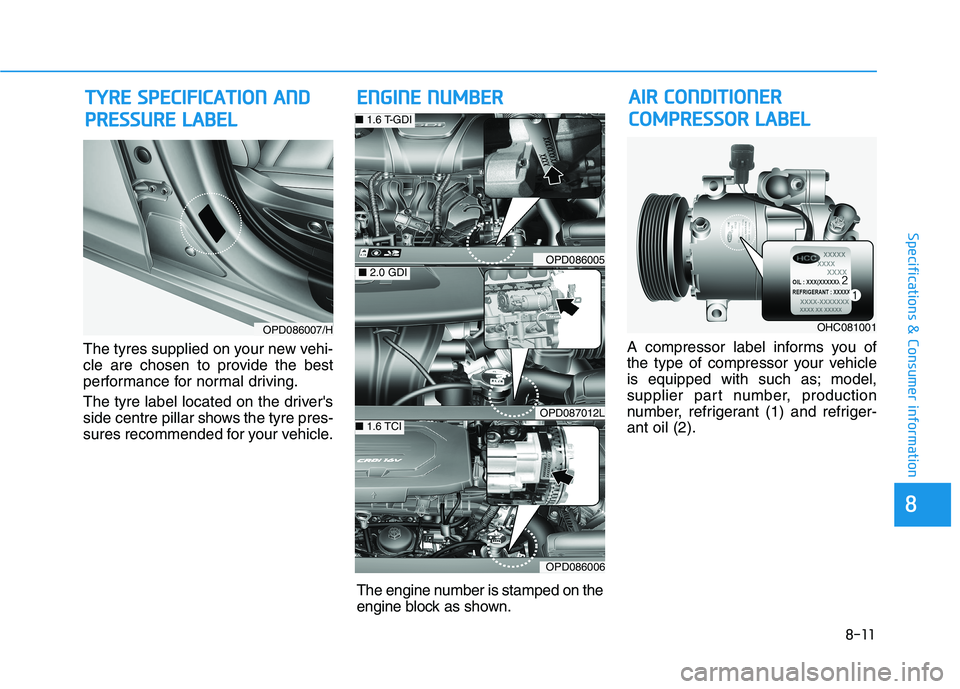
The tyres supplied on your new vehi-
cle are chosen to provide the best
performance for normal driving.
The tyre label located on the driver's
side centre pillar shows the tyre pres-
sures recommended for your vehicle.A compressor label informs you of
the type of compressor your vehicle
is equipped with such as; model,
supplier part number, production
number, refrigerant (1) and refriger-
ant oil (2).
T TY
YR
RE
E
S
SP
PE
EC
CI
IF
FI
IC
CA
AT
TI
IO
ON
N
A
AN
ND
D
P PR
RE
ES
SS
SU
UR
RE
E
L
LA
AB
BE
EL
L
OPD086007/H
E EN
NG
GI
IN
NE
E
N
NU
UM
MB
BE
ER
RA AI
IR
R
C
CO
ON
ND
DI
IT
TI
IO
ON
NE
ER
R
C CO
OM
MP
PR
RE
ES
SS
SO
OR
R
L
LA
AB
BE
EL
L
OPD086005
OPD087012L
OPD086006
■2.0 GDI
■ 1.6 T-GDI
■ 1.6 TCI
OHC081001
The engine number is stamped on the
engine block as shown.