Page 465 of 719
464
uuWhen Driving uShifting
Driving
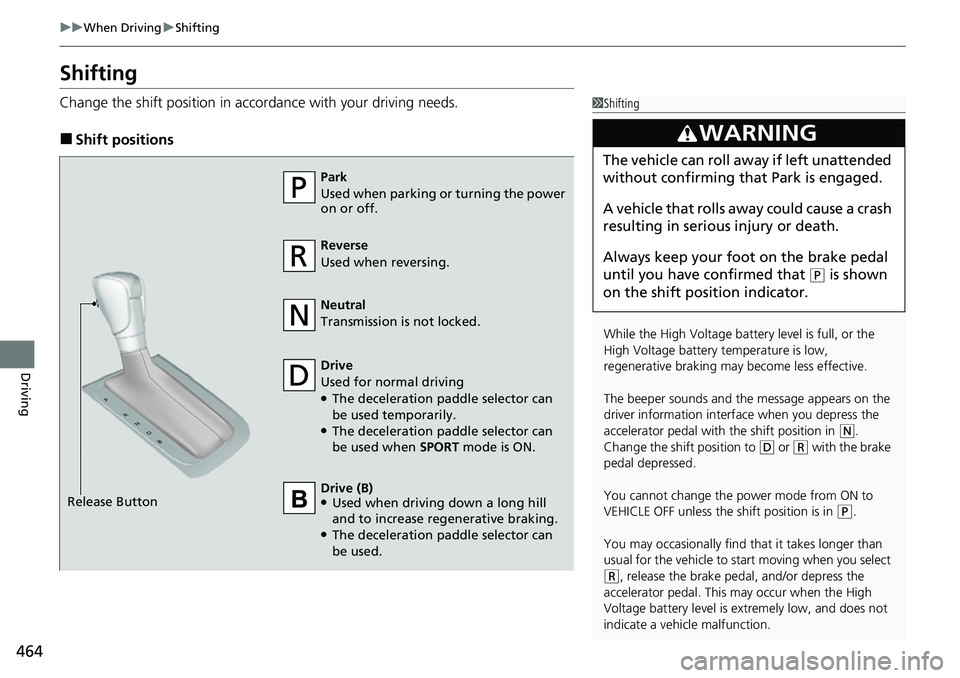
Shifting
Change the shift positi on in accordance with your driving needs.
■Shift positions
1Shifting
While the High Voltage battery level is full, or the
High Voltage battery temperature is low,
regenerative braking ma y become less effective.
The beeper sounds and the message appears on the
driver information interf ace when you depress the
accelerator pedal with the shift position in
( N.
Change the shift position to
( D or (R with the brake
pedal depressed.
You cannot change the power mode from ON to
VEHICLE OFF unless the shift position is in
( P.
You may occasionally find th at it takes longer than
usual for the vehicle to st art moving when you select
(R, release the brake peda l, and/or depress the
accelerator pedal. This may occur when the High
Voltage battery level is extremely low, and does not
indicate a vehicle malfunction.
3WARNING
The vehicle can roll aw ay if left unattended
without confirming that Park is engaged.
A vehicle that rolls away could cause a crash
resulting in seriou s injury or death.
Always keep your foot on the brake pedal
until you have confirmed that
( P is shown
on the shift posi tion indicator.
Reverse
Used when reversing.
Drive
Used for normal driving
●The deceleration paddle selector can
be used temporarily.
●The deceleration paddle selector can
be used when SPORT mode is ON.
Park
Used when parking or turning the power
on or off.
Neutral
Transmission is not locked.
Release Button Drive (B)
●Used when driving down a long hill
and to increase regenerative braking.
●The deceleration paddle selector can
be used.
Page 492 of 719
491
uuWhen Driving uHigh Voltage Battery
Driving
High Voltage Battery
The High Voltage battery gradually discharges even if the vehicle is not in use. As a
result, if your vehicle is parked for an extended period of time, the battery charge
level will become low. Extended periods of time at a low state of charge will shorten
battery life. To maintain the battery state of charge, drive your vehicle for more than
30 minutes at least once every three months.
Extreme high temperatures can affect the battery life. You can minimize the effects
by parking the vehicle in the shade during the summer.1 High Voltage Battery
Be careful not to let the High Voltage battery drain
too much. If the battery level becomes close to zero,
it will make it impossible to turn the power system
on.
Page 502 of 719
501
uuHonda Sensing ®u Collision Mitigation Braking SystemTM (CMBSTM)
Continued
Driving
■Vehicle conditions
• Headlight lenses are dirty or the h eadlights are not properly adjusted.
• The outside of the windshield is blocked by dirt, mud, leaves, wet snow, etc.
• The inside of the windshield is fogged.
• An abnormal tire or wheel condition (inco rrect sizes, varied sizes or construction,
improperly inflated, etc.).
• When tire chains are installed.
• The vehicle is tilted due to a heavy load or suspension modifications.
• The camera temperature gets too high.
• Driving with the parking brake applied.
• When the radar sensor behind the Hond a emblem on the front grille gets dirty.
• The vehicle is towing a trailer.
• Driving at night or in a dark place (e.g., a tunnel) with the headlights off.
• There is residue on the windshi eld from the windshield wipers.
Page 505 of 719
504
uuHonda Sensing ®u Collision Mitigation Braking SystemTM (CMBSTM)
Driving
■Automatic shutoff
The CMBSTM may automatically shut itself off and the safety support indicator
(amber) comes and stays on when:
• You drive off-road or on a mountain ro ad, or curved and winding road for an
extended period.
• Driving in bad weather (rain, fog, snow, etc.).
• Driving with the parking brake applied.
• The camera temperature gets too high.
• The front of the camera or radar sensor behind the Honda emblem is covered by
dirt, fog, rain, mud, wet snow, seals, accessories, stickers, or film on the
windshield.
• An abnormal tire condition is detected (i ncorrect tire size, flat tire, etc.).
Once the conditions that caused the CMBS
TM to shut off improv e or are addressed
(e.g., cleaning), the system comes back on.
Page 507 of 719
506
uuHonda Sensing ®u Collision Mitigation Braking SystemTM (CMBSTM)
Driving
• When your vehicle approaches vehicles , pedestrians, or moving bicycles.
• When vehicles, pedestrians, or moving bicycles are passing in front of you.
• When you drive under a low structure or through a narrow gate at high speed.
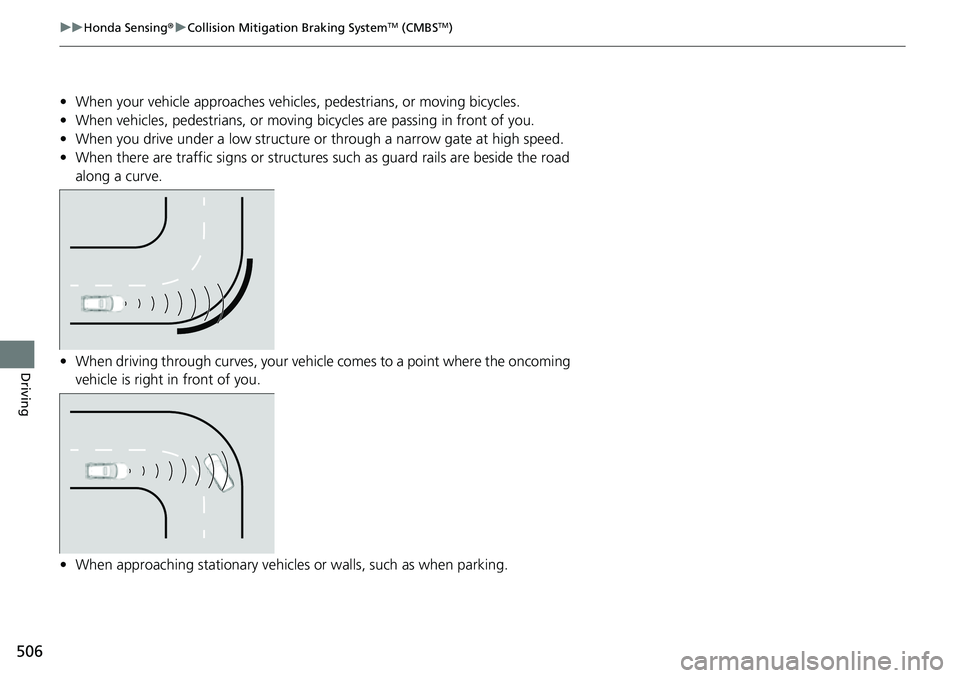
• When there are traffic signs or structures such as guard rails are beside the road
along a curve.
• When driving through curves, your vehicle comes to a point where the oncoming
vehicle is right in front of you.
• When approaching stationary vehicles or walls, such as when parking.
Page 509 of 719

uuHonda Sensing ®u Low Speed Braking Control*
508
Driving
■Assistive braking
Assistive braking provides a visual and audible alert when the vehicle is moving
between approximately 1 and 6 mph (2 and 10 km/h) and there is the possibility of
a collision with a detected wall or other obstacles, as well as providing assistance
with braking.
If the only rear sensors are turned off using the parking sensor system, the assistive
braking will not work when reversing.
2 Parking sensor system on and off P. 585
■How the System Works1Low Speed Braking Control*
For directions on the prop er handling of the sonar
sensors, please refer to the following page.
2 Sonar Sensors
* P. 571
The vehicle will release the brake and start moving a
few seconds after the system is activated. To keep the
vehicle stopped, keep the brake pedal depressed or
put the transmission into
( P.
In order to prevent the sy stem from activating when
not needed, always turn it off during vehicle
maintenance, when loading on ships, trucks, and so
on, or when using a chas sis dynamometer or free
rollers for inspection or when washing the car in
conveyor type car wash machine.
If you put any accessories on or around the rear
sensors, the Low Speed Br aking Control System may
activate if it detects these accessories as an obstacle.
In this case, turn off the rear sensor. 2 Customized Features P. 376Audible Alert
Beep Beep
The vehicle
applies brake Driver
depresses
brake pedal
Remove
brake after
maintaining
stationary
positionStop
* Not available on all models
Page 510 of 719

509
uuHonda Sensing ®u Low Speed Braking Control*
Continued
Driving
■Assistive driving power suppression
When the vehicle is stopped or moving at less than 6 mph (10 km/h) and there is an
obstacle such as a wall near the front of or back of the vehicle, if the accelerator
pedal is depressed more than necessary, the system will inform you with a visual and
audible alert. At the same time, the sy stem will prevent sudden forward or
backwards movement by limiting the outpu t of the power system, then assistive
braking will activate when you get closer to the obstacle.
Assistive driving power suppression will not activate in the following situations.
When moving forward:
• When on a steep slope or the shift position is in
(P, (R, or (N.
When reversing:
• When on a steep slope or the shift position is in a position other than
(R.
If the only rear sensors are turned off usi ng the parking sensor system, the assistive
driving power suppression will not work when reversing.
2 Parking sensor system on and off P. 585
Audible Alert
Beep
Beep
Accidental depression of
the accelerator/Limiting
the output of the power
system
Page 515 of 719

uuHonda Sensing ®u Adaptive Cruise Control (ACC) with Low Speed Follow
514
Driving
■How to activate the system1Adaptive Cruise Control (ACC) with Low Speed Follow
The radar sensor for ACC with Low Speed Follow is
shared with the Collision Mitigation Braking System
TM
(CMBSTM).
2 Collision Mitigation Braking SystemTM
(CMBSTM) P. 495
ACC with Low Speed Follow may not work properly
under certain conditions.
2 ACC with Low Speed Follow Conditions
and Limitations P. 521
When not using ACC with Low Speed Follow: Turn
off adaptive cruise by pressing the button.
Do not use ACC with Low Speed Follow under the
following conditions:
•On roads with frequent la ne-change or continuous
stop and go traffic, ACC with Low Speed Follow
cannot keep an appropriate distance between your
vehicle and the vehicle ahead of you.
•On roads with sharp turns.•On roads with toll collection facilities or other
objects between lanes of traffic, or in parking
areas, or faci lities with driv e through access.
•On roads with bad weather (rain, fog, snow, etc.),
ACC with Low Speed Follow may not detect the
distance between your vehicle and the vehicle
ahead of you properly.
•On roads with slippery or icy surfaces. The wheels
may spin out and your vehi cle may lose the control
on the condition.
•On roads with steep uphill or steep downhill slopes.•On roads with undulating slopes.
How to use
■Press the button on the
steering wheel.
(white) is on in the gauge.
ACC with Low Speed Follow is ready to use.