2023 FORD BRONCO fuel
[x] Cancel search: fuelPage 185 of 642
RUNNING OUT OF FUEL
FILLING A PORTABLE FUELCONTAINER
WARNING: Flow of fuel through afuel pump nozzle can produce staticelectricity. This can cause a fire if you arefilling an ungrounded fuel container.
Use the following guidelines to avoidelectrostatic charge build-up, which canproduce a spark, when filling anungrounded fuel container:
•Only use an approved fuel container totransfer fuel to your vehicle. Place thecontainer on the ground when filling it.
•Do not fill a fuel container when it isinside your vehicle (including the cargoarea).
•Keep the fuel pump nozzle in contactwith the fuel container when filling it.
•Do not use a device that holds the fuelpump nozzle lever in the fill position.
ADDING FUEL FROM A PORTABLEFUEL CONTAINER
WARNING: Do not insert the nozzleof a fuel container or an aftermarketfunnel into the fuel filler neck. This maydamage the fuel system filler neck or itsseal and cause fuel to run onto theground.
WARNING: Do not pry open thefuel tank filler valve. This could damagethe fuel system. Failure to follow thisinstruction could result in fire, personalinjury or death.
WARNING: Do not dispose of fuelin the household refuse or the publicsewage system. Use an authorized wastedisposal facility.
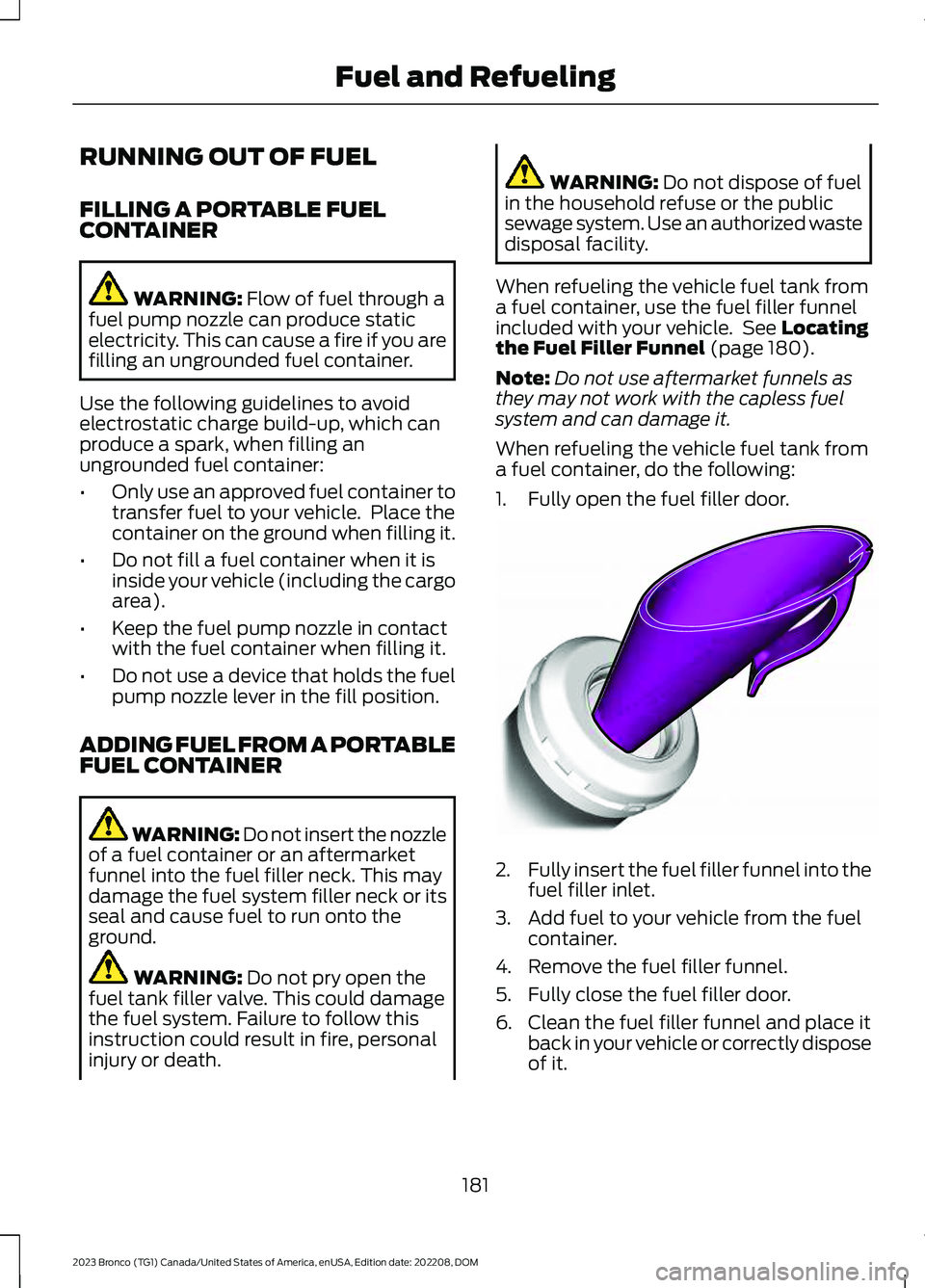
When refueling the vehicle fuel tank froma fuel container, use the fuel filler funnelincluded with your vehicle. See Locatingthe Fuel Filler Funnel (page 180).
Note:Do not use aftermarket funnels asthey may not work with the capless fuelsystem and can damage it.
When refueling the vehicle fuel tank froma fuel container, do the following:
1.Fully open the fuel filler door.
2.Fully insert the fuel filler funnel into thefuel filler inlet.
3.Add fuel to your vehicle from the fuelcontainer.
4.Remove the fuel filler funnel.
5.Fully close the fuel filler door.
6.Clean the fuel filler funnel and place itback in your vehicle or correctly disposeof it.
181
2023 Bronco (TG1) Canada/United States of America, enUSA, Edition date: 202208, DOMFuel and RefuelingE157452
Page 186 of 642

Note:If your vehicle runs out of fuel add aminimum of 1.3 gal (5 L) of fuel to restartthe engine.
Note:You may need to switch the ignitionfrom off to on several times after refuelingto allow the fuel system to pump the fuelfrom the tank to the engine. Whenrestarting, cranking time takes a fewseconds longer than normal.
Note:Extra funnels can be purchased froman authorized dealer if you choose todispose of the funnel.
REFUELING
REFUELING SYSTEM OVERVIEW
Fuel filler door.A
Fuel filler inlet.B
Fuel tank filler pipe.C
REFUELING YOUR VEHICLE
Easy Fuel Capless Fuel Filler
WARNING: When refueling alwaysshut the engine off and never allowsparks or open flames near the fuel tankfiller valve. Never smoke or use a cellphone while refueling. Fuel vapor isextremely hazardous under certainconditions. Avoid inhaling excess fumes.
WARNING: The fuel system maybe under pressure. If you hear a hissingsound near the fuel filler inlet, do notrefuel until the sound stops. Otherwise,fuel may spray out, which could causeserious personal injury.
WARNING: Do not pry open thefuel tank filler valve. This could damagethe fuel system. Failure to follow thisinstruction could result in fire, personalinjury or death.
WARNING: Do not remove the fuelpump nozzle from its fully insertedposition when refueling.
WARNING: Stop refueling whenthe fuel pump nozzle automaticallyshuts off for the first time. Failure tofollow this will fill the expansion spacein the fuel tank and could lead to fueloverflowing.
WARNING: Do not overfill the fueltank. The pressure in an overfilled tankmay cause leakage and lead to fuel sprayand fire.
WARNING: Wait at least fiveseconds before removing the fuel pumpnozzle to allow any residual fuel to draininto the fuel tank.
1.Fully open the fuel filler door.
2.Select the correct fuel pump nozzle foryour vehicle.
182
2023 Bronco (TG1) Canada/United States of America, enUSA, Edition date: 202208, DOMFuel and RefuelingBCA E267248
Page 187 of 642

3.Insert the fuel pump nozzle up to thefirst notch. Keep the fuel pump nozzleresting on the fuel tank filler pipe.
4.Hold the fuel pump nozzle in positionA when refueling. Holding the fuelpump nozzle in position B can affectthe flow of fuel and shut off the fuelpump nozzle before the fuel tank is full.
5.Operate the fuel pump nozzle withinthe area shown. Refer to A for left handdrive or B for right hand drive.
6.When the pump shuts off, wait fiveseconds, then raise the fuel pumpnozzle and slowly remove it.
7.Fully close the fuel filler door.
Note: Do not attempt to start the engineif you have filled the fuel tank with incorrectfuel. Incorrect fuel use could cause damagenot covered by the vehicle Warranty. Haveyour vehicle immediately checked.
FUEL TANK CAPACITY
Advertised Capacity
The advertised capacity is the maximumamount of fuel that you can add to the fueltank when the fuel gauge indicates empty.
In addition, the fuel tank contains an emptyreserve. The empty reserve is anunspecified amount of fuel that remainsin the fuel tank when the fuel gaugeindicates empty.
183
2023 Bronco (TG1) Canada/United States of America, enUSA, Edition date: 202208, DOMFuel and RefuelingE139202 E327438 E206912 E119081
Page 188 of 642
Note:The amount of fuel in the emptyreserve varies and should not be relied uponto increase driving range.
FUEL AND REFUELING –
TROUBLESHOOTING
FUEL AND REFUELING –WARNING LAMPS
If it illuminates when you aredriving, refuel as soon aspossible.
FUEL AND REFUELING –INFORMATION MESSAGES
Refueling System Warning
If the fuel tank filler valve does not fullyclose, a message could appear in theinstrument cluster display.
Message
Check Fuel Fill Inlet
If the message appears, do the following:
1.Stop your vehicle as soon as it is safeto do so and switch the engine off.
2.Shift into park (P) or neutral (N).
3.Apply the parking brake.
4.Fully open the fuel filler door.
5.Check the fuel tank filler valve for anydebris that may be restricting itsmovement.
6.Remove any debris from the fuel tankfiller valve.
7.Fully insert a fuel pump nozzle or thefuel filler funnel provided with yourvehicle into the fuel filler pipe. SeeLocating the Fuel Filler Funnel(page 180). This action should dislodgeany debris that may be preventing thefuel tank filler valve from fully closing.
8.Remove the fuel pump nozzle or fuelfiller funnel from the fuel filler pipe.
9.Fully close the fuel filler door.
Note:The message may not immediatelyreset. If the message continues to appearand a warning lamp illuminates, have yourvehicle checked as soon as possible.
184
2023 Bronco (TG1) Canada/United States of America, enUSA, Edition date: 202208, DOMFuel and Refueling
Page 189 of 642

WHAT IS THE CATALYTIC
CONVERTER
The catalytic converter is part of yourvehicle's emissions system and filtersharmful pollutants from the exhaust gas.
CATALYTIC CONVERTER
PRECAUTIONS
WARNING: Do not park, idle ordrive your vehicle on dry grass or otherdry ground cover. The emission systemheats up the engine compartment andexhaust system, creating the risk of fire.
WARNING: The normal operatingtemperature of the exhaust system isvery high. Never work around or attemptto repair any part of the exhaust systemuntil it has cooled. Use special care whenworking around the catalytic converter.The catalytic converter heats up to a veryhigh temperature after only a shortperiod of engine operation and stays hotafter the engine is switched off.
WARNING: Exhaust leaks mayresult in entry of harmful and potentiallylethal fumes into the passengercompartment. If you smell exhaustfumes inside your vehicle, have yourvehicle inspected immediately. Do notdrive if you smell exhaust fumes.
To avoid damaging the catalytic converter:
•Do not crank the engine for more than10 seconds at a time.
•Do not run the engine with a spark pluglead disconnected.
•Do not push-start or tow-start yourvehicle. Use booster cables. See JumpStarting the Vehicle (page 330).
•Use the correct fuel. See Fuel andRefueling (page 179).
•Do not switch the ignition off when yourvehicle is moving.
•Avoid running out of fuel.
•Have the items listed in scheduledmaintenance information performedaccording to the specified schedule.
Note:Do not make any unauthorizedchanges to your vehicle or engine. By law,vehicle owners and anyone whomanufactures, repairs, or services a fleet ofvehicles are not permitted to intentionallyremove an emission control device orprevent it from working.
CATALYTIC CONVERTER –
TROUBLESHOOTING
CATALYTIC CONVERTER –WARNING LAMPS
Your vehicle has an on-board diagnosticssystem that monitors the emission controlsystem. If any of the following warninglamps illuminate, this may indicate thatthe on-board diagnostics system hasdetected an emission control systemmalfunction.
Continuing to drive your vehicle may causereduced power or the engine to stop.Failure to respond to a warning lamp maycause damage that your vehicle Warrantymay not cover. Have your vehicle checkedas soon as possible.
185
2023 Bronco (TG1) Canada/United States of America, enUSA, Edition date: 202208, DOMCatalytic ConverterE103308 E67021 E67028
Page 191 of 642

Note:You can only move the gearshift leverto crawler (C) by raising the collar belowthe gearshift knob up before shifting tocrawler. This is a lockout feature whichprotects the transmission from accidentallyengaging crawler (C) when intending toselect second (2).
If crawler (C) is not fully engaged press theclutch pedal down, return the gearshift tothe neutral position, then release the clutchpedal. Re-apply the clutch pedal, then liftthe gearshift collar and shift into crawler(C) again.
The crawler gear enables an easier start inunusual conditions or terrain. You shouldchange up to first (1) when possible andrefrain from using crawler (C) at highengine speeds as transmission damagecould result. See Manual TransmissionPrecautions (page 186).
In normal use, make sure your vehicle isstationary before selecting crawler (C) asit is primarily a starting gear. If you changedown to crawler (C) from first (1) while thevehicle is moving, make sure the enginespeed is below 1500 rpm, and that theclutch pedal is fully pressed for a smoothtransition to crawler gear.
RECOMMENDED SHIFT
SPEEDS
Recommended Shift Speeds
For best fuel efficiency when driving yourvehicle, shift to the next gear by 3000RPM.
Shifting at a higher RPM such as3000-6000 RPM can increase theperformance capabilities of the vehicle.However, higher engine and transmissionspeeds can increase wear and reduce fueleconomy.
When downshifting your vehicle, alwaysshift at the lowest engine RPM possible tomatch your driving conditions. This isusually under 2000 RPM for all forwardgears, except for downshifting into thecrawler (C) gear which you should dobelow 1500 RPM. See ManualTransmission Precautions (page 186).
Note:Always fully depress the clutch pedalbetween gear shifts.
187
2023 Bronco (TG1) Canada/United States of America, enUSA, Edition date: 202208, DOMManual TransmissionE99067
Page 193 of 642

MANUAL TRANSMISSION –
TROUBLESHOOTING
MANUAL TRANSMISSION –FREQUENTLY ASKED QUESTIONS
Using Crawler Gear
When shifting into crawler (C), make sureyour vehicle is completely stationary andthat the engine speed is below 1500 RPM.
Shift out of crawler (C) as soon aspossible. Prolonged use of crawler (C) cancause transmission wear and increasedfuel consumption.
189
2023 Bronco (TG1) Canada/United States of America, enUSA, Edition date: 202208, DOMManual TransmissionE322877
Page 268 of 642

Note:Depending on the four-wheel drivemode selected when using baja mode ondry, hard pavement, your vehicle couldexperience vibration, driveline bind up,damage and potential excessive tire andvehicle wear.
ECO - EXCLUDING: RAPTOR
For efficient driving. This modehelps deliver maximum fuelefficiency and helps to increasedriving range.
Two-wheel drive high (2H) is the defaultfour-wheel drive mode. Four-wheel drivelow (4L) is not selectable in eco mode.
The front electronic locking differential isnot available in eco mode. The rearelectronic locking differential is availablebelow 25 mph (40 km/h).
The stabilizer bar disconnect is notavailable in eco mode.
MUD/RUTS - EXCLUDING:RAPTOR
For off-road driving. This modeenhances vehicle performanceto traverse muddy, rutted oruneven terrains.
Four-wheel drive high (4H) is the defaultfour-wheel drive mode. Four-wheel drivelow (4L) is selectable in mud/rut mode.
The front electronic locking differential isavailable below 25 mph (40 km/h) whenin four-wheel drive low (4L). The rearelectronic locking differential is engagedwhen in mud/ruts mode and is availableat any speed in all selectable four-wheeldrive modes.
The stabilizer bar disconnect is availablein four-wheel drive high (4H) or four-wheeldrive low (4L).
Note:Depending on the four-wheel drivemode you select when using Mud/Rutsmode on dry, hard pavement, your vehiclecould experience vibration, driveline bindup, damage and potential excessive tire andvehicle wear.
Note:Automatic disconnect is not availablewith some vehicle options.
NORMAL - EXCLUDING: RAPTOR
For everyday driving. This modeis the perfect balance ofexcitement, comfort andconvenience. This is the default mode aftereach ignition cycle, the driveline settingsremain the same prior to the ignition cycle.
Two-wheel drive high (2H) is the defaultfour-wheel drive mode. All four-wheel drivemodes are selectable when in normalmode.
The front electronic locking differential isavailable below 25 mph (40 km/h) whenin four-wheel drive low (4L). The rearelectronic locking differential is availablebelow 25 mph (40 km/h).
Note:The rear electronic locking differentialis available at any speed when in four-wheeldrive low (4L).
The stabilizer bar disconnect is availablein four-wheel drive high (4H) or four-wheeldrive low (4L).
NORMAL - RAPTOR
For everyday driving. This modeis the perfect balance ofexcitement, comfort andconvenience. This is the default mode aftereach ignition cycle.
264
2023 Bronco (TG1) Canada/United States of America, enUSA, Edition date: 202208, DOMG.O.A.T. Mode ControlE295413 E296606 E317283 E366490