2023 FORD BRONCO fuel cap
[x] Cancel search: fuel capPage 187 of 642

3.Insert the fuel pump nozzle up to thefirst notch. Keep the fuel pump nozzleresting on the fuel tank filler pipe.
4.Hold the fuel pump nozzle in positionA when refueling. Holding the fuelpump nozzle in position B can affectthe flow of fuel and shut off the fuelpump nozzle before the fuel tank is full.
5.Operate the fuel pump nozzle withinthe area shown. Refer to A for left handdrive or B for right hand drive.
6.When the pump shuts off, wait fiveseconds, then raise the fuel pumpnozzle and slowly remove it.
7.Fully close the fuel filler door.
Note: Do not attempt to start the engineif you have filled the fuel tank with incorrectfuel. Incorrect fuel use could cause damagenot covered by the vehicle Warranty. Haveyour vehicle immediately checked.
FUEL TANK CAPACITY
Advertised Capacity
The advertised capacity is the maximumamount of fuel that you can add to the fueltank when the fuel gauge indicates empty.
In addition, the fuel tank contains an emptyreserve. The empty reserve is anunspecified amount of fuel that remainsin the fuel tank when the fuel gaugeindicates empty.
183
2023 Bronco (TG1) Canada/United States of America, enUSA, Edition date: 202208, DOMFuel and RefuelingE139202 E327438 E206912 E119081
Page 191 of 642

Note:You can only move the gearshift leverto crawler (C) by raising the collar belowthe gearshift knob up before shifting tocrawler. This is a lockout feature whichprotects the transmission from accidentallyengaging crawler (C) when intending toselect second (2).
If crawler (C) is not fully engaged press theclutch pedal down, return the gearshift tothe neutral position, then release the clutchpedal. Re-apply the clutch pedal, then liftthe gearshift collar and shift into crawler(C) again.
The crawler gear enables an easier start inunusual conditions or terrain. You shouldchange up to first (1) when possible andrefrain from using crawler (C) at highengine speeds as transmission damagecould result. See Manual TransmissionPrecautions (page 186).
In normal use, make sure your vehicle isstationary before selecting crawler (C) asit is primarily a starting gear. If you changedown to crawler (C) from first (1) while thevehicle is moving, make sure the enginespeed is below 1500 rpm, and that theclutch pedal is fully pressed for a smoothtransition to crawler gear.
RECOMMENDED SHIFT
SPEEDS
Recommended Shift Speeds
For best fuel efficiency when driving yourvehicle, shift to the next gear by 3000RPM.
Shifting at a higher RPM such as3000-6000 RPM can increase theperformance capabilities of the vehicle.However, higher engine and transmissionspeeds can increase wear and reduce fueleconomy.
When downshifting your vehicle, alwaysshift at the lowest engine RPM possible tomatch your driving conditions. This isusually under 2000 RPM for all forwardgears, except for downshifting into thecrawler (C) gear which you should dobelow 1500 RPM. See ManualTransmission Precautions (page 186).
Note:Always fully depress the clutch pedalbetween gear shifts.
187
2023 Bronco (TG1) Canada/United States of America, enUSA, Edition date: 202208, DOMManual TransmissionE99067
Page 303 of 642

Suppose your vehicle has a1400-pound (635-kilogram) cargoand luggage capacity. You andone of your friends decide to pickup cement from the local homeimprovement store to finish thatpatio you have been planning forthe past two years. Measuring theinside of the vehicle with the rearseat folded down, you have roomfor twelve 100-pound(45-kilogram) bags of cement. Doyou have enough load capacity totransport the cement to yourhome? If you and your friend eachweigh 220 pounds (99 kilograms),the calculation would be: 1400 -(2 x 220) - (12 x 100) = 1400 - 440- 1200 = - 240 pounds. No, you donot have enough cargo capacityto carry that much weight. Inmetric units, the calculation wouldbe: 635 kilograms - (2 x 99kilograms) - (12 x 45 kilograms) =635 - 198 - 540 = -103 kilograms.You will need to reduce the loadweight by at least 240 pounds(104 kilograms). If you removethree 100-pound (45-kilogram)cement bags, then the loadcalculation would be: 1400 - (2 x220) - (9 x 100) = 1400 - 440 -900 = 60 pounds. Now you havethe load capacity to transport thecement and your friend home. Inmetric units, the calculation wouldbe: 635 kilograms - (2 x 99kilograms) - (9 x 45 kilograms) =635 - 198 - 405 = 32 kilograms.
The above calculations alsoassume that the loads arepositioned in your vehicle in amanner that does not overloadthe front or the rear gross axleweight rating specified for yourvehicle on the Safety ComplianceCertification label.
ROOF RACK (IF EQUIPPED)
ROOF RACK PRECAUTIONS
WARNING: Read and follow themanufacturer's instructions when youare fitting a roof rack.
WARNING: When loading the roofracks, we recommend you evenlydistribute the load, as well as maintaina low center of gravity. Loaded vehicles,with higher centers of gravity, mayhandle differently than unloadedvehicles. Take extra precautions, suchas slower speeds and increased stoppingdistance, when driving a heavily loadedvehicle.
Note:If you use a roof rack, the fuelconsumption of your vehicle will be higherand you may experience different drivingcharacteristics.
Note:Never place loads directly on the roofpanel. The roof panel is not designed todirectly carry a load.
You must place loads directly on thecrossbars fitted to the roof rack side rails.When using the roof rack system, werecommend that you use genuine Fordaccessory crossbars specifically designedfor your vehicle.
299
2023 Bronco (TG1) Canada/United States of America, enUSA, Edition date: 202208, DOMLoad Carrying
Page 353 of 642

MAINTENANCE PRECAUTIONS
Service your vehicle regularly to helpmaintain its roadworthiness and resalevalue. There is a large network ofauthorized dealers that are there to helpyou with their professional servicingexpertise. We believe that their speciallytrained technicians are best qualified toservice your vehicle properly and expertly.They are supported by a wide range ofhighly specialized tools developedspecifically for servicing your vehicle.
If your vehicle requires professional service,an authorized dealer can provide thenecessary parts and service. Check yourwarranty information to find out whichparts and services are covered.
Use only recommended fuels, lubricants,fluids and service parts conforming tospecifications. See Capacities andSpecifications (page 461).
•Do not work on a hot engine.
•Make sure that nothing gets caught inmoving parts.
•Do not work on a vehicle with theengine running in an enclosed space,unless you are sure you have enoughventilation.
•Keep all open flames and other burningmaterial, such as cigarettes, away fromthe battery and all fuel related parts.
•Set the parking brake, shift thetransmission to park (P) and block thewheels.
OPENING AND CLOSING THE
HOOD
Opening the Hood
1.Pull the hood release handle under theleft-hand side of the instrument panel.
2.Release the hood latch by pushing thesecondary release lever to yourleft-hand side.
349
2023 Bronco (TG1) Canada/United States of America, enUSA, Edition date: 202208, DOMMaintenanceE331612 E331900
Page 365 of 642

1.Remove the two clips from the air filterhousing cover.
2.Carefully lift the air filter housing cover.Do not disconnect or damage theintake air temperature sensor orharness.
3.Remove the air filter element from theair filter housing.
4.To install, reverse the removalprocedure.
CHANGING THE FUEL FILTER
Your vehicle has a lifetime fuel filter thatintegrates with the fuel tank. It does notneed regular maintenance or replacement.
12V BATTERY
12V BATTERY PRECAUTIONS
WARNING: Batteries normallyproduce explosive gases which cancause personal injury. Therefore, do notallow flames, sparks or lightedsubstances to come near the battery.When working near the battery, alwaysshield your face and protect your eyes.Always provide correct ventilation.
WARNING: When lifting aplastic-cased battery, excessive pressureon the end walls could cause acid to flowthrough the vent caps, resulting inpersonal injury and damage to thevehicle or battery. Lift the battery with abattery carrier or with your hands onopposite corners.
WARNING: Keep batteries out ofreach of children. Batteries containsulfuric acid. Avoid contact with skin,eyes or clothing. Shield your eyes whenworking near the battery to protectagainst possible splashing of acidsolution. In case of acid contact with skinor eyes, flush immediately with water fora minimum of 15 minutes and get promptmedical attention. If acid is swallowed,call a physician immediately.
WARNING: Battery posts,terminals and related accessoriescontain lead and lead compounds,chemicals known to the State ofCalifornia to cause cancer andreproductive harm.Wash your handsafter handling.
361
2023 Bronco (TG1) Canada/United States of America, enUSA, Edition date: 202208, DOMMaintenance E361336
Page 471 of 642

ENGINE OIL CAPACITY AND
SPECIFICATION - 2.3L
ECOBOOST™
Use oil that meets the definedspecification and viscosity grade.
If you do not use oil that meets the definedspecification and viscosity grade, it couldresult in:
•Component damage that your vehiclewarranty does not cover.
•Longer engine cranking periods.
•Increased emission levels.
•Reduced vehicle performance.
•Reduced fuel economy.
An oil that displays this symbol conformsto current engine, emission system andfuel economy performance standards ofILSAC.
We recommend Motorcraft motor oil foryour vehicle. If Motorcraft oil is notavailable, use motor oils of therecommended viscosity grade that displaythe API Certification Mark for gasolineengines.
Do not use supplemental engine oiladditives because they are unnecessaryand could lead to engine damage that yourvehicle warranty does not cover.
Capacities
Including the Oil FilterVariant
6.0 qt (5.7 L)All.
Materials
SpecificationName
WSS-M2C961-A1Motorcraft® SAE 5W-30 Synthetic Blend MotorOil(U.S.)Motorcraft® SAE 5W-30 Super Premium Motor Oil/ Huile moteur de très haute qualité SAE 5W-30Motorcraft®(Canada)XO-5W30-Q1SP(U.S.)CXO-5W30-LSP6(Canada)
467
2023 Bronco (TG1) Canada/United States of America, enUSA, Edition date: 202208, DOMCapacities and SpecificationsE142732
Page 472 of 642

Alternative Engine Oil forExtremely Cold Climates
To improve engine cold start performance,
we recommend that you use the followingalternative engine oil in extremely coldclimates, where the ambient temperaturereaches -22.0°F (-30°C) or below.
Materials
SpecificationName
WSS-M2C963-A1Engine Oil - SAE 0W-30 - Synthetic Blend
Note:If you use your vehicle regularly abovethe altitude of 7,500 ft (2,286 m) and underthe temperature of -4.0°F (-20°C), it isrecommended to use the alternative engineoil.
ENGINE OIL CAPACITY AND
SPECIFICATION - 2.7L
ECOBOOST™
Use oil that meets the definedspecification and viscosity grade.
If you do not use oil that meets the definedspecification and viscosity grade, it couldresult in:
•Component damage that your vehiclewarranty does not cover.
•Longer engine cranking periods.
•Increased emission levels.
•Reduced vehicle performance.
•Reduced fuel economy.
468
2023 Bronco (TG1) Canada/United States of America, enUSA, Edition date: 202208, DOMCapacities and SpecificationsE240523 E142732
Page 473 of 642
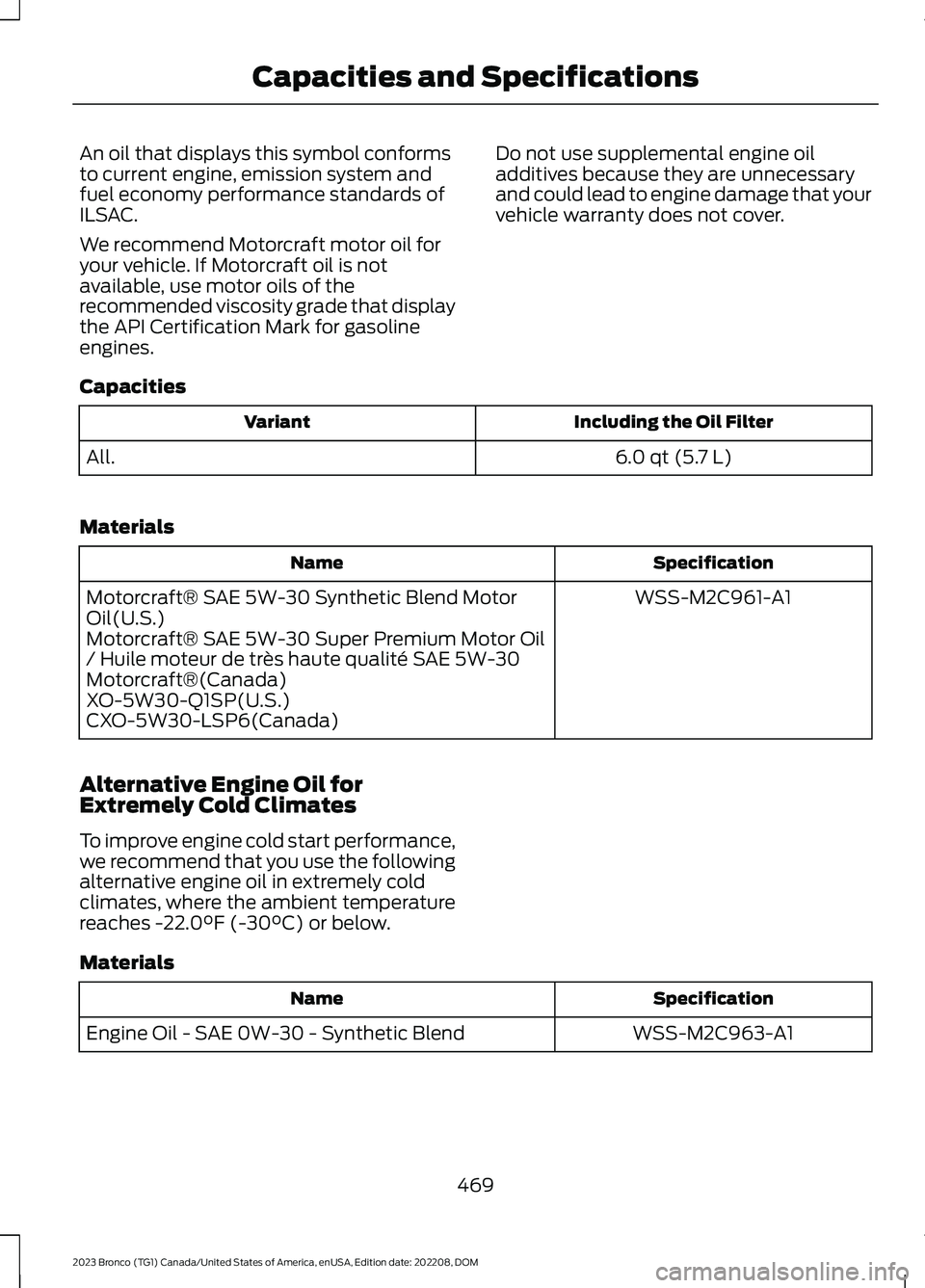
An oil that displays this symbol conformsto current engine, emission system andfuel economy performance standards ofILSAC.
We recommend Motorcraft motor oil foryour vehicle. If Motorcraft oil is notavailable, use motor oils of therecommended viscosity grade that displaythe API Certification Mark for gasolineengines.
Do not use supplemental engine oiladditives because they are unnecessaryand could lead to engine damage that yourvehicle warranty does not cover.
Capacities
Including the Oil FilterVariant
6.0 qt (5.7 L)All.
Materials
SpecificationName
WSS-M2C961-A1Motorcraft® SAE 5W-30 Synthetic Blend MotorOil(U.S.)Motorcraft® SAE 5W-30 Super Premium Motor Oil/ Huile moteur de très haute qualité SAE 5W-30Motorcraft®(Canada)XO-5W30-Q1SP(U.S.)CXO-5W30-LSP6(Canada)
Alternative Engine Oil forExtremely Cold Climates
To improve engine cold start performance,we recommend that you use the followingalternative engine oil in extremely coldclimates, where the ambient temperaturereaches -22.0°F (-30°C) or below.
Materials
SpecificationName
WSS-M2C963-A1Engine Oil - SAE 0W-30 - Synthetic Blend
469
2023 Bronco (TG1) Canada/United States of America, enUSA, Edition date: 202208, DOMCapacities and Specifications