2023 DODGE HORNET wheel size
[x] Cancel search: wheel sizePage 259 of 288

SERVICING AND MAINTENANCE257
TIRE TYPES
All Season Tires — If Equipped
All Season tires provide traction for all seasons (Spring,
Summer, Autumn, and Winter). Traction levels may vary
between different All Season tires. All Season tires can be
identified by the M+S, M&S, M/S or MS designation on the
tire sidewall. Use All Season tires only in sets of four;
failure to do so may adversely affect the safety and
handling of your vehicle.
Summer Or Three Season Tires —
If Equipped
Summer tires provide traction in both wet and dry
conditions, and are not intended to be driven in snow or on
ice. If your vehicle is equipped with Summer tires, be
aware these tires are not designed for Winter or cold
driving conditions. Install Winter tires on your vehicle when
ambient temperatures are less than 40°F (5°C) or if
roads are covered with ice or snow. For more information,
contact an authorized dealer.
Summer tires do not contain the all season designation or
mountain/snowflake symbol on the tire sidewall. Use
Summer tires only in sets of four; failure to do so may
adversely affect the safety and handling of your vehicle.
Snow Tires
Some areas of the country require the use of snow tires
during the Winter. Snow tires can be identified by a
mountain/snowflake symbol on the tire sidewall.
If you need snow tires, select tires equivalent in
size and type to the original equipment tires.
Use snow tires only in sets of four; failure to do
so may adversely affect the safety and handling
of your vehicle.
Snow tires generally have lower speed ratings than what
was originally equipped with your vehicle and should not be
operated at sustained speeds over 75 mph (120 km/h). For speeds above 75 mph (120 km/h) refer to original
equipment or an authorized tire dealer for recommended
safe operating speeds, loading and cold tire inflation
pressures.
While studded tires improve performance on ice, skid and
traction capability on wet or dry surfaces may be poorer
than that of non-studded tires. Some states prohibit
studded tires; therefore, local laws should be checked
before using these tire types.
WARNING!
Do not use a tire, wheel size, load rating, or speed
rating other than that specified for your vehicle.
Some combinations of unapproved tires and wheels
may change suspension dimensions and perfor -
mance characteristics, resulting in changes to
steering, handling, and braking of your vehicle.
This can cause unpredictable handling and stress to
steering and suspension components. You could
lose control and have a collision resulting in serious
injury or death. Use only the tire and wheel sizes with
load ratings approved for your vehicle.
Never use a tire with a smaller Load Index or capacity
other than what was originally equipped on your
vehicle. Using a tire with a smaller Load Index could
result in tire overloading and failure. You could lose
control and have a collision.
Failure to equip your vehicle with tires having
adequate speed capability can result in sudden tire
failure and loss of vehicle control.
CAUTION!
Replacing original tires with tires of a different size may
result in false speedometer and odometer readings.
WARNING!
Do not use Summer tires in snow/ice conditions. You
could lose vehicle control, resulting in severe injury or
death. Driving too fast for conditions also creates the
possibility of loss of vehicle control.
8
23_GG_OM_EN_USC_t.book Page 257
Page 260 of 288

258SERVICING AND MAINTENANCE
SPARE TIRES — IF EQUIPPED
NOTE:For vehicles equipped with Tire Service Kit instead of a
spare tire Úpage 211.
For restrictions when towing with a spare tire designated
for temporary emergency use
Úpage 124.
Spare Tire Matching Original Equipped Tire
And Wheel — If Equipped
Your vehicle may be equipped with a spare tire and wheel
equivalent in look and function to the original equipment
tire and wheel found on the front or rear axle of your
vehicle. This spare tire may be used in the tire rotation for
your vehicle. If your vehicle has this option, refer to an
authorized tire dealer for the recommended tire rotation
pattern.
Compact Spare Tire — If Equipped
The compact spare is for temporary emergency use only.
You can identify if your vehicle is equipped with a compact
spare by looking at the spare tire description on the
Tire And Loading Information Placard located on the
driver’s side door opening or on the sidewall of the tire.
Compact spare tire descriptions begin with the
letter “T” or “S” preceding the size designation.
Example: T145/80D18 103M.
T, S = Temporary Spare Tire
Since this tire has limited tread life, the original equipment
tire should be repaired (or replaced) and reinstalled on
your vehicle at the first opportunity.
Do not install a wheel cover or attempt to mount a
conventional tire on the compact spare wheel, since the
wheel is designed specifically for the compact spare tire.
Do not install more than one compact spare tire and wheel
on the vehicle at any given time.
Full-Size Spare — If Equipped
The Full-Size spare is for temporary emergency use only.
This tire may look like the originally equipped tire on the
front or rear axle of your vehicle, but it is not. This spare
tire may have limited tread life. When the tread is worn to
the tread wear indicators, the temporary use Full-Size
spare tire needs to be replaced. Since it is not the same as
your original equipment tire, replace (or repair) the original
equipment tire and reinstall on the vehicle at the first
opportunity.
Limited Use Spare — If Equipped
The limited use spare tire is for temporary emergency use
only. This tire is identified by a label located on the limited
use spare wheel. This label contains the driving limitations
for this spare. This tire may look like the original equipped
tire on the front or rear axle of your vehicle, but it is not.
Installation of this limited use spare tire affects vehicle
handling. Since it is not the same as your original
equipment tire, replace (or repair) the original equipment
tire and reinstall on the vehicle at the first opportunity.
CAUTION!
Because of the reduced ground clearance, do not take
your vehicle through an automatic car wash with a
compact or limited use temporary spare installed.
Damage to the vehicle may result.
WARNING!
Compact and collapsible spares are for temporary
emergency use only. With these spares, do not drive
more than 50 mph (80 km/h). Temporary use spares have limited tread life. When the tread is worn to the
tread wear indicators, the temporary use spare tire
needs to be replaced. Be sure to follow the warnings,
which apply to your spare. Failure to do so could result
in spare tire failure and loss of vehicle control.WARNING!
Limited use spares are for emergency use only.
Installation of this limited use spare tire affects vehicle
handling. With this tire, do not drive more than the
speed listed on the limited use spare wheel. Keep
inflated to the cold tire inflation pressures listed on your
Tire And Loading Information Placard located on the
driver’s side B-pillar or the rear edge of the driver’s side
door. Replace (or repair) the original equipment tire at
the first opportunity and reinstall it on your vehicle.
Failure to do so could result in loss of vehicle control.
23_GG_OM_EN_USC_t.book Page 258
Page 261 of 288

SERVICING AND MAINTENANCE259
(Continued)
SNOW TRACTION DEVICES
Use of traction devices require sufficient tire-to-body clearance. Due to limited clearance, the following snow traction devices are recommended. Follow these recommendations to
guard against damage:
Snow traction device must be of proper size for the tire, as recommended by the snow traction device manufacturer.
No other tire sizes are recommended for use with the snow traction device.
Please follow the table for the recommended tire size, axle and snow traction device:
Trim Level AxleTire/Wheel Size Snow Traction Device
(Maximum Projection Beyond Tire Profile Or Equivalent)
GT
GT Plus Front
215/60R177mm Cable or Chain
WARNING!
Using tires of different size and type (M+S, Snow)
between front and rear axles can cause unpredictable
handling. You could lose control and have a collision.
CAUTION!
To avoid damage to your vehicle or tires, observe the
following precautions:
Because of restricted traction device clearance
between tires and other suspension components, it
is important that only traction devices in good condi -
tion are used. Broken devices can cause serious
damage. Stop the vehicle immediately if noise occurs
that could indicate device breakage. Remove the
damaged parts of the device before further use.
Install device as tightly as possible and then retighten
after driving about ½ mile (0.8 km). Autosock traction
devices do not require retightening.
Do not exceed 30 mph (48 km/h).
Drive cautiously and avoid severe turns and large
bumps, especially with a loaded vehicle.
Do not drive for a prolonged period on dry pavement.
Observe the traction device manufacturer’s instruc -
tions on the method of installation, operating speed,
and conditions for use. Always use the suggested
operating speed of the device manufacturer’s if it is
less than 30 mph (48 km/h).
Do not use traction devices on a compact spare tire.
CAUTION!
8
23_GG_OM_EN_USC_t.book Page 259
Page 262 of 288
260SERVICING AND MAINTENANCE
TIRE ROTATION RECOMMENDATIONS
The tires on the front and rear of your vehicle operate at
different loads and perform different steering, handling,
and braking functions. For these reasons, they wear at
unequal rates.
These effects can be reduced by timely rotation of tires.
The benefits of rotation are especially worthwhile with
aggressive tread designs such as those on On/Off Road
type tires. Rotation will increase tread life, help to
maintain mud, snow, and wet traction levels, and
contribute to a smooth, quiet ride.
For the proper maintenance intervals
Úpage 224. The
reasons for any rapid or unusual wear should be corrected
prior to rotation being performed.
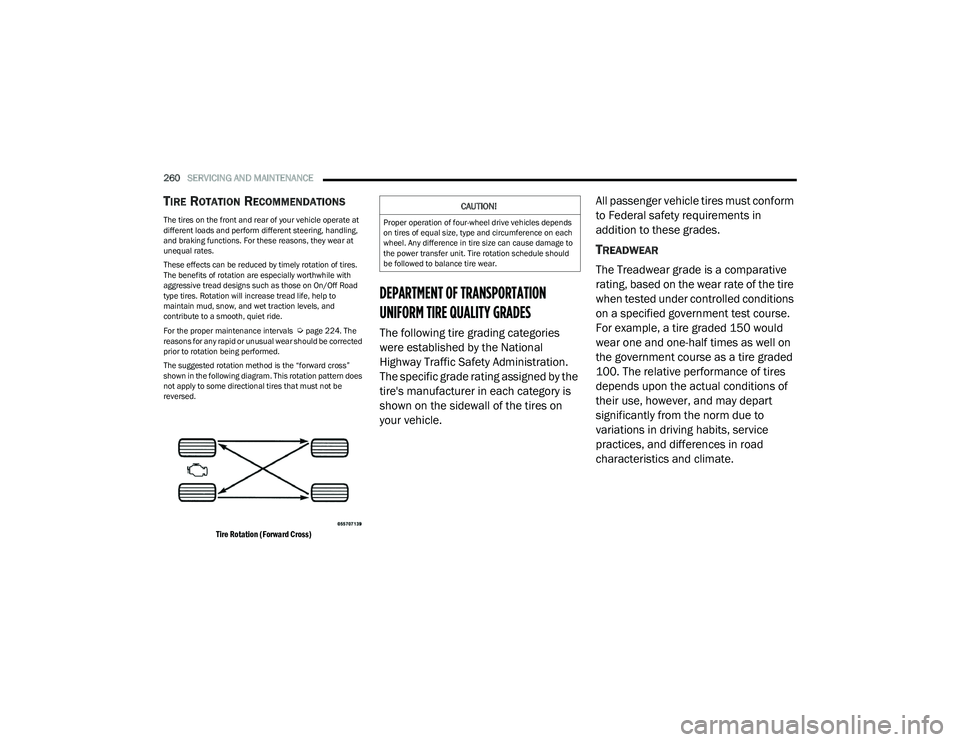
The suggested rotation method is the “forward cross”
shown in the following diagram. This rotation pattern does
not apply to some directional tires that must not be
reversed.
Tire Rotation (Forward Cross)
DEPARTMENT OF TRANSPORTATION
UNIFORM TIRE QUALITY GRADES
The following tire grading categories
were established by the National
Highway Traffic Safety Administration.
The specific grade rating assigned by the
tire's manufacturer in each category is
shown on the sidewall of the tires on
your vehicle. All passenger vehicle tires must conform
to Federal safety requirements in
addition to these grades.
TREADWEAR
The Treadwear grade is a comparative
rating, based on the wear rate of the tire
when tested under controlled conditions
on a specified government test course.
For example, a tire graded 150 would
wear one and one-half times as well on
the government course as a tire graded
100. The relative performance of tires
depends upon the actual conditions of
their use, however, and may depart
significantly from the norm due to
variations in driving habits, service
practices, and differences in road
characteristics and climate.
CAUTION!
Proper operation of four-wheel drive vehicles depends
on tires of equal size, type and circumference on each
wheel. Any difference in tire size can cause damage to
the power transfer unit. Tire rotation schedule should
be followed to balance tire wear.
23_GG_OM_EN_USC_t.book Page 260
Page 267 of 288

265
TECHNICAL SPECIFICATIONS
VEHICLE IDENTIFICATION NUMBER (VIN)
The VIN is found on the left front corner of the windshield
and is visible from outside of the vehicle.
Vehicle Identification Number
NOTE:
It is illegal to remove or alter the VIN.
BRAKE SYSTEM
Your vehicle is equipped with power assisted brakes as
standard equipment. In the event power assist is lost for
any reason (for example, repeated brake applications with
the engine off), the brakes will still function. However, the
effort required to brake the vehicle will be much greater
than that required with the power system operating. If either of the two hydraulic systems lose normal
capability, the remaining system will still function with
some loss of overall braking effectiveness. This will be
evident by increased pedal travel during application and
greater pedal force required to slow or stop. In addition, if
the malfunction is caused by an internal leak, as the brake
fluid in the master cylinder drops, the Brake Warning Light
will illuminate.
WHEEL AND TIRE TORQUE SPECIFICATIONS
Proper lug nut/bolt torque is very important to ensure that
the wheel is properly mounted to the vehicle. Any time a
wheel has been removed and reinstalled on the vehicle,
the lug nuts/bolts should be torqued using a properly
calibrated torque wrench using a six-sided (hex) deep wall
socket.
TORQUE SPECIFICATIONS
**Use only authorized dealer recommended lug nuts/
bolts and clean or remove any dirt or oil before tightening.
Inspect the wheel mounting surface prior to mounting the
tire and remove any corrosion or loose particles.
Wheel Mounting Surface
WARNING!
Driving a vehicle with the Brake Warning Light on is
dangerous. A significant decrease in braking
performance or vehicle stability during braking may
occur. It will take you longer to stop the vehicle or will
make your vehicle harder to control. You could have a
collision. Have the vehicle checked immediately.
Lug Nut/Bolt
Torque
**Lug Nut/Bolt
SizeLug Nut/Bolt
Socket Size
88.5 ft-lb
(120 N·m) M12 x 1.25 17 mm
9
23_GG_OM_EN_USC_t.book Page 265
Page 285 of 288

283
Selection Of Coolant (Antifreeze) ................................ 269
Sentry Key (Immobilizer).................................................16
Service Assistance ....................................................... 270
Service Contract ........................................................... 272
Service Manuals........................................................... 274
Shift Lever Override ..................................................... 218
ShiftingAutomatic Transmission............................................86
Shoulder Belts .............................................................. 170
Side Distance Warning ................................................ 107
Side View Mirror Adjustment ................................... 34
, 35
Signals, Turn................................................... 42, 77, 201
Snow Chains (Tire Chains)........................................... 259
Snow Tires .................................................................... 257
Spare Tires ................................................................... 258
Specifications Fuel (Gasoline) ........................................................ 269Oil ............................................................................. 269
Speedometer...................................................................69
Starting ..................................................................... 18
, 80
Automatic Transmission............................................80
Button .........................................................................16
Cold Weather ............................................................. 81
Engine Fails To Start..................................................81
Remote ....................................................................... 18
Starting And Operating ...................................................80 Starting Procedures ........................................................80
Steering Tilt Column .................................................................26
Wheel, Heated ...........................................................26
Wheel, Tilt...................................................................26
Steering Wheel Audio Controls ................................... 150
Steering Wheel Mounted Sound System Controls..... 150
Storage ............................................................................50
Storage, Vehicle .............................................................. 50 Stuck, Freeing ............................................................... 219
Sun Roof ................................................................... 56
, 58
Sun Visor ......................................................................... 34
Supplemental Restraint System – Air Bag ..................176
Surround View Camera System ...................................117
Synthetic Engine Oil ...................................................... 228
System, Remote Starting ............................................... 18
TTelescoping Steering Column ........................................ 26
Temperature Control, Automatic (ATC) ......................... 49 Tie Down Hooks, Cargo .................................................. 64
Tilt Steering Column ....................................................... 26
Time Delay Headlight .................................................................... 41
Tire And Loading Information Placard ......................... 251
Tire Inflator Kit — If Equipped
b
................................ 211
Tire Markings ................................................................ 246
Tire Safety Information................................................. 246
Tire Service Kit .............................................................. 211
Tires ................................................... 201
, 254, 258, 260
Aging (Life Of Tires) ................................................. 256
Air Pressure.............................................................. 254
Chains ...................................................................... 259
Changing .................................................................. 206
Compact Spare ........................................................ 258
General Information ...................................... 254
, 258
High Speed .............................................................. 255
Inflation Pressure ....................................................254 Jacking .....................................................................206
Life Of Tires .............................................................. 256
Load Capacity .......................................................... 251
Pressure Monitoring System (TPMS) ..............75
, 165
Quality Grading ........................................................ 260 Radial ....................................................................... 255
Replacement ........................................................... 256
Rotation ................................................................... 260
Safety .............................................................. 246
, 254
Sizes......................................................................... 247
Snow Tires ............................................................... 257 Spare Tires .............................................................. 258Spinning ................................................................... 255
Trailer Towing .......................................................... 124
Tread Wear Indicators ............................................ 256
Wheel Nut Torque ................................................... 265
To Open Hood ................................................................. 58
Tongue Weight/Trailer Weight..................................... 123
Towing ........................................................................... 121 Disabled Vehicle...................................................... 220
Guide........................................................................ 122
Recreational ............................................................ 126
Weight ...................................................................... 122
Towing Behind A Motorhome ...................................... 126
Towing Eyes .................................................................. 221
Traction ......................................................................... 127
Traction Control ...................................................157
, 158
Traffic Sign Recognition System............................. 76, 99
Trailer Towing ............................................................... 121 Minimum Requirements ......................................... 123Tips........................................................................... 125
Trailer And Tongue Weight ..................................... 123
Wiring ....................................................................... 124
Trailer Towing Guide .................................................... 122
Trailer Weight................................................................ 122
Transaxle Automatic .................................................................. 85
Operation ................................................................... 85
Transfer Case Fluid ......................................................................... 269
11
23_GG_OM_EN_USC_t.book Page 283