2023 DODGE HORNET fuel type
[x] Cancel search: fuel typePage 229 of 288

SERVICING AND MAINTENANCE227
CHECKING OIL LEVEL
To ensure proper engine lubrication, the engine oil must
be maintained at the correct level. Check the oil level at
regular intervals, such as every fuel stop. The best time to
check the engine oil level is about five minutes after a fully
warmed up engine is shut off.
Checking the oil while the vehicle is on level ground will
improve the accuracy of the oil level readings.
There are four possible dipstick types:
Crosshatched zone.
Crosshatched zone marked SAFE.
Crosshatched zone marked with MIN at the low end of
the range and MAX at the high end of the range.
Crosshatched zone marked with dimples at the MIN
and the MAX ends of the range.
NOTE:Always maintain the oil level within the crosshatch
markings on the dipstick.
Adding 1 qt (1 L) of oil when the reading is at the low end
of the dipstick range will raise the oil level to the high end
of the range marking.
ADDING WASHER FLUID
The fluid reservoir is located in the front of the engine
compartment. Be sure to check the fluid level in the
reservoir at regular intervals. Fill the reservoir with
windshield washer solvent (not radiator antifreeze) and
operate the system for a few seconds to flush out the
residual washer fluid.
When refilling the washer fluid reservoir, take some
washer fluid, apply it to a cloth or towel, and wipe clean the
wiper blades; this will help blade performance.
To prevent freeze-up of your windshield washer system in
cold weather, select a solution or mixture that meets or
exceeds the temperature range of your climate. This rating
information can be found on most washer fluid containers.
MAINTENANCE-FREE BATTERY
Your vehicle is equipped with a maintenance-free battery.
You will never have to add water, and periodic
maintenance is not required.CAUTION!
Overfilling or underfilling the engine oil will cause
aeration or loss of oil pressure. This could damage your
engine.
WARNING!
Commercially available windshield washer solvents are
flammable. They could ignite and burn you. Care must
be exercised when filling or working around the washer
solution.
WARNING!
Battery fluid is a corrosive acid solution and can burn
or even blind you. Do not allow battery fluid to
contact your eyes, skin, or clothing. Do not lean over
a battery when attaching clamps. If acid splashes in
eyes or on skin, flush the area immediately with large
amounts of water
Úpage 215.
Battery gas is flammable and explosive. Keep flame
or sparks away from the battery. Do not use a
booster battery or any other booster source with an
output greater than 12 Volts. Do not allow cable
clamps to touch each other.
Battery posts, terminals, and related accessories
contain lead and lead compounds. Wash hands after
handling.
CAUTION!
It is essential when replacing the cables on the
battery that the positive cable is attached to the posi -
tive post and the negative cable is attached to the
negative post. Battery posts are marked positive (+)
and negative (-) and are identified on the battery
case. Cable clamps should be tight on the terminal
posts and free of corrosion.
If a “fast charger” is used while the battery is in the
vehicle, disconnect both vehicle battery cables
before connecting the charger to the battery. Do not
use a “fast charger” to provide starting voltage.
8
23_GG_OM_EN_USC_t.book Page 227
Page 256 of 288

254SERVICING AND MAINTENANCE
(Continued)
TIRES — GENERAL INFORMATION
Tire Pressure
Proper tire inflation pressure is essential to the safe and
satisfactory operation of your vehicle. Four primary areas
are affected by improper tire pressure:
Safety
Fuel Economy
Tread Wear
Ride Comfort and Vehicle Stability
Safety Both underinflation and overinflation affect the stability of
the vehicle and can produce a feeling of sluggish response
or over responsiveness in the steering.
NOTE:
Unequal tire pressures from side to side may cause
erratic and unpredictable steering response.
Unequal tire pressure from side to side may cause the
vehicle to drift left or right.
Fuel Economy
Underinflated tires will increase tire rolling resistance
resulting in higher fuel consumption.
Tread Wear
Improper cold tire inflation pressures can cause abnormal
wear patterns and reduced tread life, resulting in the need
for earlier tire replacement.
Ride Comfort And Vehicle Stability
Proper tire inflation contributes to a comfortable ride.
Overinflation produces a jarring and uncomfortable ride.
Tire Inflation Pressures
The proper cold tire inflation pressure is listed on the
driver's side B-pillar or rear edge of the driver's side door.
At least once a month:
Check and adjust tire pressure with a good quality
pocket-type pressure gauge. Do not make a visual judg -
ment when determining proper inflation. Tires may look
properly inflated even when they are underinflated.
Inspect tires for signs of tire wear or visible damage.
Inflation pressures specified on the placard are always
“cold tire inflation pressure”. Cold tire inflation pressure is
defined as the tire pressure after the vehicle has not been
driven for at least three hours, or driven less than 1 mile
(1.6 km) after sitting for a minimum of three hours. The
cold tire inflation pressure must not exceed the maximum
inflation pressure molded into the tire sidewall.
Check tire pressures more often if subject to a wide range
of outdoor temperatures, as tire pressures vary with
temperature changes.
Tire pressures change by approximately 1 psi (7 kPa) per
12°F (7°C) of air temperature change. Keep this in mind
when checking tire pressure inside a garage, especially in
the Winter.
WARNING!
Improperly inflated tires are dangerous and can
cause collisions.
Underinflation increases tire flexing and can result in
overheating and tire failure.
Overinflation reduces a tire's ability to cushion shock.
Objects on the road and chuckholes can cause
damage that result in tire failure.
Overinflated or underinflated tires can affect vehicle
handling and can fail suddenly, resulting in loss of
vehicle control.
Unequal tire pressures can cause steering problems.
You could lose control of your vehicle.
Unequal tire pressures from one side of the vehicle
to the other can cause the vehicle to drift to the
right or left.
Always drive with each tire inflated to the recom -
mended cold tire inflation pressure.
WARNING!
CAUTION!
After inspecting or adjusting the tire pressure, always
reinstall the valve stem cap. This will prevent moisture
and dirt from entering the valve stem, which could
damage the valve stem.
23_GG_OM_EN_USC_t.book Page 254
Page 279 of 288
277
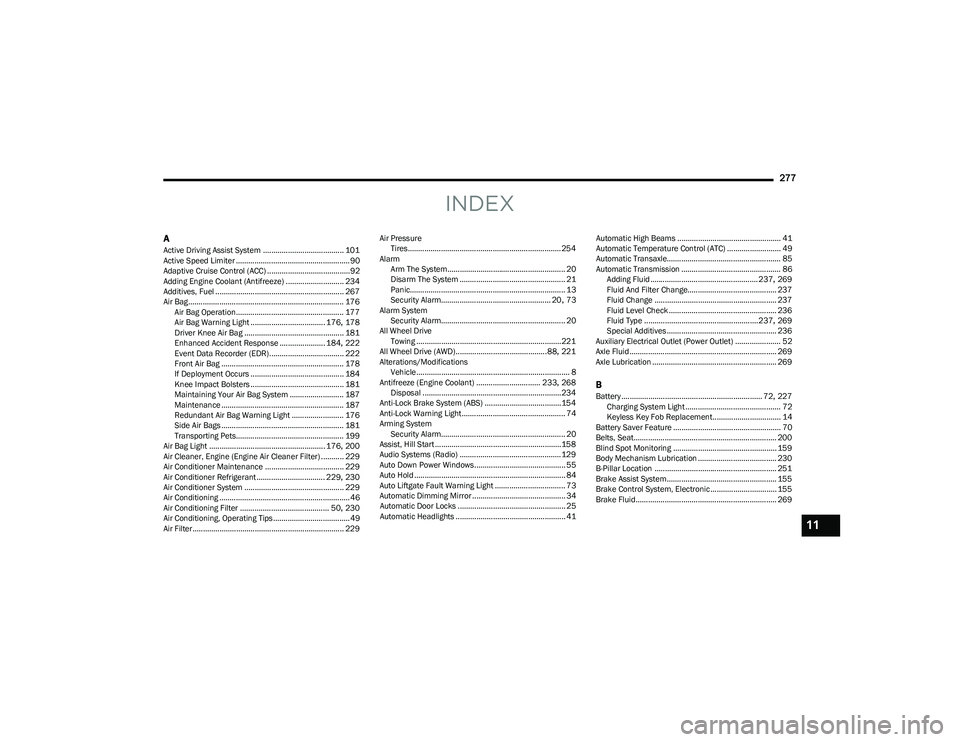
INDEX
AActive Driving Assist System ....................................... 101
Active Speed Limiter ....................................................... 90
Adaptive Cruise Control (ACC) ........................................92
Adding Engine Coolant (Antifreeze) ............................ 234
Additives, Fuel .............................................................. 267
Air Bag........................................................................... 176Air Bag Operation.................................................... 177
Air Bag Warning Light .................................... 176
, 178
Driver Knee Air Bag ................................................ 181
Enhanced Accident Response ...................... 184
, 222
Event Data Recorder (EDR).................................... 222 Front Air Bag ........................................................... 178
If Deployment Occurs ............................................. 184
Knee Impact Bolsters ............................................. 181
Maintaining Your Air Bag System .......................... 187
Maintenance ........................................................... 187
Redundant Air Bag Warning Light ......................... 176
Side Air Bags ........................................................... 181
Transporting Pets.................................................... 199
Air Bag Light ........................................................ 176
, 200
Air Cleaner, Engine (Engine Air Cleaner Filter) ........... 229
Air Conditioner Maintenance ...................................... 229
Air Conditioner Refrigerant ................................. 229
, 230
Air Conditioner System ................................................ 229
Air Conditioning ............................................................... 46
Air Conditioning Filter ........................................... 50
, 230
Air Conditioning, Operating Tips ..................................... 49 Air Filter......................................................................... 229 Air Pressure
Tires.......................................................................... 254
Alarm Arm The System......................................................... 20
Disarm The System ................................................... 21
Panic........................................................................... 13
Security Alarm..................................................... 20
, 73
Alarm System Security Alarm............................................................ 20
All Wheel Drive Towing ...................................................................... 221
All Wheel Drive (AWD)............................................88
, 221
Alterations/Modifications Vehicle.......................................................................... 8
Antifreeze (Engine Coolant) ............................... 233
, 268
Disposal ...................................................................234
Anti-Lock Brake System (ABS) ..................................... 154
Anti-Lock Warning Light.................................................. 74
Arming System Security Alarm............................................................ 20
Assist, Hill Start ............................................................. 158
Audio Systems (Radio) ................................................. 129
Auto Down Power Windows............................................ 55
Auto Hold ......................................................................... 84
Auto Liftgate Fault Warning Light .................................. 73
Automatic Dimming Mirror ............................................. 34 Automatic Door Locks .................................................... 25Automatic Headlights ..................................................... 41 Automatic High Beams .................................................. 41
Automatic Temperature Control (ATC) .......................... 49
Automatic Transaxle....................................................... 85
Automatic Transmission ................................................ 86 Adding Fluid .................................................... 237
, 269
Fluid And Filter Change........................................... 237
Fluid Change ........................................................... 237
Fluid Level Check .................................................... 236
Fluid Type .......................................................237
, 269
Special Additives ..................................................... 236
Auxiliary Electrical Outlet (Power Outlet) ...................... 52
Axle Fluid....................................................................... 269
Axle Lubrication ............................................................ 269
BBattery.................................................................... 72, 227
Charging System Light .............................................. 72
Keyless Key Fob Replacement................................. 14
Battery Saver Feature .................................................... 70
Belts, Seat..................................................................... 200
Blind Spot Monitoring .................................................. 159
Body Mechanism Lubrication ...................................... 230
B-Pillar Location ........................................................... 251
Brake Assist System..................................................... 155
Brake Control System, Electronic................................ 155
Brake Fluid.................................................................... 269
11
23_GG_OM_EN_USC_t.book Page 277