2023 CITROEN C4 CACTUS lock
[x] Cancel search: lockPage 30 of 196

28
Ease of use and comfort
Steering wheel
adjustment
► When stationary, lower the control A to
release the steering wheel.
► Adjust the steering wheel height and reach to
suit your driving position.
► Raise the control A to lock the steering
wheel.
As a safety precaution, these operations should only be carried out while the
vehicle is stationary.
► Turn the knob manually to obtain the desired
level of lumbar support.
Head restraint height
adjustment
► To raise it, pull it upwards as far as possible
(notch).
►
T
o remove it, press the lug A and pull it
upwards.
►
T
o put it back in place, engage the head
restraint rods in the openings keeping them in
line with the seat backrest.
►
T
o lower it, press the lug A and push down on
the head restraint at the same time.
The head restraint has a frame with notches which prevents it from lowering;
this is a safety device in case of impact.
The adjustment is correct when the upper
edge of the head restraint is level with the
top of the head.
Never drive with the head restraints removed;
they must be fitted and correctly adjusted.
Heated seats
► With the engine running, use the adjustment
knob to switch on and select the level of heating
required:
0
: Off.
1
: Low.
2
: Medium.
3
: High.
The front seats can be heated individually.
Before leaving the vehicle, ensure that
the adjustment knob of the passenger
seat is at position
0, so that the heating does
not unnecessarily operate if no passenger is
present during the next journey.
Do not use the function when the seat
is not occupied.
Reduce the heating intensity as soon as
possible.
When the seat and passenger compartment
have reached a satisfactory temperature,
switch the function off; reducing electricity
consumption in turn decreases fuel
consumption.
Prolonged use of the heated seats is not
recommended for those with sensitive
skin.
There is a risk of burns for people whose
perception of heat is impaired (illness, taking
medication, etc.).
To keep the heated pad intact and to prevent
a short circuit:
–
do not place sharp or heavy objects on the
seat,
–
do not kneel or stand on the seat,
–
do not spill liquids onto the seat,
–
never use the heating function if the seat
is wet.
Page 31 of 196

29
Ease of use and comfort
3Steering wheel
adjustment
► When stationary, lower the control A to
release the steering wheel.
►
Adjust the steering wheel height and reach to
suit your driving position.
►
Raise the control A
to lock the steering
wheel.
As a safety precaution, these operations should only be carried out while the
vehicle is stationary.
Mirrors
Door mirrors
The objects observed are, in reality, closer than they appear.
Take this into account in order to correctly
judge the distance of vehicles approaching
from behind.
Electric adjustment
► Turn control A to the right or to the left to
select the corresponding mirror.
►
Move the control in any of the four directions
to adjust.
►
Return the control to the central position.
As a safety measure, the mirrors should be adjusted to reduce the blind spots.
Manual folding
You can manually fold the mirrors (parking
obstruction, narrow garage, etc.)
►
T
urn the mirror towards the vehicle.
Electric folding
If your vehicle is fitted with this function, the
mirrors can be folded electrically from the inside,
with the vehicle parked and the ignition on:
► Turn control A to opposite the mark.
From outside: lock the vehicle using the remote
control or the "Keyless Entry and Starting"
system.
The folding and unfolding of the door mirrors when locking or unlocking the
vehicle can be deactivated via the vehicle
configuration menu.
Demisting - Defrosting
Demisting-defrosting of the door mirrors
operates with the engine running, by
switching on the heated rear screen.
For more information on Demisting - defrosting
the rear screen , refer to the corresponding
section.
Page 38 of 196

36
Ease of use and comfort
Boot lighting
It comes on automatically when the boot is
opened.
There are different lighting times:
– when the ignition is off, approximately ten
minutes,
– in energy economy mode, approximately thirty
seconds,
– with the engine running, unlimited.
Panoramic glass sunroof
Rear screen demisting
- defrosting
On / Off
► Press this button to demist/defrost the rear
screen and, depending on version, the door
mirrors.
The button indicator lamp comes on.
Defrosting switches off automatically to prevent
excessive electrical consumption.
►
It is possible to stop the demisting / defrosting
operation before it is switched off automatically
by pressing this button again.
The button
indicator lamp goes off.
Switch off the demisting/defrosting of
the rear screen and door mirrors as
soon as appropriate, as lower current
consumption results in reduced fuel
consumption.
Rear screen demisting - defrosting can
only be operated when the engine is
running.
Courtesy lamps
1. Front courtesy lamp
2. Front map reading lamps
3.Rear courtesy lamp
4. Rear map reading lamps
Front and rear courtesy
lamps
In this position, the courtesy lamp comes
on gradually:
–
when the vehicle is unlocked.
– when the key is removed from the ignition
switch.
–
when a door is opened.
–
when the remote control locking button is
activated, in order to locate the vehicle.
It switches off gradually:
–
when the vehicle is locked.
–
when the ignition is switched on.
–
30 seconds after the last door is closed.
Permanently off.
Permanent lighting.
In "Permanent lighting" mode, the lighting time
varies according to the circumstances:
–
With
the ignition off, approximately 10 minutes.
–
In energy saving mode, approximately 30
seconds.
–
With the engine running, unlimited.
When the front courtesy lamp is in the
"Permanent lighting" position, the rear
courtesy lamp also comes on, unless it is in
the "Permanently off" position.
To switch off the rear courtesy lamp, put it in
the "Permanently off" position.
Map reading lamps
► With the ignition on, operate the
corresponding switch.
Take care not to place anything in contact with the courtesy lamps.
Page 55 of 196
53
Safety
5Deactivation is confirmed by the
illumination of this indicator lamp in the
instrument panel and the display of a message.
The ASR system is reactivated automatically
every time the ignition is switched back on or
from 31 mph (50
km/h).
Reactivation is manual below 31 mph (50 km/h).
Malfunction
In the event of a system malfunction, this
warning lamp comes on, accompanied by
an onscreen message and audible signal.
Contact a CITROËN dealer or a qualified
workshop to have the systems checked.
ASR / DSC
These systems enhance safety during
normal driving, but should not encourage
the driver to take extra risks or drive at high
speed.
It is in conditions of reduced grip (rain, snow,
ice) that the risk of loss of grip increases. It
is therefore important for your safety to keep
these systems activated in all conditions, and
particularly in difficult conditions.
Correct operation of these systems depends
on compliance with the manufacturer's
recommendations relating to the wheels
(tyres and rims), braking and electronic
components, as well as the assembly and
repair procedures used by CITROËN dealers.
The use of snow tyres is recommended, to
ensure that these systems remain effective
in winter conditions. All four wheels must be
fitted with tyres approved for the vehicle.
Seat belts
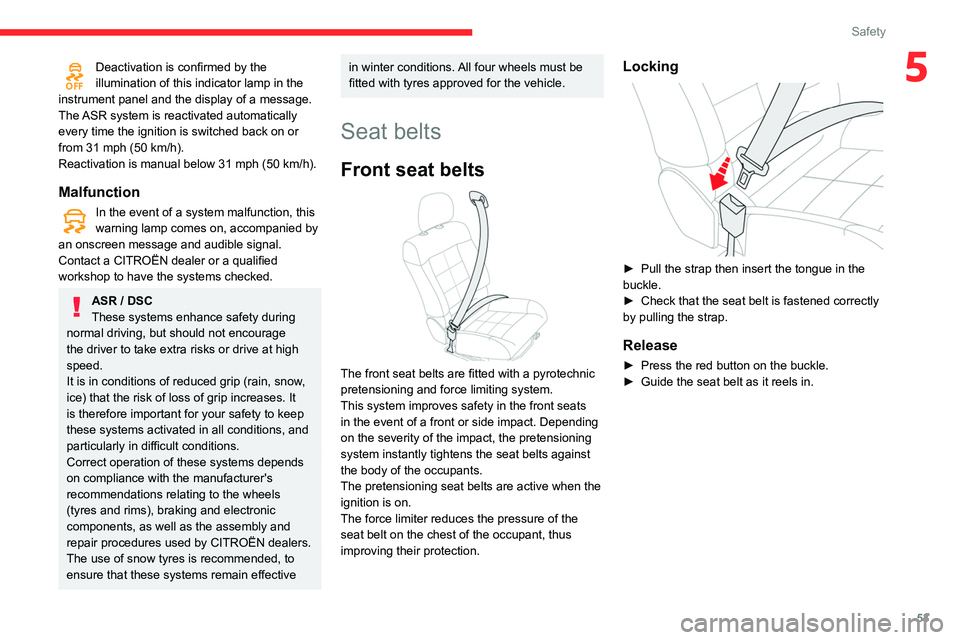
Front seat belts
The front seat belts are fitted with a pyrotechnic
pretensioning and force limiting system.
This system improves safety in the front seats
in the event of a front or side impact. Depending
on the severity of the impact, the pretensioning
system instantly tightens the seat belts against
the body of the occupants.
The pretensioning seat belts are active when the
ignition is on.
The force limiter reduces the pressure of the
seat belt on the chest of the occupant, thus
improving their protection.
Locking
► Pull the strap then insert the tongue in the
buckle.
►
Check that the seat belt is fastened correctly
by pulling the strap.
Release
► Press the red button on the buckle.
► Guide the seat belt as it reels in.
Page 60 of 196

58
Safety
of the vehicle's rear seat, and is ideally in contact
with it.
Centre rear seat
A child seat with a support leg must never be
installed on the centre rear passenger seat .
Child seat at the front
► Adjust the front passenger seat to the
intermediate longitudinal position , with the
backrest straightened .
"Forward facing"
You must leave the front passenger
airbag active.
– Statistically , the safest seats in your
vehicle for carrying children are the rear
seats.
–
Children weighing less than 9 kg must
travel in the "rear facing" position, whether in
the front or rear of the vehicle.
It is recommended that children travel
on the rear seats of the vehicle:
–
‘rear facing’ up to the age of 3,
–
‘forward facing’ over the age of 3.
Make sure that the seat belt is correctly
positioned and tightened.
For child seats with a support leg, ensure that
the support leg is in firm and steady contact
with the floor.
Remove and stow the head restraint
before installing a child seat with
backrest on a passenger seat. Refit the head
restraint once the child seat has been
removed.
Advice
An incorrectly installed child seat compromises the child's safety in the
event of an accident.
Ensure that there is no seat belt or seat belt
buckle under the child seat, as this could
destabilise it.
Remember to fasten the seat belts or the
harness of child seats, keeping the slack
relative to the child's body to a minimum,
even for short journeys.
When installing a child seat using the seat
belt, ensure that the seat belt is tightened
correctly on the child seat and that it secures
the child seat firmly on the seat of the vehicle.
If the passenger seat is adjustable, move it
forwards if necessary.
Remove the head restraint before
installing a child seat with a backrest on a
passenger seat.
Ensure that the head restraint is stored or
attached securely to prevent it from being
thrown around the vehicle in the event of
sharp braking. Refit the head restraint once
the child seat has been removed.
Installing a booster seat
The chest part of the seat belt must be
positioned on the child's shoulder without
touching the neck.
Ensure that the lap part of the seat belt
passes correctly over the child's thighs.
Use a booster seat with backrest, equipped
with a belt guide at shoulder level.
Additional protections
To prevent accidental opening of the
doors and rear windows, use the "Child lock".
Take care not to open the rear windows by
more than one third.
To protect young children from the rays of the
sun, fit side blinds on the rear windows.
As a safety precaution, do not leave:
–
a child alone and unattended in a vehicle,
–
a child or an animal in a vehicle which is
exposed to the sun, with the windows closed,
–
the keys within reach of children inside the
vehicle.
Child seat at the rear
"Forward facing" or "Rearward
facing"
► Move the vehicle's front seat forward and
straighten the backrest so that the legs of the
child in the "forward facing" child seat or the
"rearward facing" child seat itself do not touch
the vehicle's front seat.
►
V
erify that the backrest of the "forward facing"
child seat is as close as possible to the backrest
Page 66 of 196

64
Safety
i-Size child seats
i-Size child seats have two latches that engage on the two rings A.
These i-Size child seats also have:
– either an upper strap that is attached to ring B.
– or a support leg that rests on the vehicle floor, compatible with the approved i-Size seat position.
Their role is to prevent the child seat from tipping forward in the even\
t of a collision.
For more information on the ISOFIX mountings, refer to the corresponding section.
In accordance with the new European regulations, this table indicates the options for installing i-Size child seats on the vehicle seats fitted with ISOFIX
mountings approved for i-Size.
i-Size child seat
Row 1 Front passenger seat
Not i-Size
Row 2 Rear side seats (a)
i-U
Rear centre seat
Not i-Size
i-U Suitable for i-Size restraint systems in the "Universal" category, "forward facing" and "rearward facing".
(a) To install a "rearward facing" or "forward facing" child seat at the rear\
, move the front seat forwards, then straighten the backrest to allow en\
ough room for the child seat and the child's legs.
Manual child lock
Weight of the child / indicative age
Under 10 kg (group 0)
Up to about 6 months old Under 10 kg
(group 0)
Under 13 kg (group 0+)
Up to about 1 year old From 9 to 18 kg (group 1)
From about 1 to 3 years old
1
st row Front passenger seat
Not ISOFIX
2
nd row Rear side seats
IL-SU* IL-SU IL-SU IL-SU IL-SU IUF
IL-SU
Rear centre seat
Not ISOFIX
IUF: seat position suitable for the installation of an Isofix Universal seat, "Forward facing", secured using the upper strap.
IL-SU: seat position suitable for the installation of an Isofix Semi-Universal seat either:
–
“rearward facing" fitted with an upper strap or a support leg,
–
"forward facing" fitted with a support leg,
–
a carrycot fitted with an upper strap or a support leg.
For more information on ISOFIX child seats and the upper strap, refer to the corresponding section.
* An ISOFIX carrycot, secured to the lower rings of an ISOFIX seat, occupies all \
of the seat positions on the rear bench seat.
Page 67 of 196

65
Safety
5i-Size child seats
i-Size child seats have two latches that engage on the two rings A.
These i-Size child seats also have:
–
either an upper strap that is attached to ring B
.
–
or a support leg that rests on the vehicle floor
, compatible with the approved i-Size seat position.
Their role is to prevent the child seat from tipping forward in the even\
t of a collision.
For more information on the ISOFIX mountings, refer to the corresponding section.
In accordance with the new European regulations, this table indicates the options for installing i-Size child seats on the vehicle
seats fitted with ISOFIX
mountings approved for i-Size.
i-Size child seat
Row 1 Front passenger seat
Not i-Size
Row 2 Rear side seats (a)
i-U
Rear centre seat
Not i-Size
i-U Suitable for i-Size restraint systems in the "Universal" category, "forward facing" and "rearward facing".
(a) To install a "rearward facing" or "forward facing" child seat at the rear\
, move the front seat forwards, then straighten the backrest to allow en\
ough room for the child seat and the child's legs.
Manual child lock
The system prevents a rear door from being
opened using its interior handle.
The control is located on the edge of each rear
door.
Page 68 of 196

66
Safety
Locking / Unlocking
► To lock, turn the red control as far as it will go
using the integral key:•
T
o the right on the left-hand rear door.
•
T
o the left on the right-hand rear door.
►
T
o unlock, turn it in the opposite direction.
Do not confuse the child lock control,
which is red, with the back-up locking
control, which is black.
Electric child lock
This control prevents the opening of the rear
doors using their interior handles.
Activation/Deactivation
► With the ignition on, press this button to
activate/deactivate the child lock.
A
message is displayed, confirming activation/
deactivation of the child lock.
When the indicator lamp is on, the child lock is
activated.
Any other indicator lamp status indicates a fault affecting the electric child lock.
Have it checked by a CITROËN dealer or a
qualified workshop.
With the child lock activated, it is still
possible to open the doors from outside.
This system is independent and in no circumstances does it take the place of
the central locking control.
Check the status of the child lock each time
you switch on the ignition.
Always keep the electronic key with you when
leaving the vehicle, even for a short time.
In the event of a serious impact, the electric
child lock is switched off automatically to
permit the exit of the rear passengers.