2023 CITROEN C3 AIRCROSS immobiliser
[x] Cancel search: immobiliserPage 14 of 244

12
Instruments
Low fuel levelFixed, accompanied by an audible signal
and a message.
When it first comes on, there is
approximately 5
litres of fuel remaining in the tank (reserve).
Refuel without delay to avoid running out of fuel.
Never drive until completely empty, as
this could damage the emissions control and
injection systems.
Water in Diesel fuel filter (depending on
version)
Fixed.
The Diesel fuel filter contains water.
Carry out (2) without delay. Risk of damaging the
fuel injection system!
Lane departure warning systemFlashing, accompanied by an audible
signal.
A lane marking has been crossed on the left or
right.
Turn the steering wheel in the opposite direction
to return to the correct trajectory.
For more information, refer to the Driving
section.
Fixed, accompanied by an onscreen
message.
The system has a fault.
Stay alert and drive carefully, then carry out (3).
Fixed.
The system has been deactivated.
If there is an unexpected change of direction,
you will no longer be warned by the system.
AdBlue® (BlueHDi)On for around 30 seconds when starting
the vehicle, accompanied by a message
indicating the driving range.
The driving range is between 1,500 and 500
miles (2,400 and 800
km).
Top up the AdBlue
®.Fixed, on switching on the ignition,
accompanied by an audible signal and a
message indicating the driving range.
The driving range is between 500 and 62 miles
(800 and 100
km).
Promptly top up the AdBlue
®, or carry out (3).Flashing, accompanied by an audible
signal and a message indicating the
driving range.
The driving range is less than 62 miles (100
km).
You must top up the AdBlue
® to avoid engine
starting being prevented , or carry out
(3).
Flashing, accompanied by an audible
signal and a message indicating that
starting is prevented.
The AdBlue
® tank is empty: the legally required
engine immobiliser system prevents the engine
from starting.
To restart the engine, top up the AdBlue
® or carry
out (2).
It is essential to add at least 5 litres of AdBlue
®
to the tank.
SCR emissions control system (BlueHDi)Fixed when the ignition is switched
on, accompanied by an audible
signal and a message.
A malfunction of the SCR emissions control
system has been detected.
This alert disappears once the exhaust
emissions return to normal levels.
Flashing AdBlue® warning lamp on
switching on the ignition, with the
Engine self-diagnostics warning lamp on fixed,
accompanied by an audible signal and a
message indicating the driving range.
Depending on the message displayed, it is
possible to drive for up to 685 miles (1,100
km)
before the engine immobiliser is triggered.
Carry out (3) without delay, to avoid starting
being prevented.
Flashing AdBlue® warning lamp on
switching on the ignition, with the
Engine self-diagnostics warning lamp on fixed,
accompanied by an audible signal and a
message indicating that starting is prevented.
The engine immobiliser prevents the engine from
restarting (the permitted driving limit has been
exceeded after confirmation of a malfunction of
the emissions control system).
To start the engine, carry out (2).
ServiceTemporarily on, accompanied by the display of a message.
One or more minor faults, for which there is/are
no specific warning lamp(s), have been detected.
Page 26 of 244
24
Access
Remote control / Key
Remote control function
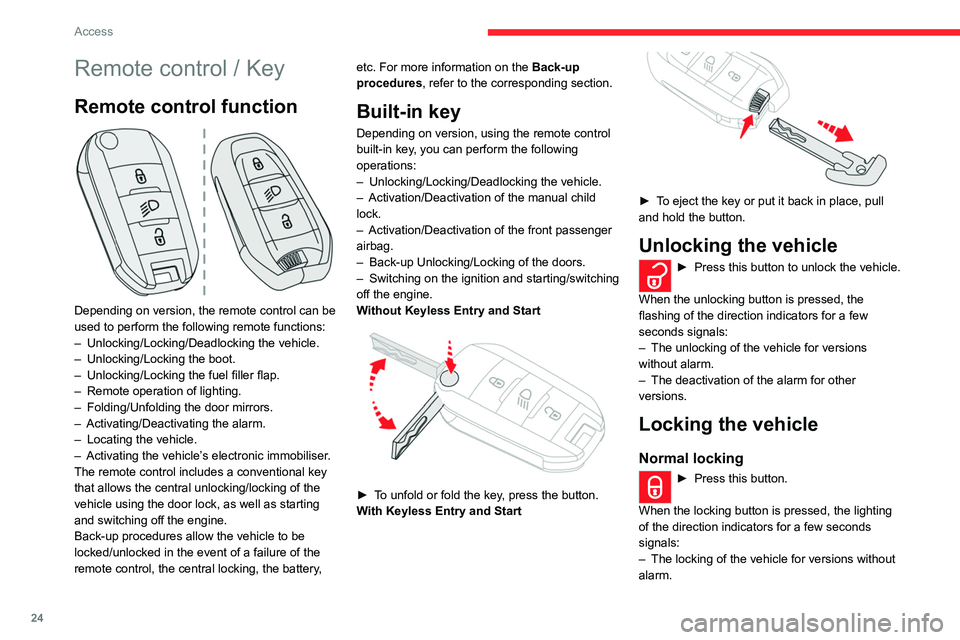
Depending on version, the remote control can be
used to perform the following remote functions:
–
Unlocking/Locking/Deadlocking the vehicle.
–
Unlocking/Locking the boot.
–
Unlocking/Locking the fuel filler flap.
–
Remote operation of lighting.
–
Folding/Unfolding the door mirrors.
–
Activating/Deactivating the alarm.
–
Locating the vehicle.
–
Activating the vehicle’
s electronic immobiliser.
The remote control includes a conventional key
that allows the central unlocking/locking of the
vehicle using the door lock, as well as starting
and switching off the engine.
Back-up procedures allow the vehicle to be
locked/unlocked in the event of a failure of the
remote control, the central locking, the battery, etc. For more information on the Back-up
procedures, refer to the corresponding section.
Built-in key
Depending on version, using the remote control
built-in key, you can perform the following
operations:
–
Unlocking/Locking/Deadlocking the vehicle.
–
Activation/Deactivation of the manual child
lock.
–
Activation/Deactivation of the front passenger
airbag.
–
Back-up Unlocking/Locking of the doors.
–
Switching on the ignition and starting/switching
off the engine.
W
ithout Keyless Entry and Start
► To unfold or fold the key, press the button.
With Keyless Entry and Start
► To eject the key or put it back in place, pull
and hold the button.
Unlocking the vehicle
► Press this button to unlock the vehicle.
When the unlocking button is pressed, the
flashing of the direction indicators for a few
seconds signals:
–
The unlocking of the vehicle for versions
without alarm.
–
The deactivation of the alarm for other
versions.
Locking the vehicle
Normal locking
► Press this button.
When the locking button is pressed, the lighting
of the direction indicators for a few seconds
signals:
–
The locking of the vehicle for versions without
alarm.
– The activation of the alarm for other versions.
If one of the doors or the boot is not fully
closed, the locking does not take place.
However, if the vehicle is equipped with the
alarm, it is fully activated after about 45
seconds.
If the vehicle is unlocked inadvertently and
there is then no action on the doors or boot,
the vehicle will automatically lock itself again
after about 30 seconds. If the alarm was
activated beforehand, the alarm is reactivated
automatically.
Locking also deactivates the central locking
button, located on the dashboard.
Deadlocking
Deadlocking renders the interior door
controls inoperative. It also disables the
central locking button.
The horn remains operational.
Never leave anyone inside the vehicle
when it is deadlocked.
► Press the locking button again within 5
seconds to deadlock the vehicle (confirmed by
the temporary lighting of the direction indicators
for versions without alarm).
Page 27 of 244

25
Access
2– The activation of the alarm for other versions.
If one of the doors or the boot is not fully
closed, the locking does not take place.
However, if the vehicle is equipped with the
alarm, it is fully activated after about 45
seconds.
If the vehicle is unlocked inadvertently and
there is then no action on the doors or boot,
the vehicle will automatically lock itself again
after about 30 seconds. If the alarm was
activated beforehand, the alarm is reactivated
automatically.
Locking also deactivates the central locking
button, located on the dashboard.
Deadlocking
Deadlocking renders the interior door
controls inoperative. It also disables the
central locking button.
The horn remains operational.
Never leave anyone inside the vehicle
when it is deadlocked.
►
Press the locking button again within 5
seconds to deadlock the vehicle (confirmed by
the temporary lighting of the direction indicators
for versions without alarm).
Locating the vehicle
This function helps you to spot your vehicle from
a distance, with the vehicle locked:
–
The sidelamps and dipped beam headlamps
come on for 30 seconds.
► Press this button.
Pressing again before the end of the timed
period switches off the lamps immediately.
Advice
Remote control
The remote control is a sensitive, high-
frequency device; avoid handling it in your
pocket, due to the risk of unintentionally
unlocking the vehicle.
Avoid pressing the remote control buttons
while out of range of the vehicle, due to
the risk of rendering the remote control
inoperative. It would then be necessary to
reset it.
The remote control does not work
when the
key is in the ignition switch, even when the
ignition is switched off.
Anti-theft protection
Do not modify the electronic vehicle
immobiliser, as this might result in
malfunctions.
For vehicles with a key ignition switch,
remember to remove the key and turn the
steering wheel to engage the steering lock.
Locking the vehicle
Driving with the doors locked could make
it more difficult for the emergency services
to enter the passenger compartment in an
emergency.
As a safety precaution, remove the key from
the ignition or take the electronic key with you
when leaving the vehicle, even for a short
time.
Purchasing a second-hand vehicle
Have the key codes memorised by a
CITROËN dealer, to ensure that the keys in
your possession are the only ones able to
start the vehicle.
Keyless Entry and Start
This system allows the unlocking, locking
and starting of the vehicle, while carrying the
Page 87 of 244

85
Driving
6Towing
Driving with a trailer places greater
demands on the towing vehicle and
particular care must be taken.
Do not exceed the maximum towable
weights.
At altitude: reduce the maximum load by
10% per 1,000 metres of altitude; the lower
air density at high altitudes decreases engine
performance.
New vehicle: do not tow a trailer until the
vehicle has driven at least 620 miles
(1,000 kilometres).
If the outside temperature is high, let the
engine idle for 1 to 2 minutes after the
vehicle comes to a stop, to help it to cool.
Before setting off
Nose weight
► Distribute the load in the trailer so that the
heaviest items are as close as possible to the
axle and the nose weight (at the point where it
joins your vehicle) approaches the maximum
permitted without exceeding it.
Tyres
► Check the tyre pressures of the towing
vehicle and of the trailer , observing the
recommended pressures.
Lighting
► Check the electrical signalling on the trailer
and the headlamp beam height of your vehicle.
If a genuine CITROËN towing device is
used, the rear parking sensors will be
deactivated automatically to avoid the audible
signal.
When driving
Cooling
Towing a trailer uphill causes the coolant
temperature to increase. The maximum towable
load depends on the gradient and the exterior
temperature. The fan’s cooling capacity does not
increase with engine speed.
►
Reduce speed and lower the engine speed to
limit the amount of heating produced.
►
Pay constant attention to the coolant
temperature.
If this warning lamp and the STOP
warning lamp come on, stop the vehicle
and switch off the engine as soon as possible.
Brakes
Using the engine brake is recommended to limit
the overheating of the brakes. Braking distances
are increased when towing a trailer.
Side wind
Bear in mind that the vehicle will be more
susceptible to wind when towing.
Anti-theft protection
Electronic immobiliser
The keys contain a code, which must be
recognised by the vehicle before starting is
possible.
If the system malfunctions, indicated by the
display of a message, the engine will not start.
Contact a CITROËN dealer.
For safety and theft protection reasons,
never leave the electronic key in the
vehicle, even when you are close to it.
Page 213 of 244

2 11
Alphabetical index
180° rear vision 11 6
A
ABS 67
Accessories
64
Active Safety Brake
106–108
AdBlue®
15, 133
AdBlue® tank
134
Additive, Diesel
131–132
Adjusting headlamps
59
Adjusting head restraints
36
Adjusting seat
36–37
Adjusting the air distribution
45
Adjusting the air flow
44–45
Adjusting the date
18–19, 23, 182, 204
Adjusting the height and reach of
the steering wheel
41
Adjusting the seat angle
37
Adjusting the seat belt height
71
Adjusting the temperature
44–45
Adjusting the time
18–19, 23, 181, 205
Advice on care and maintenance
135
Advice on driving
7, 84–85
Airbags
73, 75, 77
Airbags, curtain
74–75
Airbags, front
74–75, 77
Airbags, lateral
74–75
Air conditioning
43–44
Air conditioning, automatic
44–45
Air conditioning, manual
44
Air intake 44–45
Air vents
42
Alarm
31–32
Android Auto connection
196
Anti-lock braking system (ABS)
67
Antitheft / Immobiliser
25
Apple CarPlay connection
178, 195
Applications
196
Armrest, front
50
Armrest, rear
51
Assistance call
65
Assistance, emergency braking
67, 108
Audible warning
65
Audio streaming (Bluetooth)
165, 177, 200
B
Battery, 12 V 127, 132, 147–149
Battery, charging
148–149
Battery, remote control
28
Blind
32–34
Blind spot sensors
111
Blinds, side
50
BlueHDi
15, 131, 137
Bluetooth (hands-free)
165–166, 179, 201
Bluetooth (telephone)
179–180, 201–202
Bodywork
136
Bonnet
128–129
Boot
30, 54
Brake discs
133
Brake lamps
146
Brakes 133
Braking assistance system
67
Braking, automatic emergency
106–108
Brightness
181
Bulbs
145
Bulbs (changing)
144–146
C
Cable, audio 199
Cable, Jack
199
Capacity, fuel tank
121–122
Cap, fuel filler
121–122
Care of the bodywork
136
CD
164
CD, MP3
164
Central locking
26, 30
Changing a bulb
144–146
Changing a fuse
147
Changing a wheel
137, 141
Changing a wiper blade
61–62
Changing the remote control battery
28
Charger, induction
48
Charger, wireless
48
Checking the engine oil level
15
Checking the levels
130–131
Checking tyre pressures
(using the kit)
138, 141
Checks
129, 132–133
Checks, routine
132–133
Child lock
83
Page 215 of 244

213
Alphabetical index
Fitting roof bars 127–128
Fittings, boot
52
Fittings, interior
47–48, 50
Fittings, rear
50
Flap, fuel filler
121–122
Flashing indicators
56, 145
Floor, boot, adjustable
52
Fluid, brake
131
Fluid, engine coolant
131
Foglamp, rear
55–56
Foglamps, front
55–56, 59–60, 145
Foglamps, rear
55
Folding the rear seats
38–40
Frequency (radio)
198
Fuel
7, 121
Fuel consumption
7
Fuel tank
121–122
Fuses
147
G
Gauge, fuel 121–122
Gearbox, automatic
90, 92–93, 133, 148
Gearbox, manual
89–90, 93, 132
Gear lever, manual gearbox
89–90
Gear shift indicator ~ Gear efficiency
indicator
92
Glove box
48
G.P.S.
192
Grab handles
50
Grip control
68
H
Hazard warning lamps 64
headlamp adjustment
59
Headlamp adjustment
59
Headlamps, automatic dipping
58–59
Headlamps, automatic illumination
57–58
Headlamps, dipped beam
55, 145
Headlamps, halogen
145
Headlamps, main beam
55, 58, 145
Head restraints, front
36
Head restraints, rear
38–40
Head-up display
98–99
Heating
42, 44
Hill Assist Descent Control (HADC)
69–70
Hill Descent Control
69–70
Hill start assist
93
Hooks
52
Horn
65
I
Ignition 45, 88, 202
Ignition on
88
Ignition switch
86–87
Immobiliser, electronic
85
Indicator, AdBlue® range
15
Indicator, coolant temperature
14
Indicator, engine oil level
15
Indicators, direction
56
Inflating tyres
133, 158
Inflating tyres and accessories
(using the kit)
138, 141
Infrared camera
97
Instrument panel
8, 8–9, 98
Instrument panel, matrix
8
Instrument panels
8
Internet browser
193, 196
ISOFIX mountings
78, 80, 82
J
Jack 138, 141, 199
Jump starting
148
K
Key 24–27
Key, electronic
25–26
Keyless Entry and Starting
25–26, 85, 87–88
Key not recognised
88–89
Key with remote control
24, 85–86
Kit, hands-free
165–166, 179, 201
Kit, puncture repair
138
Kit, temporary puncture repair
137–139, 141
L
Labels 5
Labels, identification
157