2023 CHEVROLET BLAZER overheating
[x] Cancel search: overheatingPage 259 of 360

Chevrolet Blazer Owner Manual (GMNA-Localizing-U.S./Canada/Mexico-
16401961) - 2023 - CRC - 5/17/22
258 Vehicle Care
Caution
If the air cleaner/filter is off, dirt can
easily get into the engine, which could
damage it. Always have the air cleaner/
filter in place when driving.
Cooling System
The cooling system allows the engine to
maintain the correct working temperature.
2.0L L4 Engine
1. Engine Cooling Fan (Out of View)
2. Engine Coolant Surge Tank andPressure Cap
3.6L V6 Engine
1. Engine Cooling Fan (Out of View)
2. Engine Coolant Surge Tank andPressure Cap
{Warning
An underhood electric fan can start up
even when the engine is not running and
can cause injury. Keep hands, clothing,
and tools away from any underhood
electric fan.
{Warning
Do not touch heater or radiator hoses,
or other engine parts. They can be very
hot and can burn you. Do not run the
engine if there is a leak; all coolant could
leak out. That could cause an engine fire
and can burn you. Fix any leak before
driving the vehicle.
Engine Coolant
The cooling system in the vehicle is filled
with DEX-COOL engine coolant. This coolant
needs to be checked and replaced at
appropriate intervals. See Maintenance
Schedule 0317.
The following explains the cooling system
and how to check and add coolant when it
is low. If there is a problem with engine
overheating, see Engine Overheating 0261.
What to Use
{Warning
Do not touch heater or radiator hoses,
or other engine parts. They can be very
hot and can burn you. Do not run the
(Continued)
Page 260 of 360

Chevrolet Blazer Owner Manual (GMNA-Localizing-U.S./Canada/Mexico-
16401961) - 2023 - CRC - 5/17/22
Vehicle Care 259
Warning (Continued)
engine if there is a leak; all coolant could
leak out. That could cause an engine fire
and can burn you. Fix any leak before
driving the vehicle.
Use a 50/50 mixture of clean, drinkable
water and DEX-COOL coolant. This mixture:
.Gives freezing protection down to −37 °C
(−34 °F), outside temperature.
.Gives boiling protection up to 129 °C
(265 °F), engine temperature.
.Protects against rust and corrosion.
.Will not damage aluminum parts.
.Helps keep the proper engine
temperature.
Caution
Do not use anything other than a mix of
DEX-COOL coolant that meets GM
Standard GMW3420 and clean, drinkable
water. Anything else can cause damage
to the engine cooling system and the
vehicle, which would not be covered by
the vehicle warranty. Never dispose of engine coolant by putting
it in the trash, or by pouring it on the
ground or into sewers, streams, or bodies of
water. Have the coolant changed by an
authorized service center, familiar with legal
requirements regarding used coolant
disposal. This will help protect the
environment and your health.
Checking Coolant
The vehicle must be on a level surface when
checking the coolant level.
Check to see if coolant is visible in the
coolant surge tank. If the coolant inside the
coolant surge tank is boiling, do not do
anything else until it cools down. See
Engine
Overheating 0261. The coolant surge tank is in the engine
compartment on the driver side of the
vehicle. See
Engine Compartment Overview
0 250.
How to Add Coolant to the Coolant
Surge Tank
{Warning
Spilling coolant on hot engine parts can
burn you. Coolant contains ethylene
glycol and it will burn if the engine parts
are hot enough.
{Warning
Steam and scalding liquids from a hot
cooling system are under pressure.
Turning the pressure cap, even a little,
can cause them to come out at high
speed and you could be burned. Never
turn the cap when the cooling system,
including the pressure cap, is hot. Wait
for the cooling system and pressure cap
to cool.
Page 262 of 360

Chevrolet Blazer Owner Manual (GMNA-Localizing-U.S./Canada/Mexico-
16401961) - 2023 - CRC - 5/17/22
Vehicle Care 261
6. Verify coolant level after the engine isshut off and the coolant is cold.
If necessary, repeat coolant fill procedure
Steps 1–6.
If the coolant still is not at the proper
level when the system cools down again,
see your dealer.
Caution
If the pressure cap is not tightly installed,
coolant loss and engine damage may
occur. Be sure the cap is properly and
tightly secured.
2.0L L4 Engine Only - Automatic Coolant
Service Fill Instructions
If equipped, this feature assists in filling and
removing air from the cooling system after
service of components or when coolant is
added after being too low.
To activate the fill and air removal process:
1. With a cold system, add coolant to the indicated mark on the surge tank.
2. Replace the cap on the surge tank.
3. Connect the vehicle to a battery charger.
4. Turn the ignition to Service Mode. See Ignition Positions 0192. 5. Turn off the air conditioning.
6. Set the parking brake.
7. At the same time, press the accelerator
and the brake for two seconds, then
release.
At the end of the cycle, check the coolant
level in the surge tank and add coolant if it
is low. Turn off the vehicle, allow the
Electronic Control Module (ECM) to go to
sleep, about two minutes, and repeat
Steps 4–7.
Listen for pump activation and movement of
the control valves while watching the level
of the coolant in the surge tank. If the tank
empties, turn the ignition off, carefully
remove the surge tank cap, refill to the
indicated mark, and repeat Steps 4–7. The
fill and air removal process will run for
approximately 10 minutes.
Engine Overheating
The vehicle has several indicators to warn of
the engine overheating.
There is an engine coolant temperature
gauge on the instrument cluster. See Engine
Coolant Temperature Gauge 097. The
vehicle may also display a message on the
Driver Information Center (DIC). If the decision is made not to lift the hood
when this warning appears, get service help
right away. See
Roadside Assistance Program
0 332.
If the decision is made to lift the hood,
make sure the vehicle is parked on a level
surface. Then check to see if the engine
cooling fan is running. If the engine is
overheating, the fan should be running. If it
is not, do not continue to run the engine.
Have the vehicle serviced.
Caution
Do not run the engine if there is a leak
in the engine cooling system. This can
cause a loss of all coolant and can
damage the system and vehicle. Have
any leaks fixed right away.
If Steam Is Coming from the Engine
Compartment
{Warning
Steam and scalding liquids from a hot
cooling system are under pressure.
Turning the pressure cap, even a little,
can cause them to come out at high (Continued)
Page 278 of 360
Chevrolet Blazer Owner Manual (GMNA-Localizing-U.S./Canada/Mexico-
16401961) - 2023 - CRC - 5/17/22
Vehicle Care 277
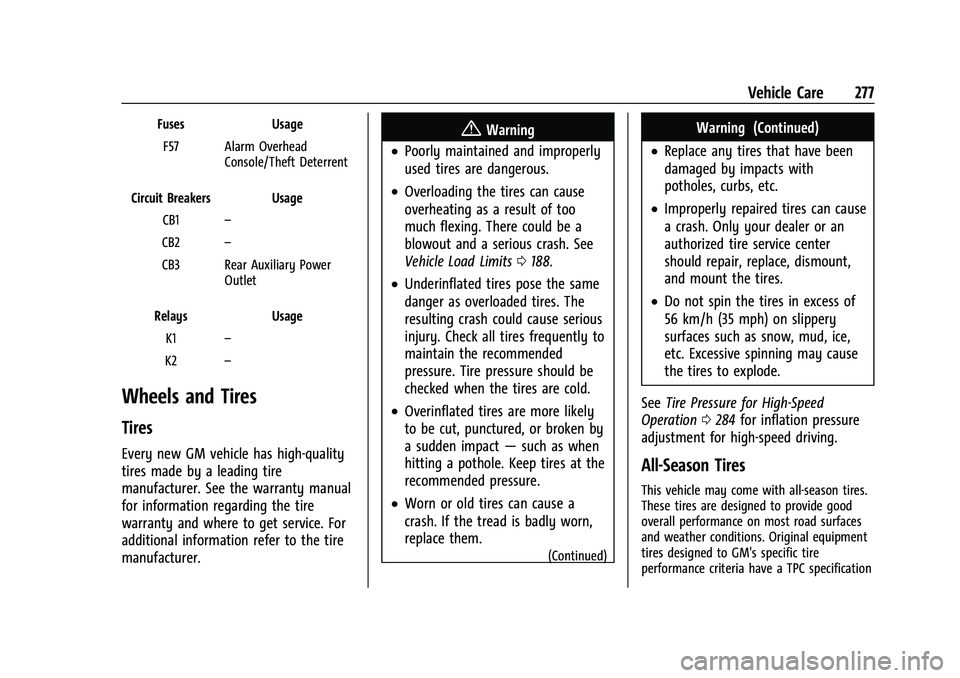
FusesUsage
F57 Alarm Overhead Console/Theft Deterrent
Circuit Breakers Usage CB1 –
CB2 –
CB3 Rear Auxiliary Power Outlet
Relays Usage
K1 –
K2 –
Wheels and Tires
Tires
Every new GM vehicle has high-quality
tires made by a leading tire
manufacturer. See the warranty manual
for information regarding the tire
warranty and where to get service. For
additional information refer to the tire
manufacturer.
{Warning
.Poorly maintained and improperly
used tires are dangerous.
.Overloading the tires can cause
overheating as a result of too
much flexing. There could be a
blowout and a serious crash. See
Vehicle Load Limits 0188.
.Underinflated tires pose the same
danger as overloaded tires. The
resulting crash could cause serious
injury. Check all tires frequently to
maintain the recommended
pressure. Tire pressure should be
checked when the tires are cold.
.Overinflated tires are more likely
to be cut, punctured, or broken by
a sudden impact —such as when
hitting a pothole. Keep tires at the
recommended pressure.
.Worn or old tires can cause a
crash. If the tread is badly worn,
replace them.
(Continued)
Warning (Continued)
.Replace any tires that have been
damaged by impacts with
potholes, curbs, etc.
.Improperly repaired tires can cause
a crash. Only your dealer or an
authorized tire service center
should repair, replace, dismount,
and mount the tires.
.Do not spin the tires in excess of
56 km/h (35 mph) on slippery
surfaces such as snow, mud, ice,
etc. Excessive spinning may cause
the tires to explode.
See Tire Pressure for High-Speed
Operation 0284 for inflation pressure
adjustment for high-speed driving.
All-Season Tires
This vehicle may come with all-season tires.
These tires are designed to provide good
overall performance on most road surfaces
and weather conditions. Original equipment
tires designed to GM's specific tire
performance criteria have a TPC specification
Page 284 of 360

Chevrolet Blazer Owner Manual (GMNA-Localizing-U.S./Canada/Mexico-
16401961) - 2023 - CRC - 5/17/22
Vehicle Care 283
Tire Pressure
Tires need the correct amount of air
pressure to operate effectively.
{Warning
Neither tire underinflation nor
overinflation is good. Underinflated
tires, or tires that do not have
enough air, can result in:
.Tire overloading and overheating,
which could lead to a blowout
.Premature or irregular wear
.Poor handling
.Reduced fuel economy for
internal combustion engine
vehicles
.Reduced range for electric vehicles
(Continued)
Warning (Continued)
Overinflated tires, or tires that have
too much air, can result in:
.Unusual wear
.Poor handling
.Rough ride
.Needless damage from road
hazards
The Tire and Loading Information label
on the vehicle indicates the original
equipment tires and the correct cold
tire inflation pressures. The
recommended pressure is the minimum
air pressure needed to support the
vehicle's maximum load carrying
capacity. See Vehicle Load Limits 0188. How the vehicle is loaded affects
vehicle handling and ride comfort.
Never load the vehicle with more
weight than it was designed to carry.
When to Check
Check the pressure of the tires once a
month or more. Do not forget the
spare, if the vehicle has one. The
compact spare cold tire pressure should
be at 420 kPa (60 psi). See
Compact
Spare Tire 0301.
How to Check
Use a good quality pocket-type gauge
to check tire pressure. Proper tire
inflation cannot be determined by
looking at the tire. Check the tire
inflation pressure when the tires are
cold, meaning the vehicle has not been
driven for at least three hours or no
more than 1.6 km (1 mi).
Page 352 of 360

Chevrolet Blazer Owner Manual (GMNA-Localizing-U.S./Canada/Mexico-
16401961) - 2023 - CRC - 5/17/22
Index 351
Driving (cont'd)Impaired . . . . . . . . . . . . . . . . . . . . . . . . . . . . . . . 180
Loss of Control . . . . . . . . . . . . . . . . . . . . . . . . 182
Off-Road . . . . . . . . . . . . . . . . . . . . . . . . . . . . . . . 182
Off-Road Recovery . . . . . . . . . . . . . . . . . . . . . . 181
Vehicle Load Limits . . . . . . . . . . . . . . . . . . . . 188
Wet Roads . . . . . . . . . . . . . . . . . . . . . . . . . . . . . 185
Winter . . . . . . . . . . . . . . . . . . . . . . . . . . . . . . . . . 187
Dual Automatic Climate Control System . . . . . 173
E
ElectricBrake Boost . . . . . . . . . . . . . . . . . . . . . . . . . . . . 202
Parking Brake . . . . . . . . . . . . . . . . . . . . . . . . . . 203
Parking Brake Light . . . . . . . . . . . . . . . . . . . . 103
Electrical
Equipment, Add-On . . . . . . . . . . . . . . . . . . . . 245
System Overload . . . . . . . . . . . . . . . . . . . . . . 268
Electrical System Engine Compartment Fuse Block . . . . . . . 270
Fuses and Circuit Breakers . . . . . . . . . . . . . 269
Instrument Panel Fuse Block . . . . . . . . . . . 273
Rear Compartment Fuse Block . . . . . . . . . 275
Emergency OnStar . . . . . . . . . . . . . . . . . . . . . . . . . . . . . . . . . 341
Engine Air Cleaner/Filter . . . . . . . . . . . . . . . . . . . . . . 256 Engine (cont'd)
Air Filter Life System . . . . . . . . . . . . . . . . . . 256
Check Light (Malfunction Indicator) . . . . 101
Compartment Overview . . . . . . . . . . . . . . . . 250
Coolant Temperature Gauge . . . . . . . . . . . . 97
Coolant Temperature Warning
Light . . . . . . . . . . . . . . . . . . . . . . . . . . . . . . . . . 106
Cooling System . . . . . . . . . . . . . . . . . . . . . . . . 258
Drive Belt Routing . . . . . . . . . . . . . . . . . . . . . 328
Exhaust . . . . . . . . . . . . . . . . . . . . . . . . . . . . . . . . 198
Heater . . . . . . . . . . . . . . . . . . . . . . . . . . . . . . . . . 195
Oil Life System . . . . . . . . . . . . . . . . . . . . . . . . 255
Oil Pressure Light . . . . . . . . . . . . . . . . . . . . . . 107
Oil Temperature Gauge . . . . . . . . . . . . . . . . . 97
Overheating . . . . . . . . . . . . . . . . . . . . . . . . . . . 261
Power Messages . . . . . . . . . . . . . . . . . . . . . . . . 114
Running While Parked . . . . . . . . . . . . . . . . . 199
Starting . . . . . . . . . . . . . . . . . . . . . . . . . . . . . . . . 193
Entry Lighting . . . . . . . . . . . . . . . . . . . . . . . . . . . . 123
Equipment, Towing . . . . . . . . . . . . . . . . . . . . . . .241
Event Data Recorders . . . . . . . . . . . . . . . . . . . . 339
Exit Lighting . . . . . . . . . . . . . . . . . . . . . . . . . . . . . . 123
Extended Parking . . . . . . . . . . . . . . . . . . . . . . . . 198
Extender, Seat Belt . . . . . . . . . . . . . . . . . . . . . . . . 51
Exterior Lamp Controls . . . . . . . . . . . . . . . . . . . . . . . . . . 118
Lamps Off Reminder . . . . . . . . . . . . . . . . . . . . 119
Lighting Battery Saver . . . . . . . . . . . . . . . . . 124
F
Filter
Engine Air Cleaner . . . . . . . . . . . . . . . . . . . . . 256
Flash-to-Pass . . . . . . . . . . . . . . . . . . . . . . . . . . . . . 120
Flashers, Hazard Warning . . . . . . . . . . . . . . . . . 121
Flat Tire . . . . . . . . . . . . . . . . . . . . . . . . . . . . . . . . . 295 Changing . . . . . . . . . . . . . . . . . . . . . . . . . . . . . . 296
Floor Mats . . . . . . . . . . . . . . . . . . . . . . . . . . . . . . . .314
Fluid Automatic Transmission . . . . . . . . . . . . . . . 255
Brakes . . . . . . . . . . . . . . . . . . . . . . . . . . . . . . . . . 263
Washer . . . . . . . . . . . . . . . . . . . . . . . . . . . . . . . . 262
Folding Mirrors . . . . . . . . . . . . . . . . . . . . . . . . . . . .27
Forward Collision Alert (FCA) System . . . . . . . . . . . 223
Frequency Statement Radio . . . . . . . . . . . . . . . . . . . . . . . . . . . . . . . . . . 337
Front Heated and Ventilated Seats . . . . . . . . . . . . 41
Pedestrian Braking (FPB) System . . . . . . . 227
Front Seats Adjustment . . . . . . . . . . . . . . . . . . . . . . . . . . . . . 36
Fuel Additives . . . . . . . . . . . . . . . . . . . . . . . . . . . . . . 233
Economy, Driving for Better . . . . . . . . . . . 179
Filling a Portable Fuel Container . . . . . . . 235
Filling the Tank . . . . . . . . . . . . . . . . . . . . . . . . 233
Foreign Countries . . . . . . . . . . . . . . . . . . . . . . 233
Page 355 of 360

Chevrolet Blazer Owner Manual (GMNA-Localizing-U.S./Canada/Mexico-
16401961) - 2023 - CRC - 5/17/22
354 Index
Locks (cont'd)Lockout Protection . . . . . . . . . . . . . . . . . . . . . . . 17
Power Door . . . . . . . . . . . . . . . . . . . . . . . . . . . . . . 17
Safety . . . . . . . . . . . . . . . . . . . . . . . . . . . . . . . . . . 18
Loss of Control . . . . . . . . . . . . . . . . . . . . . . . . . . .182
Low Fuel Warning Light . . . . . . . . . . . . . . . . . 107
Lower Anchors and Tethers for Children (LATCH System) . . . . . . . . . . . . . . . . 68
Lumbar Adjustment . . . . . . . . . . . . . . . . . . . . . . . 39 Front Seats . . . . . . . . . . . . . . . . . . . . . . . . . . . . . 39
M
MaintenanceRecords . . . . . . . . . . . . . . . . . . . . . . . . . . . . . . . . 324
Maintenance Schedule . . . . . . . . . . . . . . . . . . . . 317 Recommended Fluids andLubricants . . . . . . . . . . . . . . . . . . . . . . . . . . . . 321
Malfunction Indicator Lamp . . . . . . . . . . . . . . .101
Manual Mode . . . . . . . . . . . . . . . . . . . . . . . . . . . . . . . . . . 201
Map Data Updates . . . . . . . . . . . . . . . . . . . . . . . 149
Maps . . . . . . . . . . . . . . . . . . . . . . . . . . . . . . . . . . . . . 141
Media Avoiding Untrusted Devices . . . . . . . . . . . . 134
Memory Seats . . . . . . . . . . . . . . . . . . . . . . . . . . . . 39
Messages Engine Power . . . . . . . . . . . . . . . . . . . . . . . . . . . 114
Vehicle . . . . . . . . . . . . . . . . . . . . . . . . . . . . . . . . . 114 Messages (cont'd)
Vehicle Speed . . . . . . . . . . . . . . . . . . . . . . . . . . . 115
Mirrors Automatic Dimming . . . . . . . . . . . . . . . . . . . . 27
Automatic Dimming Rearview . . . . . . . . . . 27
Convex . . . . . . . . . . . . . . . . . . . . . . . . . . . . . . . . . 26
Folding . . . . . . . . . . . . . . . . . . . . . . . . . . . . . . . . . 27
Heated . . . . . . . . . . . . . . . . . . . . . . . . . . . . . . . . . 27
Interior Rearview . . . . . . . . . . . . . . . . . . . . . . . 27
Manual Rearview . . . . . . . . . . . . . . . . . . . . . . . 27
Power . . . . . . . . . . . . . . . . . . . . . . . . . . . . . . . . . . 26
Rear Camera . . . . . . . . . . . . . . . . . . . . . . . . . . . . 27
Tilt in Reverse . . . . . . . . . . . . . . . . . . . . . . . . . . 27
Mode Driver Control . . . . . . . . . . . . . . . . . . . . . . . . . 206
Monitor System, Tire Pressure . . . . . . . . . . . 285
Multi-band Antenna . . . . . . . . . . . . . . . . . . . . . .134
Multi-Point Vehicle Inspection (MPVI) . . . . 319
N
Navigation Connected Services . . . . . . . . . . . . . . . . . . . . 345
Destination . . . . . . . . . . . . . . . . . . . . . . . . . . . . 142
Symbols . . . . . . . . . . . . . . . . . . . . . . . . . . . . . . . . 141
Using the System . . . . . . . . . . . . . . . . . . . . . . 138
New Vehicle Break-In . . . . . . . . . . . . . . . . . . . . . 191
O
Odometer . . . . . . . . . . . . . . . . . . . . . . . . . . . . . . . . 95 Odometer (cont'd)
Trip . . . . . . . . . . . . . . . . . . . . . . . . . . . . . . . . . . . . . 96
Off-Road Driving . . . . . . . . . . . . . . . . . . . . . . . . . . . . . . . . 182
Recovery . . . . . . . . . . . . . . . . . . . . . . . . . . . . . . . . 181
Oil Engine . . . . . . . . . . . . . . . . . . . . . . . . . . . . . . . . . 253
Engine Oil Life System . . . . . . . . . . . . . . . . . 255
Pressure Light . . . . . . . . . . . . . . . . . . . . . . . . . 107
Older Children, Restraints . . . . . . . . . . . . . . . . . 62
Online Account . . . . . . . . . . . . . . . . . . . . . . . . . . . 331
OnStar . . . . . . . . . . . . . . . . . . . . . . . . . . . . . . . . . . . 339 Additional Information . . . . . . . . . . . . . . . . . 342
Overview . . . . . . . . . . . . . . . . . . . . . . . . . . . . . . 340
OnStar Emergency . . . . . . . . . . . . . . . . . . . . . . . .341
OnStar Security . . . . . . . . . . . . . . . . . . . . . . . . . . .341
Outlets Power . . . . . . . . . . . . . . . . . . . . . . . . . . . . . . . . . . 88
Overheating, Engine . . . . . . . . . . . . . . . . . . . . . 261
Overview . . . . . . . . . . . . . . . . . . . . . . . . . . . . . . . . 126 Instrument Panel . . . . . . . . . . . . . . . . . . . . . . . . 4
P
Park
Assist . . . . . . . . . . . . . . . . . . . . . . . . . . . . . . 218, 221
Shifting Into . . . . . . . . . . . . . . . . . . . . . . . . . . . 196
Shifting Out of . . . . . . . . . . . . . . . . . . . . . . . . 197