2023 CADILLAC XT4 weight
[x] Cancel search: weightPage 236 of 476

Cadillac XT4 Owner Manual (GMNA-Localizing-U.S./Canada/Mexico-
16412876) - 2023 - CRC - 3/25/22
Driving and Operating 235
.Do not damage shrubs,
flowers, trees, or grasses or
disturb wildlife.
.Do not park over things that
burn. See Parking over
Things That Burn0255.
Driving on Hills
Driving safely on hills requires
good judgment and an
understanding of what the
vehicle can and cannot do.
{Warning
Many hills are simply too
steep for any vehicle. Driving
up hills can cause the vehicle
to stall. Driving down hills
can cause loss of control.
Driving across hills can
cause a rollover. You could
be injured or killed. Do not
drive on steep hills.
Before driving on a hill, assess
the steepness, traction, and
obstructions. If the terrain ahead cannot be seen, get out
of the vehicle and walk the hill
before driving further.
When driving on hills:
.Use a low gear and keep a
firm grip on the steering
wheel.
.Maintain a slow speed.
.When possible, drive straight
up or down the hill.
.Slow down when
approaching the top of
the hill.
{Warning
Driving to the top of a hill at
high speed can cause a
crash. There could be a
drop-off, embankment, cliff,
or even another vehicle. You
could be seriously injured or
killed. As you near the top of
a hill, slow down and stay
alert.
.Use headlamps even during
the day to make the vehicle
more visible.
.Never go downhill forward
or backward with the
transmission in N (Neutral).
The brakes could overheat
and you could lose control.
.When driving down a hill,
keep the vehicle headed
straight down. Use a low
gear because the engine will
work with the brakes to slow
the vehicle and help keep
the vehicle under control.
{Warning
Heavy braking when going
down a hill can cause your
brakes to overheat and fade.
This could cause loss of
control and you or others
could be injured or killed.
Apply the brakes lightly
when descending a hill and
use a low gear to keep
vehicle speed under control.
.Avoid turns that take the
vehicle across the incline of
the hill. Driving across an
incline puts more weight on
Page 243 of 476
Cadillac XT4 Owner Manual (GMNA-Localizing-U.S./Canada/Mexico-
16412876) - 2023 - CRC - 3/25/22
242 Driving and Operating
the forward and reverse
directions causes a rocking
motion that could free the
vehicle. If that does not get
the vehicle out after a few
tries, it might need to be
towed out. If the vehicle does
need to be towed out, see
Transporting a Disabled
Vehicle0407.
Vehicle Load Limits
It is very important to know
how much weight the
vehicle can carry. This
weight is called the vehicle
capacity weight and
includes the weight of all
occupants, cargo, and all
nonfactory-installed
options. Two labels on the
vehicle may show how
much weight it may
properly carry, the Tire and
Loading Information label
and the Certification/Tire
label.
{Warning
Do not load the vehicle
any heavier than the
Gross Vehicle Weight
Rating (GVWR), or either
the maximum front or
rear Gross Axle Weight
Rating (GAWR). This can
cause systems to break
and change the way the
vehicle handles. This
could cause loss of
control and a crash.
Overloading can also
reduce stopping
performance, damage the
tires, and shorten the life
of the vehicle.Tire and Loading Information
Label
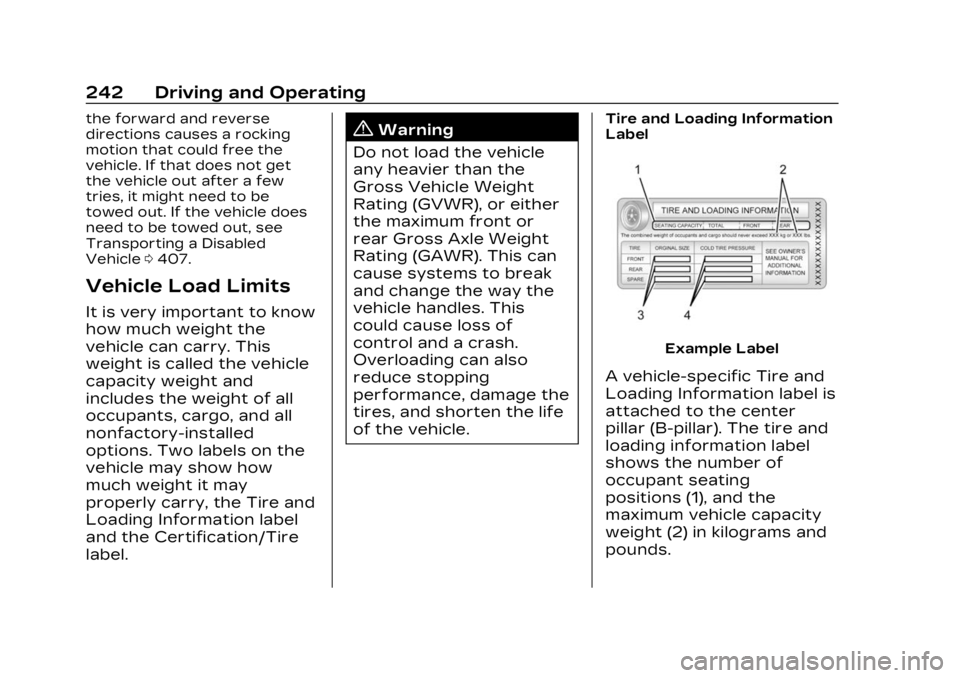
Example Label
A vehicle-specific Tire and
Loading Information label is
attached to the center
pillar (B-pillar). The tire and
loading information label
shows the number of
occupant seating
positions (1), and the
maximum vehicle capacity
weight (2) in kilograms and
pounds.
Page 244 of 476

Cadillac XT4 Owner Manual (GMNA-Localizing-U.S./Canada/Mexico-
16412876) - 2023 - CRC - 3/25/22
Driving and Operating 243
The Tire and Loading
Information label also
shows the size of the
original equipment tires (3)
and the recommended cold
tire inflation pressures (4).
For more information on
tires and inflation see Tires
0364 and
Tire Pressure 0372.
There is also important
loading information on the
vehicle Certification/Tire
label. It may show the
Gross Vehicle Weight
Rating (GVWR) and the
Gross Axle Weight Rating
(GAWR) for the front and
rear axle. See
“Certification/Tire Label”
later in this section.
“Steps for Determining
Correct Load Limit– 1.
Locate the statement
"The combined weight
of occupants and cargo should never exceed
XXX kg or XXX lbs." on
your vehicle’s placard.
2.Determine the combined
weight of the driver and
passengers that will be
riding in your vehicle.
3.Subtract the combined
weight of the driver and
passengers from
XXX kg or XXX lbs.
4.The resulting figure
equals the available
amount of cargo and
luggage load capacity.
For example, if the
"XXX" amount equals
1400 lbs. and there will
be five 150 lb
passengers in your
vehicle, the amount of
available cargo and
luggage load capacity is
650 lbs. (1400-750 (5 x
150) = 650 lbs.)
5.Determine the combined
weight of luggage and
cargo being loaded on
the vehicle. That weight
may not safely exceed
the available cargo and
luggage load capacity
calculated in Step 4.
6.If your vehicle will be
towing a trailer, load
from your trailer will be
transferred to your
vehicle. Consult this
manual to determine
how this reduces the
available cargo and
luggage load capacity of
your vehicle.”
See Trailer Towing 0318
for important information
on towing a trailer, towing
safety rules and
trailering tips.
Page 245 of 476

Cadillac XT4 Owner Manual (GMNA-Localizing-U.S./Canada/Mexico-
16412876) - 2023 - CRC - 3/25/22
244 Driving and Operating
Example 1
1.Vehicle Capacity
Weight for Example 1 =
453 kg (1,000 lbs).
2.Subtract Occupant
Weight @ 68 kg
(150 lbs) × 2 = 136 kg
(300 lbs).
3.Available Occupant and
Cargo Weight = 317 kg
(700 lbs).
Example 2
1.Vehicle Capacity
Weight for Example 2 =
453 kg (1,000 lbs).
2.Subtract Occupant
Weight @ 68 kg
(150 lbs) × 5 = 340 kg
(750 lbs).
3.Available Cargo Weight
= 113 kg (250 lbs).
Example 3
1.Vehicle Capacity
Weight for Example 3 =
453 kg (1,000 lbs).
2.Subtract Occupant
Weight @ 91 kg
(200 lbs) × 5 = 453 kg
(1,000 lbs).
3.Available Cargo Weight
= 0 kg (0 lbs).
Refer to the vehicle's tire
and loading information
label for specific
information about the
vehicle's capacity weight
Page 246 of 476

Cadillac XT4 Owner Manual (GMNA-Localizing-U.S./Canada/Mexico-
16412876) - 2023 - CRC - 3/25/22
Driving and Operating 245
and seating positions. The
combined weight of the
driver, passengers, and
cargo should never exceed
the vehicle's capacity
weight.
Certification/Tire Label
Label Example
A vehicle-specific
Certification/Tire label is
attached to the center
pillar (B-pillar).
The label may show the
size of the vehicle's original
tires and the inflationpressures needed to obtain
the gross weight capacity
of the vehicle. The label
shows the gross weight
capacity of the vehicle. This
is called the Gross Vehicle
Weight Rating (GVWR). The
GVWR includes the weight
of the vehicle, all
occupants, fuel, and cargo.
The Certification/Tire label
may also show the
maximum weights for the
front and rear axles, called
the Gross Axle Weight
Rating (GAWR). To find out
the actual loads on the
front and rear axles, weigh
the vehicle at a weigh
station. Your dealer can
help with this. Be sure to
spread the load equally on
both sides of the
centerline.
Caution
Overloading the vehicle may
cause damage. Repairs
would not be covered by the
vehicle warranty. Do not
overload the vehicle.
{Warning
Things inside the vehicle
can strike and injure
people in a sudden stop
or turn, or in a crash.
.Put things in the cargo
area of the vehicle. In
the cargo area, put
them as far forward as
possible. Try to spread
the weight evenly.
.Never stack heavier
things, like suitcases,
inside the vehicle so
that some of them are
above the tops of the
seats.
(Continued)
Page 319 of 476

Cadillac XT4 Owner Manual (GMNA-Localizing-U.S./Canada/Mexico-
16412876) - 2023 - CRC - 3/25/22
318 Driving and Operating
cooling system, and brake
system before and during
each trip.
Check periodically that all nuts
and bolts on the trailer hitch
are tight.
Engine Cooling When
Trailer Towing
The cooling system may
temporarily overheat during
severe operating conditions.
See Engine Overheating0342.
Trailer Towing
Caution
Towing a trailer improperly
can damage the vehicle and
result in costly repairs not
covered by the vehicle
warranty. To tow a trailer
correctly, follow the
directions in this section and
see your dealer for
important information about
towing a trailer with the
vehicle. Trailering is different than just
driving the vehicle by itself.
Trailering means changes in
handling, acceleration, braking,
durability, and fuel economy.
Successful, safe trailering
takes correct equipment, and
it has to be used properly.
The following information has
many time-tested, important
trailering tips and safety rules.
Many of these are important
for your safety and that of
your passengers. Read this
section carefully before pulling
a trailer.Trailer Weight
{Warning
Never exceed the towing
capacity for your vehicle.
Safe trailering requires
monitoring the weight, speed,
altitude, road grades, outside
temperature, dimensions of
the front of the trailer, and
how frequently the vehicle is
used to tow a trailer.
Trailer Weight Ratings
When towing a trailer, the
combined weight of the
vehicle, vehicle contents,
trailer, and trailer contents
must be below all of the
maximum weight ratings for
the vehicle including:
.Gross Combined Weight
Rating (GCWR)
.Gross Vehicle Weight
Rating (GVWR)
.Maximum Trailer Weight
Rating
.Gross Axle Weight
Rating-Rear (GAWR-RR)
.Maximum Trailer Tongue
Weight Rating
Page 320 of 476
Cadillac XT4 Owner Manual (GMNA-Localizing-U.S./Canada/Mexico-
16412876) - 2023 - CRC - 3/25/22
Driving and Operating 319
See“Weight-Distributing Hitch
Adjustment” under Towing
Equipment 0322 to determine
if equalizer bars are required
to obtain the maximum trailer
weight rating.
See “Trailer Brakes” under
Towing Equipment 0322 to
determine if brakes are
required based on the trailer
weight.
The only way to be sure the
weight is not exceeding any of
these ratings is to weigh the
tow vehicle and trailer
combination, fully loaded for
the trip, getting individual
weights for each of these
items.
{Warning
You and others could be
seriously injured or killed if
the trailer is too heavy or
the trailer brakes are
inadequate for the load. The
vehicle may be damaged,
(Continued)
Warning (Continued)
and the repairs would not be
covered by the vehicle
warranty.
Only tow a trailer if all the
steps in this section have
been followed. Ask your
dealer for advice and
information about towing a
trailer.
Gross Combined Weight
Rating (GCWR)
GCWR is the total allowable
weight of the completely
loaded vehicle and trailer
including any fuel, passengers,
cargo, equipment, and
accessories. Do not exceed
the GCWR for your vehicle.
The GCWR for the vehicle is
on the Tow Rating Chart
following.
Gross Vehicle Weight
Rating (GVWR)
For information about the
vehicle's maximum load
capacity, see Vehicle Load
Limits0242. When calculating
the GVWR with a trailer
attached, the trailer tongue
weight must be included as
part of the weight the vehicle
is carrying.
Maximum Trailer Weight
The maximum trailer weight
rating is calculated assuming
the tow vehicle has a driver, a
front seat passenger, and all
required trailering equipment.
This value represents the
heaviest trailer the vehicle can
tow, but it may be necessary
to reduce the trailer weight to
stay within the GCW, GVWR,
maximum trailer tongue load,
or GAWR-RR for the vehicle.
Use the tow rating chart to
determine how much the
trailer can weigh, based on the
vehicle model and options.
Page 321 of 476

Cadillac XT4 Owner Manual (GMNA-Localizing-U.S./Canada/Mexico-
16412876) - 2023 - CRC - 3/25/22
320 Driving and Operating
VehicleMaximum Trailer
Weight GCWR* Maximum
Tongue Weight
2.0L L4 Gas Engine (LSY) 1 134 kg (2,500 lb) 3 150 kg (6,945 lb) 113 kg (250 lb)
2.0L L4 Gas Engine (LSY) with
Heavy Duty Cooling System (V08) 1 588 kg (3,500 lb) 3 600 kg
(7,936 lb)159 kg (350 lb)
*The Gross Combination Weight Rating (GCWR) is the total allowable weight of the completely
loaded vehicle and trailer including any passengers, cargo, equipment, and conversions. The
GCWR for the vehicle should not be exceeded.
Maximum Trailer Tongue
Weight Rating
The Maximum Trailer Tongue
Weight Rating is the allowable
trailer tongue weight that the
vehicle can support using a
conventional trailer hitch.
It may be necessary to reduce
the overall trailer weight to
stay within the maximum
trailer tongue weight rating
while still maintaining the
correct trailer load balance.
The trailer tongue weight
contributes to the Gross
Vehicle Weight (GVW). GVW
includes the curb weight of
your vehicle, any passengers, cargo, equipment and the
trailer tongue weight. Vehicle
options, passengers, cargo,
and equipment reduce the
maximum allowable tongue
weight the vehicle can carry,
which also reduces the
maximum allowable trailer
weight.
Trailer Load Balance
The correct trailer load
balance must be maintained to
ensure trailer stability.
Incorrect load balance is a
leading cause of trailer sway.