2023 CADILLAC LYRIC brakes
[x] Cancel search: brakesPage 202 of 424
Cadillac Lyriq Owner Manual (GMNA-Localizing-U.S./Canada-15644413) -
2023 - CRC - 2/23/22
Driving and Operating 201
Winter Driving
Driving on Snow or IceCaution
To avoid damage to the
wheels and brake
components, always clear
snow and ice from inside the
wheels and underneath the
vehicle before driving.
Snow or ice between the tires
and the road creates less
traction or grip, so drive
carefully. Wet ice can occur at
about 0°C (32°F) when
freezing rain begins to fall.
Avoid driving on wet ice or in
freezing rain until roads can be
treated.
For Slippery Road Driving:
.Turn off cruise control.
.If enabled, turn off
One-Pedal Driving. See
One-Pedal Driving 0214
.If turned off, turn on the
Traction Control and the
Electronic Stability Control systems. See Traction
Control/Electronic Stability
Control
0221.
.Select the Snow/Ice driver
mode. See Driver Mode
Control 0223.
.Accelerate gently.
Accelerating too quickly
causes the wheels to spin
and makes the surface under
the tires slick.
.Allow greater following
distance and watch for
slippery spots. Icy patches
can occur on otherwise clear
roads in shaded areas. The
surface of a curve or an
overpass can remain icy
when the surrounding roads
are clear. Avoid sudden
steering maneuvers and
braking while on ice.
.Antilock Brake System (ABS)
improves vehicle stability
during hard stops, but the
brakes should be applied
sooner than when on dry
pavement. See Antilock
Brake System (ABS) 0216.
Blizzard Conditions
If you become stranded or
cannot continue driving due to
winter storm conditions, stop
the vehicle in a safe place and
signal for help. Stay with the
vehicle unless there is help
nearby.
If you stay in your vehicle
while waiting, signal for help
and keep everyone in the
vehicle safe by turning on the
hazard warning flashers and
tying a red cloth to an outside
mirror.
To conserve battery energy
while waiting for help, run the
vehicle for only short periods
as needed to warm the vehicle
and then shut the vehicle off
and partially close the window.
Moving about to keep warm
also helps. For additional tips
to help conserve battery
energy in cold weather, see
Driving for Better Energy
Efficiency 0193.
Page 208 of 424

Cadillac Lyriq Owner Manual (GMNA-Localizing-U.S./Canada-15644413) -
2023 - CRC - 2/23/22
Driving and Operating 207
ON/RUN :This position is for
starting and driving. With the
vehicle off, and the brake
pedal applied, pressing
POWER
Oonce will place the
vehicle in ON/RUN. When the
vehicle ready light is on in the
instrument cluster, the vehicle
is ready to be driven. This
could take up to 15 seconds at
extremely cold temperatures.
Service Mode
This power mode is available
for service and diagnostics,
and to verify the proper
operation of the service
vehicle soon light as may be
required for inspection or
maintenance purposes. With
the vehicle off, and the brake
pedal not applied, pressing
and holding POWER
Ofor
more than five seconds will
place the vehicle in Service
Mode. The instruments and
audio systems will operate as
they do in ON/RUN, but the
vehicle will not be able to be
driven. The propulsion system will not start in Service Mode.
Press POWER
Oagain to turn
the vehicle off.
Caution
Placing the vehicle in
Service Mode will use the
12-volt battery. Do not use
Service Mode for an
extended period, or the
vehicle may not start.
STOPPING THE VEHICLE/
OFF : To turn the vehicle off,
apply the brakes, press the
button on top of the shift lever
to shift to P (Park) and press
POWER
O.
Alternatively, apply the brakes
and press POWER
O. The
electric drive unit will shift to
P (Park) then shut off
automatically.
Retained Accessory
Power (RAP) will remain active
until the driver door is opened.
If the vehicle must be shut off
in an emergency: 1. Brake using a firm and
steady pressure. Do not
pump the brakes
repeatedly. This may
deplete power assist,
requiring increased brake
pedal force.
2. Shift the vehicle to N (Neutral). This can be
done while the vehicle is
moving. After shifting to
N (Neutral), firmly apply the
brakes and steer the vehicle
to a safe location.
3. Come to a complete stop, shift to P (Park), and turn
the vehicle off by pressing
POWER
O.
4. Set the parking brake.
{Warning
Turning off the vehicle while
moving may disable the
airbags. While driving, only
shut the propulsion system
off in an emergency.
Page 215 of 424

Cadillac Lyriq Owner Manual (GMNA-Localizing-U.S./Canada-15644413) -
2023 - CRC - 2/23/22
214 Driving and Operating
Caution
Spinning the tires
excessively may damage the
electric drive unit. The repair
will not be covered by the
vehicle warranty. If you are
stuck, do not spin the tires.
When stopping on a steep hill,
use the brakes to hold the
vehicle in place.
When shifting to P (Park) on a
hill, use the brakes to hold the
vehicle then shift to P (Park).
One-Pedal Driving
One-Pedal Driving allows the
use of the accelerator pedal to
control the deceleration of the
vehicle to a complete stop.
Completely releasing the
accelerator pedal will result in
aggressive deceleration. Partially lifting off the
accelerator pedal allows the
deceleration of the vehicle to
be adjusted as desired.
Use the brake pedal if
emergency braking is required.
To view and configure
One-Pedal Driving, from the
infotainment display home
screen, Select Virtual Controls
> Drive & Park > One-Pedal
Driving.
Select Off to disable
One-Pedal Driving for
traditional two-pedal driving,
similar to a gasoline vehicle.
Select On to enable one-pedal
driving where a moderate level
of braking is applied when the
accelerator pedal is released
while driving.
Select High to enable
one-pedal driving where a
strong level of braking is
applied when the accelerator
pedal is released while driving.
When enabled, One-Pedal
Driving applies in R (Reverse),
D (Drive). This feature remains
enabled until manually disabled
by the driver. Press the
accelerator pedal to the
desired speed. The brake
lamps will come on during
substantial deceleration and
when the vehicle is stopped.
If One-Pedal Driving is turned
off while stopped, the vehicle
will stay stopped. Press the
brake pedal or accelerator
pedal to return to two-pedal
driving.
Page 216 of 424

Cadillac Lyriq Owner Manual (GMNA-Localizing-U.S./Canada-15644413) -
2023 - CRC - 2/23/22
Driving and Operating 215
For faster access, One-Pedal
Driving can be toggled on the
Driver Mode screen. From the
infotainment display home
screen, select Drive Mode to
open the Drive Mode screen.
Touch
lto toggle One-Pedal
Driving on or off. When turned
on, One-Pedal Driving returns
to the previously selected
level. To change the level,
press the Settings link in the
pop-up box to go to the full
One-Pedal Driving selection.
When possible, One-Pedal
Driving uses regenerative
braking to slow the vehicle for
energy efficiency. Friction
brakes may be used in some
cases when regenerative
braking is reduced. Friction
brakes will be used to hold the
vehicle after coming to a stop,
and a noise may be noticed
when the brakes apply. When driving on slippery
roads, it is recommended to
turn off One-Pedal Driving.
See Winter Driving
0201.
While using One-Pedal Driving,
the Electric Parking Brake may
apply in some circumstances.
This can occur when:
.The driver exits the vehicle.
.The vehicle has remained
stationary for five minutes.
To resume driving, press the
accelerator pedal, and the
Electric Parking Brake will
automatically disengage.
Drive Systems
All-Wheel Drive
This vehicle may be equipped
with advanced electric
All-Wheel Drive (eAWD). The
eAWD system delivers power to all four wheels, and the
system adjusts automatically
to the driving conditions. The
eAWD system continuously
varies the drive power to the
front and rear wheels to
maximize driving efficiency and
improve driving dynamics.
Your vehicle has exceptional
driving capability, but care
must always be taken to
adjust driving style to the
traffic and road conditions.
The vehicle eAWD settings
may be customized for the
driver mode selected. See
Driver Mode Control
0223 for
more information.
Page 217 of 424
Cadillac Lyriq Owner Manual (GMNA-Localizing-U.S./Canada-15644413) -
2023 - CRC - 2/23/22
216 Driving and Operating
Brakes
Electric Brake Boost
Vehicles equipped with
electric brake boost have
hydraulic brake circuits that
are electronically controlled
when the brake pedal is
applied during normal
operation. The system
performs routine tests and
turns off within a few minutes
after the vehicle is turned off.
Noise may be heard during
this time. If the brake pedal is
pressed during the tests or
when the electric brake boost
system is off, a noticeable
change in pedal force and
travel may be felt. This is
normal.
Antilock Brake
System (ABS)
The Antilock Brake System
(ABS) helps prevent a braking
skid and maintain steering
while braking hard.
ABS performs a system check
when the vehicle is first driven.
A momentary motor or clicking
noise may be heard while this
test is going on, and the brake
pedal may move slightly. This
is normal.
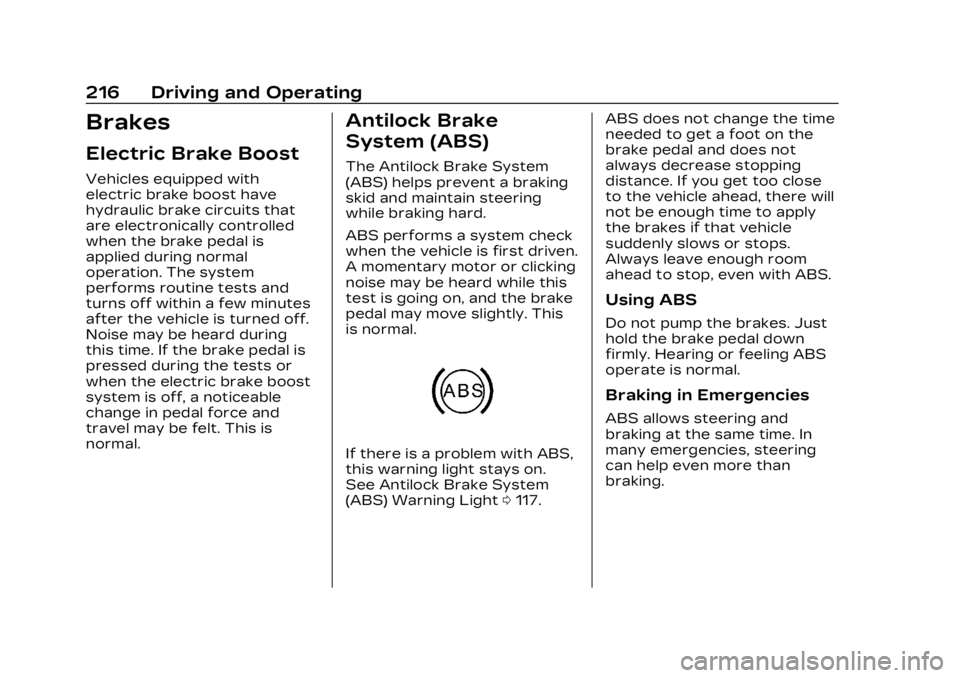
If there is a problem with ABS,
this warning light stays on.
See Antilock Brake System
(ABS) Warning Light0117. ABS does not change the time
needed to get a foot on the
brake pedal and does not
always decrease stopping
distance. If you get too close
to the vehicle ahead, there will
not be enough time to apply
the brakes if that vehicle
suddenly slows or stops.
Always leave enough room
ahead to stop, even with ABS.
Using ABS
Do not pump the brakes. Just
hold the brake pedal down
firmly. Hearing or feeling ABS
operate is normal.
Braking in Emergencies
ABS allows steering and
braking at the same time. In
many emergencies, steering
can help even more than
braking.
Page 220 of 424
Cadillac Lyriq Owner Manual (GMNA-Localizing-U.S./Canada-15644413) -
2023 - CRC - 2/23/22
Driving and Operating 219
from rolling in an unintended
direction during the transition
from brake pedal release to
accelerator pedal apply. The
brakes release when the
accelerator pedal is applied.
The brakes may also release
under other conditions. Do not
rely on HSA to hold the
vehicle.
HSA is available when the
vehicle is facing uphill in a
forward gear, or when facing
downhill in R (Reverse). The
vehicle must come to a
complete stop on a grade for
HSA to activate.Automatic Vehicle
Hold (AVH)
{Warning
Do not rely on this feature.
It does not replace the need
to pay attention and drive
safely. You may not hear or
feel alerts or warnings
provided by this system.
Failure to use proper care
when driving may result in
injury, death, or vehicle
damage.When Automatic Vehicle Hold
(AVH) is turned on and the
vehicle is braked to a stop,
AVH prevents the vehicle from
moving during the transition
from brake pedal release to
accelerator pedal apply. The
brakes release when the
accelerator pedal is applied.
The brakes may also release
under other conditions. Do not
rely on AVH to hold the
vehicle.
If the accelerator pedal is not
applied within a few minutes,
the Electric Parking Brake will
apply. The parking brake will
also apply if the driver door is
opened or the driver seat belt
is unfastened while AVH is
holding the vehicle.
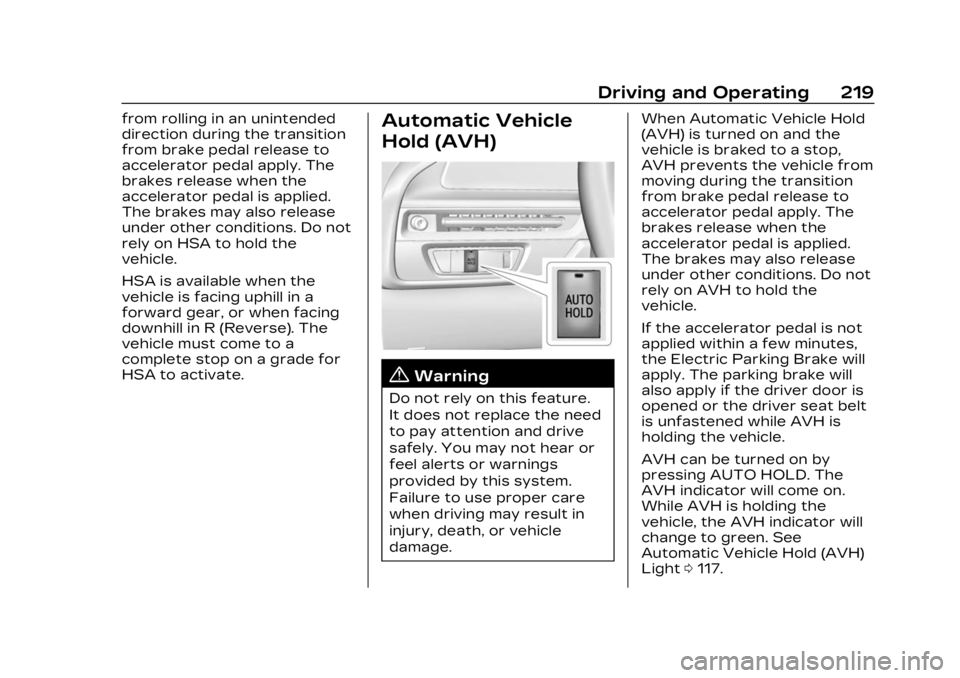
AVH can be turned on by
pressing AUTO HOLD. The
AVH indicator will come on.
While AVH is holding the
vehicle, the AVH indicator will
change to green. See
Automatic Vehicle Hold (AVH)
Light
0117.
Page 221 of 424
Cadillac Lyriq Owner Manual (GMNA-Localizing-U.S./Canada-15644413) -
2023 - CRC - 2/23/22
220 Driving and Operating
Regenerative Braking
Regenerative braking takes
some of the energy from the
moving vehicle and turns it
back into electrical energy.
This energy is then stored
back into the high voltage
battery system, contributing
to increased energy efficiency.
Regenerative power may be
limited when the battery is
near full charge or cold. See
“Regenerative Power Limited”
under Power Indicator Gauge
0111. Regenerative braking
supplements your vehicle’s
conventional brakes, especially
when going downhill. See Hill
and Mountain Roads 0200.
{Warning
Do not charge your vehicle’s
battery above an 80%
charge if you are going to
drive down long, steep
grades such as mountain
passes. This provides room
(Continued)
Warning (Continued)
in the battery for
regenerative braking to
supplement your
conventional brakes during
the descent. This is
especially important when
towing a trailer, which puts
additional stress on your
vehicle’s braking system.
See“Charge Now” under
Charging 0123 for
information on setting
charge limits. See Hill and
Mountain Roads 0200 for
important information about
driving on grades.
The brake system uses
regenerative braking,
conventional hydraulic braking,
or a combination of both as
appropriate.
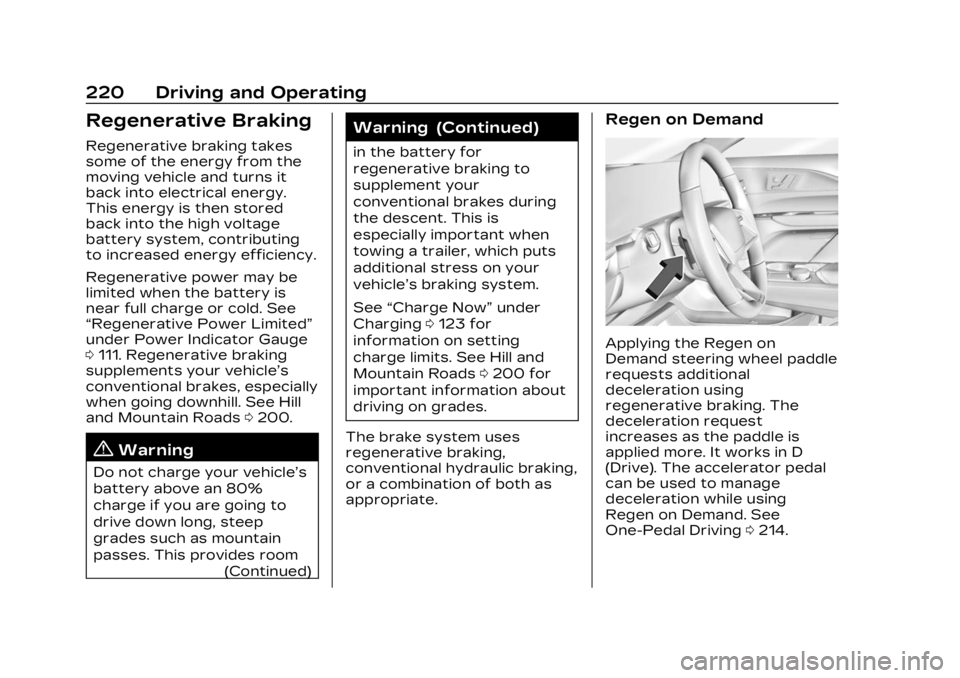
Regen on Demand
Applying the Regen on
Demand steering wheel paddle
requests additional
deceleration using
regenerative braking. The
deceleration request
increases as the paddle is
applied more. It works in D
(Drive). The accelerator pedal
can be used to manage
deceleration while using
Regen on Demand. See
One-Pedal Driving 0214.
Page 222 of 424

Cadillac Lyriq Owner Manual (GMNA-Localizing-U.S./Canada-15644413) -
2023 - CRC - 2/23/22
Driving and Operating 221
If the vehicle is brought to a
complete stop while the
Regen on Demand paddle is
applied, the vehicle will not
creep forward when the
paddle is released. The
accelerator pedal must be
pressed to move the vehicle
forward.
If the vehicle is on a steep
grade, the brake pedal must
be used to hold the vehicle.
When available regenerative
braking power is limited, the
hydraulic brakes may be
applied to make up the
difference.
Cruise control will turn off and
the brake lamps may come on
when this feature is activated.
Avoid using Regen on Demand
under slippery road conditions.
Use the brake pedal as the
primary braking device.Ride Control
Systems
Traction Control/
Electronic Stability
Control
System Operation
The vehicle has a Traction
Control System (TCS) and
StabiliTrak/Electronic Stability
Control (ESC). These systems
help limit wheel spin and assist
the driver in maintaining
control, especially on slippery
road conditions.
TCS activates if it senses any
of the drive wheels are
spinning or beginning to lose
traction. When this happens,
TCS applies the brakes to the
spinning wheels and reduces
vehicle power to limit
wheel spin.
StabiliTrak/ESC activates
when the vehicle senses a
difference between the
intended path and thedirection the vehicle is actually
traveling. StabiliTrak/ESC
selectively applies braking
pressure to one or more of
the vehicle wheel brakes to
assist the driver in keeping the
vehicle on the intended path.
Trailer Sway Control (TSC) is
also on automatically when the
vehicle is started. See Trailer
Sway Control (TSC)
0304.
If cruise control is being used
and traction control or
StabiliTrak/ESC begins to limit
wheel spin, cruise control will
disengage. Cruise control may
be turned back on when road
conditions allow.
Both systems come on
automatically when the vehicle
is started and begins to move.
The systems may be heard or
felt while they are operating
or while performing diagnostic
checks. This is normal and
does not mean there is a
problem with the vehicle.