2022 YAMAHA JETBLASTER Flush
[x] Cancel search: FlushPage 7 of 98

Table of contents
Operation ......................................... 57Operating your watercraft ............. 57
Getting to know your watercraft ...... 57
Learning to operate your
watercraft ...................................... 57
Riding position ................................. 58
Launching the watercraft ................. 58
Starting the engine on water ............ 58
Stopping the engine ......................... 59
Leaving the watercraft...................... 59
Operating the watercraft .................. 59
Turning the watercraft ...................... 60
Stopping the watercraft ................... 61
Operating the watercraft in reverse or neutral ...................................... 62
Boarding the watercraft ................... 63
Starting off........................................ 65
Capsized watercraft ......................... 66
Beaching and docking the
watercraft ...................................... 67
Operating in weeded areas .............. 67
After removing the watercraft from the water ....................................... 67
Care and storage............................. 69Post-operation care ...................... 69
Flushing the cooling water
passages....................................... 69
Cleaning the watercraft .................... 70
Battery care ...................................... 70
Long-term storage ........................ 72
Cleaning ........................................... 72
Lubrication ....................................... 72
Rustproofing..................................... 73
Maintenance .................................... 75 Maintenance.................................. 75
Periodic maintenance chart ............. 76
Engine oil and oil filter ...................... 78
Specifications .................................. 79Specifications................................ 79 Trouble recovery ............................. 81
Troubleshooting ............................ 81
Troubleshooting chart ...................... 81
Emergency procedures ................ 84
Cleaning the jet intake and
impeller ......................................... 84
Raising the reverse gate .................. 85
Jumping the battery ......................... 85
Towing the watercraft....................... 86
Submerged watercraft ..................... 86
Index................................................. 88
UF6C70E0.book Page 2 Wednesday, November 10, 2021 11:33 AM
Page 30 of 98

Description
23
Engine compartment
8
3
1011
4
2
1
56
7
9
1 Water separator (page 26)
2 Fuel tank
3 Air filter case
4 Flushing hose connector (page 69)
5 Oil tank filler cap/Dipstick (page 43)
6 Oil tank
7 Battery (page 51)
8 Fuse box 9
Spark plug/Ignition coil
10 Fire extinguisher holder (page 40)
11 Seat storage compartment (page 40)
UF6C70E0.book Page 23 Wednesday, November 10, 2021 11:33 AM
Page 50 of 98

Operation and handling requirements
43
EJU40291
Engine oil requirementsEJU44531Engine oilECJ00282
Use only 4-stroke engine oil. Usage of 2-
stroke engine oil could result in severe en-
gine damage.
Why Yamalube
YAMALUBE oil is a Genuine YAMAHA Part
born of the engineers’ passion and belief that
engine oil is an important liquid engine com-
ponent. We form teams of specialists in the
fields of mechanical engineering, chemistry,
electronics and track testing, and have them
develop the engine together with the oil it will
use. Yamalube oils take full advantage of the
base oil’s qualities and blend in the ideal ba-
lance of additives to make sure the final oil
clears our performance standards. Thus,
Yamalube mineral, semisynthetic and syn- thetic oils have their own distinct characters
and value. Yamaha’s experience gained over
many years of research and development
into oil since the 1960’s helps make
Yamalube the best choice for your Yamaha engine. Checking the engine oil level
EWJ00341
Engine oil is extremely hot immediately af-
ter the engine is turned off. Coming in con-
tact with or getting any engine oil on your
clothes could result in burns.
ECJ00392
Do not run the engine with too much or
not enough oil in the oil tank, otherwise
the engine could be damaged.
Make sure that debris and water do not
enter the oil tank filler hole. Debris and
water in the engine oil can cause serious
engine damage.
TIP
When checking the engine oil level on land,
the engine must be running while water is
being supplied to the cooling water pas-
sages. (See “Flushing the cooling water
passages” on page 69 for information on
supplying water.)
When checking the engine oil level on wa-
ter, moor the watercraft so that it will not
drift away.
To check the engine oil level:
(1) With the engine stopped, place the wa-
tercraft in a precisely level position on
land or launch the watercraft.
(2) Look in all directions, and then start the engine. (See page 58 for information on
starting the engine.)
(3) Run the engine at idling speed for 6 mi- nutes or more. Run the engine an addi-
tional 5 minutes if the ambient
temperature is 20 °C (68 °F) or less.
(4) Stop the engine.
Recommended engine oil:
YAMALUBE 4W or 4-stroke motor oil
Recommended engine oil type: SAE 10W-30, 10W-40, 20W-40,
20W-50
Recommended engine oil grade: API SG, SH, SJ, SL
UF6C70E0.book Page 43 Wednesday, November 10, 2021 11:33 AM
Page 76 of 98
Care and storage
69
EJU37148
Post-operation careEWJ00332
Always place the watercraft upright in a
horizontal position when storing it, other-
wise fuel could leak out into the engine or
engine compartment, which could create
a fire hazard.
After using the watercraft, always take it out
of the water, clean it, and store it. Leaving the
watercraft in the water for extended periods
will accelerate the rate of normal deteriora-
tion of the jet pump and hull. Marine organ-
isms and corrosion are some of the
conditions that can shorten the life of many
watercraft components.
EJU44560Flushing the cooling water passagesECJ01311
Do not run the engine over 4000 r/min on
land. Also, do not run the engine for more
than 15 seconds without supplying water,
otherwise the engine could overheat.
Flush the cooling water passages to prevent
them from clogging with salt, sand, or dirt.
(1) Place the watercraft in a horizontal posi-tion.
(2) Remove the seat and seat storage com- partment. (See page 36 for seat removal
and installation procedures and page 40
for information on the seat storage com-
partment.)
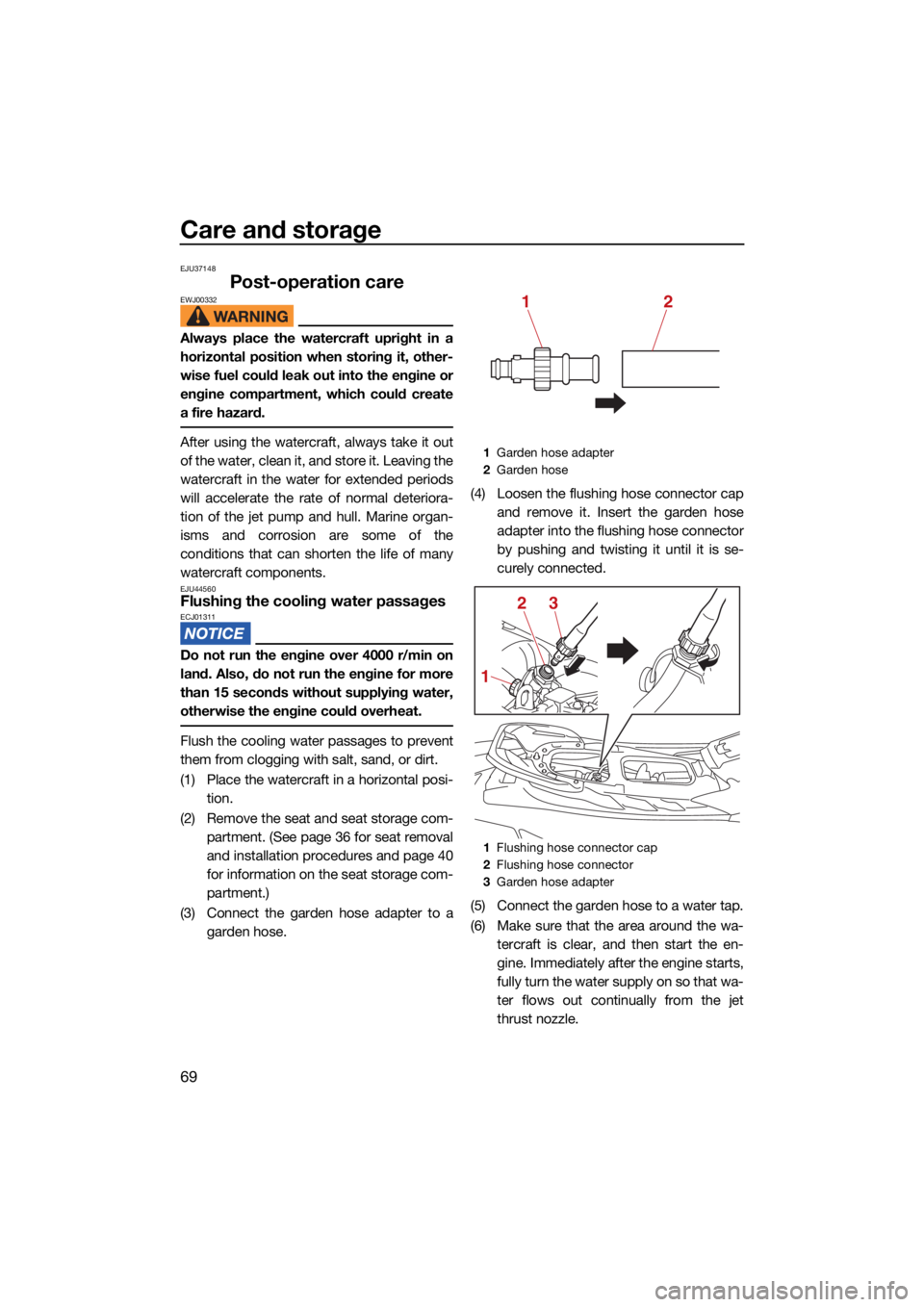
(3) Connect the garden hose adapter to a garden hose. (4) Loosen the flushing hose connector cap
and remove it. Insert the garden hose
adapter into the flushing hose connector
by pushing and twisting it until it is se-
curely connected.
(5) Connect the garden hose to a water tap.
(6) Make sure that the area around the wa- tercraft is clear, and then start the en-
gine. Immediately after the engine starts,
fully turn the water supply on so that wa-
ter flows out continually from the jet
thrust nozzle.
1Garden hose adapter
2 Garden hose
1 Flushing hose connector cap
2 Flushing hose connector
3 Garden hose adapter
12
32
1
UF6C70E0.book Page 69 Wednesday, November 10, 2021 11:33 AM
Page 77 of 98

Care and storage
70
(7) Run the engine at idling speed for about3 minutes watching the engine condition.
If the engine stops while flushing, turn
the water supply off immediately and
perform the procedure again from step 6.
NOTICE: Do not supply water to the
cooling water passages when the en-
gine is not running. The water could
flow back through the muffler into the
engine, causing severe engine dam-
age.
[ECJ00123]
(8) Turn the water supply off.
(9) Discharge the remaining water out of the cooling water passages by alternately
squeezing and releasing the throttle lever
quickly for 10 to 15 seconds.
(10) Stop the engine.
(11) Remove the garden hose adapter, and then securely install the flushing hose
connector cap by tightening it until it
stops.
(12) Securely install the seat storage com- partment and seat in their original posi-
tions.
EJU44770Cleaning the watercraft
(1) Remove the seat and fire extinguisherholder. (See page 36 for seat removal
and installation procedures and page 40
for information on the fire extinguisher
holder.) (2) If the watercraft will be stored for a week
or more, rustproof the internal engine
components to help prevent corrosion.
(See page 73 for information on rust-
proofing the internal engine compo-
nents.)
(3) Rinse the engine and engine compart- ment with a small amount of water.
NOTICE: Do not use high-pressure
water when rinsing the engine or en-
gine compartment as severe engine
damage could result.
[ECJ00572]
(4) Drain the water from the engine com- partment. (See page 45 for information
on draining the bilge water.)
(5) Wipe the engine and engine compart- ment with a dry cloth.
(6) Wash down the hull, deck, and jet pump with fresh water.
(7) Wipe the hull, deck, and jet pump with a dry cloth.
(8) Wipe all vinyl and rubber components, such as the seat and engine compart-
ment seals, with a vinyl protectant.
(9) To minimize corrosion, spray metallic parts of the hull, deck, and engine with a
rust inhibitor.
(10) Allow the engine compartment to air dry completely before installing the seat.
(11) Securely install the fire extinguisher hold- er and seat in their original positions.
EJU3368DBattery care
If the watercraft will not be used for more than
a month, remove the battery from the water-
craft, check it, and then store it in a cool, dry
place.
EWJ00794
Battery electrolyte is poisonous and dan-
gerous, causing severe burns, etc. Elec-
UF6C70E0.book Page 70 Wednesday, November 10, 2021 11:33 AM
Page 78 of 98

Care and storage
71
trolyte contains sulfuric acid. Avoid
contact with skin, eyes, or clothing.
Batteries produce explosive gases. Keep
sparks, flames, cigarettes, etc., well away.
If using or charging the battery in an en-
closed space, make sure that it is well
ventilated. Always shield your eyes when
working near batteries.
Keep out of the reach of children.
Antidotes
External: Flush with water.
Internal: Drink large quantities of water or
milk. Follow with milk of magnesia, beaten
egg, or vegetable oil. Call a physician im-
mediately.
Eyes: Flush with water for 15 minutes and
get prompt medical attention.
To remove the battery:
(1) Disconnect the negative (–) battery lead.
(2) Disconnect the positive (+) battery lead.
(3) Unhook the battery bands, and then re-move the battery from the watercraft.
Checking the battery
Make sure that the battery case is not dam-
aged.
Make sure that the battery terminals are
not corroded or damaged. Checking the battery voltage and charging
the battery
It is recommended to have a Yamaha dealer
check the battery voltage and charge the bat-
tery. Have a Yamaha dealer charge the bat-
tery as soon as possible if it seems to have
discharged. Keep in mind that the battery
tends to discharge more quickly if the vehicle
is equipped with optional electrical accesso-
ries.
NOTICE: To charge a VRLA (Valve
Regulated Lead Acid) battery, a special
(constant-voltage) battery charger is re-
quired. Using a conventional battery char-
ger will damage the battery.
[ECJ02810]
Checking the battery bands
Make sure that the battery bands are not
damaged.
To store the battery:
(1) Clean the battery case using fresh water.
(2) If the battery terminals are dirty or cor- roded, clean them using a wire brush.
1Negative (–) battery terminal: Black lead
2 Battery band
3 Positive (+) battery terminal: Red lead
1
3
2
1Battery band
1
UF6C70E0.book Page 71 Wednesday, November 10, 2021 11:33 AM
Page 79 of 98

Care and storage
72
(3) Apply water-resistant grease to the bat-tery terminals.
(4) Store the battery in a cool, dry place. NOTICE: Storing the battery in an un-
charged condition can cause perma-
nent battery damage. Check the
battery periodically.
[ECJ00103]
To install the battery:
(1) Place the battery in the battery compart- ment and hook the battery bands onto
the holders.
(2) Connect the positive (+) battery lead (red) to the positive (+) battery terminal.
NOTICE: Reversal of the battery leads
will damage the electrical parts.
[ECJ00262]
(3) Connect the negative (–) battery lead (black) to the negative (–) battery termi-
nal.
(4) Make sure that the battery is securely held in place.
EJU33495
Long-term storageEWJ00332
Always place the watercraft upright in a
horizontal position when storing it, other-
wise fuel could leak out into the engine or
engine compartment, which could create
a fire hazard.
Storage for long periods of time, such as win-
ter storage, requires preventive maintenance
to ensure against deterioration. It is advisable
to have the watercraft serviced by a Yamaha
dealer prior to storage.
However, the following procedures can be
performed easily by the owner.
EJU40763Cleaning
(1) Flush the cooling water passages. (Seepage 69 for information on flushing the
cooling water passages.)
TIP
If you will be storing the watercraft for a pro-
longed period, such as winter storage, top off
the fuel tank with fresh gasoline and add fuel
stabilizer and conditioner to the fuel tank ac-
cording to the manufacturer’s instruction be-
fore starting the engine.
(2) Clean the watercraft. (See page 70 for in-formation on cleaning the watercraft.)
Wax the hull with a non-abrasive wax.
EJU44741Lubrication
To keep moving parts sliding or rotating
smoothly, lubricate them with water-resistant
grease.
1Battery terminal
Recommended water-resistant grease:
YAMALUBE MARINE
GREASE/Yamaha Grease A
1
Recommended water-resistant grease:
YAMALUBE MARINE GREASE /
Ya m a h a G r e a s e A
UF6C70E0.book Page 72 Wednesday, November 10, 2021 11:33 AM
Page 95 of 98

88
Index
A
After removing the watercraft from the water ..................................................... 67
B
Battery care.............................................. 70
Battery checks ......................................... 51
Battery, jumping....................................... 85
Beaching and docking the watercraft ...... 67
Bilge water check..................................... 51
Bilge water, draining ................................ 45
Bilge water, draining on land ................... 45
Bilge water, draining on water ................. 45
Boarding alone ......................................... 63
Boarding and starting off from a dock ..... 66
Boarding the watercraft ........................... 63
Boarding with passenger(s) ..................... 64
Bow eye ................................................... 38
Bow storage compartment ...................... 39
Builder’s plate ............................................ 2
C
Capsized watercraft ................................. 66
Check engine warning ............................. 35
Cleaning ................................................... 72
Cleaning the watercraft ............................ 70
Cleat ......................................................... 38
Cooling water pilot outlet ......................... 25
Cooling water pilot outlet check .............. 55
Craft Identification Number (CIN)............... 1
Cruising limitations................................... 10
E
Electric trim system.................................. 29
Electric trim system check ....................... 53
Emergency procedures ............................ 84
Engine break-in ........................................ 47
Engine compartment check ..................... 50
Engine idling speed check ....................... 56
Engine oil ................................................. 43
Engine oil and oil filter .............................. 78
Engine oil level check............................... 51
Engine oil requirements ........................... 43
Engine overheat warning ......................... 34
Engine serial number ................................. 1
Engine shut-off cord (lanyard) check ....... 53
Engine shut-off switch ............................. 24
Engine start/stop switch .......................... 24 Engine unit check ..................................... 51
Enjoy your watercraft responsibly ............ 18
Equipment ................................................ 36
F
Fire extinguisher check ............................ 54
Fire extinguisher holder............................ 40
Fire extinguisher holder checks ............... 54
Flushing the cooling water passages....... 69
Foot chocks ............................................. 37
Fuel .......................................................... 41
Fuel level check........................................ 50
Fuel level meter ........................................ 34
Fuel level warning..................................... 34
Fuel requirements .................................... 41
Fuel system checks ................................. 50
G
Getting to know your watercraft .............. 57
Glossary, watercraft ................................. 19
Glove compartment ................................. 39
H
Handgrip .................................................. 36
Hazard information................................... 14
Hood check .............................................. 55
Hour meter and voltmeter ........................ 33
Hull and deck check ................................ 54
I
Identification numbers ............................... 1
Information display................................... 31
J
Jet intake and impeller, cleaning.............. 84
Jet intake checks ..................................... 54
Jet thrust nozzle and reverse gate
check .................................................... 54
Jumper cables, connecting ...................... 85
L
Labels, important ....................................... 4
Labels, other .............................................. 8
Labels, warning .......................................... 5
Launching the watercraft ......................... 58
Learning to operate your watercraft......... 57
Leaving the watercraft.............................. 59
Limitations on who may operate the watercraft ................................................ 9
Long-term storage ................................... 72
Lubrication ............................................... 72
UF6C70E0.book Page 88 Wednesday, November 10, 2021 11:33 AM