2022 YAMAHA JETBLASTER engine overheat
[x] Cancel search: engine overheatPage 74 of 98

Operation
67
(3) Start the engine and operate the water-craft at planing speed to drain the bilge
water from the engine compartment.
(See page 45 for information on draining
the bilge water. If the engine does not
start, see “Towing the watercraft” on
page 86 or “Submerged watercraft” on
page 86.) NOTICE: Do not run the en-
gine at full throttle for at least 1 minute
after the engine has been restarted.
Bilge water in the engine compart-
ment can splash into the engine,
which can result in severe damage.
[ECJ00554]
EJU43283
Beaching and docking the watercraft
To beach the watercraft:
(1) Make sure that there are no boats, swim- mers, or obstacles near the beach.
(2) Release the throttle lever to reduce speed about 100 m (330 ft) before you
reach the intended beaching area.
(3) Slowly approach the beach using the throttle lever and RiDE lever to control
the watercraft speed. NOTICE: Never
run the engine in water that is less
than 60 cm (2 ft) deep from the bottom
of the watercraft, otherwise pebbles
or sand could be sucked into the jet
intake, causing impeller damage and
engine overheating.
[ECJ00473]
(4) After reaching land, stop the engine, and then get off the watercraft and pull it up
on the beach.
To dock the watercraft:
(1) Make sure that there are no boats, swim-mers, or obstacles near the dock.
(2) Release the throttle lever to reduce speed about 100 m (330 ft) away from
the dock.
(3) Slowly approach the dock using the throttle lever and RiDE lever to control
the watercraft speed.
(4) After coming alongside the dock, stop the engine, and then get off the water-
craft.
EJU37194Operating in weeded areas
Always avoid using your watercraft in areas
where weed growth is thick. If operating in
weeded areas is unavoidable, alternately
squeeze the throttle lever and relax your grip
on the throttle lever to vary the engine speed.
Weeds tend to become clogged more when
operating at a steady speed and at trolling
speed. If weeds may have clogged the intake
area, clean the jet intake. (See page 84 for in-
formation on the jet intake.)
EJU40243After removing the watercraft from
the water
ECJ01311
Do not run the engine over 4000 r/min on
land. Also, do not run the engine for more
than 15 seconds without supplying water,
otherwise the engine could overheat.
After operating and removing the watercraft
from the water, promptly discharge the re-
maining water from th e cooling water pas-
sages.
UF6C70E0.book Page 67 Wednesday, November 10, 2021 11:33 AM
Page 76 of 98
Care and storage
69
EJU37148
Post-operation careEWJ00332
Always place the watercraft upright in a
horizontal position when storing it, other-
wise fuel could leak out into the engine or
engine compartment, which could create
a fire hazard.
After using the watercraft, always take it out
of the water, clean it, and store it. Leaving the
watercraft in the water for extended periods
will accelerate the rate of normal deteriora-
tion of the jet pump and hull. Marine organ-
isms and corrosion are some of the
conditions that can shorten the life of many
watercraft components.
EJU44560Flushing the cooling water passagesECJ01311
Do not run the engine over 4000 r/min on
land. Also, do not run the engine for more
than 15 seconds without supplying water,
otherwise the engine could overheat.
Flush the cooling water passages to prevent
them from clogging with salt, sand, or dirt.
(1) Place the watercraft in a horizontal posi-tion.
(2) Remove the seat and seat storage com- partment. (See page 36 for seat removal
and installation procedures and page 40
for information on the seat storage com-
partment.)
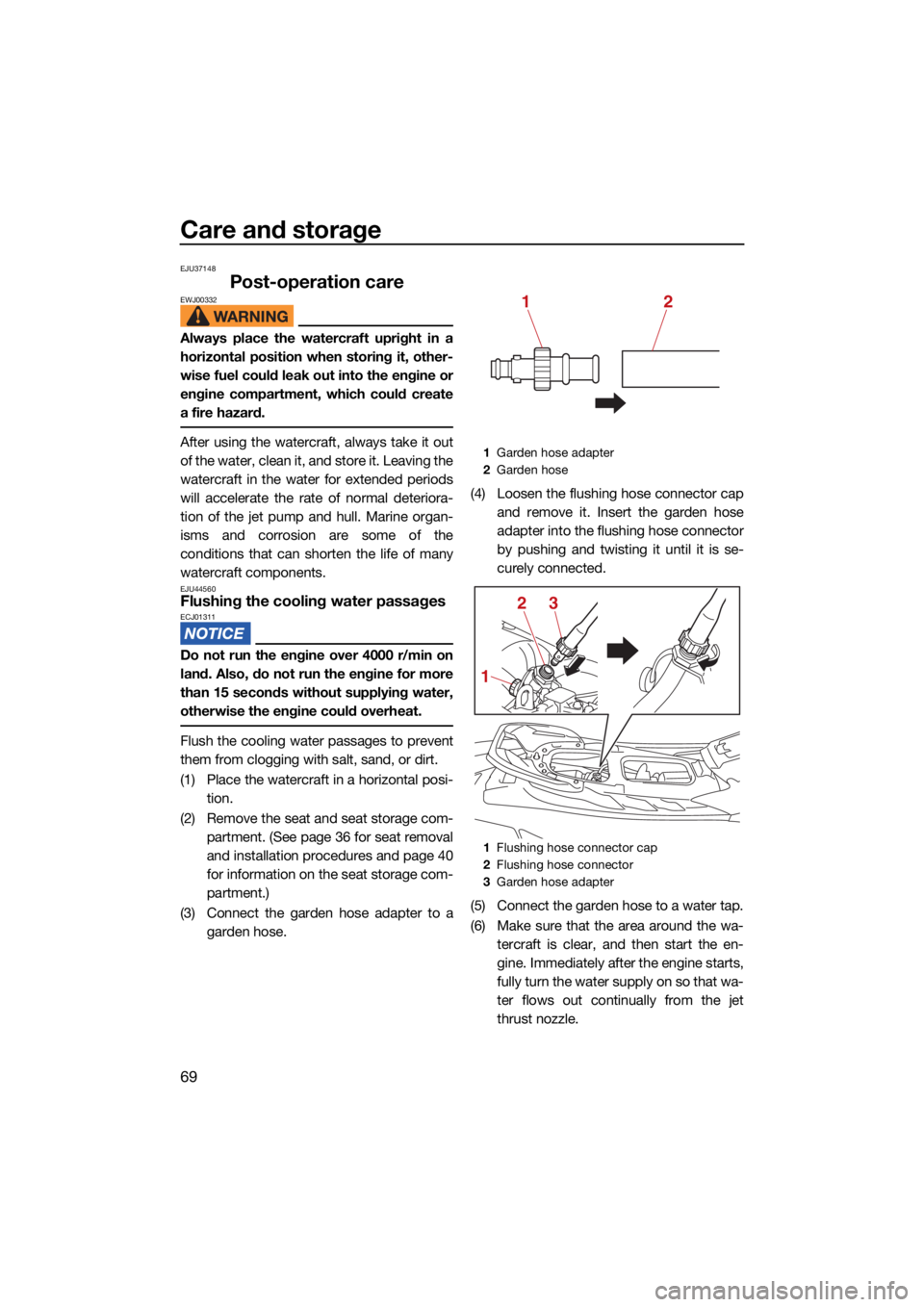
(3) Connect the garden hose adapter to a garden hose. (4) Loosen the flushing hose connector cap
and remove it. Insert the garden hose
adapter into the flushing hose connector
by pushing and twisting it until it is se-
curely connected.
(5) Connect the garden hose to a water tap.
(6) Make sure that the area around the wa- tercraft is clear, and then start the en-
gine. Immediately after the engine starts,
fully turn the water supply on so that wa-
ter flows out continually from the jet
thrust nozzle.
1Garden hose adapter
2 Garden hose
1 Flushing hose connector cap
2 Flushing hose connector
3 Garden hose adapter
12
32
1
UF6C70E0.book Page 69 Wednesday, November 10, 2021 11:33 AM
Page 91 of 98

Trouble recovery
84
EJU34625
Emergency proceduresEJU44592Cleaning the jet intake and impellerEWJ00783
Before attempting to remove weeds or de-
bris from the jet intake or impeller area,
shut the engine off and remove the clip
from the engine shut-off switch. Severe in-
jury or death could result from coming in
contact with the rotating parts of the jet
pump.
If weeds or debris gets caught in the jet intake
or impeller, cavitation can occur, causing jet
thrust to decrease even though engine speed
rises. If this condition is allowed to continue,
the engine will overheat and may seize.
NOTICE: If weeds or debris gets caught in
the jet intake, do not operate the water-
craft above trolling speed until they have
been removed.
[ECJ00654]
If there is any sign that the jet intake or impel-
ler is clogged with weeds or debris, return to
shore and check the intake and impeller. Al-
ways stop the engine before beaching the
watercraft. (1) Place a suitable clean cloth or carpeting
underneath the watercraft to protect it
from abrasions and scratches. Turn the
watercraft on its side as shown.
NOTICE: When turning the watercraft
on its side, support the bow so that
the handlebars are not bent or dam-
aged.
[ECJ02691]
(2) Remove any weeds or debris from around the jet intake, drive shaft, impel-
UF6C70E0.book Page 84 Wednesday, November 10, 2021 11:33 AM
Page 95 of 98

88
Index
A
After removing the watercraft from the water ..................................................... 67
B
Battery care.............................................. 70
Battery checks ......................................... 51
Battery, jumping....................................... 85
Beaching and docking the watercraft ...... 67
Bilge water check..................................... 51
Bilge water, draining ................................ 45
Bilge water, draining on land ................... 45
Bilge water, draining on water ................. 45
Boarding alone ......................................... 63
Boarding and starting off from a dock ..... 66
Boarding the watercraft ........................... 63
Boarding with passenger(s) ..................... 64
Bow eye ................................................... 38
Bow storage compartment ...................... 39
Builder’s plate ............................................ 2
C
Capsized watercraft ................................. 66
Check engine warning ............................. 35
Cleaning ................................................... 72
Cleaning the watercraft ............................ 70
Cleat ......................................................... 38
Cooling water pilot outlet ......................... 25
Cooling water pilot outlet check .............. 55
Craft Identification Number (CIN)............... 1
Cruising limitations................................... 10
E
Electric trim system.................................. 29
Electric trim system check ....................... 53
Emergency procedures ............................ 84
Engine break-in ........................................ 47
Engine compartment check ..................... 50
Engine idling speed check ....................... 56
Engine oil ................................................. 43
Engine oil and oil filter .............................. 78
Engine oil level check............................... 51
Engine oil requirements ........................... 43
Engine overheat warning ......................... 34
Engine serial number ................................. 1
Engine shut-off cord (lanyard) check ....... 53
Engine shut-off switch ............................. 24
Engine start/stop switch .......................... 24 Engine unit check ..................................... 51
Enjoy your watercraft responsibly ............ 18
Equipment ................................................ 36
F
Fire extinguisher check ............................ 54
Fire extinguisher holder............................ 40
Fire extinguisher holder checks ............... 54
Flushing the cooling water passages....... 69
Foot chocks ............................................. 37
Fuel .......................................................... 41
Fuel level check........................................ 50
Fuel level meter ........................................ 34
Fuel level warning..................................... 34
Fuel requirements .................................... 41
Fuel system checks ................................. 50
G
Getting to know your watercraft .............. 57
Glossary, watercraft ................................. 19
Glove compartment ................................. 39
H
Handgrip .................................................. 36
Hazard information................................... 14
Hood check .............................................. 55
Hour meter and voltmeter ........................ 33
Hull and deck check ................................ 54
I
Identification numbers ............................... 1
Information display................................... 31
J
Jet intake and impeller, cleaning.............. 84
Jet intake checks ..................................... 54
Jet thrust nozzle and reverse gate
check .................................................... 54
Jumper cables, connecting ...................... 85
L
Labels, important ....................................... 4
Labels, other .............................................. 8
Labels, warning .......................................... 5
Launching the watercraft ......................... 58
Learning to operate your watercraft......... 57
Leaving the watercraft.............................. 59
Limitations on who may operate the watercraft ................................................ 9
Long-term storage ................................... 72
Lubrication ............................................... 72
UF6C70E0.book Page 88 Wednesday, November 10, 2021 11:33 AM