2022 YAMAHA JETBLASTER cooling
[x] Cancel search: coolingPage 62 of 98
![YAMAHA JETBLASTER 2022 Owners Manual Pre-operation checks
55
flood the engine compartment and cause
the watercraft to submerge.
[ECJ00364]
Securely install the stern drain plugs by tight-
ening them until they stop.
EJU44640Hood check
C](/manual-img/51/50521/w960_50521-61.png "YAMAHA JETBLASTER 2022 Owners Manual Pre-operation checks
55
flood the engine compartment and cause
the watercraft to submerge.
[ECJ00364]
Securely install the stern drain plugs by tight-
ening them until they stop.
EJU44640Hood check
C")
Pre-operation checks
55
flood the engine compartment and cause
the watercraft to submerge.
[ECJ00364]
Securely install the stern drain plugs by tight-
ening them until they stop.
EJU44640Hood check
Close the hood, hook the hood latches, and
check that the hood is securely closed.
EJU40147Post-launch checks
Perform the post-launch checks in the pre-
operation checklist while the watercraft is in
the water and the engine is running.
To perform the post-launch checks:
(1) Launch the watercraft. (See page 58 forinformation on launching the watercraft.)
(2) Perform the checks and make sure that there are no malfunctioning items or oth-
er problems.
EJU40553Cooling water pilot outlet check
Make sure that water is discharged from the
cooling water pilot outlet while the engine is
running. (See page 25 for information on the
cooling water pilot outlet.)
EJU32715Multifunction information center check
Make sure that the multifunction information
center operates properly. (See page 31 for in-
formation on proper operation of the multi-
function information center.)
1Stern drain plug
2 O-ring
1 Stern drain plug
1 Hood latch
2
1
1
1
UF6C70E0.book Page 55 Wednesday, November 10, 2021 11:33 AM
Page 74 of 98

Operation
67
(3) Start the engine and operate the water-craft at planing speed to drain the bilge
water from the engine compartment.
(See page 45 for information on draining
the bilge water. If the engine does not
start, see “Towing the watercraft” on
page 86 or “Submerged watercraft” on
page 86.) NOTICE: Do not run the en-
gine at full throttle for at least 1 minute
after the engine has been restarted.
Bilge water in the engine compart-
ment can splash into the engine,
which can result in severe damage.
[ECJ00554]
EJU43283
Beaching and docking the watercraft
To beach the watercraft:
(1) Make sure that there are no boats, swim- mers, or obstacles near the beach.
(2) Release the throttle lever to reduce speed about 100 m (330 ft) before you
reach the intended beaching area.
(3) Slowly approach the beach using the throttle lever and RiDE lever to control
the watercraft speed. NOTICE: Never
run the engine in water that is less
than 60 cm (2 ft) deep from the bottom
of the watercraft, otherwise pebbles
or sand could be sucked into the jet
intake, causing impeller damage and
engine overheating.
[ECJ00473]
(4) After reaching land, stop the engine, and then get off the watercraft and pull it up
on the beach.
To dock the watercraft:
(1) Make sure that there are no boats, swim-mers, or obstacles near the dock.
(2) Release the throttle lever to reduce speed about 100 m (330 ft) away from
the dock.
(3) Slowly approach the dock using the throttle lever and RiDE lever to control
the watercraft speed.
(4) After coming alongside the dock, stop the engine, and then get off the water-
craft.
EJU37194Operating in weeded areas
Always avoid using your watercraft in areas
where weed growth is thick. If operating in
weeded areas is unavoidable, alternately
squeeze the throttle lever and relax your grip
on the throttle lever to vary the engine speed.
Weeds tend to become clogged more when
operating at a steady speed and at trolling
speed. If weeds may have clogged the intake
area, clean the jet intake. (See page 84 for in-
formation on the jet intake.)
EJU40243After removing the watercraft from
the water
ECJ01311
Do not run the engine over 4000 r/min on
land. Also, do not run the engine for more
than 15 seconds without supplying water,
otherwise the engine could overheat.
After operating and removing the watercraft
from the water, promptly discharge the re-
maining water from th e cooling water pas-
sages.
UF6C70E0.book Page 67 Wednesday, November 10, 2021 11:33 AM
Page 75 of 98

Operation
68
To discharge water from the cooling wa-
ter passages:
(1) Make sure that the area around the wa-tercraft is clear, and then start the en-
gine.
(2) Discharge the remaining water out of the cooling water passages by alternately
squeezing and releasing the throttle lever
quickly for 10 to 15 seconds.
(3) Stop the engine.
UF6C70E0.book Page 68 Wednesday, November 10, 2021 11:33 AM
Page 76 of 98
Care and storage
69
EJU37148
Post-operation careEWJ00332
Always place the watercraft upright in a
horizontal position when storing it, other-
wise fuel could leak out into the engine or
engine compartment, which could create
a fire hazard.
After using the watercraft, always take it out
of the water, clean it, and store it. Leaving the
watercraft in the water for extended periods
will accelerate the rate of normal deteriora-
tion of the jet pump and hull. Marine organ-
isms and corrosion are some of the
conditions that can shorten the life of many
watercraft components.
EJU44560Flushing the cooling water passagesECJ01311
Do not run the engine over 4000 r/min on
land. Also, do not run the engine for more
than 15 seconds without supplying water,
otherwise the engine could overheat.
Flush the cooling water passages to prevent
them from clogging with salt, sand, or dirt.
(1) Place the watercraft in a horizontal posi-tion.
(2) Remove the seat and seat storage com- partment. (See page 36 for seat removal
and installation procedures and page 40
for information on the seat storage com-
partment.)
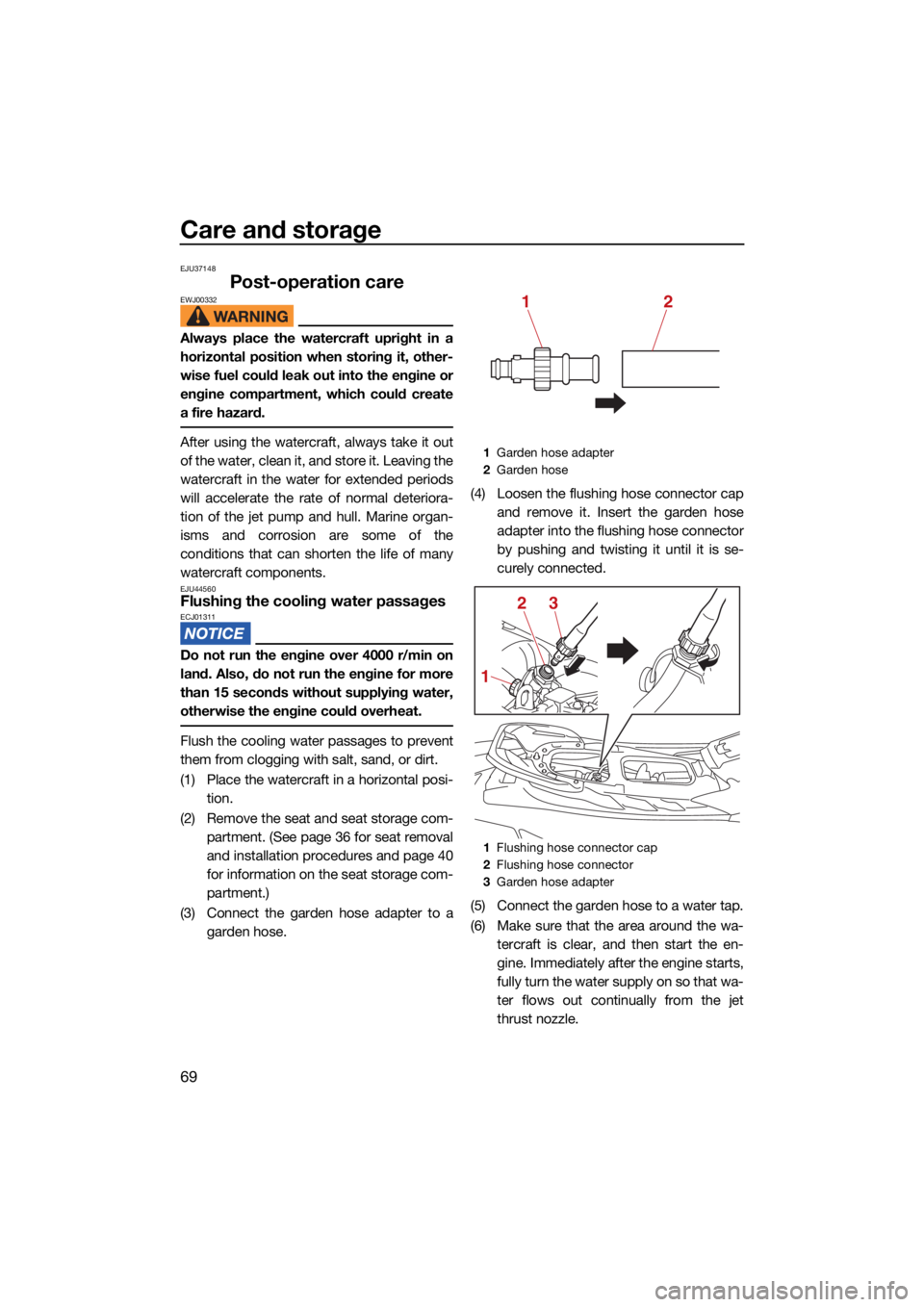
(3) Connect the garden hose adapter to a garden hose. (4) Loosen the flushing hose connector cap
and remove it. Insert the garden hose
adapter into the flushing hose connector
by pushing and twisting it until it is se-
curely connected.
(5) Connect the garden hose to a water tap.
(6) Make sure that the area around the wa- tercraft is clear, and then start the en-
gine. Immediately after the engine starts,
fully turn the water supply on so that wa-
ter flows out continually from the jet
thrust nozzle.
1Garden hose adapter
2 Garden hose
1 Flushing hose connector cap
2 Flushing hose connector
3 Garden hose adapter
12
32
1
UF6C70E0.book Page 69 Wednesday, November 10, 2021 11:33 AM
Page 77 of 98

Care and storage
70
(7) Run the engine at idling speed for about3 minutes watching the engine condition.
If the engine stops while flushing, turn
the water supply off immediately and
perform the procedure again from step 6.
NOTICE: Do not supply water to the
cooling water passages when the en-
gine is not running. The water could
flow back through the muffler into the
engine, causing severe engine dam-
age.
[ECJ00123]
(8) Turn the water supply off.
(9) Discharge the remaining water out of the cooling water passages by alternately
squeezing and releasing the throttle lever
quickly for 10 to 15 seconds.
(10) Stop the engine.
(11) Remove the garden hose adapter, and then securely install the flushing hose
connector cap by tightening it until it
stops.
(12) Securely install the seat storage com- partment and seat in their original posi-
tions.
EJU44770Cleaning the watercraft
(1) Remove the seat and fire extinguisherholder. (See page 36 for seat removal
and installation procedures and page 40
for information on the fire extinguisher
holder.) (2) If the watercraft will be stored for a week
or more, rustproof the internal engine
components to help prevent corrosion.
(See page 73 for information on rust-
proofing the internal engine compo-
nents.)
(3) Rinse the engine and engine compart- ment with a small amount of water.
NOTICE: Do not use high-pressure
water when rinsing the engine or en-
gine compartment as severe engine
damage could result.
[ECJ00572]
(4) Drain the water from the engine com- partment. (See page 45 for information
on draining the bilge water.)
(5) Wipe the engine and engine compart- ment with a dry cloth.
(6) Wash down the hull, deck, and jet pump with fresh water.
(7) Wipe the hull, deck, and jet pump with a dry cloth.
(8) Wipe all vinyl and rubber components, such as the seat and engine compart-
ment seals, with a vinyl protectant.
(9) To minimize corrosion, spray metallic parts of the hull, deck, and engine with a
rust inhibitor.
(10) Allow the engine compartment to air dry completely before installing the seat.
(11) Securely install the fire extinguisher hold- er and seat in their original positions.
EJU3368DBattery care
If the watercraft will not be used for more than
a month, remove the battery from the water-
craft, check it, and then store it in a cool, dry
place.
EWJ00794
Battery electrolyte is poisonous and dan-
gerous, causing severe burns, etc. Elec-
UF6C70E0.book Page 70 Wednesday, November 10, 2021 11:33 AM
Page 79 of 98

Care and storage
72
(3) Apply water-resistant grease to the bat-tery terminals.
(4) Store the battery in a cool, dry place. NOTICE: Storing the battery in an un-
charged condition can cause perma-
nent battery damage. Check the
battery periodically.
[ECJ00103]
To install the battery:
(1) Place the battery in the battery compart- ment and hook the battery bands onto
the holders.
(2) Connect the positive (+) battery lead (red) to the positive (+) battery terminal.
NOTICE: Reversal of the battery leads
will damage the electrical parts.
[ECJ00262]
(3) Connect the negative (–) battery lead (black) to the negative (–) battery termi-
nal.
(4) Make sure that the battery is securely held in place.
EJU33495
Long-term storageEWJ00332
Always place the watercraft upright in a
horizontal position when storing it, other-
wise fuel could leak out into the engine or
engine compartment, which could create
a fire hazard.
Storage for long periods of time, such as win-
ter storage, requires preventive maintenance
to ensure against deterioration. It is advisable
to have the watercraft serviced by a Yamaha
dealer prior to storage.
However, the following procedures can be
performed easily by the owner.
EJU40763Cleaning
(1) Flush the cooling water passages. (Seepage 69 for information on flushing the
cooling water passages.)
TIP
If you will be storing the watercraft for a pro-
longed period, such as winter storage, top off
the fuel tank with fresh gasoline and add fuel
stabilizer and conditioner to the fuel tank ac-
cording to the manufacturer’s instruction be-
fore starting the engine.
(2) Clean the watercraft. (See page 70 for in-formation on cleaning the watercraft.)
Wax the hull with a non-abrasive wax.
EJU44741Lubrication
To keep moving parts sliding or rotating
smoothly, lubricate them with water-resistant
grease.
1Battery terminal
Recommended water-resistant grease:
YAMALUBE MARINE
GREASE/Yamaha Grease A
1
Recommended water-resistant grease:
YAMALUBE MARINE GREASE /
Ya m a h a G r e a s e A
UF6C70E0.book Page 72 Wednesday, November 10, 2021 11:33 AM
Page 83 of 98

Maintenance
76
EJU43103Periodic maintenance chart
The periodic maintenance chart gives general guidelines for periodic maintenance. Have a
Yamaha dealer perform the checks in the following chart. However, maintenance may need to be performed more frequently depending on your operating conditions. If you have any
questions, consult a Yamaha dealer.
This “ √” mark indicates items to be checked and serviced by a Yamaha dealer.
Item OperationInitial Thereafter every
Page
10 hours 50 hours
or 12
months *1 100
hours or 12
months *1 200
hours or 24
months *1
Fuel line Check fuel hoses and
clamps
√
—
Fuel filler cap/Wa-
ter separator Check O-rings for cracks
and deformation
√
—
Fuel tank Check installation and
straps
√
—
Water inlet strainer Check for clogs and dam-
age
√
—
Cooling water hos-
es Check for damage and
leakage, and check
clamps
√
—
Engine oil Replace √√ 78
Oil filter Replace √78
Spark plugs Check √√ —
Battery Check state of charge,
terminals and bands
√
—
Battery leads Check terminals √—
Steering master Check operation and for
looseness
√√
—
Steering cable Check exterior and con-
nections, and lubricate
√
—
Electric trim rod Check exterior and con-
nections, and lubricate
√
—
Shift rod and re-
verse gate Check exterior and con-
nections, and lubricate
√
—
Air filter element Check for damage and
dirt
√
—
Air intake hoses Check for damage, and
check clamps
√
—
Throttle body Lubricate throttle valve √—
Exhaust system Check
for exhaust leak-
age, and check hoses and
clamps √
—
UF6C70E0.book Page 76 Wednesday, November 10, 2021 11:33 AM
Page 86 of 98

Specifications
79
EJU45443
Specifications
Watercraft capaci-
ty:Maximum people on board: 3 person
Maximum load capacity: 225 kg (496 lb)
Dimensions and
weight: Length: 3.14 m (123.6 in)
Width: 1.13 m (44.5 in)
Height: 1.18 m (46.5 in)
Dry weight: 241 kg (531 lb)
Performance: Maximum output (according to ISO
8665/SAE J1228): 80.9 kW at 8000 r/min
Maximum fuel consumption: 33.1 L/h (8.7 US gal/h, 7.3 Imp.gal/h)
Cruising range at full throttle: 1.51 hour
Trolling speed: 1500 ±100 r/min
Engine: Engine type: Liquid cooled 4-stroke, DOHC
Number of cylinders: 3
Engine displacement: 1049 cm³
Bore × stroke: 82.0 × 66.2 mm (3.23 × 2.61 in)
Compression ratio: 11.0 : 1
Valve clearance-intake (cold): 0.15–0.22 mm (0.0059–0.0087 in)
Valve clearance-exhaust (cold): 0.26–0.32 mm (0.0102–0.0126 in)
Lubrication system: Dry sump
Cooling system: Water
Starting system: Electric
Ignition system: T.C.I.
Spark plug (NGK): CR9EB
Spark plug gap: 0.7–0.8 mm (0.028–0.031 in)
Battery capacity: 12 V, 18 Ah
Battery type: YTX20L-BS
Charging system: Flywheel magneto
Drive unit: Propulsion system: Jet pump
Jet pump type: Axial flow, single stage
Impeller rotation: Counterclockwise
Jet thrust nozzle angle: 24+24 °
Jet thrust nozzle trim angle: -5, 0, 5, 10, 15 °
UF6C70E0.book Page 79 Wednesday, November 10, 2021 11:33 AM