2022 TOYOTA VENZA HYBRID towing
[x] Cancel search: towingPage 3 of 548
3TABLE OF CONTENTS
1
2
3
4
5
6
7
8
9
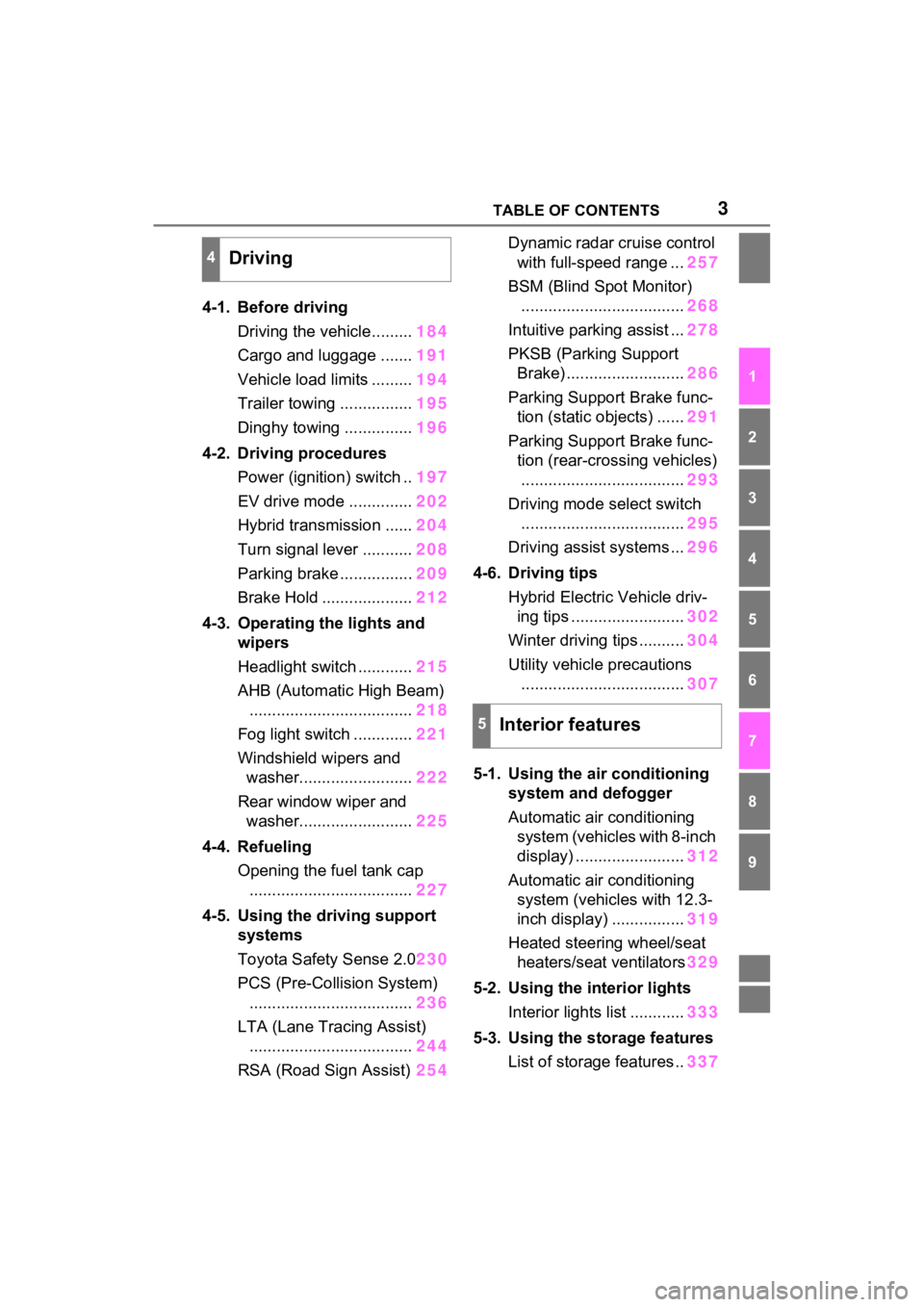
4-1. Before drivingDriving the vehicle......... 184
Cargo and luggage ....... 191
Vehicle load limits ......... 194
Trailer towing ................ 195
Dinghy towing ............... 196
4-2. Driving procedures Power (ignition) switch .. 197
EV drive mode .............. 202
Hybrid transmission ...... 204
Turn signal lever ........... 208
Parking brake ................ 209
Brake Hold .................... 212
4-3. Operating the lights and wipers
Headlight switch ............ 215
AHB (Automatic High Beam) .................................... 218
Fog light switch ............. 221
Windshield wipers and washer......................... 222
Rear window wiper and washer......................... 225
4-4. Refueling Opening the fuel tank cap.................................... 227
4-5. Using the driving support
systems
Toyota Safety Sense 2.0 230
PCS (Pre-Collision System) .................................... 236
LTA (Lane Tracing Assist) .................................... 244
RSA (Road Sign Assist) 254Dynamic radar cruise control
with full-speed range ... 257
BSM (Blind Spot Monitor) .................................... 268
Intuitive parking assist ... 278
PKSB (Parking Support Brake) .......................... 286
Parking Support Brake func- tion (static objects) ...... 291
Parking Support Brake func- tion (rear-crossing vehicles).................................... 293
Driving mode s elect switch
.................................... 295
Driving assist systems ... 296
4-6. Driving tips Hybrid Electric Vehicle driv-ing tips ......................... 302
Winter driving tips .......... 304
Utility vehicle precautions .................................... 307
5-1. Using the ai r conditioning
system and defogger
Automatic air conditioning system (vehicles with 8-inch
display) ........................ 312
Automatic air conditioning system (vehicl es with 12.3-
inch display) ................ 31
9
Heated stee
ring wheel/seat
heaters/seat ventilators 329
5-2. Using the interior lights Interior lights list ............ 333
5-3. Using the storage features List of storage features .. 337
4Driving
5Interior features
Page 17 of 548
17Pictorial index
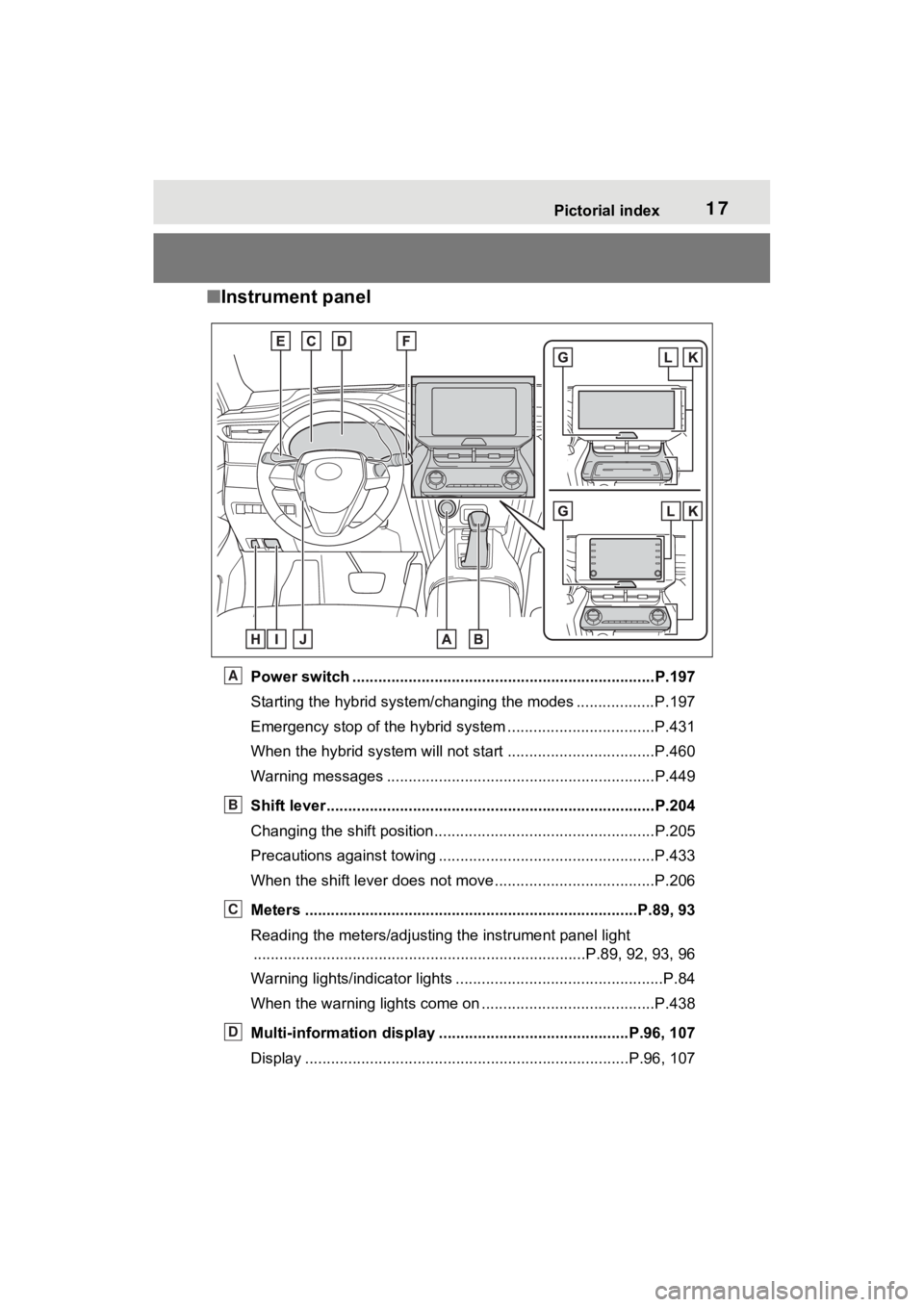
■Instrument panel
Power switch ................................................... ...................P.197
Starting the hybrid system/changing the modes .................. P.197
Emergency stop of the hybrid system ............................ ......P.431
When the hybrid system will not start .......................... ........P.460
Warning messages ..............................................................P.449
Shift lever.................................................... ........................P.204
Changing the shift position.................................... ...............P.205
Precautions against towing ..................................................P.433
When the shift lever does not move............................. ........P.206
Meters ......................................................... ....................P.89, 93
Reading the meters/adjusting the instrument panel light ............................................................... ..............P.89, 92, 93, 96
Warning lights/indicator lights ................................ ................P.84
When the warning lights come on ................................ ........P.438
Multi-information display . ...........................................P.96, 107
Display ........................................................ ...................P.96, 107A
B
C
D
Page 58 of 548
581-2. Child safety
buckle. Make sure that the
belt is not twisted.
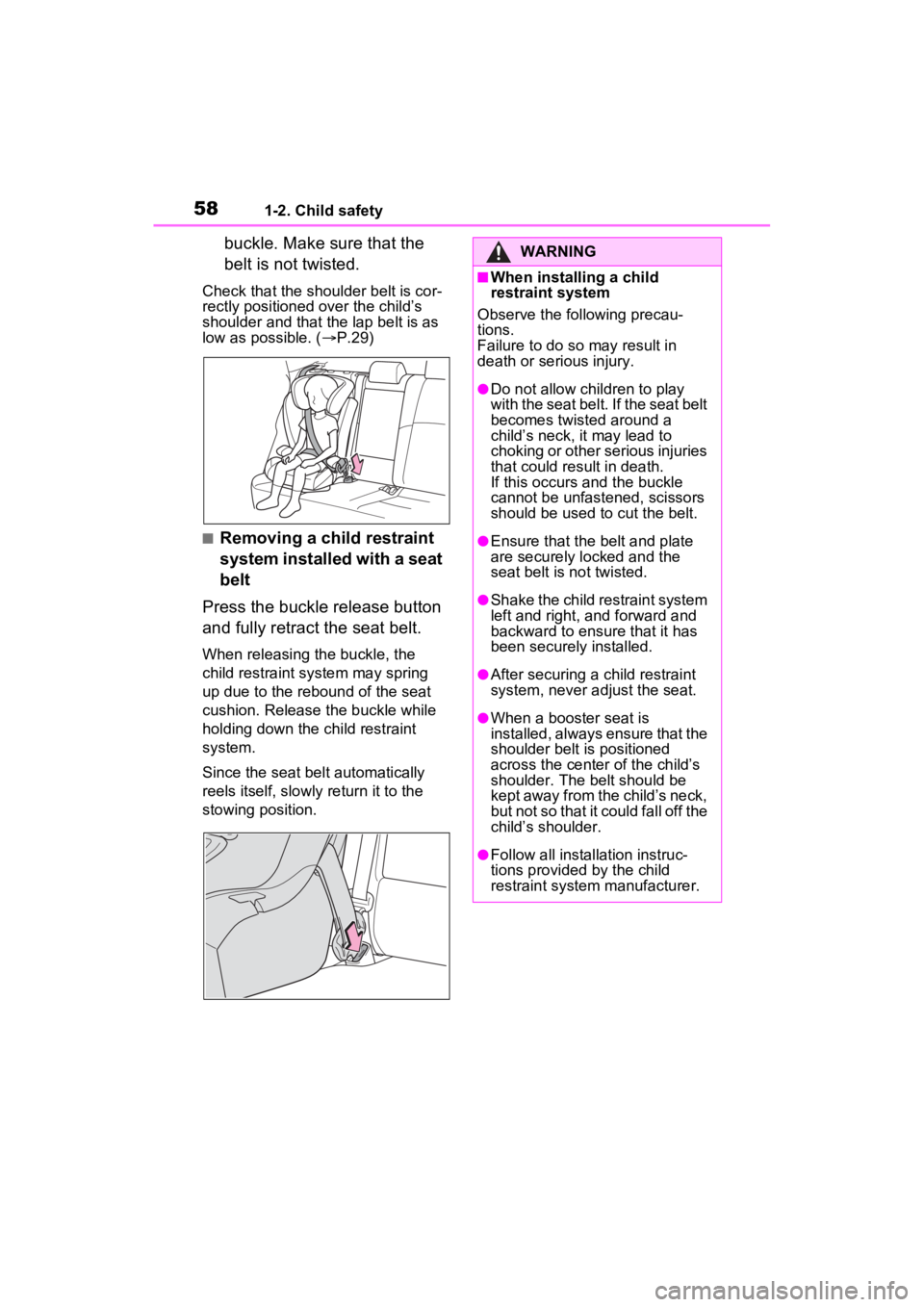
Check that the shoulder belt is cor-
rectly positioned over the child’s
shoulder and that the lap belt is as
low as possible. (P.29)
■Removing a child restraint
system installed with a seat
belt
Press the buckle release button
and fully retract the seat belt.
When releasing the buckle, the
child restraint system may spring
up due to the rebound of the seat
cushion. Release the buckle while
holding down the child restraint
system.
Since the seat belt automatically
reels itself, slowly return it to the
stowing position.
WARNING
■When installing a child
restraint system
Observe the following precau-
tions.
Failure to do so may result in
death or serious injury.
●Do not allow children to play
with the seat belt. If the seat belt
becomes twisted around a
child’s neck, it may lead to
choking or other serious injuries
that could result in death.
If this occurs and the buckle
cannot be unfastened, scissors
should be used to cut the belt.
●Ensure that the belt and plate
are securely locked and the
seat belt is not twisted.
●Shake the child restraint system
left and right, and forward and
backward to ensure that it has
been securely installed.
●After securing a child restraint
system, never adjust the seat.
●When a booster seat is
installed, always ensure that the
shoulder belt is positioned
across the center of the child’s
shoulder. The belt should be
kept away from the child’s neck,
but not so that it could fall off the
child’s shoulder.
●Follow all installation instruc-
tions provided by the child
restraint system manufacturer.
Page 69 of 548
691-3. Emergency assistance
1
For safety and security
cle’s location, assess the emer-
gency, and dispatch the
necessary assistance required.
If you accidentally press the “SOS”
button, tell the response-center
agent that you are not experiencing
an emergency.
■Enhanced Roadside Assis-
tance
Enhanced Roadside Assistance
adds GPS data to the already
included warranty-based Toyota
roadside service.
Subscribers can press the
“SOS” button to reach a Safety
Connect response-center agent,
who can help with a wide range
of needs, such as: towing, flat
tire, fuel delivery, etc. For a
description of the Enhanced
Roadside Assistance services
and their limitations, please see
the Safety Connect Terms and
Conditions, which are available
at Toyota.com in the United
States, Toyotapr.com in Puerto
Rico and Toyota.ca in Canada.
Important! Read this informa-
tion before using Safety Con-
nect.
■Exposure to radio fre-
quency signals
The Safety Connect system
installed in your vehicle is a low-
power radio transmitter and receiver. It receives and also
sends out radio frequency (RF)
signals.
In August 1996, the Federal
Communications Commission
(FCC) adopted RF exposure
guidelines with safety levels for
mobile wireless phones. Those
guidelines are consistent with
the safety standards previously
set by the following U.S. and
international standards bodies.
ANSI (American National
Standards Institute) C95.1
[1992]
NCRP (National Council on
Radiation Protection and
Measurement) Report 86
[1986]
ICNIRP (International Com-
mission on Non-Ionizing Radi-
ation Protection) [1996]
Those standards were based on
comprehensive and periodic
evaluations of the relevant sci-
entific literature. Over 120 scien-
tists, engineers, and physicians
from universities, and govern-
ment health agencies and
industries reviewed the avail-
able body of research to
develop the ANSI Standard
(C95.1).
The design of Safety Connect
complies with the FCC guide-
lines in addition to those stan-
dards.
Safety information for
Safety Connect
Page 76 of 548
761-4. Hybrid system
WARNING
●If electric wires are exposed
inside or outside your vehicle,
an electric shock may occur.
Never touch exposed electric
wires.
●Do not touch the battery if liquid
is leaking from or adhering to it.
If electrolyte (carbonic-based
organic electrolyte) from the
hybrid battery (traction battery)
comes into contact with the
eyes or skin, it could cause
blindness or skin wounds. In the
unlikely event that it comes into
contact with the eyes or skin,
wash it off immediately with a
large amount of water, and seek
immediate medical attention.
●If electrolyte is leaking from the
hybrid battery (traction battery),
do not approach the vehicle.
Even in the unlikely event that
the hybrid battery (traction bat-
tery) is damaged, the internal
construction of the battery will
prevent a large amount of elec-
trolyte from leaking out. How-
ever, any electrolyte that does
leak out will give off a vapor.
This vapor is an irritant to skin
and eyes and could cause acute
poisoning if inhaled.
●Do not bring burning or high-
temperature items close to the
electrolyte.
The electrolyte may ignite and
cause a fire.
●If a fire occurs in the Hybrid
Electric Vehicle, leave the vehi-
cle as soon as possible. Never
use a fire extinguisher that is
not meant for electric fires.
Using even a small amount of
water may be dangerous.
●If your vehicle needs to be
towed, do so with four wheels
raised. If the wheels connected
to the electric motor (traction
motor) are on the ground when
towing, the motor may continue
to generate electricity. This may
cause a fire. ( P.433)
●Carefully inspect the ground
under the vehicle. If you find
that liquid has l eaked onto the
ground, the fuel system may
have been damaged. Leave the
vehicle as soon as possible.
■Hybrid battery (traction bat-
tery)
●Never resell, hand over or mod-
ify the hybrid battery. To prevent
accidents, hybrid batteries that
have been removed from a dis-
posed vehicle are collected
through Toyota dealer. Do not
dispose of the battery yourself.
●Your vehicle contains a sealed
lithium-ion battery.
Unless the battery is properly col-
lected, the following may occur,
resulting in dea th or serious
injury:
• The hybrid batte ry may be ille-
gally disposed of or dumped,
and it is hazardous to the envi-
ronment or someone may touch
a high voltage part, resulting in
an electric shock.
• The hybrid battery is intended to be used exclusively with your
Hybrid Electric Vehicle. If the
hybrid battery is used outside of
your vehicle or modified in any
way, accidents such as electric
shock, heat generation, smoke
generation, an explosion and
electrolyte leakage may occur.
Page 179 of 548
1783-4. Adjusting the steering wheel and mirrors
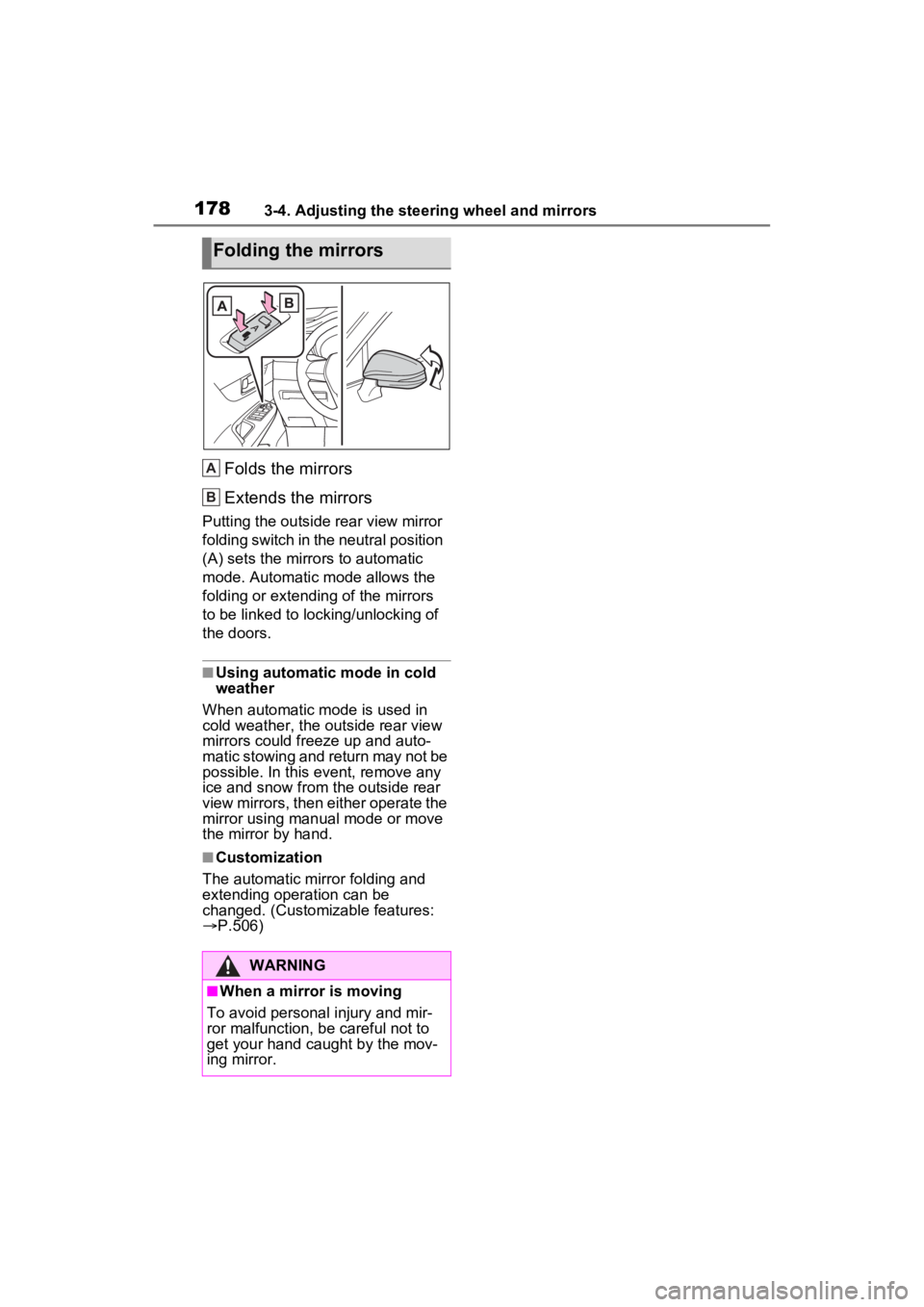
Folds the mirrors
Extends the mirrors
Putting the outside rear view mirror
folding switch in the neutral position
(A) sets the mirrors to automatic
mode. Automatic mode allows the
folding or extending of the mirrors
to be linked to locking/unlocking of
the doors.
■Using automatic mode in cold
weather
When automatic mode is used in
cold weather, the outside rear view
mirrors could free ze up and auto-
matic stowing and return may not be
possible. In this event, remove any
ice and snow from the outside rear
view mirrors, then either operate the
mirror using manual mode or move
the mirror by hand.
■Customization
The automatic mirror folding and
extending operation can be
changed. (Customizable features:
P.506)
Folding the mirrors
WARNING
■When a mirror is moving
To avoid personal injury and mir-
ror malfunction, be careful not to
get your hand caught by the mov-
ing mirror.
A
B
Page 183 of 548
183
4
4
Driving
Driving
4-1. Before drivingDriving the vehicle....... 184
Cargo and luggage ..... 191
Vehicle load limits ....... 194
Trailer towing .............. 195
Dinghy towing ............. 196
4-2. Driving procedures Power (ignition) switch 197
EV drive mode ............ 202
Hybrid transmission .... 204
Turn signal lever ......... 208
Parking brake .............. 209
Brake Hold .................. 212
4-3. Operating the lights and wipers
Headlight switch .......... 215
AHB (Automatic High Beam)........................ 218
Fog light switch ........... 221
Windshield wipers and washer....................... 222
Rear window wiper and washer....................... 225
4-4. Refueling Opening the fuel tank cap.................................. 227
4-5. Using the driving support
systems
Toyota Safety Sense 2.0 .................................. 230PCS (Pre-Collision System)
.................................. 236
LTA (Lane Tracing Assist) .................................. 244
RSA (Road Sign Assist) .................................. 254
Dynamic radar cruise con- trol with full-speed range.................................. 257
BSM (Blind Spot Monitor) .................................. 268
Intuitive parking assist . 278
PKSB (Parking Support Brake) ........................ 286
Parking Support Brake func- tion (static objects)
.................................. 291
Parking Support Brake function (rear-crossing
vehicles) .................... 293
Driving mode select switch .................................. 295
Driving assist systems. 296
4-6. Driving tips Hybrid Electric Vehicle driv-ing tips ....................... 302
Winter driving tips........ 304
Utility vehicle precautions .................................. 307
Page 193 of 548
1934-1. Before driving
4
Driving
there will be five 150 lb passen-
gers in your vehicle, the amount
of available cargo and luggage
load capacity is 650 lbs. (1400 -
750 (5 150) = 650 lbs.)
(5) Determine the combined
weight of luggage and cargo
being loaded on the vehicle.
That weight may not safely
exceed the available cargo and
luggage load capacity calcu-
lated in Step 4.
(6) If your vehicle will be towing
a trailer, load from your trailer
will be transferred to your vehi-
cle. Consult this manual to
determine how this reduces the
available cargo and luggage
load capacity of your vehicle.
( P.194)
Toyota does not recommend
towing a trailer with your vehicle.
Your vehicle is not designed for
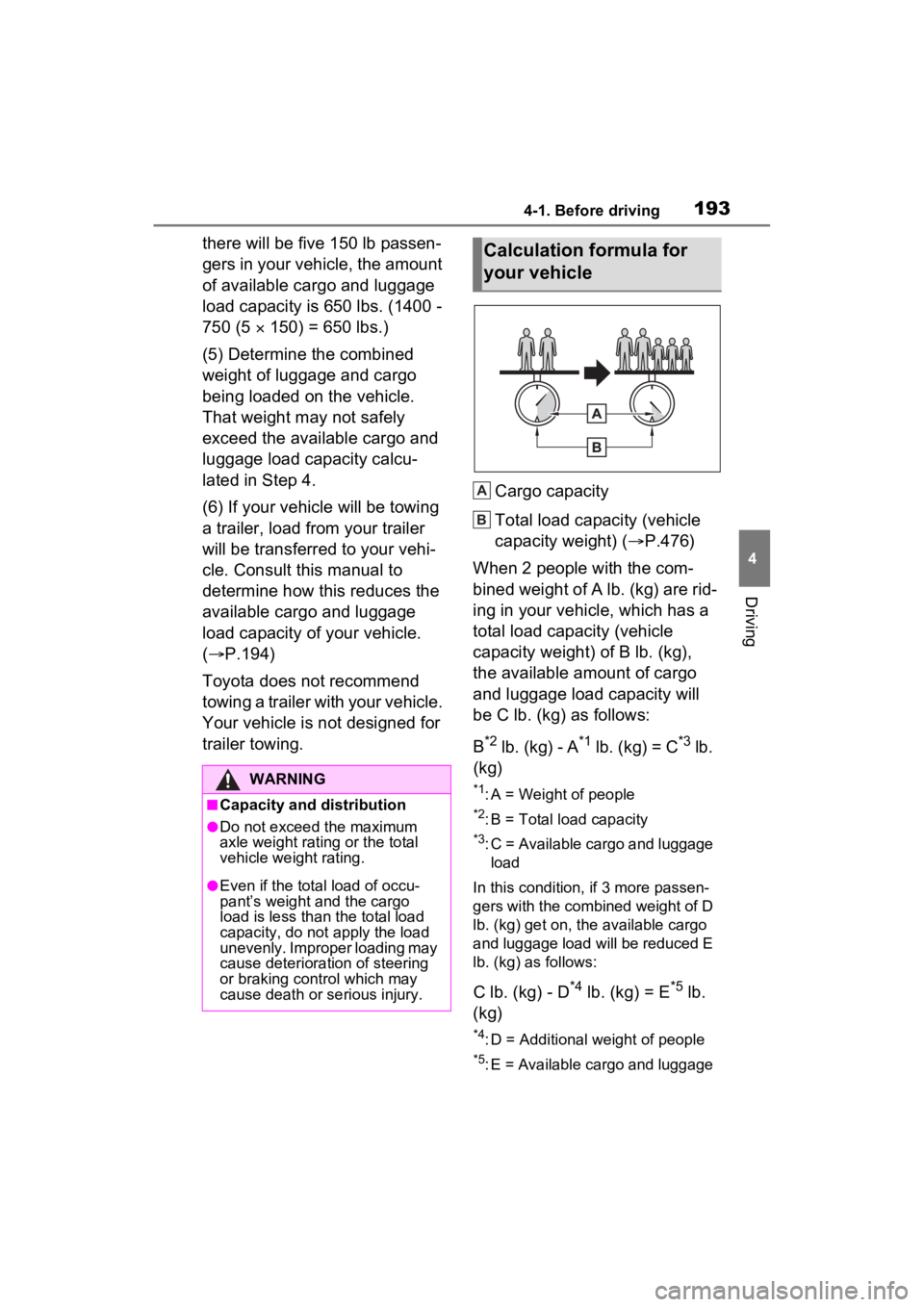
trailer towing. Cargo capacity
Total load capacity (vehicle
capacity weight) (
P.476)
When 2 people with the com-
bined weight of A lb. (kg) are rid-
ing in your vehicle, which has a
total load capacity (vehicle
capacity weight) of B lb. (kg),
the available amount of cargo
and luggage load capacity will
be C lb. (kg) as follows:
B
*2 lb. (kg) - A*1 lb. (kg) = C*3 lb.
(kg)
*1: A = Weight of people
*2: B = Total load capacity
*3: C = Available cargo and luggage load
In this condition, if 3 more passen-
gers with the combined weight of D
lb. (kg) get on, the available cargo
and luggage load will be reduced E
lb. (kg) as follows:
C lb. (kg) - D*4 lb. (kg) = E*5 lb.
(kg)
*4: D = Additional weight of people
*5: E = Available cargo and luggage
WARNING
■Capacity and distribution
●Do not exceed the maximum
axle weight rating or the total
vehicle weight rating.
●Even if the tota l load of occu-
pant’s weight and the cargo
load is less than the total load
capacity, do not apply the load
unevenly. Improper loading may
cause deteriorat ion of steering
or braking control which may
cause death or serious injury.
Calculation formula for
your vehicle
A
B