Page 455 of 592
4556-3. Do-it-yourself maintenance
6
Maintenance and care
SEQUOIA_OM_USA_OM0C047U
Turn the bulb bases counter-
clockwise.Stop/tail and rear side
marker light
Rear turn signal light
Remove the light bulb. Stop/tail and rear side
marker light
Rear turn signal light
When installing, reverse the steps listed.2
3
4
Page 456 of 592
4566-3. Do-it-yourself maintenance
SEQUOIA_OM_USA_OM0C047U■
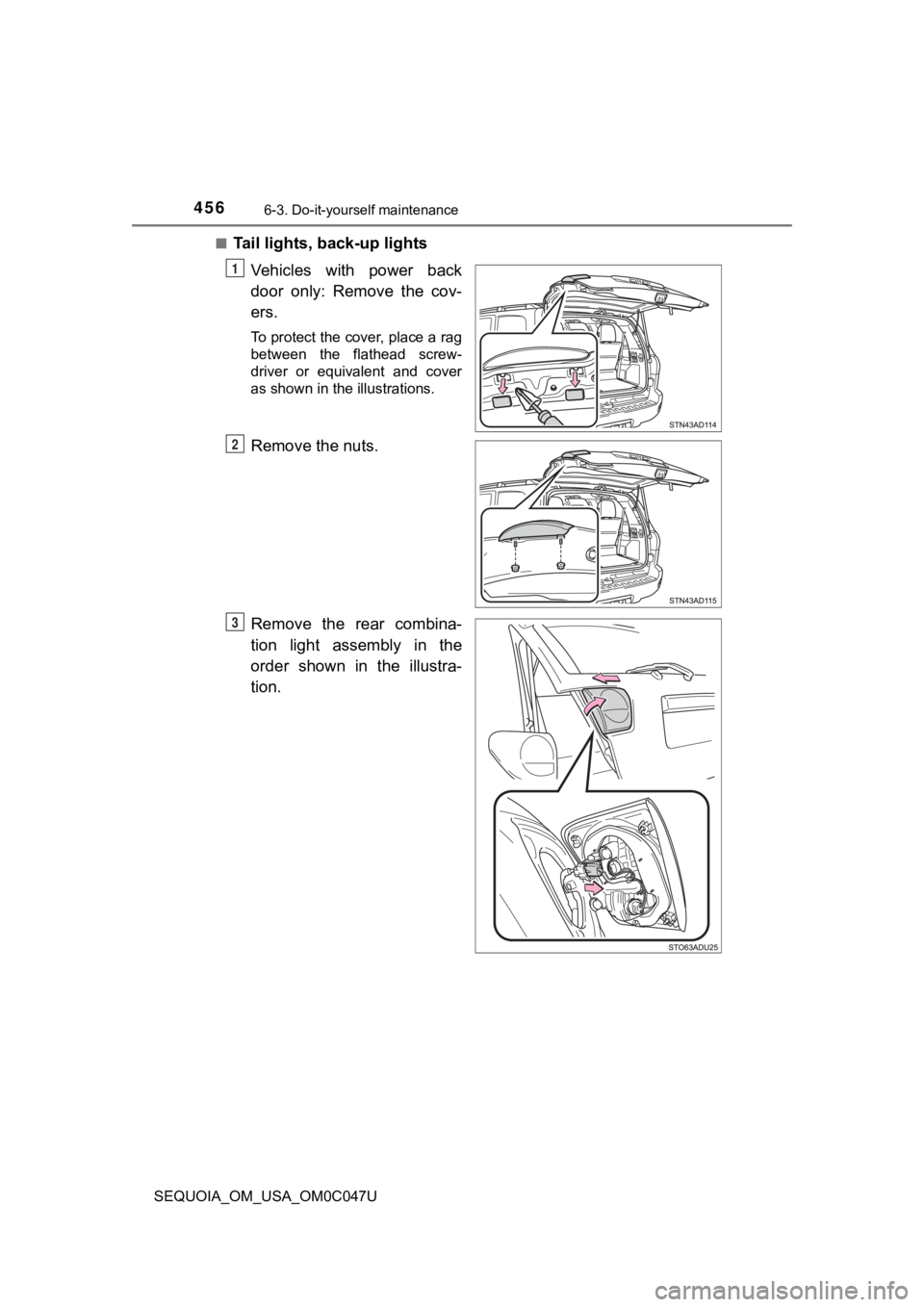
Tail lights, back-up lights
Vehicles with power back
door only: Remove the cov-
ers.
To protect the cover, place a rag
between the flathead screw-
driver or equivalent and cover
as shown in the illustrations.
Remove the nuts.
Remove the rear combina-
tion light assembly in the
order shown in the illustra-
tion.
1
2
3
Page 457 of 592
4576-3. Do-it-yourself maintenance
6
Maintenance and care
SEQUOIA_OM_USA_OM0C047U
Turn the bulb base counter-
clockwise.Tail light
Back-up light
Remove the light bulb. Tail light
Back-up light
When installing, reverse the steps listed.4
5
6
Page 458 of 592
4586-3. Do-it-yourself maintenance
SEQUOIA_OM_USA_OM0C047U■
License plate lights
Remove the screws and
lens.
Remove the light bulb.
When installing, reverse the steps listed.
1
2
3
Page 459 of 592

4596-3. Do-it-yourself maintenance
6
Maintenance and care
SEQUOIA_OM_USA_OM0C047U■
Replacing the following bulbs
If any of the lights listed below has burnt out, have it replac
ed by
your Toyota dealer.
● Headlight low beams
● Headlight high beams
● Front side marker lights
● Daytime running lights
● Parking lights
● Front turn signal lights
● Front fog lights
● Side turn signal lights (if equipped)
● High mounted stoplight
● Outer foot lights (if equipped)
■LED light bulbs
The following lights consist of a number of LEDs. If any LEDs burn out, take
your vehicle to your Toyota dealer to have the light replaced.
●Headlight low beams
● Headlight high beams
● Front side marker lights
● Daytime running lights
● Parking lights
● Front turn signal lights
● Front fog lights
● Side turn signal lights (if equipped)
● High mounted stoplight
● Outer foot lights (if equipped)
■ Condensation build-up on the inside of the lens
Temporary condensation build-up on the inside of the lens does not indicate a
malfunction. Contact your Toyota dealer for more information in the following
situations:
● Large drops of water have built up on the inside of the lens.
● Water has built up inside the lens.
Page 460 of 592

4606-3. Do-it-yourself maintenance
SEQUOIA_OM_USA_OM0C047U
WARNING
■Replacing light bulbs
● Turn off the lights. Do not attempt to replace the bulb immediately after
turning off the lights.
The bulbs become very hot and may cause burns.
● Do not touch the glass portion of the light bulb with bare hand s. When it is
unavoidable to hold the glass portion, use and hold with a clea n dry cloth
to avoid getting moisture and oils on the bulb.
Also, if the bulb is scratched or dropped, it may blow out or crack.
● Fully install light bulbs and any parts used to secure them. Failure to do so
may result in heat damage, fire, or water entering the headligh t unit. This
may damage the headlights or cause condensation to build up on the lens.
● Do not attempt to repair or disassemble light bulbs, connectors , electric
circuits or component parts.
Doing so may result in death or serious injury due to electric shock.
■ To prevent damage or fire
● Make sure bulbs are fully seated and locked.
● Check the wattage of the bulb before installing to prevent heat damage.
Page 479 of 592

4797-2. Steps to take in an emergency
7
When trouble arises
SEQUOIA_OM_USA_OM0C047U
WARNING
■Maintenance of the tires
Each tire, including the spare (if provided), should be checked monthly
when cold and inflated to the inflation pressure recommended by the
vehicle manufacturer on the vehicle placard or tire inflation p ressure
label (tire and load information label). (If your vehicle has t ires of a dif-
ferent size than the size indicated on the vehicle placard or t ire inflation
pressure label [tire and load information label], you should de termine
the proper tire inflation p ressure for those tires.)
As an added safety feature, your vehicle has been equipped with a tire
pressure monitoring system (TPMS -tire pressure warning system) that
illuminates a low tire pressure telltale (tire pressure warning light) when
one or more of your tires is significantly under-inflated. Acco rdingly,
when the low tire pressure telltale (tire pressure warning ligh t) illumi-
nates, you should stop and check your tires as soon as possible , and
inflate them to the proper pressure. Driving on a significantly under-
inflated tire causes the tire to overheat and can lead to tire failure.
Under-inflation also reduces fuel efficiency and tire tread lif e, and may
affect the vehicle’s handling and stopping ability.
Please note that the TPMS (tire pressure warning system) is not a sub-
stitute for proper tire maintenance, and it is the driver’s res ponsibility to
maintain correct tire pressure, even if under-inflation has not reached
the level to trigger illumination of the TPMS low tire pressure telltale (tire pressure warning light).
Your vehicle has also been equipped with a TPMS (tire pressure warn-
ing system) malfunction indicato r to indicate when the system is not
operating properly. The TPMS (tire pressure warning system) mal func-
tion indicator is combined with the low tire pressure telltale (tire pressure
warning light). When the system detects a malfunction, the tell tale will
flash for approximately one minute and then remain continuously illumi-
nated. This sequence will continue upon subsequent vehicle star t-ups
as long as the malfunction exists . When the malfunction indicator is illu-
minated, the system may not be able to detect or signal low tir e pres-
sure as intended.
TPMS (tire pressure warning system) malfunctions may occur for a vari-
ety of reasons, including the installation of replacement or alternate tires
or wheels on the vehicle that prevent the TPMS (tire pressure w arning
system) from functioning properly. Always check the TPMS (tire pres-
sure warning system) malfunction telltale after replacing one or more
tires or wheels on your vehicle to ensure that the replacement or alter-
nate tires and wheels allow the TPMS (tire pressure warning system) to
continue to function properly.
Page 485 of 592

4857-2. Steps to take in an emergency
7
When trouble arises
SEQUOIA_OM_USA_OM0C047U
Indicates the following:• The brake fluid level is low; or
• The brake system is malfunctioning.
Immediately stop the vehicle in a safe place
and contact your Toyota dealer.
Indicates remaining fuel is approximately 4.0 gal.
(15.0 L, 3.3 Imp.gal.) or less
A buzzer also sounds.
Refuel the vehicle.
Indicates that the tire inflation pressure is low
Check the tire inflation pressure, and
adjust to the appropriate level.
Indicates that the washer fluid level is low
Add washer fluid.
Indicates that intuitive parking assist sensor is
dirty or covered with ice (if equipped)
Clean the sensor.
Indicates that the headlight switch is in or
position (with the key removed and the
driver’s door opened) A buzzer also sounds.
Turn the lights off.
Indicates that the moon roof is not fully closed
(with the engine switch off, and the driver’s door
open)
A buzzer also sounds.
Close the moon roof.
Indicates that all maintenance according to the
driven distance on the maintenance schedule
*
should be performed soon.
Comes on approximately 4500 miles (7200 km)
after the message has been reset.
If necessary, perfo rm maintenance.
Warning messageDetails/Actions
Check Brake System
Fuel Low
Tire Pressure Low
Check Tire
Windshield
Washer Fluid Low
Clean Parking Assist Sensor
Turn Lights Off
(Flashes)
Moon Roof Open
(Flashes)
Maintenance
Required Soon