2022 TOYOTA PROACE VERSO engine warning
[x] Cancel search: engine warningPage 220 of 360

220
WARNI NG
Only use products recommended by TOYOTA or products of equivalent quality and specification.In order to optimise the operation of components as important as those in the braking system, TOYOTA selects and offers very specific products.
12 V battery
The battery does not require any maintenance.However, check regularly that the terminals are correctly tightened (versions without quick release terminals) and that the connections are clean.
NOTIC E
For more information on the precautions to take before any work on the 12 V battery, refer to the corresponding section.
WARNI NG
Versions equipped with Stop & Start are fitted with a 12 V lead-acid battery of specific technology and specification.Its replacement should be carried out only by any authorized Toyota retailer or Toyota authorized repairer, or any reliable repairer.
Passenger compartment
filter
Depending on the environment and the use of the vehicle (e.g. dusty atmosphere, city driving), change it twice as often, if necessary.
NOTIC E
A clogged passenger compartment filter can adversely affect air conditioning system performance and generate undesirable odours.
Air filter
Depending on the environment and the use of the vehicle (e.g. dusty atmosphere,
city driving), change it twice as often, if necessary.
Oil filter
Change the oil filter each time the engine oil is changed.
Particle filter (Diesel)
The start of clogging of the particle filter is indicated by the temporary lighting of this warning lamp, accompanied by an alert message.
As soon as the traffic conditions permit, regenerate the filter by driving at a speed of at least 60 km/h (37 mph) until the warning lamp goes off.
NOTIC E
If the warning lamp stays on, this indicates a low Diesel additive level.For more information on Checking levels, refer to the corresponding section.
NOTIC E
Following prolonged operation of the vehicle at very low speed or at idle, you may, in exceptional circumstances, notice the emission of water vapour at the exhaust while accelerating. This has no impact on the vehicle’s behaviour or the environment.
Page 222 of 360

222
Fitting different tyres on the front and rear axles can cause the VSC to mistime.Always mark the direction of rotation on the tyres that will be stored when fitting winter or summer tyres. Store them in a cool, dry place and away from direct exposure to the sun's rays.Winter or 4-seasons tyres can be identified by this symbol on their sidewalls.
Shock absorbers
It is not easy for drivers to detect when shock absorbers are worn. Nevertheless, the shock absorbers have a major impact on road holding and braking performance.For your safety and driving comfort, it is important to have them regularly checked by any authorized Toyota retailer or Toyota authorized repairer, or any reliable repairer.
Timing and accessory kits
The timing and accessory kits are used from the time the engine is started until it is switched off. It is normal for them to wear over time.A faulty timing or accessory kit can damage the engine, rendering it unusable. Observe the recommended replacement frequency, stated in distance travelled or time elapsed, whichever is reached first.
AdBlue® (Diesel engines)
To respect the environment and ensure compliance with the Euro 6 standard, without adversely affecting the performance or fuel consumption of its Diesel engines, TOYOTA has taken the decision to equip its vehicles with a system that associates SCR (Selective Catalytic Reduction) with a Diesel particle filter (DPF) for
the treatment of exhaust gases.
SCR system
Using a liquid called AdBlue® that contains urea, a catalytic converter turns up to 85% of the nitrogen oxides (NOx) into nitrogen and water, which are harmless to health and the environment.The AdBlue® is contained in a special tank holding about 20 litres.Its capacity allows a driving range of approximately 3,000 miles (5,000 km) (which may vary considerably depending on your driving style and the vehicle). An alert system is automatically triggered when the remaining range reaches 1,500 miles (2,400 km), i.e. once the reserve level has been reached.Several alerts are triggered successively during the remaining 1,500 miles (2,400 km) until the tank is empty and the vehicle is immobilised.If the estimated distance travelled by the vehicle between two services is greater than 3,000 miles (5,000 km), it will be necessary to top up the AdBlue.
NOTIC E
For more information on the Warning and indicator lamps and the associated alerts, or the Indicators, please refer to the corresponding sections.
WARNI NG
Once the AdBlue® tank is empty, a device required by law prevents the engine from being restarted.If the SCR system is faulty, the level of emissions from the vehicle will no longer meet the Euro 6 standard and the vehicle starts polluting the environment.In the event of a confirmed SCR system malfunction, it is essential to visit any authorized Toyota retailer or Toyota authorized repairer, or any reliable repairer. After 685 miles (1,100 km), a device is automatically activated to prevent the engine from starting.In both cases, a range indicator indicates the distance that can be travelled before the vehicle is stopped.
Page 229 of 360
229
In the event of a breakdown
8
Warning triangle
This reflective and dismantlable device is to be installed on the side of the road when a vehicle is broken down or damaged.
WARNI NG
Before getting out of the vehicleTurn on the hazard warning lamps, then put on the safety vest to assemble and install the triangle.
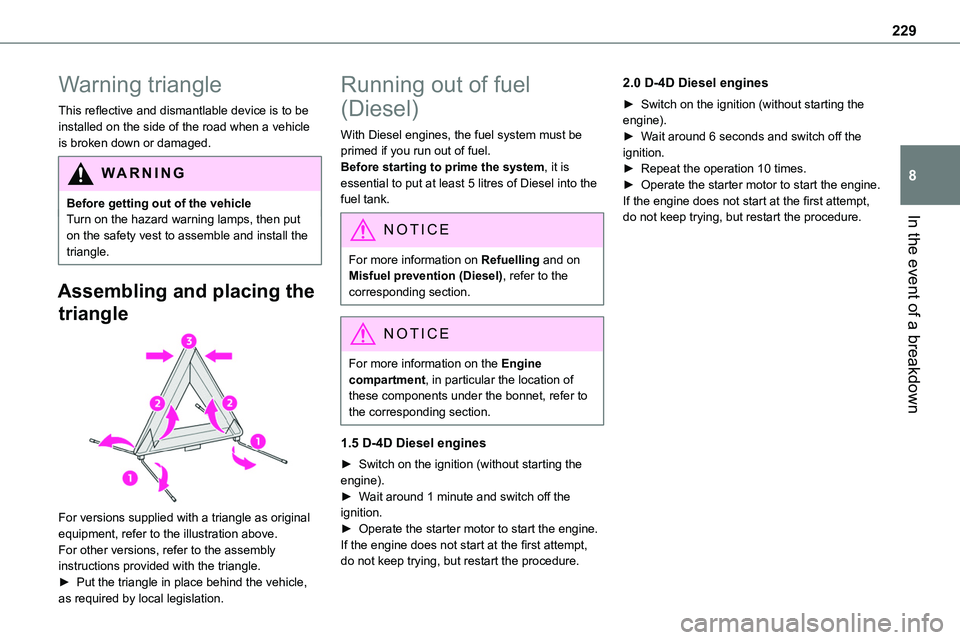
Assembling and placing the
triangle
For versions supplied with a triangle as original equipment, refer to the illustration above.For other versions, refer to the assembly instructions provided with the triangle.► Put the triangle in place behind the vehicle,
as required by local legislation.
Running out of fuel
(Diesel)
With Diesel engines, the fuel system must be primed if you run out of fuel.Before starting to prime the system, it is essential to put at least 5 litres of Diesel into the fuel tank.
NOTIC E
For more information on Refuelling and on Misfuel prevention (Diesel), refer to the corresponding section.
NOTIC E
For more information on the Engine compartment, in particular the location of these components under the bonnet, refer to the corresponding section.
1.5 D-4D Diesel engines
► Switch on the ignition (without starting the engine).► Wait around 1 minute and switch off the ignition.► Operate the starter motor to start the engine.If the engine does not start at the first attempt, do not keep trying, but restart the procedure.
2.0 D-4D Diesel engines
► Switch on the ignition (without starting the engine).► Wait around 6 seconds and switch off the ignition.► Repeat the operation 10 times.► Operate the starter motor to start the engine.If the engine does not start at the first attempt, do not keep trying, but restart the procedure.
Page 253 of 360
253
In the event of a breakdown
8
Towing constraints
Type of vehicle(engine/gearbox)Front wheels on the groundRear wheels on the groundFlatbed4 wheels on the ground with towbar
Internal combustion/Manual
Internal combustion/Automatic
Electric
NOTIC E
In case of battery or electric parking brake failure, it is essential to call a professional using flatbed recovery vehicles (excluding manual gearbox).
Accessing the eye
The towing eye is stowed in the tool box.
NOTIC E
For more information on the Tool box, refer to the corresponding section.
Towing your vehicle
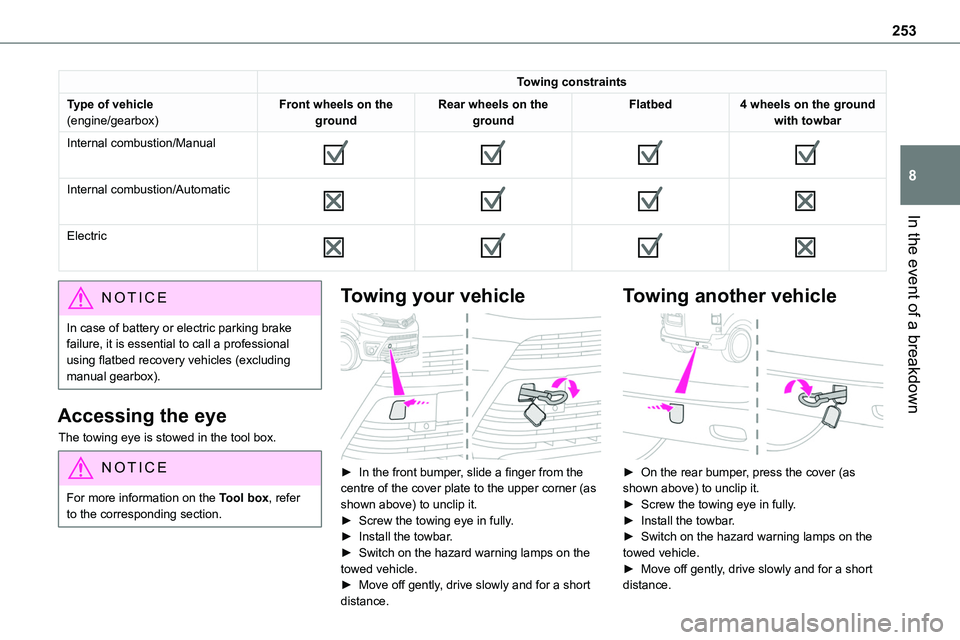
► In the front bumper, slide a finger from the centre of the cover plate to the upper corner (as shown above) to unclip it.► Screw the towing eye in fully.► Install the towbar.► Switch on the hazard warning lamps on the towed vehicle.
► Move off gently, drive slowly and for a short distance.
Towing another vehicle
► On the rear bumper, press the cover (as shown above) to unclip it.► Screw the towing eye in fully.► Install the towbar.► Switch on the hazard warning lamps on the towed vehicle.► Move off gently, drive slowly and for a short
distance.
Page 324 of 360

324
Changing the remote control battery 39Changing to free-wheeling 225, 252Charge level indicator (Electric) 22Charging cable 204Charging cable (Electric) 203Charging connector (Electric) 202, 208–209, 2 11Charging flap (Electric) 202, 208–209, 2 11
Charging system (Electric) 5, 9, 27, 200, 217Charging the traction battery (Electric) 21, 200, 208–209, 2 11Checking the engine oil level 19Checking the levels 217–219Checking tyre pressures (using the kit) 231–234Checks 216, 219–222Checks, routine 219–221Child lock 148–149Child lock on rear windows 149Children 121, 129, 135–136, 144, 144–145, 144–145Children (safety) 148Child seats 121, 125–126, 128–132, 145Child seats, conventional 128–132Child seats, i-Size 144–145Child seats, ISOFIX 135–136, 144, 144–145, 144–145Cleaning (advice) 201, 226–228Closing the boot 49Closing the doors 30, 36, 48Collision Risk Alert 186–187Compressor, tyre inflation 231
Configuration, vehicle 26–27Connected applications 306Connection, Bluetooth 273, 287–288, 307, 312–313Connection, Wi-Fi network 307–308Connectivity 306Consumption figures 27Container, AdBlue® 223
Control, emergency boot release 39Control, emergency door 31, 38–39Control, heated seats 57Control stalk, lighting 101Control stalk, wipers 106, 108Control unit 203–204Courtesy lamp 99Courtesy lamp, front 99–100, 244Courtesy lamp, rear 99–100, 244Courtesy lamps 99–100, 244Cover, load space 80Crew cab, fixed 74–75Crew cab, folding 75Cruise control 174, 176–177, 179–182Cruise control, adaptive 177, 182, 184–186Cruise control by speed limit recognition 176–177Cruise control, dynamic with Stop function 176–177Cup holder 76
D
DAB (Digital Audio Broadcasting) - Digital radio 269, 284, 310Date (setting) 29, 290, 316Daytime running lamps 103, 240–242Deactivating the passenger airbag 122, 127Deactivation of DSC (ESC) 11 5
Deadlocking 37Deferred charging 27, 210Deferred charging (Electric) 27–28, 202, 208Defrosting 59, 93Demisting 93Demisting, rear 93Demisting, rear screen 93Dimensions 261Dipstick 19, 217Direction indicators 102, 240–241, 243, 245Display, head-up 173–174Domestic charging 204Domestic charging (Electric) 209, 2 11, 259Door pockets 77Doors, rear 48Doors, side 44Doors, side-hinged 36–37, 48, 243Driver’s attention warning 190Drive selector (Electric) 166, 221Driving 150–151Driving aids camera (warnings) 172Driving aids (recommendations) 171Driving economically 8Driving modes 167
Page 325 of 360

325
Alphabetical index
Driving modes (Electric) 167Dynamic stability control (DSC) 11 5, 11 7–11 8
E
EBFD 11 4Eco-driving (advice) 8
ECO mode 167Economy mode 212Electric motor 5, 9, 27, 200, 213, 217, 248, 252, 259Electric windows 52Electronic brake force distribution (EBFD) 11 4–11 5Emergency braking assistance (EBA) 11 5Emergency call 11 2–11 3Emergency warning lamps 11 2, 229Emissions control system, SCR 21, 222Energy economy mode 212Energy flows 27Energy recovery 21, 166Engine 222Engine compartment 216Engine, Diesel 198, 216, 229, 255Engines 254Environment 8, 40, 96, 151
F
Fatigue detection 189–190
Filling the AdBlue® tank 219, 223Filling the fuel tank 199–200Filter, air 220Filter, oil 220Filter, particle 219–220Filter, passenger compartment 88, 220Finisher 239Fitting a wheel 237–239
Fitting roof bars 214Fittings, interior 76–77, 82Fittings, rear 82Flap, charging 210Flap, fuel filler 199–200Flap, removable 60–62Flashing indicators 102Floor cab 245Fluid, brake 218Fluid, engine coolant 218Fluid, power steering 218Foglamp, rear 101, 243, 245Foglamps, front 101, 242Foglamps, rear 101Frequency (radio) 309Fuel 8, 198Fuel consumption 8Fuel tank 198, 200Fusebox, dashboard 245Fusebox, engine compartment 245, 247Fuses 245–247
G
Gauge, fuel 198–200Gearbox, automatic 160, 162–166, 169, 221, 249Gearbox, manual 160–161, 169, 221Gear lever, automatic gearbox 162–165Gear lever, manual gearbox 161
Gear shift indicator ~ Gear efficiency indicator 161Glove box 76–77G.P.S. 302
H
Hazard warning lamps 11 2, 229headlamp adjustment 105Headlamp adjustment 105Headlamps, automatic dipping 104–105Headlamps, automatic illumination 103Headlamps, dipped beam 101, 240–241Headlamps, halogen 240–241Headlamps, main beam 101, 240–241Headlamps, Xenon 240Head restraints, front 55Head-up display 173–174Heated bench seat 56Heating 88–90, 93–96Heating, additional 50, 94–96Heating, programmable 28, 50, 94–96, 98High voltage 200
Page 326 of 360

326
Hill start assist 160–161Histogramme, fuel consumption 27–28Horn 11 4
I
Ignition 155–156, 314
Ignition on 156Immobiliser, electronic 152Indicator, AdBlue® range 20Indicator, coolant temperature 18–19Indicator, engine oil level 19Indicator lamps, operation 101Indicators, direction 102Inflating tyres 221, 264Inflating tyres and accessories (using the kit) 231–234Information, vehicle 320Infrared camera 172Instrument panel 10, 173Intelligent Traction Control 11 6Internet browser 303, 306ISOFIX 144, 144–145
J
Jack 235Jump starting 249
K
Key 30–31, 33–34, 36, 38Key, electronic 30, 156Keyless Entry and Starting 30–32, 34–37, 153, 155–156Key not recognised 156Key with remote control 36
Kit, hands-free 273, 287–288, 312Kit, puncture repair 232–234Kit, temporary puncture repair 231–234
L
Labels 6, 64Labels, identification 264Lane Departure Warning System (LDWS) 188–189Leather (care) 228Level, AdBlue® 219Level, brake fluid 218Level, Diesel additive 219–220Level, engine coolant 18–19, 218Level, engine oil 19, 217Level, headlamp wash 107Level, power steering fluid 218Levels and checks 216–219Level, screenwash fluid 107, 219Lighting 101Lighting dimmer 23Lighting, exterior 101
Lighting, guide-me home 103Lighting, interior 99, 106Lighting, mood 106Lighting, welcome 103–104Loading 81, 214Loading area fittings 80Load reduction mode 212Load restraint 81
Locating your vehicle 31Locking 30–31, 36Locking from the inside 40–42Locking the doors 40–41Low fuel level 198–200Lumbar 53, 57
M
Mains socket (domestic network) 203Maintenance (advice) 201, 226Maintenance, routine 173, 219, 222Manoeuvring aids (recommendations) 171Map reading lamps 99Markings, identification 264Massage function 57Mat 76–77, 173Memorising a speed 174Menu 286Menu, main 26, 267Menus (audio) 280–281, 295–296Menu short cuts 26Messages 314
Page 327 of 360

327
Alphabetical index
Messages, quick 314Minimum traction battery charge level (Electric) 22Mirror, rear view 59Mirrors, door 58–59, 93, 191–192Misfuel prevention 200Mobile application 27–28, 98, 210Motor, electric 155, 217, 259
Mountings, ISOFIX 133, 144, 144–145MP3 CD 271
N
Navigation 300–302Navigation, connected 303–305Net, cargo 60–62Net, high load retaining 82–83Number plate lamps 244
O
Obstacle detection 192Oil change 217Oil consumption 217OIl, engine 217On-board tools 230–231Opening the bonnet 215–216Opening the boot 30–31, 49Opening the doors 30–31, 42–43Opening to 180° 48
P
Pads, brake 221Paint 227, 264Paint colour code 264Paint, matt 227Panoramic glass sunroof 84Parcel shelf, rear 78
Parking brake 157, 221Parking brake, electric 157–160, 221Parking sensors, audible and visual 192Parking sensors, front 193Parking sensors, rear 192Passenger compartment temperature pre-conditioning (Electric) 28, 98Pedestrian horn (Electric) 11 4, 151Plates, identification 264Player, Apple® 272, 285, 3 11Player, MP3 CD 271Player, USB 270, 284, 310Port, USB 79, 270, 284, 286, 305, 310Power 21Power indicator (Electric) 9, 21Power mode 167Pressures, tyres 221, 232, 234, 264Pre-tensioning seat belts 121Priming the fuel system 229Profiles 289, 315Protecting children 122, 125–127, 129, 135–136, 144, 144–145, 144–145Public fast charging station 203, 209Puncture 231–232, 234–235
R
Radar (warnings) 172Radio 267–268, 282, 284, 308–309Radio, digital (Digital Audio Broadcasting - DAB) 269, 284, 310Range, AdBlue 20, 219RDS 282, 309
Rear screen, demisting 93Recharging the battery 250Recharging the traction battery 204Recharging the traction battery (Electric) 200, 208–209, 2 11Recirculation, air 90–92Recovery 252Recovery of the vehicle 252Reduction of electrical load 212Regeneration of the particle filter 220Regenerative braking (deceleration by engine braking) 166Reinitialisation of the under-inflation detection system 171Reinitialising the remote control 40Reminder, key in ignition 155Reminder, lighting on 102Remote control 30–34, 36, 38, 152Remote functions 210Remotely operable functions (Electric) 28, 98Removing a wheel 237–239Removing the mat 76Replacing bulbs 239–240, 243, 245Replacing fuses 245–247