Page 395 of 556
3957-3. Do-it-yourself maintenance
Owners Manual_USA_M62084_en
7
Maintenance and care
Inverter coolant reservoir ( P.398)
Fuel cell stack coolant reservoir ( P.398)
Fuse boxes ( P.425)
Brake fluid reservoir ( P.399)
Washer fluid tank ( P.399)
Inverter coolant radiator ( P.398)
Electric cooling fan
Condenser ( P.398)
Fuel cell stack coolant radiator ( P.398)
■12-volt battery
P. 4 0 0
Fuel cell unit compartment
Components
Page 396 of 556
3967-3. Do-it-yourself maintenance
Owners Manual_USA_M62084_en
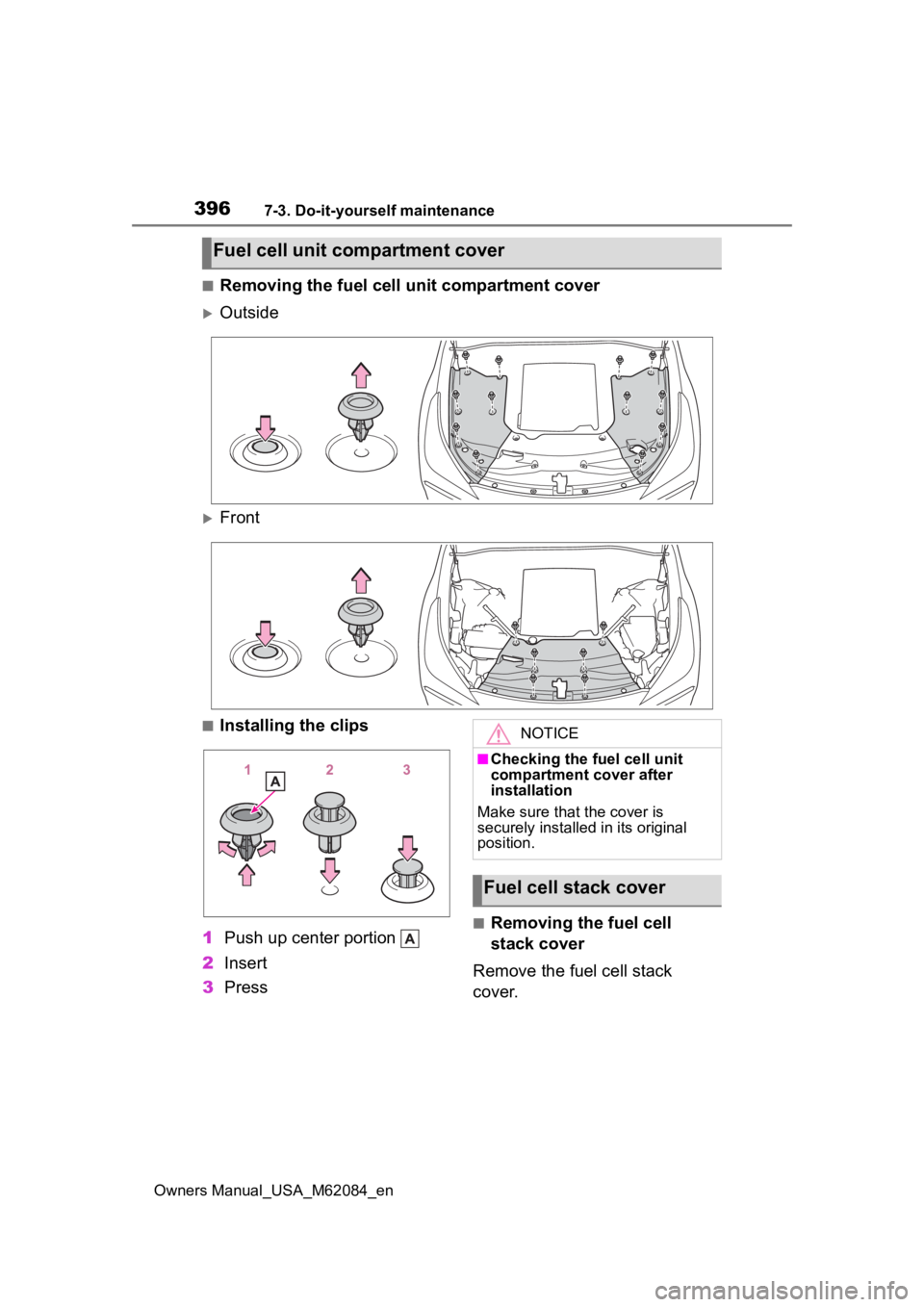
■Removing the fuel cell unit compartment cover
Outside
Front
■Installing the clips
1 Push up center portion
2 Insert
3 Press
■Removing the fuel cell
stack cover
Remove the fuel cell stack
cover.
Fuel cell unit compartment cover
NOTICE
■Checking the fuel cell unit
compartment cover after
installation
Make sure that the cover is
securely installed in its original
position.
Fuel cell stack cover
Page 397 of 556
3977-3. Do-it-yourself maintenance
Owners Manual_USA_M62084_en
7
Maintenance and care
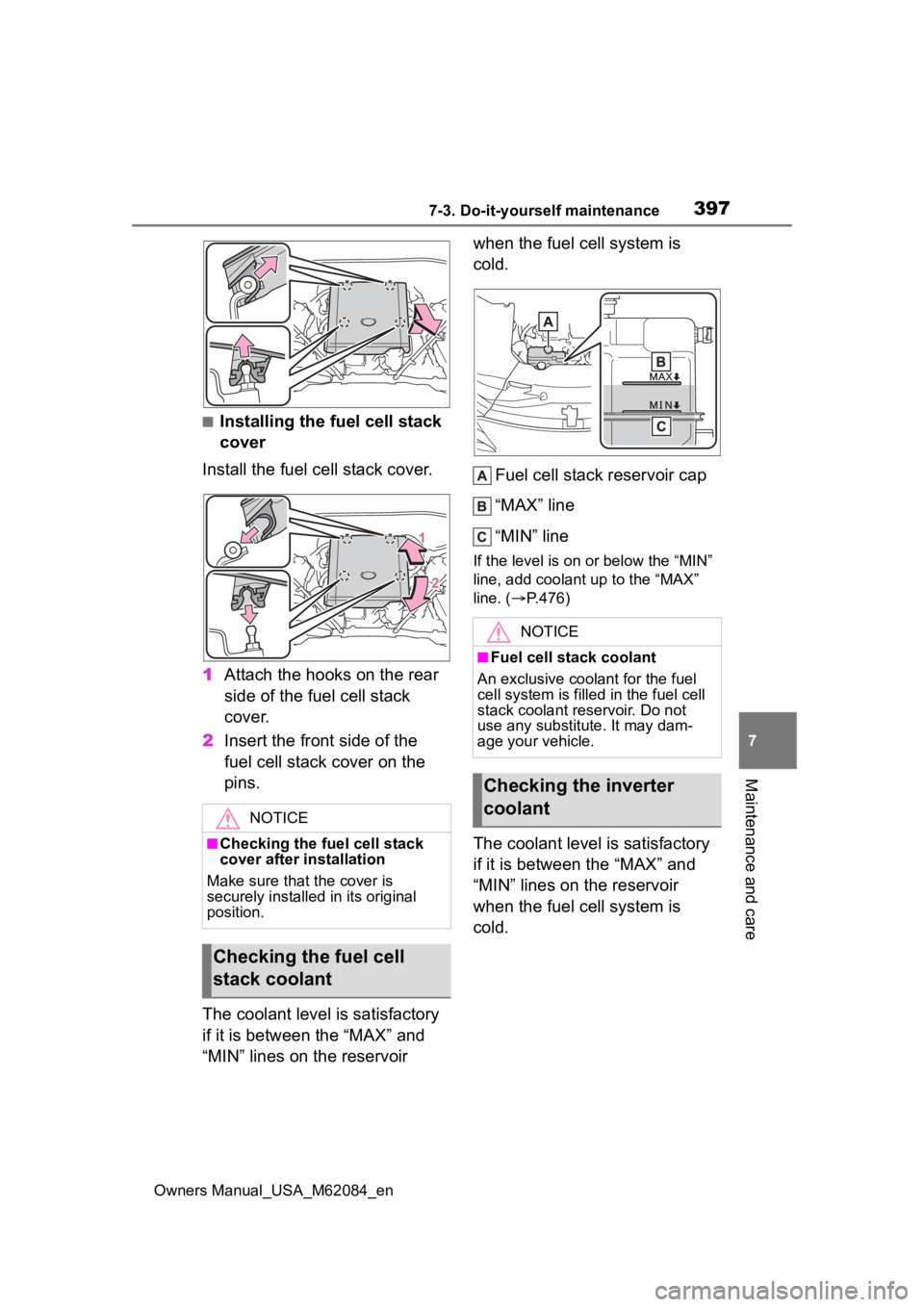
■Installing the fuel cell stack
cover
Install the fuel cell stack cover.
1 Attach the hooks on the rear
side of the fuel cell stack
cover.
2 Insert the front side of the
fuel cell stack cover on the
pins.
The coolant level is satisfactory
if it is between the “MAX” and
“MIN” lines on the reservoir when the fuel cell system is
cold.
Fuel cell stack reservoir cap
“MAX” line
“MIN” line
If the level is on or below the “MIN”
line, add coolant up to the “MAX”
line. ( P.476)
The coolant level is satisfactory
if it is between the “MAX” and
“MIN” lines on the reservoir
when the fuel cell system is
cold.
NOTICE
■Checking the fuel cell stack
cover after installation
Make sure that the cover is
securely installed in its original
position.
Checking the fuel cell
stack coolant
NOTICE
■Fuel cell stack coolant
An exclusive coola nt for the fuel
cell system is filled in the fuel cell
stack coolant reservoir. Do not
use any substitute. It may dam-
age your vehicle.
Checking the inverter
coolant
Page 398 of 556
3987-3. Do-it-yourself maintenance
Owners Manual_USA_M62084_en
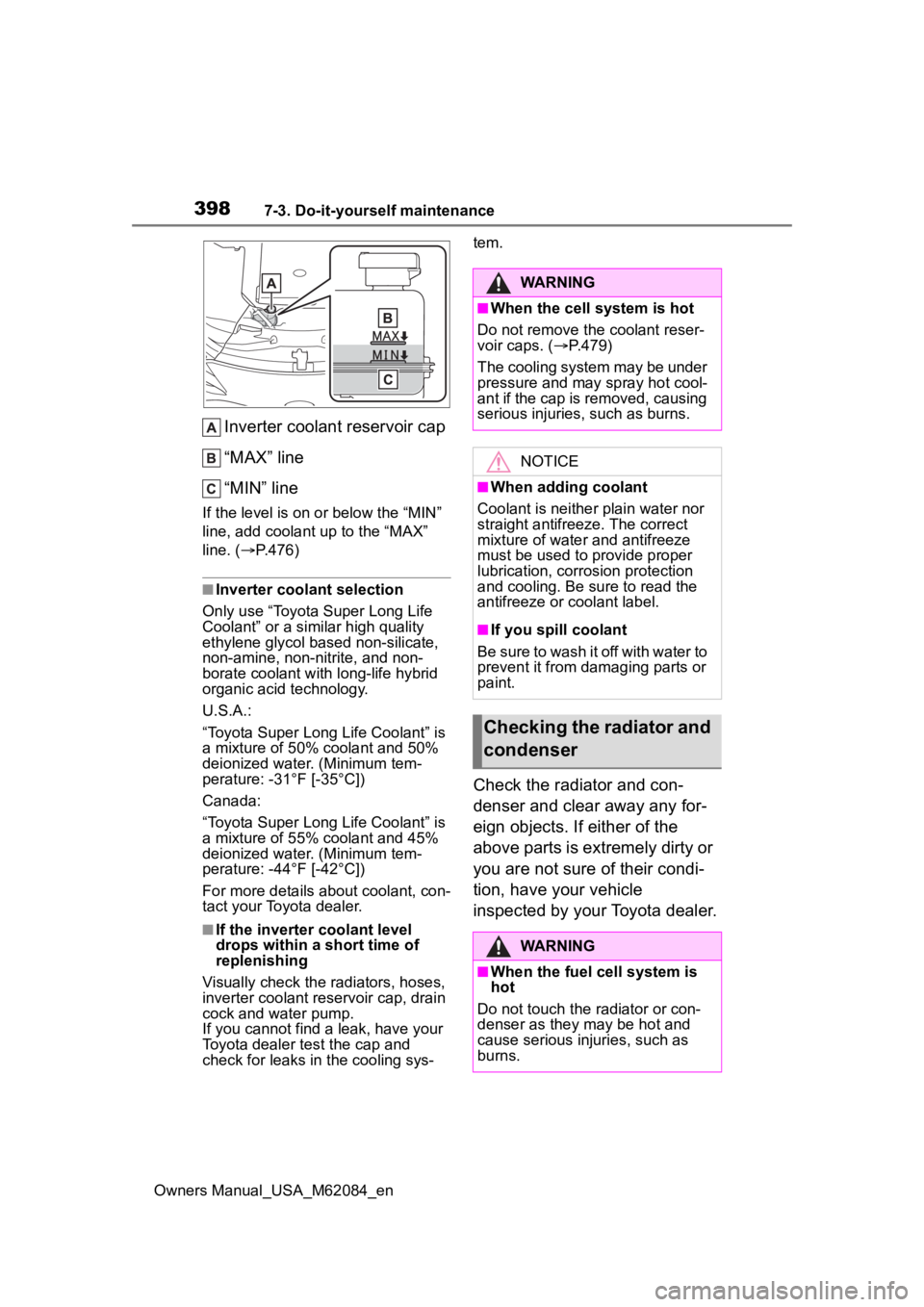
Inverter coolant reservoir cap
“MAX” line
“MIN” line
If the level is on or below the “MIN”
line, add coolant up to the “MAX”
line. (P.476)
■Inverter coolant selection
Only use “Toyota Super Long Life
Coolant” or a similar high quality
ethylene glycol based non-silicate,
non-amine, non-nitrite, and non-
borate coolant with long-life hybrid
organic acid technology.
U.S.A.:
“Toyota Super Long Life Coolant” is
a mixture of 50% coolant and 50%
deionized water. (Minimum tem-
perature: -31°F [-35°C])
Canada:
“Toyota Super Long Life Coolant” is
a mixture of 55% coolant and 45%
deionized water. (Minimum tem-
perature: -44°F [-42°C])
For more details about coolant, con-
tact your Toyota dealer.
■If the inverter coolant level
drops within a short time of
replenishing
Visually check the radiators, hoses,
inverter coolant reservoir cap, drain
cock and water pump.
If you cannot find a leak, have your
Toyota dealer test the cap and
check for leaks in the cooling sys- tem.
Check the radiator and con-
denser and clear away any for-
eign objects. If either of the
above parts is extremely dirty or
you are not sure of their condi-
tion, have your vehicle
inspected by your Toyota dealer.
WARNING
■When the cell system is hot
Do not remove the coolant reser-
voir caps. ( P.479)
The cooling system may be under
pressure and may spray hot cool-
ant if the cap is removed, causing
serious injuries, such as burns.
NOTICE
■When adding coolant
Coolant is neither plain water nor
straight antifreeze. The correct
mixture of water and antifreeze
must be used to provide proper
lubrication, corrosion protection
and cooling. Be sure to read the
antifreeze or coolant label.
■If you spill coolant
Be sure to wash it off with water to
prevent it from damaging parts or
paint.
Checking the radiator and
condenser
WARNING
■When the fuel cell system is
hot
Do not touch the radiator or con-
denser as they may be hot and
cause serious injuries, such as
burns.
Page 399 of 556
3997-3. Do-it-yourself maintenance
Owners Manual_USA_M62084_en
7
Maintenance and care
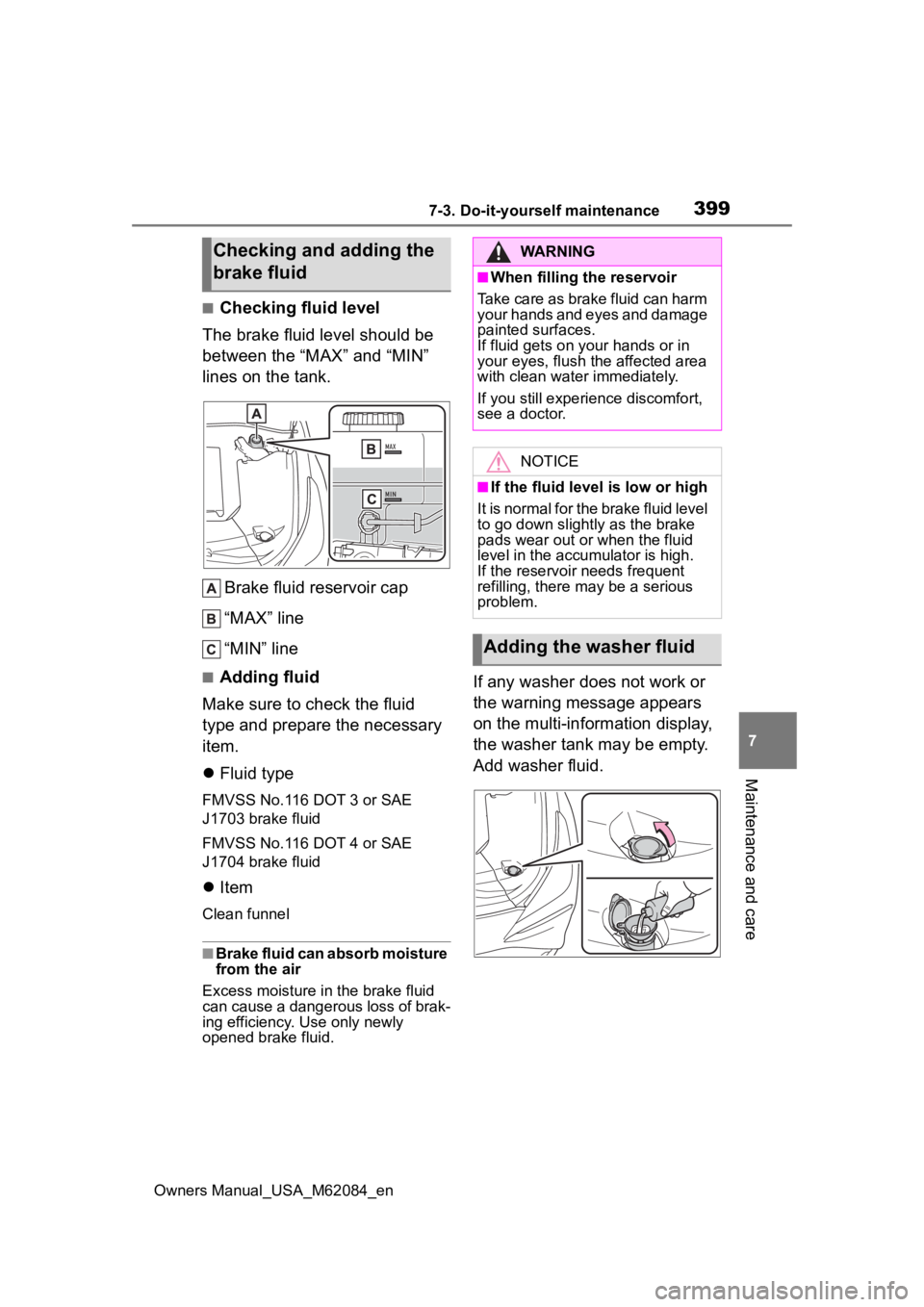
■Checking fluid level
The brake fluid level should be
between the “MAX” and “MIN”
lines on the tank.
Brake fluid reservoir cap
“MAX” line
“MIN” line
■Adding fluid
Make sure to check the fluid
type and prepare the necessary
item.
Fluid type
FMVSS No.116 DOT 3 or SAE
J1703 brake fluid
FMVSS No.116 DOT 4 or SAE
J1704 brake fluid
Item
Clean funnel
■Brake fluid can absorb moisture
from the air
Excess moisture in the brake fluid
can cause a dangerous loss of brak-
ing efficiency. Use only newly
opened brake fluid.
If any washer does not work or
the warning message appears
on the multi-information display,
the washer tank may be empty.
Add washer fluid.
Checking and adding the
brake fluidWARNING
■When filling the reservoir
Take care as brake fluid can harm
your hands and eyes and damage
painted surfaces.
If fluid gets on your hands or in
your eyes, flush the affected area
with clean water immediately.
If you still experi ence discomfort,
see a doctor.
NOTICE
■If the fluid level is low or high
It is normal for the brake fluid level
to go down slight ly as the brake
pads wear out or when the fluid
level in the accumulator is high.
If the reservoir needs frequent
refilling, there m ay be a serious
problem.
Adding the washer fluid
Page 400 of 556
4007-3. Do-it-yourself maintenance
Owners Manual_USA_M62084_en
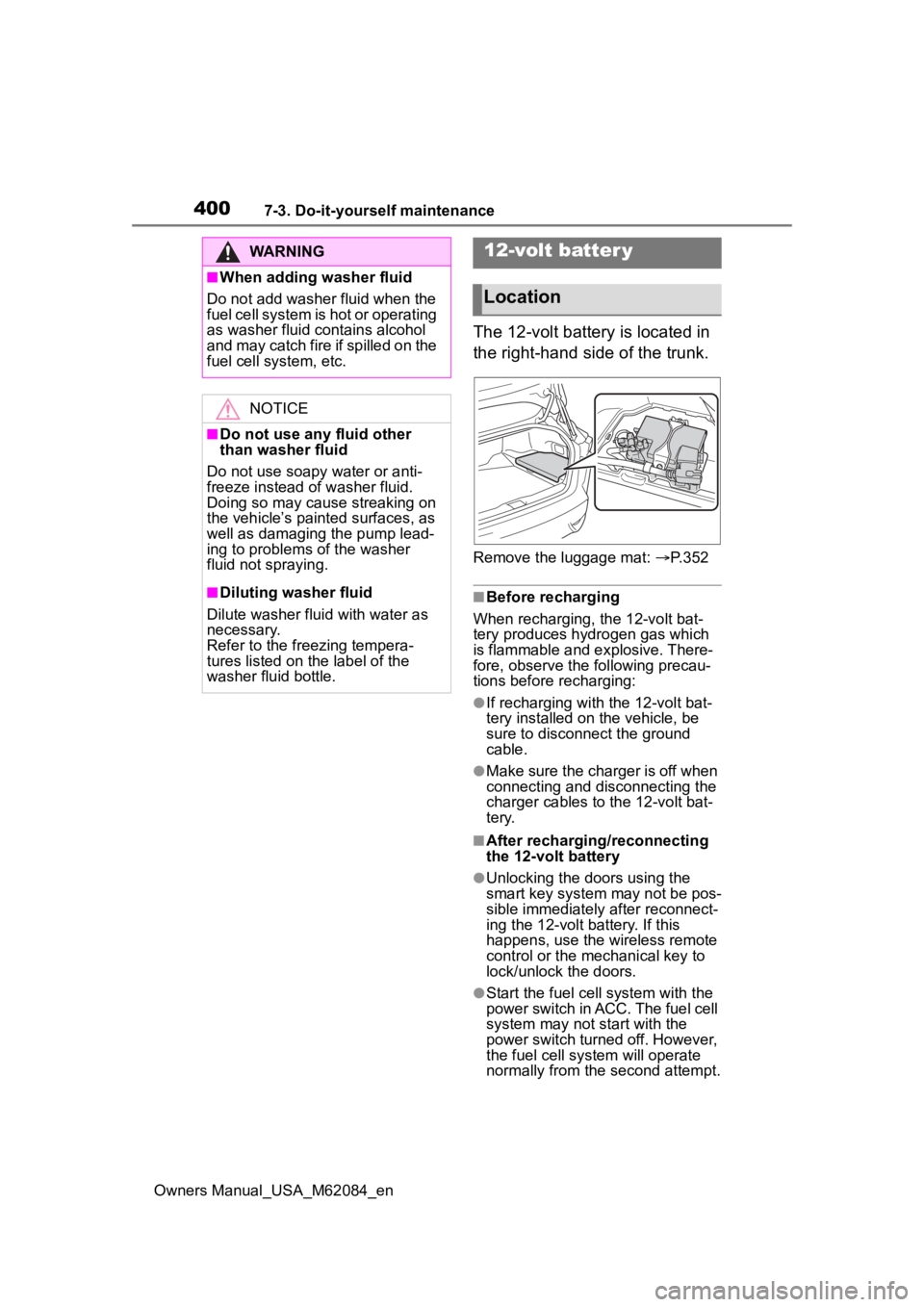
The 12-volt battery is located in
the right-hand side of the trunk.
Remove the luggage mat: P. 3 5 2
■Before recharging
When recharging, the 12-volt bat-
tery produces hydrogen gas which
is flammable and explosive. There-
fore, observe the following precau-
tions before recharging:
●If recharging with the 12-volt bat-
tery installed on the vehicle, be
sure to disconnect the ground
cable.
●Make sure the charger is off when
connecting and disconnecting the
charger cables to the 12-volt bat-
tery.
■After recharging/reconnecting
the 12-volt battery
●Unlocking the doors using the
smart key system may not be pos-
sible immediately after reconnect-
ing the 12-volt battery. If this
happens, use the wireless remote
control or the mechanical key to
lock/unlock the doors.
●Start the fuel cell system with the
power switch in ACC. The fuel cell
system may not start with the
power switch turned off. However,
the fuel cell system will operate
normally from the second attempt.
WARNING
■When adding washer fluid
Do not add washer fluid when the
fuel cell system is hot or operating
as washer fluid contains alcohol
and may catch fire if spilled on the
fuel cell system, etc.
NOTICE
■Do not use any fluid other
than washer fluid
Do not use soapy water or anti-
freeze instead of washer fluid.
Doing so may cause streaking on
the vehicle’s painted surfaces, as
well as damaging the pump lead-
ing to problems of the washer
fluid not spraying.
■Diluting washer fluid
Dilute washer fluid with water as
necessary.
Refer to the freezing tempera-
tures listed on the label of the
washer fluid bottle.
12-volt batter y
Location
Page 401 of 556
4017-3. Do-it-yourself maintenance
Owners Manual_USA_M62084_en
7
Maintenance and care
●The power switch mode is
recorded by the vehicle. If the 12-
volt battery is reconnected, the
vehicle will return the power
switch mode to the status it was in
before the 12-volt battery was dis-
connected. Make sure to turn off
the power switch before discon-
necting the 12-volt battery. Take
extra care when connecting the
12-volt battery if the power switch
mode prior to discharge is
unknown.
●When the 12-volt b attery is recon-
nected, start the fuel cell system,
depress the brake pedal, and con-
firm that it is possible to shift into
each shift position.
If the system will not start even after
multiple attempts, contact your Toy-
ota dealer.
WARNING
■Chemicals in the 12-volt bat-
tery
The 12-volt battery contains poi-
sonous and corrosi ve sulfuric acid
and may produce hydrogen gas
which is flammable and explosive.
To reduce the risk of death or seri-
ous injury, take th e following pre-
cautions while working on or near
the 12-volt battery:
●Do not cause sparks by touch-
ing the 12-volt battery terminals
with tools.
●Do not smoke or light a match
near the 12-volt battery.
●Avoid contact with eyes, skin
and clothes.
●Never inhale or swallow electro-
lyte.
●Wear protective safety glasses
when working near the 12-volt
battery.
●Keep children away from the
12-volt battery.
■Where to safely charge the
12-volt battery
Always charge the 12-volt battery
in an open area. Do not charge
the 12-volt battery in a garage or
closed room where there is insuf-
ficient ventilation.
■Emergency measures regard-
ing electrolyte
●If electrolyte gets in your eyes
Flush your eyes with clean
water for at least 15 minutes
and get immediate medical
attention. If possible, continue
to apply water with a sponge or
cloth while traveling to the near-
est medical facility.
●If electrolyte gets on your skin
Wash the affected area thor-
oughly. If you feel pain or burn-
ing, get medical attention
immediately.
●If electrolyte gets on your
clothes
It can soak through clothing on
to your skin. Imm ediately take
off the clothing and follow the
procedure above if necessary.
●If you accidentally swallow elec-
trolyte
Drink a large quantity of water
or milk. Get emergency medical
attention immediately.
■When replacing the 12-volt
battery
Use a 12-volt battery designed for
this vehicle. Failu re to do so may
cause gas (hydrogen) to enter the
passenger compartment, causing
a fire or explosion.
For replacement of the 12-volt
battery, contact your Toyota
dealer.
Page 402 of 556
4027-3. Do-it-yourself maintenance
Owners Manual_USA_M62084_en
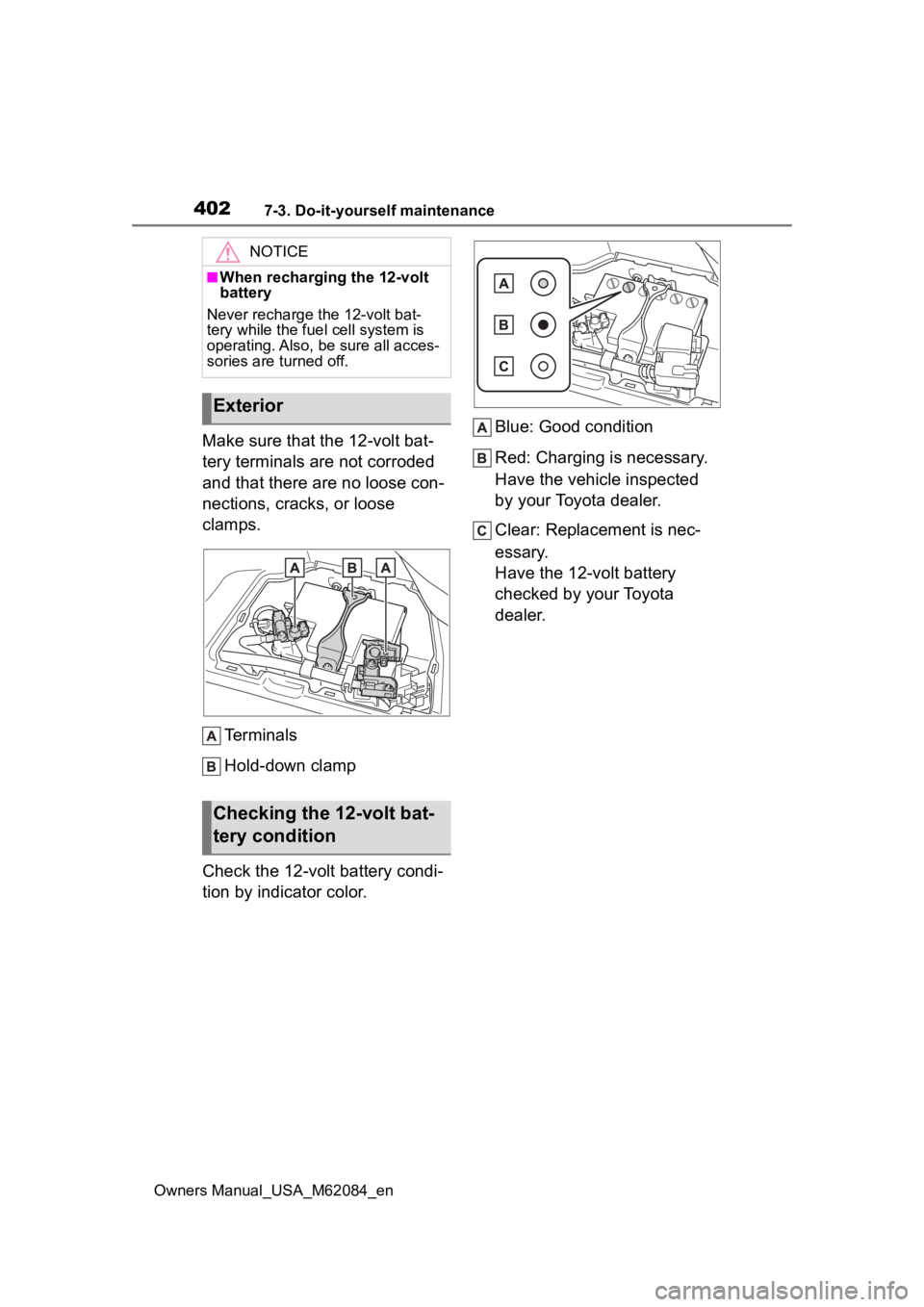
Make sure that the 12-volt bat-
tery terminals are not corroded
and that there are no loose con-
nections, cracks, or loose
clamps.
Terminals
Hold-down clamp
Check the 12-volt battery condi-
tion by indicator color. Blue: Good condition
Red: Charging is necessary.
Have the vehicle inspected
by your Toyota dealer.
Clear: Replacement is nec-
essary.
Have the 12-volt battery
checked by your Toyota
dealer.
NOTICE
■When recharging the 12-volt
battery
Never recharge the 12-volt bat-
tery while the fue l cell system is
operating. Also, be sure all acces-
sories are turned off.
Exterior
Checking the 12-volt bat-
tery condition