2022 TOYOTA MIRAI cooling
[x] Cancel search: coolingPage 335 of 556
3356-1. Using the air conditioning system and defogger
Owners Manual_USA_M62084_en
6
Interior features
mirror defoggers switch.
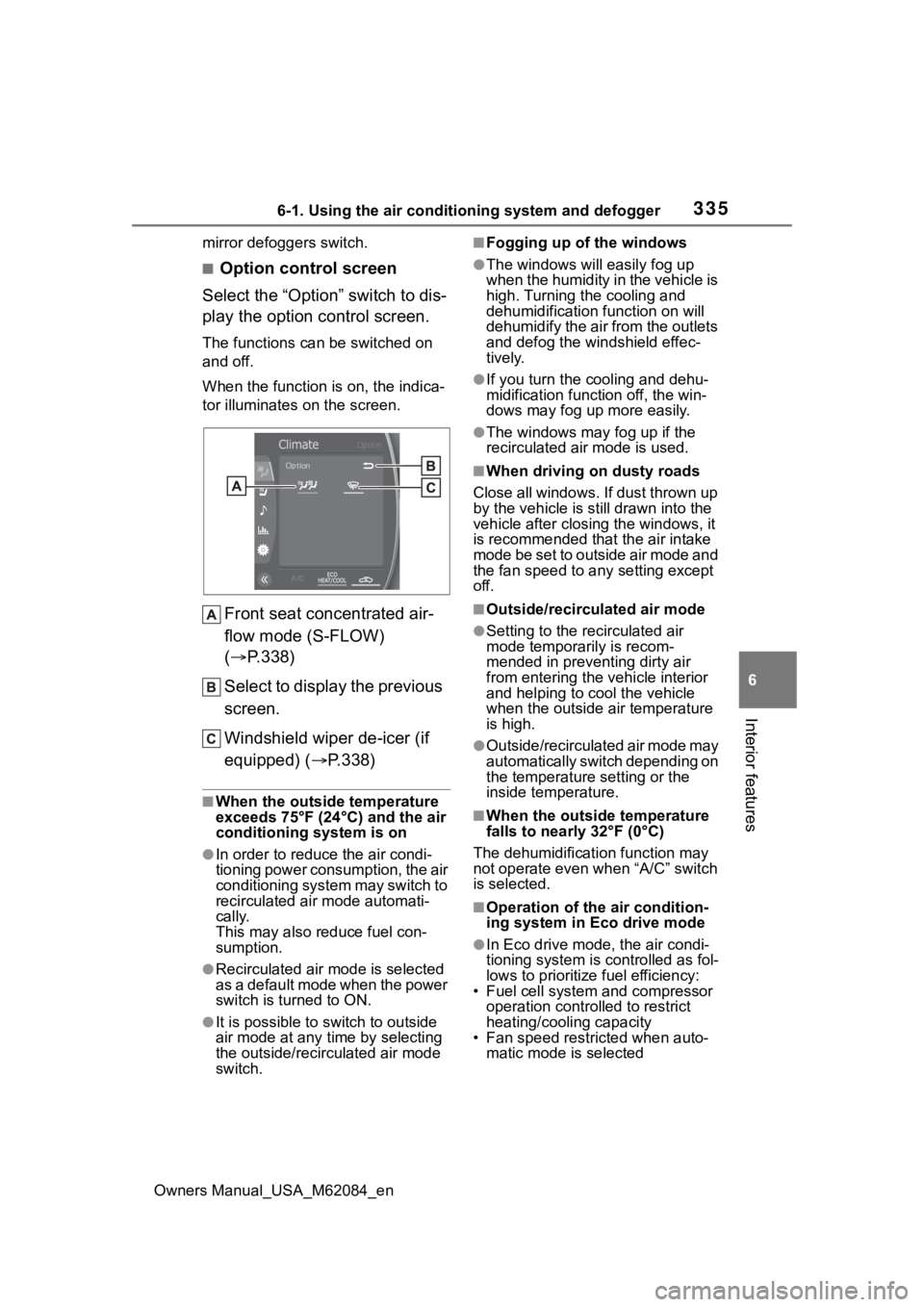
■Option control screen
Select the “Option” switch to dis-
play the option control screen.
The functions can be switched on
and off.
When the function i s on, the indica-
tor illuminates on the screen.
Front seat concentrated air-
flow mode (S-FLOW)
( P.338)
Select to display the previous
screen.
Windshield wiper de-icer (if
equipped) ( P.338)
■When the outside temperature
exceeds 75°F (24°C) and the air
conditioning system is on
●In order to reduce the air condi-
tioning power consumption, the air
conditioning system may switch to
recirculated air mode automati-
cally.
This may also reduce fuel con-
sumption.
●Recirculated air mode is selected
as a default mode when the power
switch is turned to ON.
●It is possible to switch to outside
air mode at any time by selecting
the outside/recirculated air mode
switch.
■Fogging up of the windows
●The windows will easily fog up
when the humidity in the vehicle is
high. Turning the cooling and
dehumidification function on will
dehumidify the air from the outlets
and defog the windshield effec-
tively.
●If you turn the cooling and dehu-
midification function off, the win-
dows may fog up more easily.
●The windows may fog up if the
recirculated air mode is used.
■When driving on dusty roads
Close all windows. If dust thrown up
by the vehicle is still drawn into the
vehicle after closing the windows, it
is recommended that the air intake
mode be set to outside air mode and
the fan speed to a ny setting except
off.
■Outside/recirculated air mode
●Setting to the recirculated air
mode temporarily is recom-
mended in preventing dirty air
from entering the vehicle interior
and helping to c ool the vehicle
when the outside air temperature
is high.
●Outside/recirculated air mode may
automatically switch depending on
the temperature setting or the
inside temperature.
■When the outside temperature
falls to nearly 32°F (0°C)
The dehumidification function may
not operate even when “A/C” switch
is selected.
■Operation of the air condition-
ing system in Eco drive mode
●In Eco drive mode, the air condi-
tioning system is controlled as fol-
lows to prioritize fuel efficiency:
• Fuel cell system and compressor
operation controlled to restrict
heating/cooling capacity
• Fan speed restri cted when auto-
matic mode is selected
Page 365 of 556
3656-4. Using the other interior features
Owners Manual_USA_M62084_en
6
Interior features
3 Disconnect each plug from
the power outlets.
4 Close the lid of each power
outlet.
■The power outlet can be used
when
The READY indicato r is illuminated.
■Electronic devices that can be
connected to the power outlets
Use electronic devices in which the
total power cons umption of all
devices connected to the 120 VAC
power outlets is less than 1500 W.
Depending on the device being
used, the current flow may become
high and the electric power for a
moment may exce ed the regulated
capacity. If the regulated capacity is
exceeded by the electronic devices
being used, the protection function
of the power outlet may operate and
power outlet may not be able to be
used, but this is not a malfunction.
However, observe th e following pre-
cautions:
●Depending on the devices used, it
may cause interference with TV
and radio broadcasts.
●Observe the precautions that are
stated in the instruction manuals
for each of the electronic devices.
●It is assumed th at many typical
general electronic devices will not
be used within th e vehicle. The
following problems may occur
when using electronic devices
within the vehicle.
• Electronic device malfunction due to vibrations while driving.
• Electronic device malfunction or poor operations due to tempera-
ture changes
* within the vehicle.
• The installation is unstable and
may not operate normally as the
compartment within the vehicle is
not flat.
*: Depending on the weather, sea- son, usage environm
ent, etc., the
vehicle compartment may
undergo extreme high or low tem-
peratures.
■Power Outlet
●The power outlet is a device in
order to use ele ctronic devices
within the vehicle.
●While a power outlet is being
used, a cooling fan sound may be
heard from near a rear seat. This
does not indicate a malfunction.
■Devices which may not operate
correctly
The following 120 VAC devices may
not operate properly even if their
power consumption is less than
1500 W:
●Devices with high initial peak watt-
age
●Measuring devices that process
precise data
●Devices that require an extremely
stable power supply
●Devices that require a constant
power supply from the power out-
let, such as a device with a timer.
■When the power supply func-
tion cannot be used
If the AC120V switch is pressed but
the switch indicator does not illumi-
nate, the protection circuit may have
operated.
In this case, perform the appropriate
procedures as follows.
●Disconnect the plug of each
device from the power outlets,
check that the total power con-
sumption of all de vices to be con-
nected to the power outlets is less
than 1500 W, reconnect the
devices and then press the
AC120V switch again.
●Disconnect the plug of each
device from the power outlets,
check that the devices are not
malfunctioning, reconnect the
Page 367 of 556
3676-4. Using the other interior features
Owners Manual_USA_M62084_en
6
Interior features
WARNING
●Do not use damaged electronic
devices. The power supply
function may not be able to be
used.
●Do not disconnect the plug of a
device while your hands are wet
or insert a pin o r other object
into the pow er outlet. Also, if a
liquid or snow is on the power
outlet, dry the outlet before
using it.
●Do not attempt to modify, disas-
semble or repair a power outlet.
For information on repairs, con-
tact your Toyota dealer.
●Do not let children touch the
power outlets.
●Keep the power outlets free of
dust and foreign matter. Also,
regularly clean the power outlet.
●If the plug of a device fits
loosely in a pow er outlet, even
though it is fully inserted,
replace the power outlet. For
information on replacement,
contact your Toyota dealer.
■Using the power outlets while
parked or stopped
Observe the following precau-
tions.
Failure to do so may lead to an
accident, possibly resulting in
death or serious injury.
●Make sure to engage the park-
ing brake and shift the shift posi-
tion to P.
●Do not leave the vehicle unat-
tended while the READY indica-
tor is illuminated and a device is
connected to a power outlet.
●Do not place luggage or get
near the vicinity of the tailpipe.
●Make sure that the hood is
closed. Do not put your head or
hands anywhere inside the fuel
cell unit room, as the cooling
fans may operate suddenly. If
too close, hands and clothing
(especially a tie, scarf, etc.) may
get caught in a fan.
●Do not stop the vehicle near
objects which burn easily.
●Install and use appropriately
related devices to make air sup-
ply and exhaust ventilation pos-
sible in places where ventilation
is bad, such as within garages,
and places where the vehicle is
surrounded (places where snow
accumulates).
●Do not use in places where ven-
tilation is bad, such as within
garages where there are no air
supply and exhaust ventilation
devices, and places where the
vehicle is surrounded (places
where snow accumulates, etc.).
●Do not use the power outlets if
the vehicle has a vehicle cover
installed.
●Do not sleep in the vehicle while
using devices such as an elec-
tric heater.
■Devices to be connected
●Read the instruction manual
included with the electronic
device being used and observe
the precautions that are stated
regarding the product.
●Do not use when the power plug
or electronic device are dam-
aged.
●Malfunctions or poor operations
may occur when the outside
temperatures are particularly
high or low.
Page 392 of 556
3927-3. Do-it-yourself maintenance
Owners Manual_USA_M62084_en
Tire inflation
pressure
( P.415)• Tire pressure
gauge
• Compressed air source
Washer fluid
( P.399)
• Water or washer
fluid containing
antifreeze (for
winter use)
• Funnel (used only for adding
water or washer
fluid)
WARNING
The fuel cell unit compartment
contains many mechanisms and
fluids that may move suddenly,
become hot, or become electri-
cally energized. To avoid death or
serious injury, observe the follow-
ing precautions.
■When working on the fuel cell
unit compartment
●Be careful not to touch the high-
voltage parts or hydrogen-
related parts.
●Make sure that the “READY”
indicator is off.
●Keep hands, clothing and tools
away from the moving fan.
●Be careful not to touch the
motor, inverter, radiator, etc.
right after driving as they may
be hot. Coolant and other fluids
may also be hot.
●Do not leave anything that may
burn easily, such as paper and
rags, in the fuel cell unit com-
partment.
ItemsParts and tools●Do not smoke, cause sparks or
expose an open flame to the 12-
volt battery. 12-volt battery
fumes are flammable.
●Be extremely cautious when
working on the 12-volt battery. It
contains poisonous and corro-
sive sulfuric acid.
●Take care because brake fluid
can harm your hands or eyes
and damage painted surfaces. If
fluid gets on your hands or in
your eyes, flush the affected
area with clean water immedi-
ately.
If you still experience discom-
fort, consult a doctor.
●Never touch, disassemble,
remove or replace the high-volt-
age parts, cables and their con-
nectors. It can cause severe
burns or electric shock that may
result in death or serious injury.
■When working near the elec-
tric cooling fan or radiator
grille
Be sure the power switch is off.
With the power switch in ON, the
electric cooling fa n may automati-
cally start to run if the air condi-
tioning is on and/or the coolant
temperature is high. ( P.398)
■Safety glasses
Wear safety glasses to prevent
flying or falling material, fluid
spray, etc. from getting in your
eyes.
NOTICE
■If you remove the air cleaner
filter
Driving with the air cleaner filter
removed may cause excessive
motor wear due to dirt in the air.
Page 395 of 556

3957-3. Do-it-yourself maintenance
Owners Manual_USA_M62084_en
7
Maintenance and care
Inverter coolant reservoir ( P.398)
Fuel cell stack coolant reservoir ( P.398)
Fuse boxes ( P.425)
Brake fluid reservoir ( P.399)
Washer fluid tank ( P.399)
Inverter coolant radiator ( P.398)
Electric cooling fan
Condenser ( P.398)
Fuel cell stack coolant radiator ( P.398)
■12-volt battery
P. 4 0 0
Fuel cell unit compartment
Components
Page 398 of 556
3987-3. Do-it-yourself maintenance
Owners Manual_USA_M62084_en
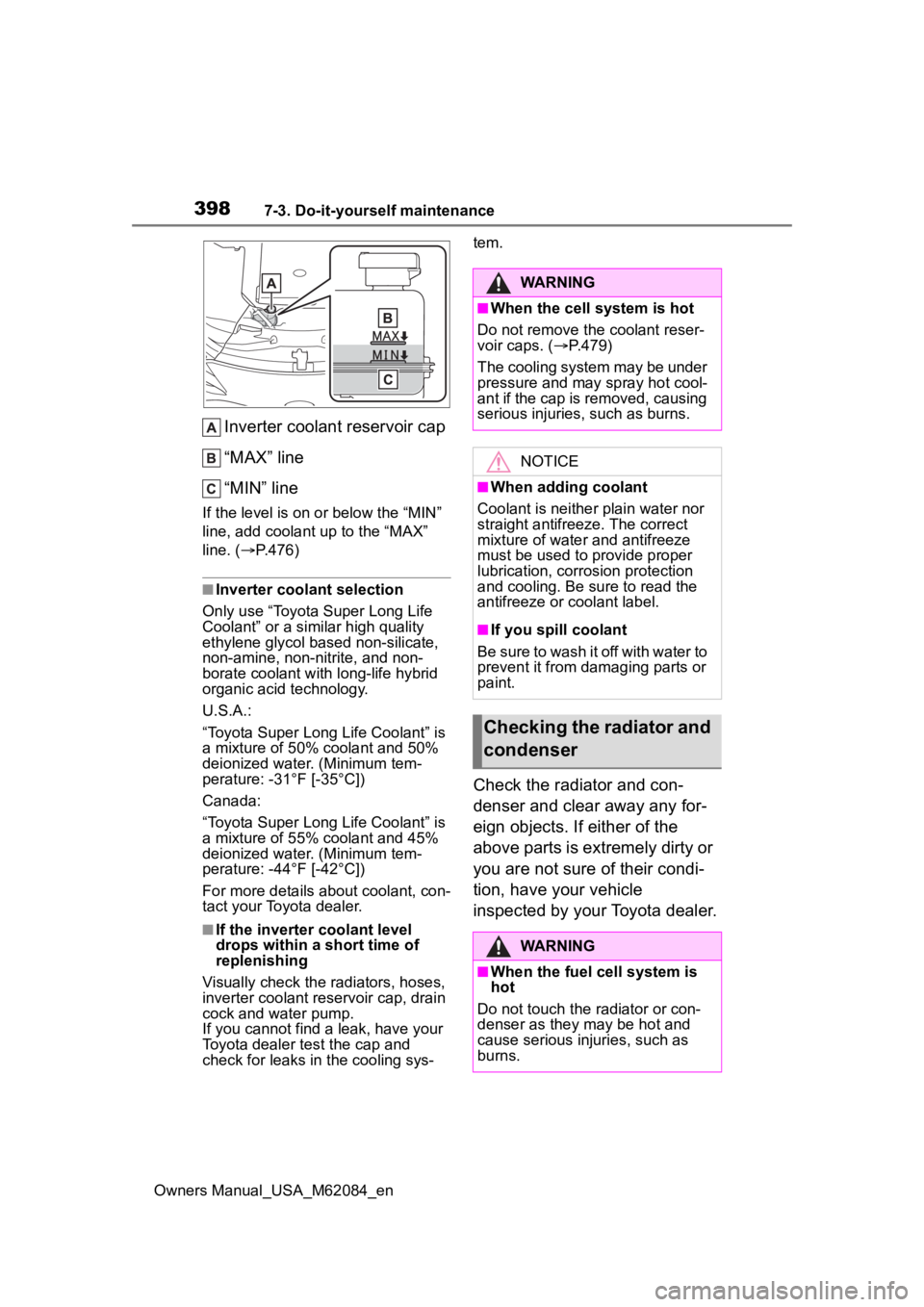
Inverter coolant reservoir cap
“MAX” line
“MIN” line
If the level is on or below the “MIN”
line, add coolant up to the “MAX”
line. (P.476)
■Inverter coolant selection
Only use “Toyota Super Long Life
Coolant” or a similar high quality
ethylene glycol based non-silicate,
non-amine, non-nitrite, and non-
borate coolant with long-life hybrid
organic acid technology.
U.S.A.:
“Toyota Super Long Life Coolant” is
a mixture of 50% coolant and 50%
deionized water. (Minimum tem-
perature: -31°F [-35°C])
Canada:
“Toyota Super Long Life Coolant” is
a mixture of 55% coolant and 45%
deionized water. (Minimum tem-
perature: -44°F [-42°C])
For more details about coolant, con-
tact your Toyota dealer.
■If the inverter coolant level
drops within a short time of
replenishing
Visually check the radiators, hoses,
inverter coolant reservoir cap, drain
cock and water pump.
If you cannot find a leak, have your
Toyota dealer test the cap and
check for leaks in the cooling sys- tem.
Check the radiator and con-
denser and clear away any for-
eign objects. If either of the
above parts is extremely dirty or
you are not sure of their condi-
tion, have your vehicle
inspected by your Toyota dealer.
WARNING
■When the cell system is hot
Do not remove the coolant reser-
voir caps. ( P.479)
The cooling system may be under
pressure and may spray hot cool-
ant if the cap is removed, causing
serious injuries, such as burns.
NOTICE
■When adding coolant
Coolant is neither plain water nor
straight antifreeze. The correct
mixture of water and antifreeze
must be used to provide proper
lubrication, corrosion protection
and cooling. Be sure to read the
antifreeze or coolant label.
■If you spill coolant
Be sure to wash it off with water to
prevent it from damaging parts or
paint.
Checking the radiator and
condenser
WARNING
■When the fuel cell system is
hot
Do not touch the radiator or con-
denser as they may be hot and
cause serious injuries, such as
burns.
Page 420 of 556
4207-3. Do-it-yourself maintenance
Owners Manual_USA_M62084_enareas with heavy traffic flow, early
replacement may be required. (For
scheduled maintenance information,
please refer to the “Scheduled
Maintenance Guide” or “Owner’s
Manual Supplement”.)
■If air flow from the vents
decreases dramatically
The filter may be clogged. Check
the filter and replace if necessary.
■Air conditioning filter with
deodorizing function
When fragrances are placed in your
vehicle, the deodorizing effect may
become significantly weakened in a
short period.
When an air conditioning odor
comes out continuously, replace the
air conditioning filter.
Remove the dust from the air
intake vents with a vacuum
cleaner etc.
Make sure to only use a vacuum to
suck out dust and clogs. Attempting
to blow out dust and clogs using an
airgun etc. may push it into the air
intake vents. ( P.422)
NOTICE
■When using the air condition-
ing system
Make sure that a filter is always
installed.
Using the air conditioning system
without a filter may cause damage
to the system.
■To prevent damage to the fil-
ter cover
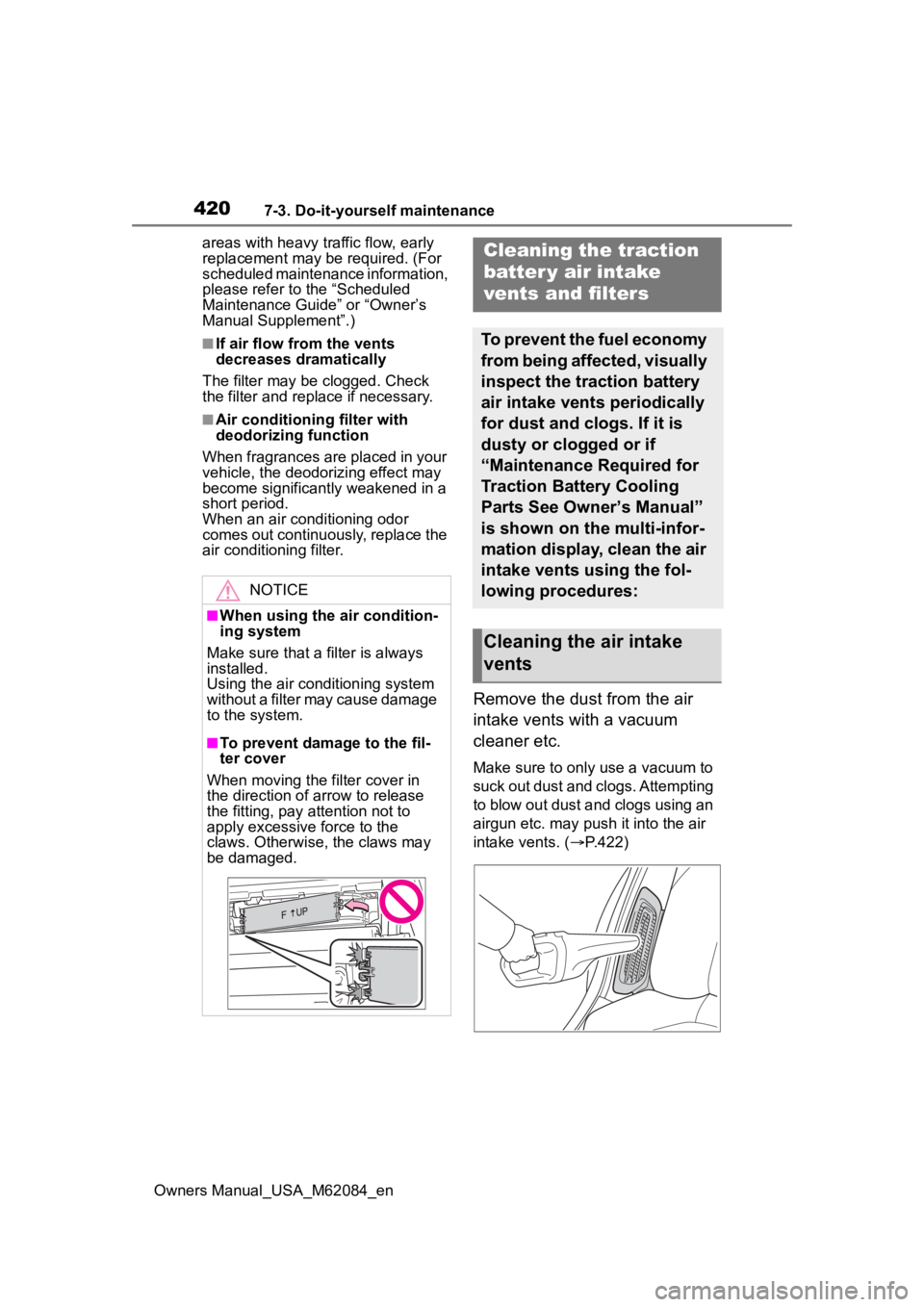
When moving the filter cover in
the direction of arrow to release
the fitting, pay attention not to
apply excessive force to the
claws. Otherwise, the claws may
be damaged.
Cleaning the traction
batter y air intake
vents and filters
To prevent the fuel economy
from being affected, visually
inspect the traction battery
air intake vents periodically
for dust and clogs. If it is
dusty or clogged or if
“Maintenance Required for
Traction Battery Cooling
Parts See Owner’s Manual”
is shown on the multi-infor-
mation display, clean the air
intake vents using the fol-
lowing procedures:
Cleaning the air intake
vents
Page 422 of 556
4227-3. Do-it-yourself maintenance
Owners Manual_USA_M62084_en
■Cleaning the air intake vents
●Dust in the air intake vents may
interfere with the cooling of the
traction battery. If charging/dis-
charging of the traction battery
becomes limited, the distance that
the vehicle can be driven using
the electric motor may be reduced
and the fuel economy may be
reduced. Inspect and clean the air
intake vents periodically.
●Improper handling of the air intake
vent covers and filters may result
in damage to the m. If you have
any concerns about cleaning the
filter, contact you r Toyota dealer.
■If “Maintenance Required for
Traction Battery Cooling Parts
See Owner’s Manual” is shown
on the multi-information display
●If this warning message is shown
on the multi-information display,
remove the air inta ke vent covers
and clean the filters. ( P.453)
●After cleaning the air intake vents,
start the fuel cell system and
check that the warning message
is no longer shown.
It may take approximately 20 min-
utes after the fuel cell system is
started until the warning message
disappears. If the warning message
does not disappear, have the vehi-
cle inspected by your Toyota dealer.
WARNING
■When cleaning the air intake
vents
●Do not use water or other liq-
uids to clean the air intake
vents. If water is applied to the
traction battery or other compo-
nents, a malfunction or fire may
occur.
●Before cleaning the air intake
vents, make su re to turn the
power switch off to stop the fuel
cell system.
■When removing the air intake
vent covers
Do not touch the service plug
located near the air intake vents.
( P. 7 9 )
NOTICE
■When cleaning the air intake
vents
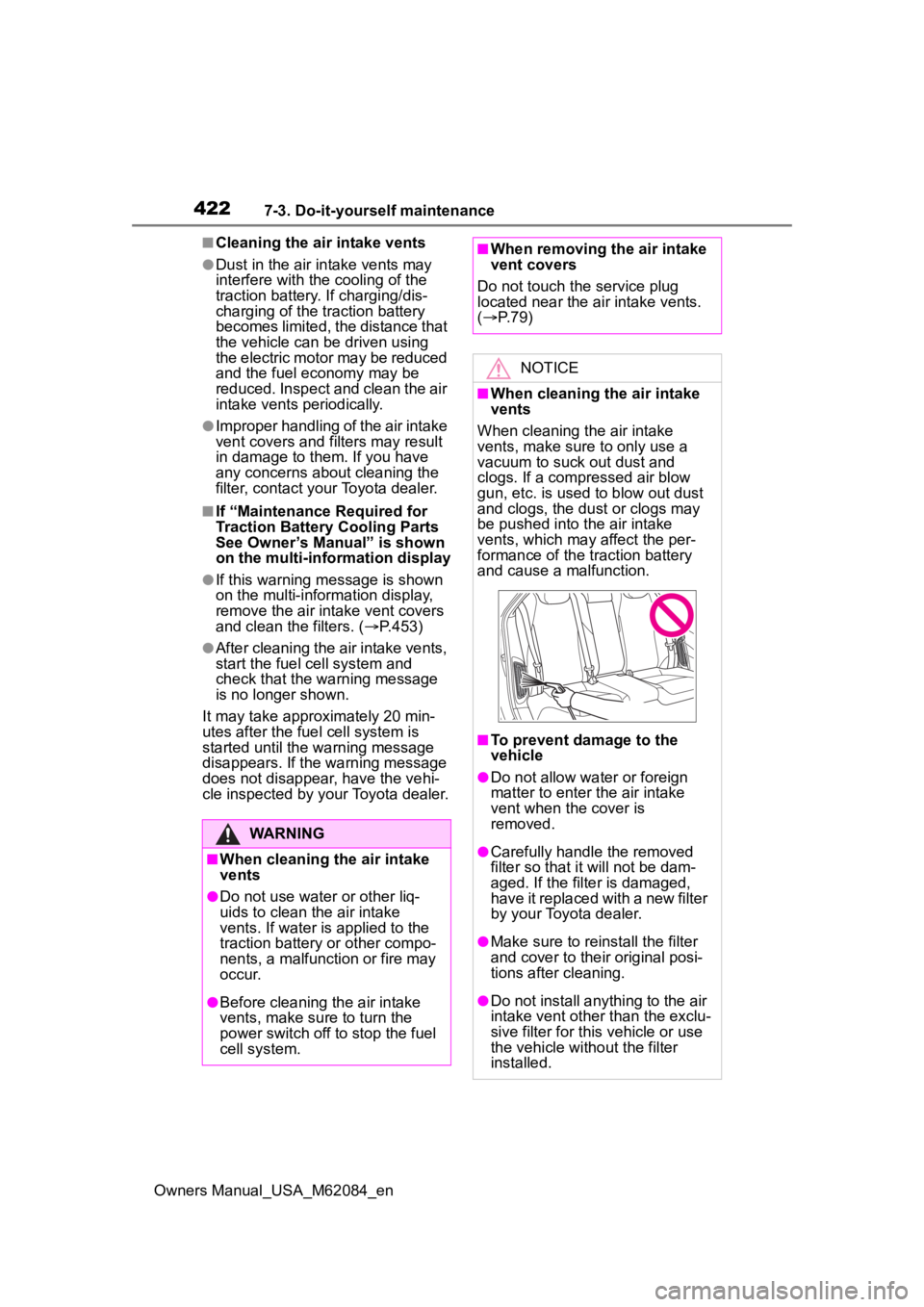
When cleaning the air intake
vents, make sure to only use a
vacuum to suck out dust and
clogs. If a comp ressed air blow
gun, etc. is used to blow out dust
and clogs, the dust or clogs may
be pushed into the air intake
vents, which may affect the per-
formance of the traction battery
and cause a malfunction.
■To prevent damage to the
vehicle
●Do not allow wa ter or foreign
matter to enter the air intake
vent when the cover is
removed.
●Carefully handle the removed
filter so that i t will not be dam-
aged. If the filter is damaged,
have it replaced with a new filter
by your Toyota dealer.
●Make sure to reinstall the filter
and cover to their original posi-
tions after cleaning.
●Do not install anything to the air
intake vent other than the exclu-
sive filter for this vehicle or use
the vehicle witho ut the filter
installed.