2022 TOYOTA HIGHLANDER ECO mode
[x] Cancel search: ECO modePage 452 of 568
4527-2. Steps to take in an emergency
The following may indicate a
problem with your transmission.
Contact your Toyota dealer or
commercial towing service
before towing.
The engine is running but the
vehicle does not move.
The vehicle makes an abnor-
mal sound.
WARNING
■While towing
When towing using cables or
chains, avoid sudden starts, etc.
which place excessive stress on
the towing eyelets, cables or
chains. The towing eyelets,
cables or chains may become
damaged, broken debris may hit
people, and cause serious dam-
age.
NOTICE
■To prevent damage to the
vehicle when towing using a
wheel-lift type truck
When raising the vehicle, ensure
adequate ground clearance for
towing at the opposite end of the
raised vehicle. Without adequate
clearance, the vehicle could be
damaged while being towed.
■To prevent damage to the
vehicle when towing with a
sling-type truck
Do not tow with a sling-type truck,
either from the front or rear.
■To prevent damage to the
vehicle during emergency
towing
Do not secure cables or chains to
the suspension components.
■When towing a vehicle
equipped with a Stop & Start
system (if equipped)
If it is necessary to tow the vehicle
with all 4 wheels on the ground,
perform the following procedure
before towing the vehicle, in order
to protect t he system.
Turn the engine switch off and
then start the engine or turn the
engine switch to ON.
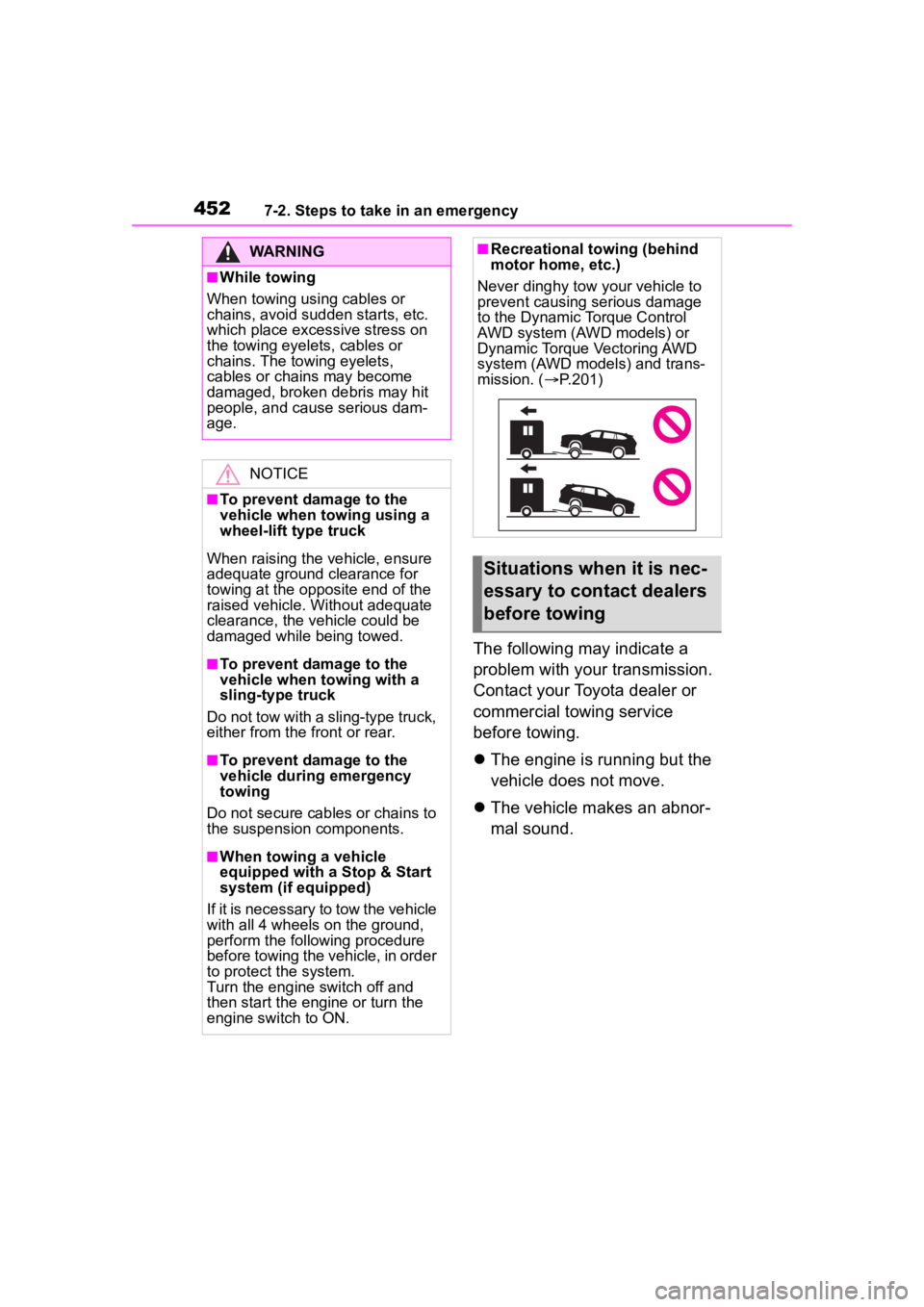
■Recreational towing (behind
motor home, etc.)
Never dinghy tow your vehicle to
prevent causing serious damage
to the Dynamic Torque Control
AWD system (AWD models) or
Dynamic Torque Vectoring AWD
system (AWD models) and trans-
mission. ( P.201)
Situations when it is nec-
essary to contact dealers
before towing
Page 468 of 568

4687-2. Steps to take in an emergency
■If “Engine Stopped Steering
Power Low” is displayed
This message is displayed if the
engine is stopped while driving.
When steering wheel operations are
heavier than usual, grip the steering
wheel firmly and operate it using
more force th an usual.
■If “Shift to P when Parked” is
displayed
This message is displayed when the
driver’s door is opened without turn-
ing the engine switch off with the
shift lever in any position other than
P. Change the shift lever to P.
■If “Auto Power OFF to Conserve
Battery” is displayed
Power was cut off due to the auto-
matic power off function. Next time
when starting the engine, increase
the engine speed slightly and main-
tain that level for approximately 5
minutes to recha rge the battery.
■If “Headlight System Malfunc-
tion Visit Your Dealer” is dis-
played
The following systems may be mal-
functioning. Have the vehicle
inspected by your Toyota dealer
immediately.
●The LED headlight system (if AFS
[Adaptive Front-lighting System]
equipped)
●AFS (Adaptive Fr ont-lighting Sys-
tem) (if equipped)
●The automatic headlight leveling
system (if equipped)
●Automatic High Beam
■If “Radar Cruise Control
Unavailable” is displayed
The dynamic radar cruise control
with full-speed range system cannot
be used temporarily. Use the system
when it becomes available again.
■If a message that indicates the
malfunction of front camera is
displayed
The following systems may be sus-
pended until the problem shown in
the message is resolved. (P.233,
462)
●PCS (Pre-Collision system)
●LTA (Lane Tracing Assist)
●Automatic High Beam
●RSA (Road Sign Assist) (if
equipped)
●Dynamic radar cruise control with
full-speed range
■If a message that indicates the
malfunction of radar sensor is
displayed
The following systems may be sus-
pended until the problem shown in
the message is resolved. (P.233,
462)
●PCS (Pre-Collision system)
●LTA (Lane Tracing Assist)
●Dynamic radar cruise control with
full-speed range
■If “AWD System Overheated
Switching to 2WD Mode” or
“AWD System Overheated 2WD
Mode Engaged” is displayed
This message may be displayed
when driving under extremely high
load conditions.
Drive the vehicle at low speeds or
stop the vehicle in a safe place with
the engine running until the mes-
sage is cleared.
If the message is not cleared, have
the vehicle inspected by your Toyota
dealer.
■If “Check Fuel Cap” is dis-
played
The fuel tank cap is not properly
installed. Correctly install the fuel
tank cap.
Page 488 of 568

4887-2. Steps to take in an emergency
1Ensure that the shift lever is
in P and depress the brake
pedal.
2 Touch the Toyota emblem
side of the electronic key to
the engine switch.
When the electronic key is
detected, a buzzer sounds and the
engine switch will turn to ON.
When the smart key system is
deactivated in customization set-
ting, the engine switch will turn to
ACC.
3Firmly depress the brake
pedal and check that is shown on the multi-informa-
tion display.
4 Press the engine switch
shortly and firmly.
In the event that the engine still
cannot be started, contact your
Toyota dealer.
■Stopping the engine
Shift the shift lever to P, set the park-
ing brake, and press the engine
switch as you normally do when
stopping the engine.
■Replacing the key battery
As the above proce dure is a tempo-
rary measure, it is recommended
that the electronic key battery be
replaced immediately when the bat-
tery is depleted. ( P.434)
■Changing engine switch modes
Release the brake pedal and press
the engine switch in step 3 above.
The engine does not start and
modes will be changed each time
the switch is pressed. ( P.204)
WARNING
■When using the mechanical
key and operating the power
windows or moon roof (if
equipped)
Operate the power window or
moon roof after checking to make
sure that there is n o possibility of
any passenger having any of their
body parts caught in the window
or moon roof. Al so, do not allow
children to operate the mechani-
cal key. It is possible for children
and other passengers to get
caught in the power window or
moon roof.
Starting the engine
Page 491 of 568

4917-2. Steps to take in an emergency
7
When trouble arises
traffic.
■When the battery is removed or
discharged
●Information stored in the ECU is
cleared. When the battery is
depleted, have the vehicle
inspected at you r Toyota dealer.
●Some systems may require initial-
ization. ( P.533)
■When removing the battery ter-
minals
When the battery terminals are
removed, the information stored in
the ECU is cleared . Before remov-
ing the battery terminals, contact
your Toyota dealer.
■Charging the battery
The electricity stor ed in the battery
will discharge gradu ally even when
the vehicle is not i n use, due to nat-
ural discharge and the draining
effects of certain electrical appli-
ances. If the vehicle is left for a long
time, the battery may discharge,
and the engine ma y be unable to
start. (The battery recharges auto-
matically during driving.)
■After jump starting the vehicle
(Vehicles with Stop & Start sys-
tem)
Be sure to disable the Stop & Start
system so that the battery can be
charged. ( P.273)
■When recharging or replacing
the battery
●In some cases, i t may not be pos-
sible to unlock the doors using the
smart key system when the bat-
tery is discharged. Use the wire-
less remote control or the
mechanical key to lock or unlock
the doors.
●The engine may not start on the
first attempt after the battery has
recharged but will start normally
after the se cond attempt. This is
not a malfunction.
●The engine switch mode is memo- rized by the vehicle. When the
battery is reconnected, the system
will return to the mode it was in
before the bat
tery was dis-
charged. Before disconnecting the
battery, turn the engine switch off.
If you are unsure what mode the
engine switch wa s in before the
battery discharged, be especially
careful when reconnecting the
battery.
●Vehicles with power back door:
The power back door must be ini-
tialized. ( P.129)
●Vehicles with Stop & Start system:
The Stop & Start system may not
automatically stop the engine for
up to an hour.
■When replacing the battery
●Use a Central Degassing type bat-
tery (European Regulations).
●Vehicles with Stop & Start system:
Use a genuine battery specifically
designed for use with the Stop &
Start system or a battery with
equivalent specifications to a gen-
uine battery. If an unsupported
battery is used, Stop & Start sys-
tem functions may be restricted to
protect the battery.
Also, battery per formance may
decrease and the engine may not
be able to restart. Contact your
Toyota dealer for details.
●Vehicles without Stop & Start sys-
tem: Use a battery that the case
size is same as the previous one
(LN3), 20 hour rate capacity
(20HR) is equivalent (70Ah) or
greater, and per formance rating
(CCA) is equivalent (603A) or
greater.
Vehicles with Stop & Start system:
Use a battery that the case size is
same as the previous one (LN3), 20
hour rate capacity (20HR) is equiva-
lent (65Ah) or greater, and perfor-
mance rating (CCA) is equivalent
(603A) or greater.
• If the sizes differ, the battery can- not be properly secured.
Page 518 of 568
5188-1. Specifications
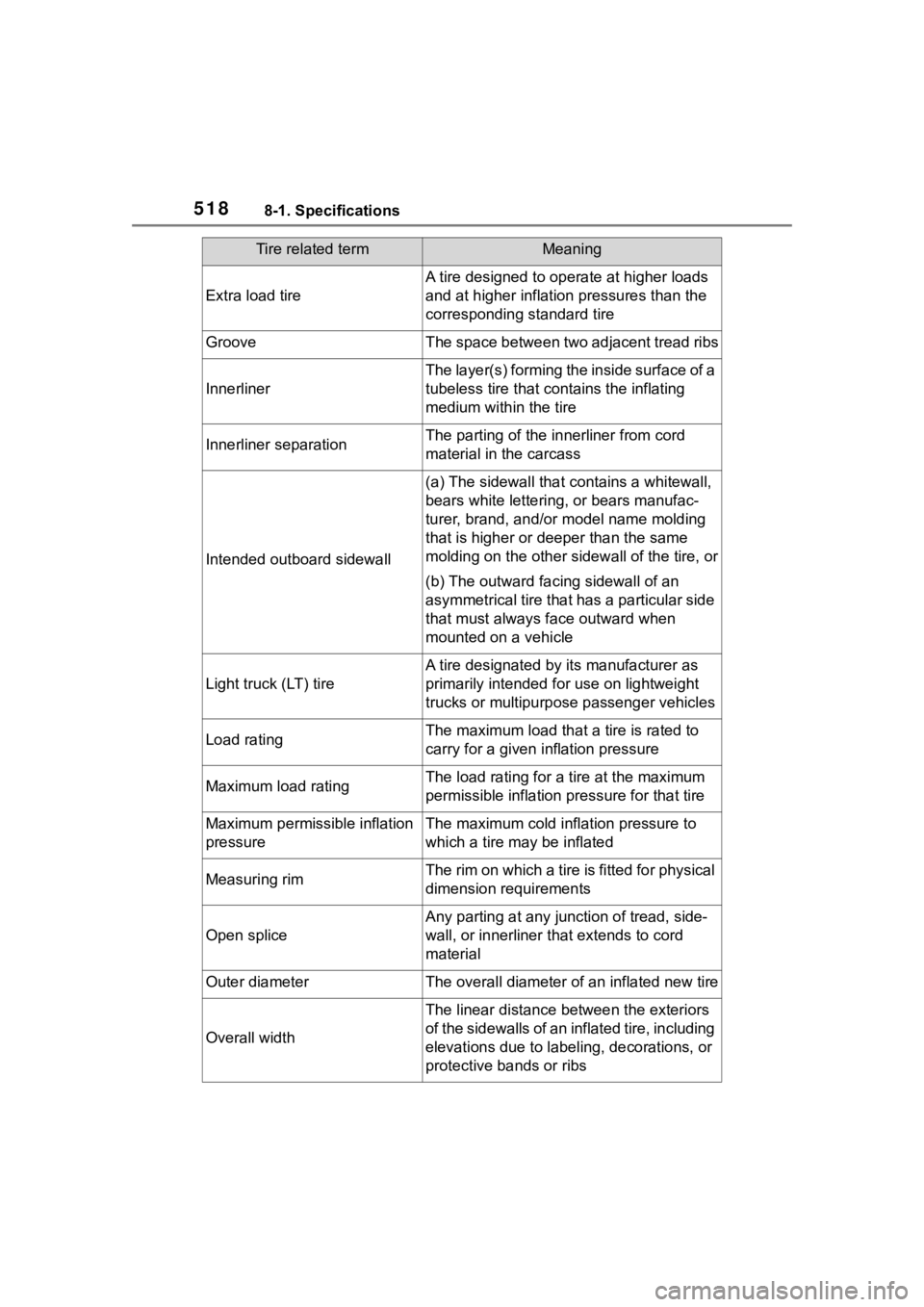
Extra load tire
A tire designed to operate at higher loads
and at higher inflation pressures than the
corresponding standard tire
GrooveThe space between two adjacent tread ribs
Innerliner
The layer(s) forming the inside surface of a
tubeless tire that contains the inflating
medium within the tire
Innerliner separationThe parting of the innerliner from cord
material in the carcass
Intended outboard sidewall
(a) The sidewall that contains a whitewall,
bears white lettering, or bears manufac-
turer, brand, and/or model name molding
that is higher or deeper than the same
molding on the other sidewall of the tire, or
(b) The outward facing sidewall of an
asymmetrical tire that has a particular side
that must always fa ce outward when
mounted on a vehicle
Light truck (LT) tire
A tire designated by i ts manufacturer as
primarily intended for use on lightweight
trucks or multipurpose passenger vehicles
Load ratingThe maximum load that a tire is rated to
carry for a given inflation pressure
Maximum load ratingThe load rating for a tire at the maximum
permissible inflation pressure for that tire
Maximum permissible inflation
pressureThe maximum cold inflation pressure to
which a tire may be inflated
Measuring rimThe rim on which a tire is fitted for physical
dimension requirements
Open splice
Any parting at any junct ion of tread, side-
wall, or innerliner that extends to cord
material
Outer diameterThe overall diameter of an inflated new tire
Overall width
The linear distance bet ween the exteriors
of the sidewalls of an inflated tire, including
elevations due to labe ling, decorations, or
protective bands or ribs
Tire related termMeaning
Page 523 of 568

5238-2. Customization
8
Vehicle specifications
*1: For details about each function: P.91, 101
*2: The default setting varies according to country.
*3: 4.2-inch display
*4: AWD models
*5: 7-inch display
*6: Selecting this item will only change the gadget.
*7: Selecting this item will turn the display of the gadget off.
Audio system linked dis-
play
*3OnOff—O—
AWD system display*3, 4OnOff—O—
Drive information type*3After startAfter reset—O—
Drive information items
(First item)
*3Distance
Average vehicle
speed
—O—
Elapsed time
Drive information items
(Second item)
*3Elapsed time
Average vehicle speed
—O—
Distance
Speedometer display*5OnOff—O—
Gadget content*5Off
Average vehicle speed
—O—Distance
Elapsed time
Fuel economy type*5Trip (after reset)Total (after start)*6
—O—
Tank (after refuel)*7
Pop-up displayOnOff—O—
Rear seat reminder
functionOnOff—O—
Suggestion functionOn
On (when the vehi- cle is stopped)
O—O
Off
Function*1Default settingCustomized setting
Page 551 of 568

551Alphabetical Index
Alphabetical Index
A
A/C ................................... 334, 339Air conditioning filter ............. 432
Automatic air conditioning sys-tem ..................................... 339
Eco air conditioning mode .... 346
Front seat concentrated airflow mode (S-FLOW) ................. 348
Manual air conditioning system ........................................... 334
Rear automatic air conditioning system ................................ 354
Rear manual air conditioning system ................................ 352
ABS (Anti-lock Brake System) ............................................... 318Warning light ........................ 458
ACA (Active Cornering Assist) ............................................... 318
Active Cornering Assist (ACA) ............................................... 318
Adaptive Front-lighting System (AFS)...................................... 218
AFS (Adaptive Front-lighting System) ................................. 218
AHB (Automatic High Beam) . 219
Air conditioning filter ............. 432
Air conditioning system 334, 339 Air conditioning filter ............. 432
Automatic air conditioning sys-tem ..................................... 339
Eco air conditioning mode .... 346
Front seat concentrated airflow mode (S-FLOW) ................. 348
Manual air conditioning system ........................................... 334
Rear automatic air conditioning system ................................ 354
Rearmanual air conditioning sys- tem ..................................... 352 Airbags
Airbag operating conditions ....36
Airbag precautions for your child.............................................39
Correct driving posture ...........25
Curtain shield airbag operating conditions .............................37
Curtain shield air bag precautions
.............................................39
Front passenger occupant clas- sification system ...................43
General airbag precautions ....39
Locations of airbags ...............34
Modification and disposal of air- bags......................................42
Side airbag operating conditions .............................................37
Side airbag precautions..........39
Side and curtain shield airbags operating conditions .............37
Side and curtain shield airbags precautions ...........................39
SRS airbags ...........................34
SRS warning light .................457
Alarm .........................................73 Warning buzzer ....................456
Anchor brackets ... ..............52, 62
Antennas (smart key system)133
Anti-lock Brake System (ABS) ...............................................318Warning light.........................458
Approach warning ..................264
Armrest ......... ......................... ..381
Assist grips .............................381
Audio system-linked display .88, 97
Automatic air conditioning sys- tem .........................................339Eco air conditioning mode ....346
Automatic headlight leveling system ...................................217
Automatic High Beam ............219
Page 552 of 568

552Alphabetical Index
Automatic light control system............................................... 217
Automatic transmission ........ 206 If the shift lever cannot be shifted from P................................. 207
M mode ................................ 208
Auxiliary boxes ............... 367, 372
Average fuel economy ....... 86, 94
Average vehicle speed....... 88, 97
AWD Control ....................... 88, 97
B
Back door ................................ 121
Back-up lights Replacing light bulbs ............ 439
Battery Battery checking................... 414
If the battery is discharged ... 490
Preparing and c hecking before
winter.................................. 324
Replacing ............................. 492
Warning light ........................ 457
Blind Spot Monitor (BSM) ...... 278
Brake Brake hold ............................ 213
Fluid ............................. 414, 504
Parking brake ....................... 210
Warning light ........................ 456
Brake assist ............................ 318
Break-in tips ........ ................... 180
Brightness control Instrument panel light control . 83
BSM (Blind Spot Monitor) ...... 278
Buzzer Hands off steering wheel warn-ing (LTA) ............................. 255
C
Care Exterior ................................. 394
Interior .................................. 397 Seat belts .............................397
Wheels and wheel ornaments
...........................................394
Cargo capacity ........................189
Cargo net hooks .....................369
Chains......................................325
Child restraint system Fixed with a LATCH system ...60
Fixed with a seat belt..............55
Front passenger occupant clas-sification system ...................43
Points to remember ................50
Riding with children ................49
Types of child restraint system installation method ...............52
Using an anchor bracket ........62
Child safety Airbag precautions .................39
Back door precautions..........121
Battery precautions ......415, 493
Child restraint system .............52
Heated steering wheel and seat heater precautio ns..............358
How your child should wear the seat belt ................................28
Moon roof precautions..........171
Panoramic moon roof precau- tions ....................................175
Power window lock switch ....169
Power window precautions...168
Rear door child-protectors ....120
Seat belt extender precautions .............................................29
Seat belt precautions..............49
Child-protectors......................120
Cleaning Exterior .................................394
Interior ..................................397
Radar sensor ........................230
Seat belts .............................397
Wheels and wheel ornaments...........................................394