Page 472 of 584
4727-1. Essential information
●If the door can be opened, open the door and exit the vehicle.
● If the door can not be opened, open the window using the power
window switch and ens ure an escape route.
● If the window can be opened, exit the vehicle through the window.
● If the door and window cannot be opened due to the rising water ,
remain calm, wait until the water level inside the vehicle rise s to the
point that the water pressure i nside of the vehicle equals the water
pressure outside of the vehicle and then open the door after wa iting
for the rising water to enter the vehicle, and exit the vehicle . When
the outside water level exc eeds half the height of the door, th e door
cannot be opened from the in side due to water pressure.
■Water level exceeds the floor
When the water level exceeds the floor and time has passed, the electrical
equipment will get damaged, the power windows will not operate, the engine
stop, and the vehicle may not be able to get moving.
■ Using an emergency escape hammer
*1
Laminated glass*2 is used in the windshield and the windows on this vehicle.
Laminated glass cannot be shattered with an emergency hammer
*1.
*1: Contact your Toyota dealer or aftermarket accessory manufactur er for fur-
ther information about an emergency hammer.
*2: If equipped
If the vehicle is submerged or water on the
road is rising
This vehicle is not designed to be able to drive on roads that are
deeply flooded with water. Do not drive on roads where the
roads may be submerged or the water may be rising. It is dan-
gerous to remain in the vehicle, if it anticipated that the veh icle
will be flooded or set a drift. Re main calm and follow the follow-
ing.
Page 495 of 584
4957-2. Steps to take in an emergency
7
When trouble arises
WARNING
■Using the tire jack
Observe the following precautions.
Improper use of the tire jack may cause the vehicle to suddenly fall off
the jack, leading to death or serious injury.
●Do not use the tire jack for any purpose other than replacing t ires or
installing and removing tire chains.
●Only use the tire jack that comes with this vehicle for replacing a flat
tire.
Do not use it on other vehicles, and do not use other tire jacks for
replacing tires on this vehicle.
●Put the jack properl y in its jack point.
●Do not put any part of your body under the vehicle while it is supported
by the jack.
●Do not start the hybrid system or drive the vehicle while the v ehicle is
supported by the jack.
●Do not raise the vehicle w hile someone is inside.
●When raising the vehicle, do not put an object on or under the jack.
●Do not raise the vehicle to a height greater than that required to
replace the tire.
●Use a jack stand if it is necessary to get under the vehicle.
●When lowering the vehicle, make sure that there is no-one near the
vehicle. If there are people nearby, warn them vocally before l owering.
NOTICE
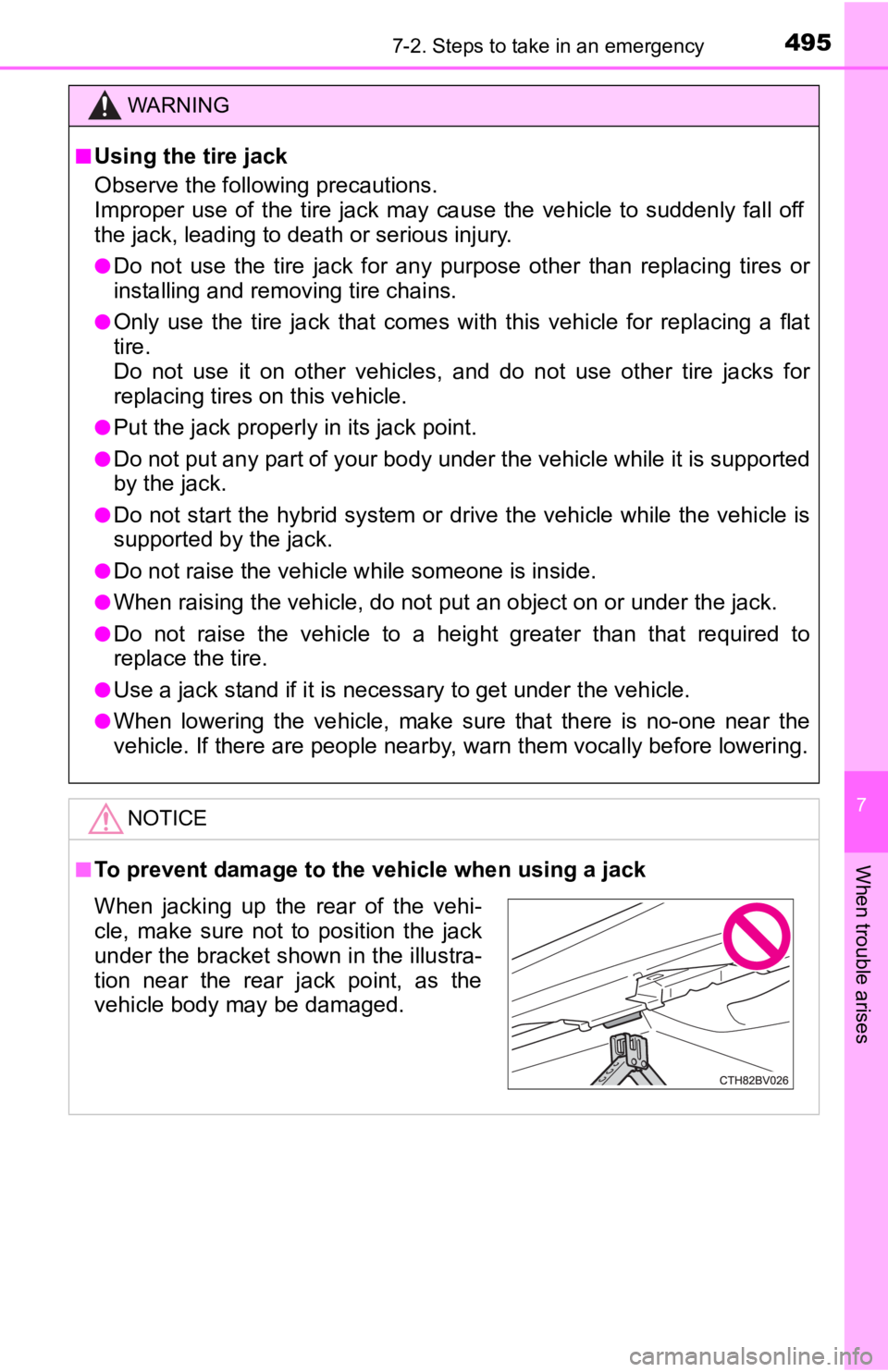
■To prevent damage to the vehicle when using a jack
When jacking up the rear of the vehi-
cle, make sure not to position the jack
under the bracket shown in the illustra-
tion near the rear jack point, as the
vehicle body may be damaged.
Page 502 of 584

5027-2. Steps to take in an emergency
■The compact spare tire
●The compact spare tire is identified by the label “TEMPORARY USE
ONLY” on the tire sidewall.
Use the compact spar e tire temporarily, and only in an emergenc y.
●Make sure to check the tire inflation pressure of the compact spare tire.
( P. 5 3 0 )
■When using the compact spare tire
As the compact spare tire is not equipped with a tire pressure warning
valve and transmitter, low inflation pressure of the spare tire will not be
indicated by the tire pressure warning system. Also, if you rep lace the
compact spare tire after the tire pressure warning light comes on, the light
remains on.
■When the compact spa re tire is equipped
When driving with the compact spare tire installed, the vehicle height will
be different than when driving with standard tires.
■If you have a flat front tire on a road covered with snow or ic e
Install the compact spare tire on one of the rear wheels of the vehicle.
Perform the following steps and f it tire chains to the front tires:
Replace a rear tire with the compact spare tire.
Replace the flat front tire with the tire removed from the rear of the vehi-
cle.
Fit tire chains to the front tires.
1
2
3
Page 524 of 584
5248-1.Specifications
*1: Unladen vehicles
*2: Vehicles with 235/45R18 tires and 235/40R19 tires
*3: Vehicles with 215/55R17 tires
Maintenance data (fuel, oil level, etc.)
Dimensions and weights
Overall length195.9 in. (4975 mm)
Overall width 72.8 in. (1850 mm)
Overall height*156.5 in. (1435 mm)
Wheelbase113.0 in. (2870 mm)
Tread
Front62.6 in. (1590 mm)*2
63.0 in. (1600 mm)*3
Rear63.2 in. (1605 mm)*2
63.6 in. (1615 mm)*3
Vehicle capacity weight
(occupants + luggage)
940 lb. (425 kg)
Seating capacity
Seating capacity
5 occupants (Front 2, Rear 3)
Page 538 of 584
5388-1. Specifications
■Typical tire size information
The illustration indicates typical
tire size.
Tire use
(P = Passenger car [some-
times omitted],
T = Temporary use)
Section widt h (millimeters)
Aspect ratio
(tire height to section width)
Tire construction code ( R = Radial, D = Diagonal)
Wheel diameter (inches)
Load index (2 digits or 3 digits)
Speed symbol (alphabet with one letter)
■Tire dimensions
Section width
Tire height
Wheel diameter
Tire size
1
2
3
4
5
6
7
1
2
3
![TOYOTA AVALON HYBRID 2022 Owners Manual 5388-1. Specifications
■Typical tire size information
The illustration indicates typical
tire size.
Tire use
(P = Passenger car [some-
times omitted],
T = Temporary use)
Section widt h (millimet](/manual-img/14/59241/w960_59241-537.png "TOYOTA AVALON HYBRID 2022 Owners Manual 5388-1. Specifications
■Typical tire size information
The illustration indicates typical
tire size.
Tire use
(P = Passenger car [some-
times omitted],
T = Temporary use)
Section widt h (millimet")